Subjugation of the Duoyan Guard
Altan Khan subordinated the Duoyan tribes along the northeastern frontier to serve as pathfinders for an internal invasion.
Ming Dynasty (明朝) · HISTORICAL EVENT
庚戌之变
The Gengxu Incident (庚戌之变) was a major frontier and defensive crisis that occurred in the autumn of 1550 during the reign of the Jiajing Emperor of the Ming Dynasty. In the mid-sixteenth century, Altan Khan unified the Right Wing of the Mongols, creating a powerful confederation across the Ordos and Xuanfu borders. Lacking agrarian produce, textiles, and iron implements, Altan Khan repeatedly dispatched diplomatic missions to Beijing requesting formal…
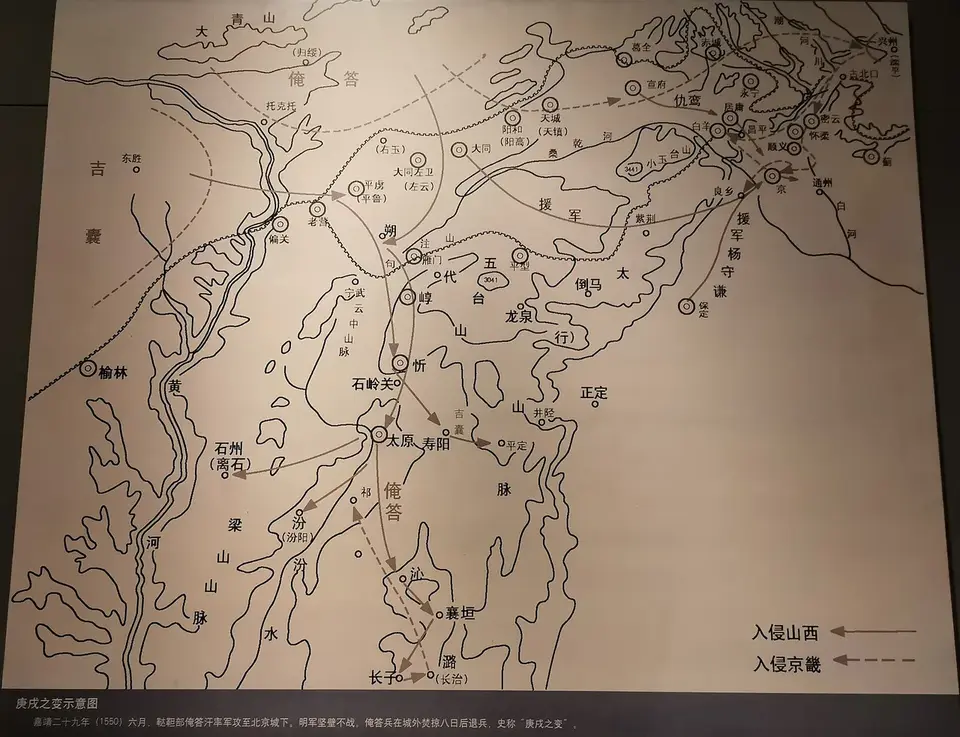
The Gengxu Incident (庚戌之变) was a major frontier and defensive crisis that occurred in the autumn of 1550 during the reign of the Jiajing Emperor of the Ming Dynasty. In the mid-sixteenth century, Altan Khan unified the Right Wing of the Mongols, creating a powerful confederation across the Ordos and Xuanfu borders. Lacking agrarian produce, textiles, and iron implements, Altan Khan repeatedly dispatched diplomatic missions to Beijing requesting formal tributary status and the reopening of frontier horse markets. However, the Jiajing Emperor adamantly rejected these overtures, executing Mongol envoys and enforcing strict border embargoes. In June 1550, Altan Khan launched an assault against Datong, killing Ming general Zhang Da. The newly appointed regional commander Qiu Luan, who had secured his post through heavy bribes to Grand Secretary Yan Song, bribed Altan Khan with state treasure to divert his invasion eastward. In August, guided by Duoyan Uriankhai scouts, Altan Khan's cavalry breached the Great Wall through collapsed sections at Gezidong west of Gubeikou, routing regional defenses and advancing to the gates of Beijing. Inside the capital, Grand Secretary Yan Song strictly forbade the garrison from engaging, permitting Mongol forces to burn and pillage the suburbs for eight days. After submitting a formal tribute petition, Altan Khan withdrew peacefully. In the aftermath, Yan Song scapegoated and executed Minister of War Ding Rukui. The crisis shattered capital complacency, prompted the construction of the Beijing Outer City, and altered Ming frontier diplomacy.
Altan Khan subordinated the Duoyan tribes along the northeastern frontier to serve as pathfinders for an internal invasion.
Mongol cavalry overran Datong, killing commander Zhang Da; newly appointed commander Qiu Luan bribed Altan Khan to divert the raid eastward.
Altan Khan feigned an attack on Gubeikou while his main cavalry force breached the wall at Gezidong, scattering the defenders at Shixiaying.
Mongol forward divisions reached Tongzhou along the Lu River, torching pastures and establishing headquarters at Gushan hill.
Altan Khan invested the northern suburbs of Beijing; Grand Secretary Yan Song commanded all garrison forces to avoid engagement.
Altan Khan dispatched captive Yang Shaofang to deliver a tribute petition to the palace, prompting the emperor to concede future horse markets.
Laden with vast plunder and thousands of captives, Mongol forces departed northward through Gubeikou, concluding the eight-day siege.
Under Yan Song's deflection of blame, the Jiajing Emperor executed Minister of War Ding Rukui in the capital marketplace.
Following the collapse of the Yuan Dynasty and its retreat to the northern steppes, the Mongol remnants fractured into the Western Oirats and the Eastern Tatars, maintaining a state of chronic conflict with the Ming Dynasty. Early Ming emperors, notably Emperor Taizu and Emperor Taizong, launched multiple northern expeditions and established the Nine Strategic Garrisons along the Great Wall to secure the northern frontier. By the mid-sixteenth century, Altan Khan of the Tumet tribe consolidated hegemony over the Right Wing tribes, commanding vast territories stretching from Xuanfu westward to the Ordos Loop.
Despite military dominance, the pastoral nomadic economy suffered from structural fragility. Pastoral production depended upon livestock herds and could not supply manufactured commodities including iron cooking cauldrons, agricultural tools, silks, cotton cloth, salt, and tea. To stabilize tribal livelihood and maintain political alliances, Altan Khan urgently sought tributary exchanges and frontier market trade with the Ming Empire. Beginning in 1542, Altan Khan repeatedly dispatched envoys bearing formal petitions to Beijing, offering nominal submission as a tributary vassal in return for authorized trade.
However, the Jiajing Emperor, engrossed in Daoist rituals in the Western Park, adhered rigidly to anti-barbarian ideology and feared repeating the 1449 Tumu Crisis. Viewing Mongol petitions as deceitful schemes, the emperor rejected all trade requests. In 1542, the Jiajing Emperor ordered the public execution of Mongol envoy Shi Tianjue in the capital marketplace, placing bounties on Mongol horsemen. Denied legal trade channels, Altan Khan adopted a coercive strategy, conducting continuous predatory border raids to compel the Ming court into economic negotiations.
While Mongol cavalry forces maintained formidable operational mobility, the northern defensive perimeter of the Ming Empire suffered from systemic institutional decay. Grand Secretary Yan Song and his son Yan Shifan monopolized court patronage, openly auctioning military commands and provincial appointments for exorbitant bribes. Border generals routinely embezzled military payrolls, falsified troop muster rolls, and usurped state military farmlands (tuntian). Frontline garrisons suffered from chronic malnutrition, lack of mounts, and deficient armor.
In May 1550, Altan Khan subjugated the Duoyan Guard chieftains, integrating them as auxiliary vanguard units. In June, Altan Khan launched a massive offensive against Datong; Ming supreme commander Zhang Da and deputy commander Lin Chun died in fierce resistance as their perimeter collapsed. Facing disaster, the newly installed commander Qiu Luan, an incompetent aristocrat elevated solely through lavish bribes to Yan Song, panicked completely. To shield himself from imperial retribution, Qiu Luan diverted imperial treasury funds to secretly deliver immense bribes of gold, silver, and silk fabrics to Altan Khan, entreating him to withdraw from Datong and direct his forces elsewhere. Recognizing Ming operational weakness, Altan Khan accepted the tribute and wheeled his armies eastward toward Zhili.
In August 1550, Altan Khan led tens of thousands of elite cavalry eastward. After conducting diversionary skirmishes against Xuanfu, where local forces mounted stiff resistance from fortified watchtowers, the Mongol host bypassed fortified hubs.
On August 14, guided through mountain defiles by Duoyan auxiliary chieftains who possessed intimate knowledge of the terrain, Altan Khan executed an elaborate tactical maneuver. Deploying several thousand horsemen to stage a noisy feint assault on the main pass of Gubeikou, Altan Khan led his primary cavalry strike force along mountain tracks toward Gezidong, situated several miles to the west. The stone ramparts at Gezidong had fallen into disrepair, with breached gaps choked by rubble. The Mongol vanguard demolished the masonry and breached the Great Wall uncontested.
Descending along the Huangyugou ravine, Mongol divisions swept upon the Ming garrison at Shixiaying. Regional Military Intendant Wang Ruxiao and General Luo Xihan attempted to deploy artillery and crossbow battalions, but swift Mongol flanking maneuvers encircled their rear, precipitating a total panic and rout. Altan Khan captured Miyun, besieged Huairou and Shunyi, and bypassed Changping. By August 17, Mongol cavalry reached the banks of the Lu River near Tongzhou, torching imperial granaries and horse pastures. Dense columns of smoke rose across the eastern horizon, visible from the imperial palaces in Beijing.
Since the 1449 defense of Beijing under Yu Qian, the Ming capital had enjoyed a century of uninterrupted domestic peace. On the morning of August 18, when Altan Khan's forward pickets deployed outside the Andingmen and Deshengmen gates, widespread terror engulfed the imperial city. The city gates were slammed shut and bolted. Altan Khan established his main encampment on Gushan hill, twenty li east of the Lu River, dispersing mobile squadrons around the eastern ramparts to plunder suburban estates and temples.
The emergency completely exposed the hollow state of the Ming capital military establishment. On official rosters, the Three Capital Battalions (San Dabang) numbered 140,000 men. When Minister of War Ding Rukui conducted an emergency muster, fewer than 50,000 men materialized. The vast majority were infirm elderly conscripts, teenage youths, or domestic servants conscripted from aristocratic and eunuch mansions to draw state rations. Arsenal weapons were encrusted with rust, bows were unstrung and warped, and defenders lacked provisions for even three days.
Shocked by the crisis, the Jiajing Emperor issued urgent decrees commanding all civil officials, imperial students, and four thousand martial examination candidates to mount the city walls. Imperial commanders Marquis Jiang Fu and Vice Minister of Personnel Wang Bangrui were assigned to supervise the nine outer gates, while Commander of the Embroidered Uniform Guard Lu Bing guarded the imperial palace gates. Urgent imperial couriers galloped across the realm commanding provincial armies to march on the capital. Between August 18 and 19, five regional relief armies totaling over fifty thousand troops arrived from Datong, Baoding, Yansui, Xuanfu, Shanxi, and Liaoyang.
Although provincial relief forces arrived outside the walls, they were exhausted from forced marches and lacked supply logistics. Compounding the disaster, the Jiajing Emperor, unaware of Qiu Luan's treacherous secret dealings with Altan Khan, appointed Qiu Luan as Generalissimo for Pacifying the Barbarians (Pinglu Dajiangjun), placing all relief contingents under his supreme command.
Qiu Luan entrenched his Datong troops outside Andingmen, refusing to engage the Mongol raiding parties. To conceal his cowardice, Qiu Luan permitted his soldiers to loosen their hair braids to mimic Mongol horsemen while marauding through Haidian and Changping, terrorizing ordinary suburban citizens. When Baoding Governor Yang Shouqian attempted to deploy his troops to shield refugees at Baiyangqiao, his unsupported battalion was quickly scattered.
Inside the imperial palace, Minister of War Ding Rukui observed the devastation of the suburbs from the city parapets. Deeply troubled, he rushed to the Western Park office of Grand Secretary Yan Song, requesting tactical guidance on whether the relief forces should mount an offensive. Yan Song smoothed his beard and advised him cynically: "The barbarian horsemen raiding outside seek only plunder; once their packs are full, they will depart voluntarily. If our forces fight and win, it constitutes a minor credit; but if they suffer a defeat, who will bear the catastrophic blame? You must strictly forbid the commanders from risking engagement!"
Subservient to Yan Song's supreme authority, Ding Rukui issued strict prohibitions barring any Ming battalion from opening the city gates to attack. Consequently, tens of thousands of garrison troops watched passively from the ramparts while Mongol cavalry burned homes, pillaged grain stores, and abducted civilian captives for eight consecutive days. Suburban populations vented their fury upon Ding Rukui. When the Jiajing Emperor observed the raging fires and demanded an explanation for military inaction, Yan Song deflected sovereign fury entirely onto Ding Rukui, memorializing that the Minister of War was solely responsible for strategic timidity. The emperor ordered Ding Rukui arrested, imprisoned, and publicly beheaded in the Western Marketplace. On the execution ground, Ding Rukui wept bitterly, crying out: "The treacherous minister Yan Song has murdered me!"
Altan Khan's strategic objective was never to undertake a protracted siege of the fortified inner capital, but rather to utilize military intimidation to force the Ming emperor to abandon trade embargos.
On August 21, Altan Khan released Yang Shaofang, a captured clerk of the Ministry of Revenue, hoisting him onto the city ramparts with a formal diplomatic petition addressed to the Jiajing Emperor. In the memorial, Altan Khan stated his conditions clearly: the Mongols sought annual tributary presentation of horses and cattle in exchange for bolts of satin and iron cauldrons to preserve their people's livelihood; if the court granted tributary markets, the armies would withdraw immediately; if refused, horsemen would raid the capital territory indefinitely.
Faced with devastated suburbs and an impotent army, the Jiajing Emperor swallowed his anti-tributary pride. Under counsel from the Grand Council, the emperor issued a soothing imperial rescript, promising that if the Mongol forces withdrew beyond the frontier, the court would officially open horse markets along the Xuanfu and Datong borders the following spring.
Satisfied that his core diplomatic objective had been achieved, and encumbered by immense plunder and exhausted mounts, Altan Khan ordered his armies to break camp on August 24. Escorting tens of thousands of captive artisans and vast herds of horses and livestock, the Mongol host marched unmolested north through Gubeikou. Ming forces did not dare pursue. Although the border horse markets opened briefly at Datong in 1551, the Ming court unilaterally suspended them the following year due to bureaucratic obstruction. Nevertheless, the Gengxu Incident decisively broke the Ming ban on northern trade.
The Gengxu Incident brutally shattered the illusion of imperial security, demonstrating that the century-old capital defense system was utterly decayed. In the immediate aftermath, Vice Minister Wang Bangrui reorganized the Three Capital Battalions, purging thousands of fraudulent enlistments and restoring basic training regimens. Crucially, the crisis revealed that the sprawling, prosperous commercial and residential quarters south of the inner city wall were entirely unprotected. In 1553 (Jiajing 32), the Jiajing Emperor ordered the construction of the Beijing Outer City wall. Although financial constraints halted construction of the northern, eastern, and western outer circuits, the completed southern wall produced the historic convex shape characteristic of late imperial Beijing.
The crisis accelerated the moral and institutional degeneration of the Ming central administration. The execution of Minister of War Ding Rukui, who was punished for faithfully carrying out the confidential directives of the Grand Secretariat, sent a chilling message through the civilian bureaucracy. Capable scholar-officials recognized that defending the state invited sovereign malice and factional destruction, fostering a culture of pervasive timidity and administrative avoidance that paralyzed Ming governance throughout the remainder of Yan Song's tenure.
Historically, the Gengxu Incident served as the catalyst that ultimately demolished the unrealistic early Ming policy of complete economic blockade against the northern steppes. Altan Khan demonstrated that nomadic pastoralists could not be starved into submission, and that denying trade inevitably provoked catastrophic military retaliation. Although the horse markets opened in 1551 were prematurely closed by conservative recalcitrance, the strategic lesson was deeply absorbed by forward-looking statesmen including Zhang Juzheng and Gao Gong. In 1571, the court concluded the historic Longqing Peace Accord, formally investing Altan Khan as Prince of Obedience and opening permanent border trade markets, inaugurating half a century of peace along the northern frontier.
Traditional and modern historians view the Gengxu Incident as one of the most disgraceful strategic failures in Ming history. In the official History of Ming, the compilers observed: "During the Gengxu crisis, the barbarian horsemen penetrated deeply to the foot of the imperial carriage, encircling the suburbs and burning at will; the court was helpless, executing generals and transferring blame to the Minister of War, a joint failure of ruler and ministers that cannot be concealed." In the History of Ming, Biography of Tatars, the historians commented: "Altan Khan's ambition was merely to secure tributary trade. The court rejected him too harshly, executing his envoys upon arrival, thereby provoking armed fury; when his army pressed upon the capital, the court hastily consented, only to break faith upon his departure, leaving border distress unresolved." The late Ming historian Gu Yingtai concluded in the Major Events of Ming History: "Qiu Luan invited frontier disaster through bribery, while Yan Song framed loyal ministers through deceit; that the Ming could not resist foreign invasion was not due to the enemy's strength, but to the self-inflicted decay of the court."