Baidicheng entrustment
Liu Bei dies at Yong'an palace after conferring supreme regency upon Zhuge Liang.
Shu Han (蜀汉) · HISTORICAL EVENT
前出师表
The Former Memorial on the Expedition (前出师表, Qian Chushi Biao) was an epochal political memorial and administrative manifesto submitted in 227 (fifth year of Jianxing) by Chancellor Zhuge Liang of Shu Han to the young emperor Liu Shan on the eve of launching the First Northern Expedition against Cao Wei. Following the tragic death of founding emperor Liu Bei at Baidicheng, Zhuge Liang had shouldered the regency, restored diplomatic ties with Eastern Wu,…
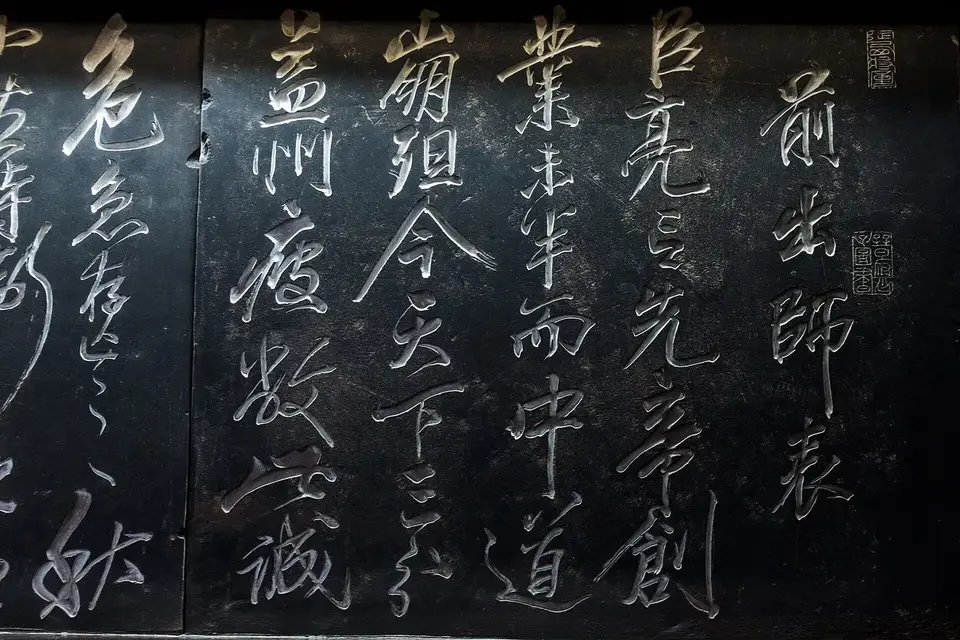
The Former Memorial on the Expedition (前出师表, Qian Chushi Biao) was an epochal political memorial and administrative manifesto submitted in 227 (fifth year of Jianxing) by Chancellor Zhuge Liang of Shu Han to the young emperor Liu Shan on the eve of launching the First Northern Expedition against Cao Wei. Following the tragic death of founding emperor Liu Bei at Baidicheng, Zhuge Liang had shouldered the regency, restored diplomatic ties with Eastern Wu, and pacified southern tribal rebellions. Determined to carry out Liu Bei's unfulfilled dream of dynastic restoration, Zhuge Liang prepared to shift the military center of gravity north to Hanzhong. In this landmark memorial, Zhuge Liang delivered a sober geopolitical assessment of Shu Han's vulnerability as a lone, resource-strained province. He presented three core principles of governance: opening imperial channels for candid advice, enforcing uniform rewards and punishments across court and bureaucracy, and appointing upright ministers while shunning flattering sycophants. Blending heartfelt personal reminiscences of Liu Bei's three visits to his cottage with an unwavering vow of loyalty, the text remains one of the greatest monuments of classical Chinese rhetoric and statecraft.
Liu Bei dies at Yong'an palace after conferring supreme regency upon Zhuge Liang.
Zhuge Liang leads armies across the Jinsha River, pacifying southern tribal insurrections.
Cao Rui ascends the Wei throne, prompting Zhuge Liang to initiate strategic preparations for northern offensive operations.
Zhuge Liang presents the memorial to Liu Shan before departing Chengdu for Hanzhong.
Headquarters are established at Mian County to train forces, conduct agricultural colonies, and organize logistics.
Zhuge Liang advances via Mount Qi; Tianshui, Nan'an, and Anding defect to Shu Han, while Jiang Wei surrenders.
Following the tactical defeat at Jieting, Zhuge Liang withdraws to Hanzhong, executes Ma Su, and demotes himself.
Zhuge Liang submits the Latter Memorial and launches a winter offensive, besieging Chencang before withdrawing.
Zhuge Liang succumbs to exhaustion during his final northern campaign, fulfilling his lifelong vow of service.
In 223 (third year of Zhangwu), First Sovereign Liu Bei suffered a catastrophic defeat at the Battle of Yiling and fell critically ill at Yong'an palace in Baidicheng. On his deathbed, Liu Bei entrusted his seventeen-year-old heir Liu Shan to Chancellor Zhuge Liang and Master of Writing (versed in the Book of Documents) Li Yan, delivering the famous charge that if the heir proved worthy, Zhuge Liang should support him, but if untalented, Zhuge Liang might assume control himself.
Shu Han stood on the brink of total collapse: the strategic Jingzhou province had been lost, the elite core of the army was eradicated at Yiling, southern aboriginal tribes revolted, Cao Wei threatened northern passes, and Eastern Wu loomed along the Yangtze. Assuming complete executive authority, Zhuge Liang dispatched Deng Zhi to restore the alliance with Sun Quan, while implementing domestic policies of agricultural promotion, legal codification, and fiscal austerity to restore dynastic vitality.
In the spring of 225 (third year of Jianxing), Zhuge Liang led imperial armies southward, crossing the Jinsha River in the fifth month and marching into uncharted tribal territories. Through combined military maneuvers and psychological warfare—epitomized by capturing and releasing tribal leader Meng Huo seven times—Zhuge Liang successfully pacified four southern commanderies.
This southern victory eliminated rear vulnerabilities and enriched Shu Han with vital resources, including tribal recruits, gold, cinnabar, warhorses, and draught cattle. By 227, internal stability was fully restored. With the recent demise of Cao Pi and the succession of the youthful Cao Rui in Wei, Zhuge Liang concluded that Shu Han could not afford prolonged passivity and must strike north into the Central Plains to alter the tripartite balance of power.
As the date approached to march the main army hundreds of miles north to Hanzhong, Zhuge Liang harbored deep concerns regarding the political equilibrium in Chengdu. Emperor Liu Shan was twenty years of age, possessing a mild and easily influenced temperament with little administrative experience. Palace eunuchs and opportunistic favorites were beginning to gather influence around the inner palace.
Zhuge Liang understood that if political factionalism, slander, or legal laxity erupted in the capital while the field army was locked in combat along the northern frontiers, the campaign would unravel from within. Before departing, he determined to draft a solemn testament that would provide binding governance guidelines for the monarch and establish administrative firewalls across the government.
In the third month of 227, Zhuge Liang formally petitioned Emperor Liu Shan to transfer the military headquarters to Mian County in Hanzhong. Nestled between the towering Qinling ranges and the southern Micang mountains, Hanzhong formed the natural gateway shielding Sichuan while serving as an ideal springboard into the Wei River valley and Longyou.
Zhuge Liang delegated daily domestic administration in Chengdu to trusted lieutenants, including Jiang Wan and Dong Yun. On the eve of his departure, seated beneath palace lamps in Chengdu, Zhuge Liang reflected upon two decades of shared struggles with the late emperor and penned the immortal memorial known to history as the Former Memorial on the Expedition.
Zhuge Liang opened the memorial with uncompromising clarity rather than florid praise, laying bare the grave perils facing the state: The late emperor had scarcely initiated his enterprise before he passed away prematurely; today the realm is divided into three, and our Yizhou province is exhausted; this is truly a critical juncture of survival and extinction.
Zhuge Liang pointed out that while Cao Wei possessed millions of subjects and dozens of commanderies across the fertile Central Plains, Shu Han governed less than one million people within a single mountainous province. Yet he noted that imperial bodyguards remained vigilant within the palace and valiant officers risked their lives on distant frontiers, solely out of profound gratitude for the late emperor's kindness. Zhuge Liang urged the young emperor to recognize this historic reservoir of loyalty and abandon complacency.
Addressing statecraft directly, Zhuge Liang offered his first fundamental maxim: opening channels for truthful advice. He counseled that the sovereign should widen his hearing to glorify the late emperor's legacy and invigorate the spirit of loyal scholars, warning firmly against undervaluing oneself or making unmeasured remarks that would obstruct the avenue of honest remonstrance.
Zhuge Liang cautioned that when a young monarch becomes arrogant or dismissive of criticism, upright officials fall silent while opportunistic flatterers monopolize imperial favor. Only by maintaining intellectual humility and welcoming blunt counsel could Liu Shan preserve civil vitality and inspire public dedication.
Zhuge Liang addressed the dangerous separation between the imperial household and executive governance, laying down the core principle of institutional equality before the law. He stated: The palace and the chancellor's ministry form a single body; evaluating talent, conferring promotion, and applying penalties must admit no difference.
Zhuge Liang insisted that those committing crimes and those performing virtuous deeds must be remanded to the designated judicial authorities for impartial adjudication, making evident the emperor's fair and enlightened rule. He prohibited private imperial favoritism that would create double standards between palace courtiers and external civil magistrates, thereby articulating the foundational tenets of public rule of law.
Turning to personnel selection, Zhuge Liang derived timeless lessons from four centuries of imperial history. He summarized: Associating with worthy ministers and distancing petty sycophants was the reason the Western Han flourished; associating with petty flatterers and alienating worthy scholars was the reason the Eastern Han collapsed.
Zhuge Liang recalled that whenever the late sovereign Liu Bei discussed these matters, he never failed to lament the disastrous corruption of emperors Huan and Ling, who allowed inner palace eunuchs to derail the imperial government. He urged Liu Shan to treat past imperial failures as mirrors for daily conduct.
To guide practical decision-making, Zhuge Liang specifically named tested ministers worthy of unreserved trust. For internal palace and court administration, he recommended palace attendants Guo Youzhi, Fei Yi, and Dong Yun, praising them as reliable, conscientious men of unblemished integrity chosen by Liu Bei. Zhuge Liang instructed the emperor to consult them on all palace affairs before implementation to ensure that omissions were corrected.
Dong Yun, in particular, was renowned for unbending rectitude, later single-handedly suppressing the ambitions of eunuch Huang Hao. For military and garrison commands, Zhuge Liang recommended general Xiang Chong, highlighting that when the entire army disintegrated at Yiling, Xiang Chong's battalions alone maintained defensive cohesion. Entrusting camp administration to Xiang Chong would guarantee garrison harmony and tactical discipline.
The memorial transitioned into an intensely personal reflection upon Zhuge Liang's original covenant with Liu Bei. He wrote: I was originally a commoner, tilling the land in Nanyang, merely seeking to preserve my life in turbulent times without seeking renown among the warlords; the late emperor did not disown me for my humble status, but condescended to visit my grass cottage three times, consulting me on contemporary affairs.
Zhuge Liang recalled how this extraordinary condescension moved him to dedicate his life to Liu Bei's service. He chronicled the ensuing twenty-one years of unending hardship: Following that encounter, we met with military catastrophe, and I accepted appointment amid defeated armies and received orders at moments of mortal danger; twenty-one years have elapsed since then.
Zhuge Liang illuminated the profound inner sense of duty that governed his every action following Liu Bei's demise. The late emperor knew of my prudence, and therefore on his deathbed entrusted me with this great enterprise; since receiving that mandate, I have grieved and sighed day and night, fearing that failing to execute the trust would tarnish the late emperor's discernment.
It was this uncompromising devotion that drove Zhuge Liang to brave tropical malarial swarms and cross the torrential Jinsha River in 225. With the south fully secured and armaments abundant, the moment had arrived to lead the armed forces north to recover the Central Plains, eradicate treason, and restore the Han capital.
Zhuge Liang concluded the memorial by establishing formal political accountability for both sovereign and minister. He offered his own pledge: I request that Your Majesty charge me with the task of punishing the traitors and achieving restoration; if I fail, then punish my crime to inform the spirit of the late emperor.
Simultaneously, he placed rigorous expectations upon court ministers such as Guo Youzhi, Fei Yi, and Dong Yun, declaring that if they failed to offer virtuous advice, their negligence should be openly rebuked. Finally, he exhorted Liu Shan to seek wise paths, accept refined counsel, and remember the late emperor's testamentary decrees. Overcome with filial emotion, Zhuge Liang closed with the poignant line: Now as I prepare to depart on distant campaign, facing this memorial my tears stream down, and I know not what I have written.
When Emperor Liu Shan received and read the memorial, he was deeply moved and issued an imperial edict endorsing the northern campaign in its entirety. The memorial was exhibited before the assembled court, inspiring civil and military officials to redouble their efforts and furnish military supplies without delay.
Zhuge Liang departed Chengdu, leading his veteran army along the perilous Golden Ox Road through the Jianmen Pass into Hanzhong. At Mian County, he established defensive encampments around Dingjun Mountain, organized agricultural colonies, manufactured repeating crossbows, and stockpiled grain reserves. In the spring of 228, Zhuge Liang led his forces out through Qishan, causing three commanderies to defect and inaugurating the historic northern campaigns that challenged the hegemony of Wei.
The submission and implementation of the Former Memorial on the Expedition preserved administrative coherence and domestic peace in Chengdu while Zhuge Liang directed distant frontier warfare. Ministers such as Jiang Wan, Dong Yun, and Fei Yi coordinated grain supplies, weapon manufacturing, and conscription, enabling a single province to wage sustained offensive warfare against a vastly superior opponent.
The memorial achieved canonical status in classical Chinese literature and political ethics. Celebrated by Song dynasty poet Lu You with the line "One memorial on the expedition made his name immortal across a thousand years," and honored by Wen Tianxiang in the Song of Righteousness, the text came to represent the pinnacle of Confucian loyalty, administrative rectitude, and self-sacrificing patriotism.