Jindi Embankment Breaches
The Yellow River breaches its dikes in Dong Commandery, submerging thirty-two counties across three commanderies.
Western Han (西汉) · HISTORICAL EVENT
河平
The Heping Era and the Yellow River Conservancy (河平) was a celebrated historical episode during the Western Han dynasty combining monumental civil engineering with imperial regnal transition under Emperor Cheng (Liu Ao). In the fourth month of 29 BCE, the Yellow River ruptured its embankments at Jindi in Dong Commandery, submerging thirty-two counties across Pingyuan, Qiancheng, and Jinan commanderies, drowning thousands and destroying more than…
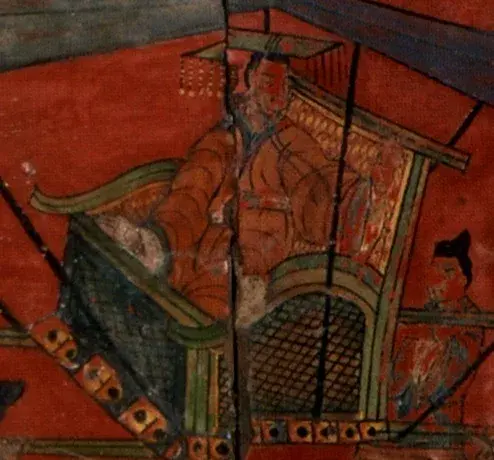
The Heping Era and the Yellow River Conservancy (河平) was a celebrated historical episode during the Western Han dynasty combining monumental civil engineering with imperial regnal transition under Emperor Cheng (Liu Ao). In the fourth month of 29 BCE, the Yellow River ruptured its embankments at Jindi in Dong Commandery, submerging thirty-two counties across Pingyuan, Qiancheng, and Jinan commanderies, drowning thousands and destroying more than 40,000 homes. Imperial relief efforts transferred nearly 10,000 refugees by boat, but conventional methods failed to halt the roaring torrents. In the spring of 28 BCE, senior counselor Du Qin recommended hydraulic specialist Wang Yanshi to serve as Imperial Embankment Envoy. Breaking with conventional methods, Wang Yanshi invented the "stone-filled bamboo cage" technique (zhujian), submerging gigantic four-zhang bamboo crates packed with boulders between twin cargo barges. Within thirty-six days, the breach was sealed and the river restored to its channel. Delighted by this divine deliverance, Emperor Cheng issued a general amnesty in the third month of 28 BCE, adopting the new era title "Heping" ("Peace upon the River") and ennobling Wang Yanshi as Marquis Within the Passes. This milestone united hydraulic innovation with imperial statecraft, initiating the four-year Heping era.
The Yellow River breaches its dikes in Dong Commandery, submerging thirty-two counties across three commanderies.
Emperor Cheng sends relief grain and deploys 500 wooden vessels, rescuing nearly 10,000 stranded citizens.
Du Qin recommends Wang Yanshi; Emperor Cheng commissions him as Imperial Embankment Envoy.
Wang Yanshi constructs four-zhang stone bamboo cages, sealing the breach within thirty-six days.
Emperor Cheng changes the reign title to "Heping," rewards Wang Yanshi, and ennobles him as marquis.
Following four years of agricultural recovery and Liu Xiang's bibliographic collation, the era concludes.
By the mid-Western Han, heavy sediment accumulation along the lower reaches of the Yellow River had elevated the riverbed above surrounding floodplains. In the fourth month of 29 BCE, sudden torrential rains upstream triggered a massive rupture at the Jindi embankments in Dong Commandery (modern Puyang, Henan). Waves flooded eastward across hundreds of kilometers, drowning thirty-two counties in Pingyuan, Qiancheng, and Jinan.
The deluge destroyed over 40,000 public administrative compounds and private dwellings, displacing hundreds of thousands of refugees and plunging the North China Plain into famine. In the eleventh month, Emperor Cheng dispatched Grand Minister of Agriculture Fei Diao to distribute treasury grain, while mobilizing 500 wooden vessels east of Henan to rescue stranded families. However, local magistrates attempting to backfill the gap with loose earth and stones found their materials swept away by the violent current. The breach widened, menacing the imperial grain transit routes and imperial stability.
Months passed without progress, causing widespread panic in the capital Chang'an. Emperor Cheng summoned Commander-in-Chief Wang Feng to devise immediate solutions. Wang Feng's confidential advisor, the astute scholar Du Qin, identified a capable hydraulic officer named Wang Yanshi. Du Qin urged Wang Feng: "Wang Yanshi possesses remarkable engineering ingenuity and deep understanding of river currents; if appointed to lead the work, he will conquer the floodwaters." Emperor Cheng approved the memorial, appointing Wang Yanshi as Imperial Embankment Envoy with absolute command over regional labor and treasury funds.
In the spring of 28 BCE, Wang Yanshi arrived at the roaring breach at Jindi. Inspecting the site amidst freezing winds, he observed that conventional loose stone dumping failed because the water's momentum easily displaced unanchored material. An engineered foundation required a massive, unified structure that possessed both tremendous weight and water-permeable friction.
To accomplish this, Wang Yanshi pioneered the "stone-filled bamboo cage" technique. He mobilized thousands of artisans and laborers to fell vast groves of mature bamboo, weaving them into cylindrical and rectangular crates measuring four zhang (approx. 9.2 meters) in length and nine spans in circumference. Laborers packed the interior of these bamboo frameworks with dense granite boulders, binding the crates with iron wire and tough hemp rope to create interlocking blocks weighing thousands of kilograms.
Wang Yanshi devised a coordinated naval deployment scheme. He lashed two massive flat-bottomed freight barges side-by-side, placing the immense stone-filled bamboo cages atop wooden sliding beams suspended between the vessels. Expert oarsmen steered the twin barges directly into the center of the roaring torrent.
At a synchronized command, crewmen severed the ropes simultaneously, allowing the massive cages to plunge into the abyss. Sinking rapidly to the riverbed, the heavy cages locked together through their interwoven bamboo frames, withstanding the current and establishing a permeable underwater stone foundation. Thousands of laborers followed immediately, dumping gravel, earth, and timber fascines atop the bamboo base. Working day and night without interruption for thirty-six days, the workforce sealed the breach, forcing the Yellow River back into its original channel to flow peacefully toward the sea and ending the regional crisis.
When couriers carried the news of the victory to Chang'an, Emperor Cheng and his court celebrated with unbridled joy. In Han cosmological theory, Yellow River breaches represented celestial admonitions against sovereign shortcomings, whereas the swift containment was heralded as a miraculous sign of heavenly blessing and dynastic virtue.
In the third month of 28 BCE, Emperor Cheng promulgated an imperial edict: "The breach at Jindi in Dong Commandery flooded the realm; now the gap is sealed and the river rests in tranquility. Let the fifth year of Jianshi be inaugurated as the first year of Heping ('Peace upon the River')!" The monarch elevated Wang Yanshi to Grandee of the Fourth Rank, granted him 100 catties of gold, and ennobled him as Marquis Within the Passes. Wang Yanshi's bamboo cage method was recorded in imperial archives, serving as an indispensable engineering handbook for Chinese hydraulic officials for centuries.
Wang Yanshi's invention of stone-filled bamboo cages (zhujian) was a monumental engineering breakthrough in ancient flood-control history. It solved the ancient structural dilemma of laying stable foundations in swift, deep river rapids by leveraging the tensile flexibility of bamboo and the ballast weight of stones. This technology was preserved across the Three Kingdoms, Tang, Song, Ming, and Qing dynasties, directly inspiring the famous bamboo-cricket dams and diversion weirs at the Dujiangyan irrigation system in Sichuan.
The adoption of the Heping era illustrated the profound cosmological connection in the Han dynasty between hydraulic natural phenomena and monarchical reign titles. By designating the era "Heping," the imperial court restored administrative confidence and moral legitimacy following a natural catastrophe. During the four years of the Heping era (28–25 BCE), agricultural production was restored across the North China Plain, public granaries were replenished, and scholar Liu Xiang began the monumental collation of classical texts in the Tianlu Pavilion, creating a period of relative domestic peace.
In the Book of Han (Han Shu, Treatise on Waterways and Canals), Ban Gu praised Wang Yanshi's achievement: "Wang Yanshi possessed ingenious insight and mastery of river works. Constructing bamboo cages four zhang in length holding 120 bushels of stone, he deployed them from twin barges to sink them in the depths. In thirty-six days, the dike was completed. The Son of Heaven was delighted and changed the era name to Heping. Wang Yanshi's accomplishment surpassed ordinary human strength; it was truly miraculous!"
In Zizhi Tongjian, Song historian Sima Guang recorded: "The Yellow River had been a scourge since antiquity, and the Jianshi breach drowned multiple commanderies. Wang Yanshi deployed bamboo cages and submerged stones, matching celestial ingenuity to tame the waves within weeks. Emperor Cheng conferred nobility and altered the era name to commemorate river tranquility—a truly splendid achievement of an ordered realm."