Uprising at Anchuhe
Wanyan Aguda rallies 2,500 warriors along the Anchuhe River and captures Ningjiangzhou
Liao Dynasty / Jin Dynasty · HISTORICAL EVENT
金灭辽之战
The Jin Conquest of Liao (金灭辽之战) was a transformative war of dynastic overthrow fought between 1114 (the fourth year of the Tianqing era of Liao) and 1125 (the third year of the Tianhui era of Jin and the fifth year of the Baoda era of Liao), during which the Jurchen chieftain Wanyan Aguda established the Jin Dynasty and completely extinguished the Khitan Liao empire. Ever since the foundation of the Liao Dynasty in the early tenth century, Khitan…
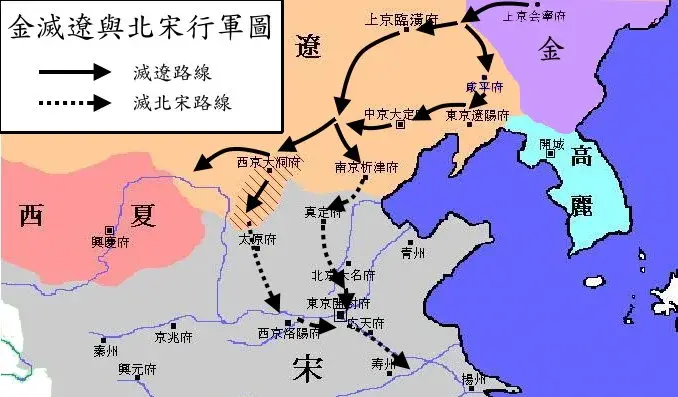
The Jin Conquest of Liao (金灭辽之战) was a transformative war of dynastic overthrow fought between 1114 (the fourth year of the Tianqing era of Liao) and 1125 (the third year of the Tianhui era of Jin and the fifth year of the Baoda era of Liao), during which the Jurchen chieftain Wanyan Aguda established the Jin Dynasty and completely extinguished the Khitan Liao empire. Ever since the foundation of the Liao Dynasty in the early tenth century, Khitan monarchs had subjected the Jurchen tribes of the northeastern forests to harsh tributary extraction and political subjugation, breeding deep-seated resentment. In the autumn of 1114, Wanyan Aguda rallied his warriors along the Anchuhe River and formally revolted, swiftly seizing Ningjiangzhou and annihilating a superior Liao army at Chuhedian. In early 1115, Aguda proclaimed himself emperor, founding the Great Jin Dynasty. He proceeded to capture Huanglongfu and shattered Emperor Tianzuo's massive counter-offensive army at Dalugucheng with just twenty thousand cavalry. Gaining unstoppable momentum, the Jin armies swept across northern lands, storming the Five Capitals of Liao in rapid succession. In February 1125, Jin general Wanyan Loushi captured Emperor Tianzuo at Xincheng in Yingzhou, bringing a complete end to the 210-year rule of the Liao Dynasty and inaugurating the Jin Dynasty's imperial dominance over North China.
Wanyan Aguda rallies 2,500 warriors along the Anchuhe River and captures Ningjiangzhou
Aguda leads 3,700 cavalry in a dawn surprise attack, shattering the Liao frontier army at Chuhedian
Aguda proclaims himself emperor at Huining, establishing the Jin Dynasty
Aguda's 20,000 cavalry route Emperor Tianzuo's massive imperial host, seizing strategic momentum
Jin armies capture the Liao supreme ancestral capital within half a day
Wanyan Loushi captures Emperor Tianzuo at Yingzhou, marking the complete extinction of the Liao Dynasty
Following the unification of northern tribes by Yelü Abaoji, the Khitan Liao Dynasty maintained extensive dominion across Mongolia and Northeast Asia. Khitan aristocrats treated the unsinicized Jurchen tribes of the northeastern forests as tributary subjects, routinely dispatching imperial envoys known as silver-tablet messengers to extort gyrfalcons (haidongqing), freshwater pearls, sable pelts, and gold. These imperial envoys behaved with extreme arrogance, demanding lavish hospitality and abusing local households, which generated fierce hatred among the Jurchen populace.
In the spring of 1112, Emperor Tianzuo of Liao held the annual First Fish Banquet along the Yazi River, commanding all tributary tribal chieftains to dance before him in celebratory submission. Wanyan Aguda, the chief of the Wanyan clan, stoically refused to dance despite repeated royal orders. Although Emperor Tianzuo contemplated executing him, he hesitated, thereby allowing the Jurchen leader to return north and begin plotting an open insurrection.
Upon assuming headship of the Wanyan confederacy, Aguda demonstrated extraordinary administrative vision and military prowess. He rapidly subdued rival chieftains and welded disparate Jurchen forest bands into a cohesive, united tribal alliance under Wanyan leadership.
Militarily, Aguda reorganized traditional tribal hunting groups into a rigorous socio-military structure known as the meng'an-mouke system. Through this institution, every household furnished battle-ready warriors, creating a formidable force of disciplined, armored heavy cavalry capable of enduring extreme wilderness campaigning and mounted shock tactics, providing the organizational backbone to confront the Khitan state.
In the autumn of 1114, learning that the Liao court was assembling border forces to curb Jurchen autonomy, Wanyan Aguda preempted the enemy. He assembled 2,500 elite warriors along the banks of the Anchuhe River (modern Ashihe) and performed solemn ancestral sacrifices, formally raising the standard of revolt.
Aguda directed his troops in a lightning assault against the heavily fortified Liao frontier bastion of Ningjiangzhou, storming the ramparts and slaying the garrison commander. Alarmed by this sudden uprising, Emperor Tianzuo dispatched tens of thousands of elite Khitan and Xi cavalry to Chuhedian to envelop the rebels. Utilizing heavy morning river fog, Aguda personally led 3,700 mounted shock troops across the river in a surprise dawn charge, completely routing the Liao army and capturing vast stores of horses, weapons, and armor. The Chuhedian triumph ignited widespread rebellions across the northeastern frontiers.
In January 1115, Wanyan Aguda held an imperial coronation ceremony at Huining Prefecture, adopting the dynastic title "Great Jin" (signifying pure gold that never tarnishes, unlike iron) and declaring the era name Shouguo. In September of that year, Aguda besieged and stormed the key Liao military depot of Huanglongfu, severing Liao's eastern supply corridors.
Desperate to reverse the tide, Emperor Tianzuo mobilized the full military might of the Khitan realm, reportedly marching with hundreds of thousands of infantry and cavalry toward the frontier. Undaunted, Aguda confronted the colossal host at Dalugucheng with merely twenty thousand veteran cavalry. Capitalizing on political divisions within the Liao command structure, Aguda hurled his armored wings in a devastating frontal penetration. The disorganized Liao host collapsed in panic, and Emperor Tianzuo fled the field in headlong retreat, cementing Jin's absolute operational superiority.
Following the disaster at Dalugucheng, Liao power disintegrated rapidly. In 1120, Aguda advanced on the ancestral homeland of the Khitan, capturing Shangjing Linhuang Prefecture within half a day and leveling imperial monuments. Jin columns subsequently overran Zhongjing Dading Prefecture and Xijing Datong Prefecture, forcing Emperor Tianzuo to flee deep into the Jiashan mountains.
Although Northern Song formed the Maritime Alliance with Jin to launch a pincer strike against Liao's southern bastions, Song forces suffered disastrous defeats beneath the walls of Yanjing, forcing Jin to intervene and seize Nanjing Xijin Prefecture. Attempting a desperate final counter-strike from the northern deserts, Emperor Tianzuo was relentlessly pursued by Jin cavalry under Wanyan Loushi. In February 1125, Loushi encircled and captured Emperor Tianzuo at Xincheng in Yingzhou. After 210 years of reign, the Liao Dynasty was completely eradicated.
The campaign concluded in total victory for the Jin Dynasty. The five metropolitan capitals of Liao were conquered, the imperial treasury and administrative archives were captured, and the Khitan imperial line was extinguished. The Jin Dynasty inherited all territories north of the Great Wall and expanded southward into northern Hebei and Shanxi.
The downfall of the Liao Dynasty was a watershed event in East Asian medieval history. It marked the elevation of the Jurchen people from a forest tribal group into the masters of an expansive continental empire, reshaping the political landscape of northern China. Furthermore, the war revealed the extreme military incompetence of the Northern Song Dynasty, directly triggering the subsequent Jin invasion of the central plains and the fall of Kaifeng. Surviving Khitan nobles under Yelü Dashi migrated westward to Central Asia, where they established the Western Liao (Qara Khitai) empire.