The Lone Departure
Xuanzang slips past border guards at Guazhou and crosses the Moheyanqi Desert alone
· HISTORICAL EVENT
玄奘西行
Xuanzang's Journey to the West (玄奘西行) was a monumental seventeen-year geographical exploration and cross-cultural odyssey spanning more than fifty thousand li across dozens of ancient kingdoms in Central and South Asia. In 627, during the first year of the Zhenguan era under Emperor Taizong of the Tang dynasty, the Buddhist monk Xuanzang resolved to seek original canonical texts in India. Evading strict frontier curfews, he slipped out of Chang'an…
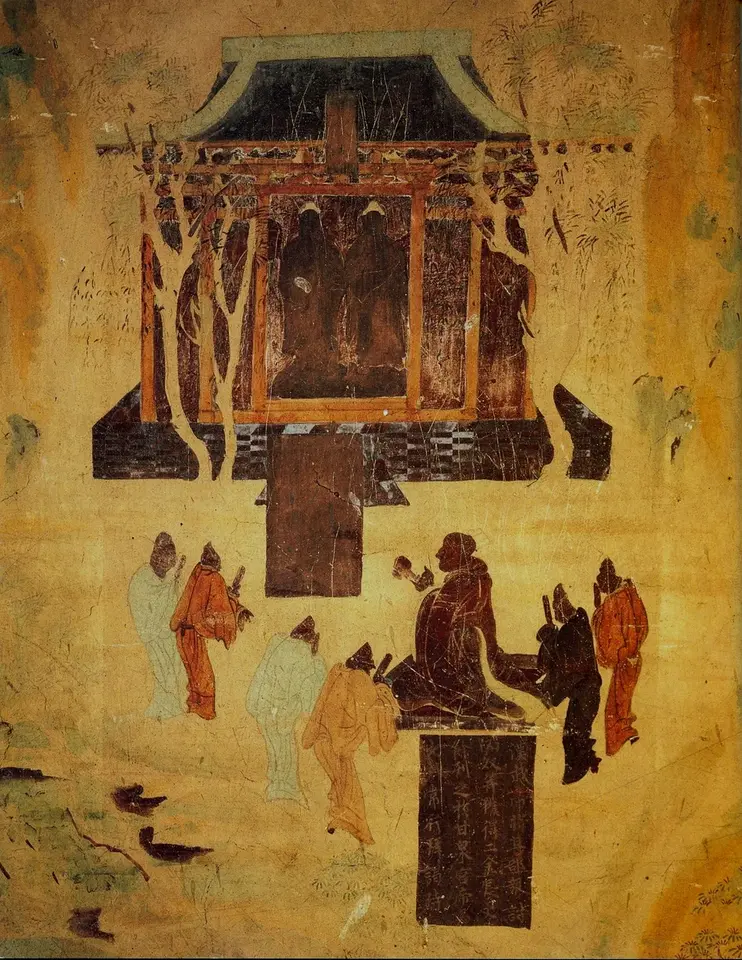
Xuanzang's Journey to the West (玄奘西行) was a monumental seventeen-year geographical exploration and cross-cultural odyssey spanning more than fifty thousand li across dozens of ancient kingdoms in Central and South Asia. In 627, during the first year of the Zhenguan era under Emperor Taizong of the Tang dynasty, the Buddhist monk Xuanzang resolved to seek original canonical texts in India. Evading strict frontier curfews, he slipped out of Chang'an alongside famine refugees, embarking upon the ancient Silk Road. Facing perilous natural hazards alone, Xuanzang crossed the lethal sands of the eight-hundred-li Moheyanqi Desert, formed a sworn brotherhood with King Qu Wentai of Gaochang, and secured diplomatic safe passage under the Western Turkic Khagan Tong Yabghu. His route wound through Suyab, Samarkand, and the treacherous Iron Gate pass, traversing the glaciated passes of the Pamirs and Hindu Kush before arriving in northern India. After exploring over one hundred and ten Indian kingdoms, he chose an arduous return journey across the Wakhan Corridor of the Pamir plateau and the southern Silk Road oasis network, arriving back in Chang'an with over six hundred Buddhist texts. Xuanzang's voyage stands as one of the towering achievements in global exploration history, providing an incomparable topographical and ethnographical record of medieval Eurasia.
Xuanzang slips past border guards at Guazhou and crosses the Moheyanqi Desert alone
King Qu Wentai provisions the expedition; Western Turkic Khagan provides military escorts
Traversing the Iron Gate and freezing mountain passes, Xuanzang reaches northern India
Studies at Nalanda Monastery and conducts field surveys across 110 kingdoms of India
Xuanzang ascends the Wakhan Corridor, crossing the Pamir plateau toward Khotan
Returning after seventeen years, Xuanzang arrives in the imperial capital and presents his findings
Event Name: Xuanzang's Journey to the West (玄奘西行); Alternative Name: The Path of Xuanzang (玄奘之路), Xuanzang's Western Expedition (玄奘西巡); Event Type: Silk Road Geographical Exploration and Civilization Exchange (丝绸之路地理探险与文明交往); Dynasty: Tang (唐代); Location: Chang'an across the Western Regions, Central Asia, and India; Time Period: 627 (First Year of Zhenguan) - 645 (Nineteenth Year of Zhenguan); Parties Involved: Tang Monk Xuanzang, Kingdom of Gaochang, Western Turkic Khaganate, Central Asian Sogdian City-States, Indian Kingdoms; Key Figures: Xuanzang (Chen Yi), Qu Wentai, Tong Yabghu Qaghan, King Harsha, Emperor Taizong of Tang; Cause: In quest of genuine Mahayana Buddhist scriptures, Xuanzang defied early Tang frontier bans to embark on a transcontinental exploration along the Silk Road; Outcome: Xuanzang traveled over fifty thousand li across seventeen years, traversing over one hundred kingdoms and bridging overland arterial routes between East and West; Impact: Immensely deepened Chinese imperial understanding of Central and South Asian geography and provided foundational records for the Great Tang Records on the Western Regions;
During the transition between the Sui and Tang dynasties, protracted warfare across the Central Plains severed direct Chinese imperial administration over the Western Regions. The Eastern Turkic Khaganate dominated the northern Mongolian steppe, while the Western Turkic Khaganate exercised hegemony across the northern and southern flanks of the Tianshan Mountains and deep into Central Asia. Oasis kingdoms throughout the Tarim Basin and the valleys beyond the Pamirs were subject to Turkic cavalry exactions. Furthermore, shifting sands, glacial mountain barriers, and ruthless desert bandits made transcontinental commerce extremely hazardous. Nonetheless, the overland Silk Road remained the indispensable bridge connecting Chinese, Sogdian, Persian, and Indian civilizations, with vibrant Buddhist monasteries along the desert oases sustaining cultural contact across the continent.
Xuanzang was ordained as a monk in his youth and immersed himself in Buddhist scriptures across Chang'an, Luoyang, and Chengdu. Troubled by pervasive translational discrepancies and theological rifts within Chinese monastic circles, he resolved to travel to India to examine original Sanskrit manuscripts. However, in the early Zhenguan reign, Emperor Taizong enforced rigorous curfews along northwestern frontier bastions such as Yumen Pass and Yangguan Pass due to ongoing military tensions with northern nomads. The imperial bureaucracy repeatedly denied Xuanzang's formal petitions for travel permits. Undaunted by official prohibition, Xuanzang seized the opportunity presented by an autumn famine in 627, when authorities permitted impoverished subjects to seek food westward. Joining migrating refugees, Xuanzang quietly departed Chang'an, commencing his solitary odyssey across thousands of miles of unknown territory.
Traveling rapidly along the Hexi Corridor, Xuanzang reached Liangzhou, where Regional Commander Li Daliang ordered him to return to the capital. Aided by local monastic devotees who concealed his identity, Xuanzang traveled under cover of darkness to Guazhou. When imperial arrest warrants arrived, local magistrate Li Chang, moved by Xuanzang's spiritual devotion, tore the warrants to pieces and advised him to flee immediately. Acquiring an aged desert horse and escorted by a local guide named Shi Pantuo, Xuanzang skirted the fortified towers along the border by night.
When his terrified guide deserted him, Xuanzang ventured alone into the blistering Moheyanqi Desert, an eight-hundred-li expanse between Hami and Lop Nor known as the Sea of Sand. Whirling dust storms and extreme temperature shifts obliterated all geographical landmarks. After traveling over a hundred li, Xuanzang accidentally spilled his water skin, losing his entire supply. Overcome by extreme dehydration and disorientation, he collapsed in the burning dunes. After four days and five nights without water, his veteran desert horse broke into a gallop, guiding the semi-conscious monk to an oasis pool surrounded by green pasture. Resting and replenishing his provisions, Xuanzang miraculously conquered the desert, reaching the oasis city of Hami.
Learning of the eminent Tang monk's arrival, King Qu Wentai of Gaochang dispatched an elite cavalry escort to bring Xuanzang to his capital at Jiaohe. Devoted to the Dharma, Qu Wentai treated Xuanzang with lavish reverence and attempted to detain him permanently as state preceptor, threatening physical confinement when the master refused. In response, Xuanzang sat motionless in his chamber, undertaking a resolute three-day hunger strike. Stricken with remorse, Qu Wentai bowed before Xuanzang, begging forgiveness and swearing a sacred fraternal covenant before the Buddha. The king mobilized state resources to provision the master's expedition, outfitting him with thirty sets of cold-weather habits, gold, silver, five hundred bolts of silk, twenty-four servants, and thirty packhorses, accompanied by twenty-four personal royal letters addressed to sovereign monarchs along the Western Regions.
Departing Gaochang, Xuanzang crossed Karasahr and Kucha, navigating the lethal glaciers of the Muzart Pass in the Tianshan Mountains, where several porters died in sudden avalanches. Skirting Lake Issyk-Kul, he arrived at Suyab, where he obtained an audience with Tong Yabghu, the supreme khagan of the Western Turks. Deeply impressed by Xuanzang's dignified presence and intellectual mastery, the khagan hosted a grand banquet and assigned military officers proficient in Chinese to escort the monk through nomadic territories, commanding local chieftains to grant him unhindered passage.
Protected by Turkic escorts, Xuanzang journeyed across the Sogdian commercial heartland, surveying cities such as Samarkand and Kesh. He reached the precipitous Iron Gate pass in modern Uzbekistan, an intimidating defile flanked by sheer cliffs where iron-studded gates hung with defensive bells barred the passage between Sogdiana and Bactria. Crossing the gorge safely, Xuanzang crossed the Oxus River into the ancient region of Tokharistan, passing Balkh before confronting the monumental Hindu Kush mountain range.
The Hindu Kush presented towering frozen ridges wrapped in perpetual blizzards, with narrow pathways suspended above yawning precipices. Enduring severe altitude sickness and bone-chilling cold, Xuanzang scaled the frozen passes with local mountain guides, arriving in Bamiyan. There, he marveled at the two colossal rock-carved Buddhas and documented the thriving monastic establishments of the valley. Continuing over the Black Mountains into Kapisa, Xuanzang finally set foot upon the plains of northern India in 629.
Within the Indian subcontinent, Xuanzang spent more than a decade pursuing scholastic mastery and conducting comprehensive field surveys. Beyond his five years of rigorous study at Nalanda Monastery, his journeys took him across dozens of kingdoms throughout northern, eastern, southern, and western India. From the fertile plains of Magadha and Kanauj along the Ganges, to coastal Bengal in the east, the volcanic Deccan plateau in the south, and the ports of Gujarat in the west, Xuanzang systematically recorded topographical terrains, urban architecture, agricultural trade, ethnic customs, and historical Buddhist monuments.
In 643, Xuanzang commenced his homeward transit bearing hundreds of precious manuscripts and sacred images. To map alternate geographical corridors, he chose an uncharted, perilous southern route: ascending northwest through the Hindu Kush, he entered the Wakhan Corridor of the Pamir plateau across the borderlands of modern Tajikistan and Afghanistan. Braving blinding alpine blizzards, Xuanzang negotiated the Mingteke Pass into Tashkurgan on the eastern slopes of the Pamirs. From there, he followed the southern rim of the Tarim Basin along the southern Silk Road, passing Yarkand, Khotan, Qiemo, and the ruins of Loulan, ultimately arriving in triumph at the Tang capital of Chang'an in 645, successfully concluding his legendary transcontinental expedition.
Xuanzang's expedition achieved the pinnacle of ancient geographical discovery and cultural interaction. Traveling alone across fifty thousand li through deserts, frozen mountains, and primeval forests, he personally visited 110 kingdoms and gathered firsthand intelligence on an additional twenty-eight realms. He successfully integrated the northern Silk Road, Central Asian mountain passes, the Gangetic river system, and the southern Pamir route into a coherent continental transportation network, returning with 657 sacred Sanskrit manuscripts.
Xuanzang's journey fundamentally reshaped Eurasian historical geography. Upon his return, under imperial decree from Emperor Taizong, Xuanzang dictated the twelve-volume masterpiece Great Tang Records on the Western Regions, meticulously recorded by his disciple Bianji. The text preserved objective, rigorous accounts of topography, distances, climate, products, languages, and political institutions across the Western Regions and India, serving as the most precise medieval geographical encyclopedia in existence. In modern times, European, Indian, and Chinese archaeologists utilized Xuanzang's precise measurements to rediscover lost civilizations, including Nalanda Monastery, the Bamiyan caves, and Emperor Ashoka's monumental pillars. The Path of Xuanzang remains a universal monument to human perseverance, intellectual curiosity, and cross-cultural dialogue.