He Jin Assassinated and Beimang Encounter
He Jin is killed by eunuchs, sparking palace fighting; Dong Zhuo enters Luoyang and intercepts the young emperor at Mount Beimang
Eastern Han Dynasty (东汉) · HISTORICAL EVENT
董卓之乱
The Turmoil of Dong Zhuo (董卓之乱) was a catastrophic political and military upheaval between 189 and 192 that precipitated the collapse of the Eastern Han dynasty and inaugurated the chaotic Three Kingdoms era. In the eighth month of 189, General-in-Chief He Jin summoned Liangzhou warlord Dong Zhuo to bring his frontier army to the imperial capital of Luoyang to intimidate the entrenched eunuch faction. Following He Jin's assassination by the eunuchs and…
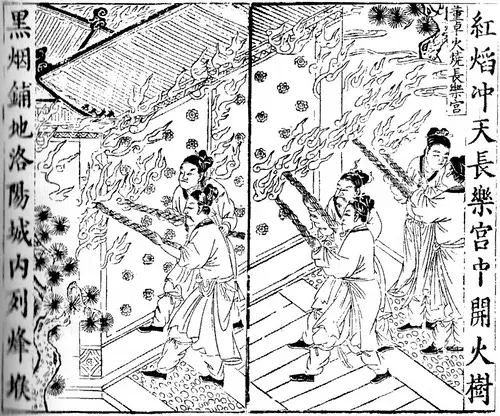
The Turmoil of Dong Zhuo (董卓之乱) was a catastrophic political and military upheaval between 189 and 192 that precipitated the collapse of the Eastern Han dynasty and inaugurated the chaotic Three Kingdoms era. In the eighth month of 189, General-in-Chief He Jin summoned Liangzhou warlord Dong Zhuo to bring his frontier army to the imperial capital of Luoyang to intimidate the entrenched eunuch faction. Following He Jin's assassination by the eunuchs and the ensuing massacre in the palace, Dong Zhuo marched his troops into Luoyang, absorbed the imperial guards, and bribed Lu Bu to murder his commander Ding Yuan. Seizing absolute military control over the court, Dong Zhuo deposed the young Emperor Shao (Liu Bian) and installed the nine-year-old Emperor Xian (Liu Xie), while declaring himself Chancellor of State and instituting a reign of terror. Dong Zhuo's brutality prompted regional leaders, including Yuan Shao, Cao Cao, and Sun Jian, to form the Guandong Coalition against him. In response, Dong Zhuo torched Luoyang, desecrated imperial tombs, and forcibly relocated millions of inhabitants to Chang'an. In the fourth month of 192, Minister over the Masses Wang Yun persuaded Lu Bu to assassinate Dong Zhuo outside Weiyang Palace. However, Dong Zhuo's lieutenants Li Jue and Guo Si subsequently stormed Chang'an, killing Wang Yun and driving the Han dynasty into permanent fragmentation.
He Jin is killed by eunuchs, sparking palace fighting; Dong Zhuo enters Luoyang and intercepts the young emperor at Mount Beimang
Dong Zhuo seizes control of the imperial guards, deposes Emperor Shao, and installs Prince Liu Xie as Emperor Xian
Dong Zhuo declares himself Chancellor of State, institutes a reign of terror, and mints debased currency
Yuan Shao, Cao Cao, Sun Jian, and other regional leaders form an alliance to overthrow Dong Zhuo
Dong Zhuo torches Luoyang, desecrates imperial tombs, and forcibly moves the capital and population to Chang'an
Dong Zhuo erects a massive fortified redoubt at Mei County, stockpiling thirty years of grain and immense treasure
Wang Yun and Lu Bu ambush and kill Dong Zhuo at the North Yeye Gate, executing the entire Dong clan
Dong Zhuo's lieutenants storm Chang'an, execute Wang Yun, and disperse the court, inaugurating full warlord fragmentation
Throughout the mid-to-late Eastern Han period, emperors routinely ascended the throne during childhood, resulting in recurrent struggles for power between consort clans and imperial eunuchs. During the reign of Emperor Ling, powerful eunuchs known as the Ten Attendants dominated the court, selling government offices and extorting the peasantry, which severely degraded imperial administrative integrity. The outbreak of the Yellow Turban Rebellion in 184 exposed systemic military weaknesses and shook the foundations of Han imperial rule across the central plains.
In the fourth month of 189, Emperor Ling died, and his fourteen-year-old son Liu Bian was enthroned as Emperor Shao under the regency of Empress Dowager He. Her brother He Jin was appointed General-in-Chief, assuming control over central military forces. Seeking to eradicate the Ten Attendants permanently, He Jin adopted the proposal of Colonel of Sili Yuan Shao to summon peripheral frontier commanders, including Dong Zhuo from Hedong and Ding Yuan from Bingzhou, to advance toward Luoyang and pressure the empress dowager into consenting to a total purge.
Dong Zhuo hailed from a prominent gentry clan in Lintao, Longxi Commandery, and spent decades fighting in the hostile northwestern borderlands. Through prolonged counterinsurgency campaigns against the Qiang and Hu rebellions, Dong Zhuo assembled a powerful private military apparatus. His Liangzhou army combined seasoned Han cavalry with ferocious auxiliary tribesmen, hardened by brutal frontier conditions and bound by intense personal loyalty to Dong Zhuo rather than the distant Han imperial house.
Aware of Dong Zhuo's expanding autonomy, the Han court repeatedly attempted to neutralize his command by offering him high civilian appointments such as Chamberlain for the Palace Revenues or Governor of Bingzhou, demanding that he surrender his troops. Exploiting his soldiers' fanatical loyalty, Dong Zhuo repeatedly refused imperial summons, claiming that his Qiang and Han troops refused to let him depart. He Jin's secret invitation provided Dong Zhuo with the perfect constitutional pretext to march his battle-hardened legions directly into the heart of the empire.
On the twenty-fifth day of the eighth month of 189, the Ten Attendants discovered He Jin's plot and assassinated him outside Jiade Hall. In retaliation, Yuan Shao and his allies led imperial troops into the palace, massacring more than two thousand eunuchs. The surviving eunuchs, led by Zhang Rang and Duan Gui, abducted the young Emperor Shao and his younger brother, Prince of Chenliu Liu Xie, fleeing north toward the Yellow River at Mount Beimang.
Approaching Luoyang, Dong Zhuo observed pillars of smoke rising over the palaces. Informed of the palace mutiny, he hastened with his cavalry to Mount Beimang to intercept the imperial retinue. When Dong Zhuo met the young emperor, he discovered that fourteen-year-old Emperor Shao was weeping uncontrollably and unable to provide a coherent account of the crisis. In contrast, nine-year-old Prince Liu Xie remained calm and articulated the entire sequence of events with composure. Dong Zhuo was deeply impressed by Liu Xie and promptly conceived a scheme to depose Emperor Shao.
Upon entering Luoyang, Dong Zhuo moved swiftly to consolidate military control. Citing his shared regional background with He Jin's troops, he annexed the imperial guards formerly commanded by He Jin and his brother He Miao. Dong Zhuo then seduced Lu Bu, a formidable warrior serving Bingzhou Inspector Ding Yuan, with gold, titles, and the legendary Red Hare steed. Lu Bu murdered Ding Yuan and brought Ding's veteran cavalry under Dong Zhuo's banner. Within days, Dong Zhuo gained uncontested command of all field forces in the capital, reducing the imperial ministers to complete submission.
Having secured monopolistic control of the military, Dong Zhuo unveiled his plan to usurp political supremacy. On the first day of the ninth month of 189, he assembled civil and military officials in Chongde Hall. Dismissing furious protests from Minister Lu Zhi and other senior statesmen, Dong Zhuo forcibly deposed Emperor Shao, demoting him to Prince of Hongnong, and elevated Prince Liu Xie to the throne as Emperor Xian. Yuan Shao drew his sword in open court to defy Dong Zhuo before fleeing to Jizhou. Shortly thereafter, Dong Zhuo murdered Empress Dowager He and dispatched his advisor Li Ru to poison the deposed Prince of Hongnong.
Following the enthronement, Dong Zhuo was appointed Excellency of Works, soon elevated to Grand Commandant, and ultimately proclaimed Chancellor of State and Marquis of Mei. He claimed exceptional imperial prerogatives, including entering court without hurrying, bearing arms before the emperor, and having his personal name omitted from official announcements. Dong Zhuo filled key security posts with his brother Dong Min and nephew Dong Huang, imposing a brutal reign of terror across Luoyang. He permitted his Liangzhou soldiers to plunder wealthy households, violate civilian women, and confiscate private assets under the guise of suppressing rebellion.
To inspire terror and silence dissent, Dong Zhuo personally presided over public banquets where captive rebels and political enemies were subjected to gruesome tortures, including tongue amputation, dismemberment, eye gouging, and boiling in cauldrons, forcing terrified officials to watch while dining. To finance his ballooning military expenditures, Dong Zhuo ordered ancient bronze statues, horses, and bells in Luoyang to be melted down, alongside standard Han copper coins, to mint tiny, debased coins lacking rims or inscriptions. This reckless measure triggered astronomical inflation, causing the monetary economy of the Eastern Han to collapse entirely.
Dong Zhuo's atrocities provoked universal outrage among the gentry and provincial governors. In the first month of 190, a coalition of regional leaders rose in armed rebellion across the eastern commanderies, electing Yuan Shao as supreme confederate leader. The Guandong Coalition included Regional Governors Han Fu, Kong Zhou, Liu Dai, Commandery Administrators Yuan Shu, Wang Kuang, Zhang Miao, Qiao Mao, Yuan Yi, Bao Xin, alongside Colonel Cao Cao.
The coalition marshaled over one hundred thousand troops, establishing forward encampments at Suanzao, Henei, and Yangzhai, threatening Luoyang from multiple directions. Recognizing that Luoyang was difficult to defend against widespread rebellion, Dong Zhuo resolved to move the capital to the strategic redoubt of Chang'an, situated behind the formidable passes of Guanzhong. When Senior Grand Commandant Huang Wan and Minister over the Masses Yang Biao vehemently opposed the relocation, Dong Zhuo stripped them of their ranks.
On the seventeenth day of the second month of 190, Dong Zhuo compelled Emperor Xian, the imperial court, and millions of Luoyang residents to evacuate westward. Liangzhou cavalry brutally drove the terrified civilian population forward, trampling countless people underfoot and leaving corpses strewn across hundreds of miles of highway due to hunger and exhaustion. Before departing, Dong Zhuo ordered his soldiers to set fire to Luoyang's palaces, government offices, ancestral temples, and private neighborhoods, reducing the imperial city and surrounding countryside to ashes. He also directed Lu Bu to excavate the tombs of past Han emperors and imperial ministers, plundering vast quantities of burial treasures.
While the coalition leaders hesitated at Suanzao and indulged in feasts, Cao Cao led his own contingent westward to pursue Dong Zhuo's rearguard. However, Cao Cao was ambushed by Dong Zhuo's capable general Xu Rong at the Bian River near Xingyang, suffering heavy casualties and escaping death only because his cousin Cao Hong offered him his horse. Soon afterward, Changsha Administrator Sun Jian led an aggressive assault through Henan, decisively defeating Dong Zhuo's forces at Yangren and slaying his general Hua Xiong. Realizing that Luoyang was untenable, Dong Zhuo withdrew his remaining garrisons behind Dagu Pass, allowing Sun Jian to enter and repair the charred ancestral temples.
In the fourth month of 190, Dong Zhuo arrived in Chang'an, continuing to hold Emperor Xian hostage and dominating western China. To guarantee his personal safety and indulge in lavish pleasures, Dong Zhuo conscripted hundreds of thousands of laborers to construct a massive fortress at Mei County, two hundred and sixty li west of Chang'an. The walls of Mei Fort matched the height and thickness of Chang'an's city ramparts. Dong Zhuo accumulated grain stores sufficient for thirty years and deposited vast treasures of plundered gold, silk, and jewels inside, declaring that if he succeeded, he would rule the world, and if he failed, he could live comfortably in Mei Fort until old age.
In Guanzhong, Dong Zhuo's oppressive administration was even more ruthless than in Luoyang. Any minor insubordination was met with the extermination of three generations of the offender's family. His subordinate commanders, including Niu Fu, Li Jue, and Guo Si, governed without restraint, extorting and murdering merchant travelers and local villagers. Within two to three years, the historically fertile Guanzhong plain was reduced to a barren wasteland where famine drove surviving inhabitants to cannibalism.
Confronted with the utter ruin of the Han state, Minister over the Masses Wang Yun pretended loyalty to Dong Zhuo while discreetly orchestrating an internal conspiracy. Wang Yun observed that although General Lu Bu served as Dong Zhuo's adopted son and chief bodyguard, relations between the two men were strained. Dong Zhuo was notoriously volatile and had once hurled a short halberd at Lu Bu during a fit of rage; furthermore, Lu Bu had engaged in an illicit affair with one of Dong Zhuo's concubines and lived in constant fear of discovery. Exploiting these anxieties, Wang Yun approached Lu Bu and persuaded him to turn against his master.
On the twenty-third day of the fourth month of 192, Emperor Xian convened a grand gathering of civil and military officials at Weiyang Palace to celebrate his recovery from illness. Wang Yun gave Lu Bu a secret imperial decree authorizing Dong Zhuo's execution. Lu Bu placed Cavalry Commandant Li Su and ten trusted bodyguards in ambush inside the North Yeye Gate, disguised as palace guards. When Dong Zhuo arrived in a heavily armored carriage, Li Su lunged forward with a halberd, striking Dong Zhuo's chest. Dong Zhuo's concealed breastplate deflected the blow, and he fell from the carriage with a wounded arm.
Terrified, Dong Zhuo cried out for his bodyguard, shouting, "Where is Lu Bu?" Lu Bu stepped forward with his halberd, proclaiming, "There is an imperial decree to chastise the rebel minister!" Lu Bu thrust his weapon into Dong Zhuo's throat, and the ambushers rushed in to decapitate him. News of Dong Zhuo's demise brought wild celebrations to the streets of Chang'an, with citizens pawning jewelry to buy wine and meat for festivities. Dong Zhuo's relatives were executed to the last individual, and Dong Zhuo's corpse was exposed in the marketplace. Because of his immense body fat, the guards placed a wick in his navel and lit it, creating a human torch that burned for days.
However, Wang Yun mishandled the aftermath of the coup by refusing to grant an amnesty to Dong Zhuo's remaining Liangzhou legions. Advised by Jia Xu, commanders Li Jue, Guo Si, and Zhang Ji gathered tens of thousands of desperate troops and stormed Chang'an in the sixth month of 192. Lu Bu was defeated and fled eastward, while Wang Yun was executed in the marketplace. The capital fell into the hands of petty warlords once again, leaving the young emperor a captive pawn and extinguishing all hopes for an imperial restoration.
The Turmoil of Dong Zhuo struck a fatal blow to the centralized administrative authority of the Eastern Han state. By deposing and murdering emperors and terrorizing civil ministers, Dong Zhuo shattered the sacred aura surrounding the imperial dynasty. In response, regional governors across the empire transformed their commands into autonomous military fiefdoms, levying taxes, raising independent armies, and waging wars of conquest.
Following Dong Zhuo's death and the fall of Chang'an to Li Jue and Guo Si, the central court completely lost its ability to enforce commands outside the capital. Warlords across northern and southern China embarked on unrestricted warfare: Yuan Shao conquered Jizhou, Cao Cao secured Yan Province, Sun Ce conquered Jiangdong, and Liu Biao held Jingzhou. The territorial and political fragmentation that defined the Three Kingdoms was firmly established.
The forced relocation of the capital and the systematic destruction of Luoyang eradicated centuries of urban culture and architectural achievement. Luoyang, one of the grandest metropolises of the ancient world, was reduced to blackened rubble, and the surrounding countryside was depopulated for hundreds of square miles.
Furthermore, Dong Zhuo's misrule and the subsequent clashes between Li Jue and Guo Si devastated the Guanzhong region. The agricultural hydraulic infrastructure was abandoned, trade ceased, and widespread cannibalism reduced the once densely populated imperial heartland to wilderness. Millions of civilians died from violence, starvation, and epidemics, causing an unprecedented demographic decline in northern China.
Dong Zhuo's decision to destroy the ancient five-baht copper coinage and circulate debased miniature coins triggered runaway hyperinflation. The commercial market collapsed entirely, and ordinary citizens abandoned metal currency. For decades following the turmoil, the Chinese economy regressed to barter trade utilizing bolts of silk and bushels of grain, severely paralyzing domestic commerce and urban revival throughout the late Han and early Three Kingdoms periods.