Fall of Zhennan Pass
French forces capture and blow up the gate at Zhennan Pass; Feng Zicai is recalled to lead the defense
Qing Dynasty (清朝) · HISTORICAL EVENT
镇南关大捷
The Battle of Zhennan Pass (镇南关大捷) was a decisive land victory achieved by Qing forces between February and March 1885 (the eleventh year of the Guangxu era) during the Sino-French War, in which veteran commander Feng Zicai crushed the invading French Tonkin Expeditionary Corps at Guanqian'ai near Zhennan Pass (modern Friendship Pass on the Sino-Vietnamese border). In early 1885, French expeditionary forces captured the strategic border bastion of…
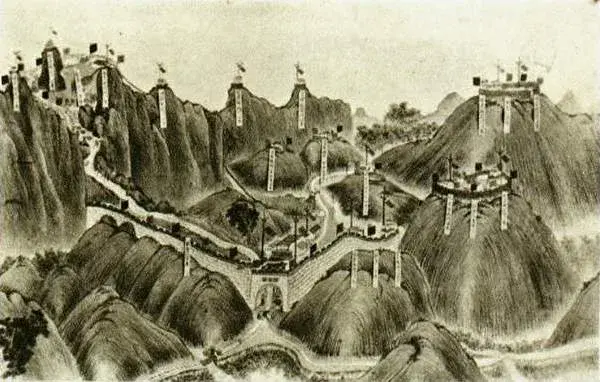
The Battle of Zhennan Pass (镇南关大捷) was a decisive land victory achieved by Qing forces between February and March 1885 (the eleventh year of the Guangxu era) during the Sino-French War, in which veteran commander Feng Zicai crushed the invading French Tonkin Expeditionary Corps at Guanqian'ai near Zhennan Pass (modern Friendship Pass on the Sino-Vietnamese border). In early 1885, French expeditionary forces captured the strategic border bastion of Zhennan Pass, demolishing the gateway fortifications and threatening southwestern China. The imperial court recalled nearly seventy-year-old retired general Feng Zicai to direct border defenses. Carrying his own coffin to the front to symbolize his resolve to die in battle, Feng surveyed the terrain and constructed a robust three-li-long stone rampart and deep entrenchments across the narrow gorge of Guanqian'ai. On March 23, 1885, French Brigadier-General François de Négrier launched an assault against the defensive rampart, briefly breaching its eastern section. At this critical juncture, the septuagenarian Feng Zicai, brandishing an iron lance, led his two sons and bodyguard battalion in a charge over the breastworks into hand-to-hand combat. Inspired by his heroism, Qing divisions surged forward, while Wang Debang's forces severed the French line of retreat and Su Yuanchun mounted a pincer assault. Scurrying in rout, the French suffered heavy casualties, and Négrier was severely wounded. Qing forces pursued the enemy across the border, liberating Dong Dang and Lang Son. The disaster triggered political turmoil in Paris, forcing the resignation of Prime Minister Jules Ferry's cabinet.
French forces capture and blow up the gate at Zhennan Pass; Feng Zicai is recalled to lead the defense
Feng Zicai mobilizes troops to build a three-li stone wall and deep trenches at Guanqian'ai
Négrier's assault breaches the wall; Feng Zicai leads a counter-charge over the rampart into melee combat
Wang Debang severs the French rear; Négrier is severely wounded and French forces flee in panic
Qing forces retake Lang Son; the Jules Ferry cabinet in Paris is toppled following the defeat
During the late nineteenth century, France intensified its colonial encroachment across the Indochinese Peninsula, seeking to annex Vietnam—a traditional tributary vassal of the Qing Dynasty—and carve out an overland corridor into southwestern China. Open hostilities erupted between China and France in 1883.
Following the naval battle of Mawei in 1884, French naval squadrons destroyed the Fujian Fleet and blockaded Taiwan. Stymied by resolute defense led by Liu Mingchuan on Taiwan, the French high command shifted its operational focus to the overland border between Guangxi and northern Vietnam. In February 1885, French expeditionary columns seized Zhennan Pass, blew up the imperial customs gatehouse, and erected a sign reading "The Gateway to Guangxi Exists No More," creating panic across southern China.
Confronted with the French advance, the civilian governor of Guangxi, Pan Dingxin, fled in disorder, shattering frontline morale. The Qing court summarily dismissed Pan and recalled former provincial commander-in-chief Feng Zicai, a respected veteran living in retirement.
Despite his advanced age, Feng Zicai answered the call with devotion, having a wooden coffin transported along with his baggage train to demonstrate that he had no intention of returning alive without victory. Upon arriving at the front, Feng harmonized the disparate regional armies and selected the defile of Guanqian'ai—flanked by sheer mountain ridges—as the optimal killing ground. Day and night, Feng directed troops and local militia in erecting a stone-and-earthen rampart eight feet high and three leagues long, fronted by interlocking ditches, where artillery and concealed ambush contingents were carefully positioned.
On March 23, 1885 (the seventh day of the second lunar month in the eleventh year of Guangxu), French 2nd Brigade commander François de Négrier mobilized approximately one thousand elite marine infantry and legionnaires, advancing in three columns under intense artillery bombardment against the rampart at Guanqian'ai.
Relying on repeating rifles and field howitzers, French troops launched relentless frontal charges, managing to breach the eastern ramparts. With the defensive line on the verge of collapse, seventy-year-old Feng Zicai brandished a spear, kicked off his sandals, and leaped over the breastworks directly into the enemy lines, roaring: "If the French breach this pass, how can we face our elders!" His two sons and personal guard plunged into the melee alongside him. Moved to tears and fury by their general's valor, thousands of Qing soldiers charged from their trenches, engaging the invaders in ferocious hand-to-hand combat with broadswords and lances.
As the frontal battle reached its peak, Commander Wang Debang directed the Dingbian Army out from mountain defiles on the French flank, cutting off their line of retreat. Simultaneously, General Su Yuanchun directed imperial reserves in a sweeping counter-attack from surrounding high ground.
Trapped within the narrow, muddy ravine, the French lost their artillery superiority. Qing units hurled boulders and unleashed musket crossfire from elevated ridges. French lines disintegrated into pandemonium. During desperate efforts to rally his rearguard, General Négrier was struck by a bullet and severely wounded, tumbling from his horse. French troops abandoned cannons, ammunition, and baggage trains, fleeing in disarray toward the border.
Refusing to give the routed enemy respite, Feng Zicai directed a general counter-offensive across the international frontier. On March 24, Qing forces stormed the border garrison of Dong Dang (Wenyuan).
On March 29, imperial divisions coordinated with Liu Yongfu's Black Flag Army to launch an assault on the strategic citadel of Lang Son. Demoralized and deprived of leadership, the surviving French garrison abandoned Lang Son and retreated south beyond Kep. The total liberation of northern border redoubts marked the triumphant conclusion of the Battle of Zhennan Pass.
The Battle of Zhennan Pass resulted in the defeat of the French 2nd Brigade, with nearly one thousand casualties among French and auxiliary troops. Large quantities of modern artillery, rifles, and munitions were captured, while Dong Dang and Lang Son were fully restored to Allied control.
The victory at Zhennan Pass was the most brilliant land triumph achieved by China in its resistance against Western imperialist expansion during the nineteenth century. It shattered the myth of Western military invincibility and triggered an immediate domestic political crisis in France, toppling the Ferry administration. However, under the appeasement policy directed by Li Hongzhang, the Qing court opted to conclude negotiations despite military success, signing the Treaty of Tientsin, which recognized the French protectorate over Vietnam, producing the historical anomaly of "China winning the war on the battlefield but losing at the negotiating table."