Siege of Hongdu
Chen Youliang mobilized his armada to besiege Hongdu; Zhu Wenzheng resisted for eighty-five days.
Late Yuan to Early Ming Dynasty · HISTORICAL EVENT
鄱阳湖之战
The Battle of Poyang Lake (鄱阳湖之战) was a decisive naval engagement fought from July to August 1363 (the twenty-third year of the Zhizheng era of late Yuan) between the insurgent forces of Zhu Yuanzhang and the Dahan fleet of Chen Youliang, widely regarded as the largest naval clash of the medieval world. In the spring of 1363, Chen Youliang capitalized on Zhu Yuanzhang's absence to lead a reported six-hundred-thousand-strong host aboard three-tiered…
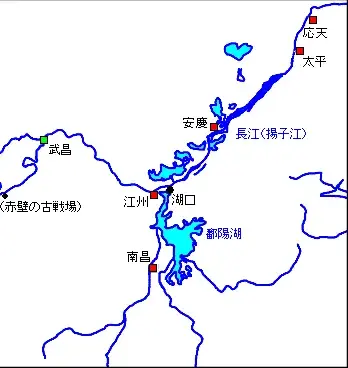
The Battle of Poyang Lake (鄱阳湖之战) was a decisive naval engagement fought from July to August 1363 (the twenty-third year of the Zhizheng era of late Yuan) between the insurgent forces of Zhu Yuanzhang and the Dahan fleet of Chen Youliang, widely regarded as the largest naval clash of the medieval world. In the spring of 1363, Chen Youliang capitalized on Zhu Yuanzhang's absence to lead a reported six-hundred-thousand-strong host aboard three-tiered tower ships to besiege the strategic city of Hongdu (modern Nanchang). Defended heroically by Zhu Wenzheng for eighty-five days, Hongdu withstood the assault until Zhu Yuanzhang arrived with two hundred thousand naval troops, sealing the Hukou strait to sever Chen's retreat to the Yangtze River. The armadas clashed at Mount Kanglang, where Chen's colossal linked ships dominated the open water. On August 30, taking advantage of a sudden northeast gale, Zhu Yuanzhang launched seven fire ships packed with explosives into Chen's dense battle lines, incinerating hundreds of warships and killing tens of thousands of enemy troops. As the trapped Dahan fleet attempted to break out through Hukou on October 3, Chen Youliang was killed by a stray arrow through the eye. The annihilation of Chen's empire eliminated Zhu Yuanzhang's greatest competitor, securing his supremacy over southern China and laying the cornerstone of the Ming Dynasty.
Chen Youliang mobilized his armada to besiege Hongdu; Zhu Wenzheng resisted for eighty-five days.
Zhu arrived with 200,000 troops, garrisoning Hukou and severing the Dahan fleet's riverine retreat.
The armadas met at Mount Kanglang; Xu Da broke the enemy vanguard while Han Cheng saved Zhu Yuanzhang.
Exploiting a sudden northeast gale, Zhu launched seven fire ships, destroying hundreds of giant enemy vessels.
Ming forces encircled the lake; Chen's troops depleted their supplies and slaughtered cavalry mounts.
During a breakout attempt at Hukou, Chen Youliang was killed by a stray arrow, and 50,000 troops surrendered.
During the chaotic collapse of the Mongol Yuan Dynasty in the mid-fourteenth century, peasant rebellions shattered imperial authority across southern China. In the Yangtze basin, two dominant warlords emerged: Chen Youliang, who assassinated his commander to declare himself Emperor of Dahan with his capital at Wuchang, and Zhu Yuanzhang, the Duke of Wu based at Jiqing (modern Nanjing). Chen Youliang possessed immense naval arsenals and commanded skilled riverine marines, while Zhu Yuanzhang followed the pragmatic advice of his scholars to build high city walls, store grain, and delay claiming imperial titles. Conflict between the two titans was inevitable.
In March 1363, rival warlord Zhang Shicheng attacked the Red Turban leader Han Lin'er at Anfeng. Overruling the objections of his counselors, Zhu Yuanzhang marched north with his primary army to relieve the siege. Perceiving that Zhu's heartland was unprotected, Chen Youliang mobilized his entire state, constructing gigantic multi-tiered tower ships clad in iron plates and carrying hundreds of horses, siege engines, and sixty thousand fighting men. In May, Chen's armada surrounded Hongdu (modern Nanchang), the gateway to Jiangxi.
Inside Hongdu, Zhu Yuanzhang's nephew Zhu Wenzheng and General Deng Yu organized an extraordinary defense. Confronted with continuous assaults by siege towers and battering rams, the garrison held the breaches for eighty-five days. A daring officer named Zhang Zide slipped through enemy water patrols in a sampan to alert Zhu Yuanzhang, buying two months for the Ming army to concentrate its scattered forces.
On August 24, 1363, Zhu Yuanzhang arrived at Hukou on the northern lip of Poyang Lake with an armada of two hundred thousand troops. Exhibiting supreme strategic foresight, Zhu avoided marching directly overland to relieve Nanchang. Instead, he deployed divisions under Chang Yuchun to occupy Hukou, Nanhu Mouth, and Jingjiang Mouth, throwing heavy iron chains and defensive palisades across the narrow passage where Poyang Lake empties into the Yangtze River, cutting off Chen's retreat route to Wuchang.
Learning that his maritime escape was barred, Chen Youliang lifted the siege of Hongdu and moved into the open waters of northern Poyang Lake. On August 28, the opposing armadas encountered each other near Mount Kanglang. Chen chained his towering dreadnoughts together to form an iron-armored floating fortress, using trebuchets and heavy ballistas to rain stones on Zhu's smaller vessels. General Xu Da led a vanguard squadron into the enemy line, boarding and destroying several forward warships and killing over one thousand enemy sailors to steady the Ming ranks.
Over two days of fierce skirmishing, Zhu Yuanzhang realized that direct frontal boarding actions against the towering Dahan vessels were unsustainable. On the afternoon of August 30, the wind abruptly shifted from southwest to a howling northeast gale.
Seizing the tactical opportunity, Zhu Yuanzhang commanded specialized assault detachments to pilot seven light swift boats laden with gunpowder, sulfur, dry reeds, and incendiary oils directly toward Chen's dense, immobile battle line. When the fire ships closed to within a hundred paces, the crews ignited the fuses and leaped into rescue skiffs. Driven by the gale, the fire ships slammed into the linked dreadnoughts. Torrents of flame leaped from ship to ship, detonating gunpowder magazines and turning the lake into an inferno. Over one hundred Dahan capital ships were incinerated, and tens of thousands of soldiers were burned or drowned, shattering Chen's tactical cohesion.
Following the conflagration, Chen Youliang withdrew the surviving remnants of his armada to Zuoli. Zhu Yuanzhang deployed mobile scouting squadrons under Chang Yuchun and Liao Yongzhong, who utilized the maneuverability of their smaller craft to intercept foraging parties and sever supply lines.
For over a month, Zhu maintained an airtight blockade across Hukou. Cut off from regional farmlands, food reserves within the Dahan fleet were exhausted. Soldiers slaughtered their warhorses for meat, and dysentery spread throughout the floating camps. Desperate to escape starvation, Chen Youliang resolved to mass his remaining three hundred vessels on October 3 to ram through the Hukou narrows into the Yangtze.
Zhu Yuanzhang had fortified both banks of Hukou with artillery redoubts and submerged stockades. As Chen's flagship led the desperate rush toward the river mouth, shore batteries and fire arrows unleashed a coordinated bombardment. Allied squadrons under Chang Yuchun and Yu Tonghai surged from hidden inlets to sever the retreating line.
Amid the deafening cannonade, Chen Youliang stuck his head out of his cabin window to issue emergency commands to his steersmen. An alert Ming marksman spotted the emperor and unleashed a heavy iron arrow that struck Chen directly through the eye, piercing his skull and killing him instantly. With their sovereign dead, over fifty thousand Dahan warriors laid down their arms and surrendered. Senior general Zhang Dingbian managed to spirit Chen's corpse and his young heir Chen Li onto a single boat to flee to Wuchang. The decisive victory placed all of central China under Zhu Yuanzhang's control.
Supreme commander of the Ming forces and Duke of Wu, later the Hongwu Emperor. Displaying profound operational genius, he sealed the lake exits, exploited natural weather shifts with fire attacks, and defeated a numerically superior rival.
Founder and emperor of the Dahan regime. A formidable warlord who built giant multi-decked warships, his strategic rigidity, chaining of capital ships, and failure to reduce Hongdu led to his death at Hukou.
The nephew of Zhu Yuanzhang and Grand Commandant of Hongdu. His extraordinary defense of Hongdu against overwhelming enemy forces for eighty-five days was the indispensable strategic anchor of the campaign.
A premier general of the Ming Dynasty and Duke of Eguo. Renowned for unparalleled personal bravery and archery, he defended Hukou and commanded naval flanking attacks that destroyed the enemy breakout.
The foremost military architect of the Ming Dynasty and Duke of Weiguo. In the opening engagement at Mount Kanglang, his vanguard charge shattered the Dahan forward battle line, securing key tactical ground.
The Battle of Poyang Lake eliminated the largest and most dangerous warlord threat facing Zhu Yuanzhang. In 1364, Zhu captured Wuchang, accepting the submission of Chen Li and annexing the fertile territories of Jiangxi and Huguang. This victory concentrated the agricultural wealth and naval mastery of the Yangtze basin in Zhu's hands.
With Chen Youliang extinguished, Zhu Yuanzhang systematically subdued Zhang Shicheng in Suzhou and compelled Fang Guozhen to surrender in Zhejiang. By 1367, Zhu consolidated the entire southern realm, issuing the famous proclamation to expel the Mongols and recover China. In 1368, his northern expedition captured Dadu (modern Beijing), driving the Yuan court back to the steppe and establishing the Ming Dynasty.