Yelü Dashi Departs Northwest for Kedun City
Amid the collapse of the Liao Dynasty, Yelü Dashi leads loyal cavalry to Kedun City to preserve the state and prepare westward expansion.
Western Liao (西辽) · HISTORICAL EVENT
卡特万之战
The Battle of Qatwan (卡特万之战, 1141 CE) was a monumental military encounter in medieval Central Asian and world history. Following the fall of the Liao Dynasty in northern China, imperial scion Yelü Dashi migrated westward to found the Western Liao Empire (Qara Khitai). After expanding into Transoxiana, Western Liao was drawn into conflict with the Seljuk Empire, the dominant power of Western Asia, over localized clashes between the Western Karakhanids and…
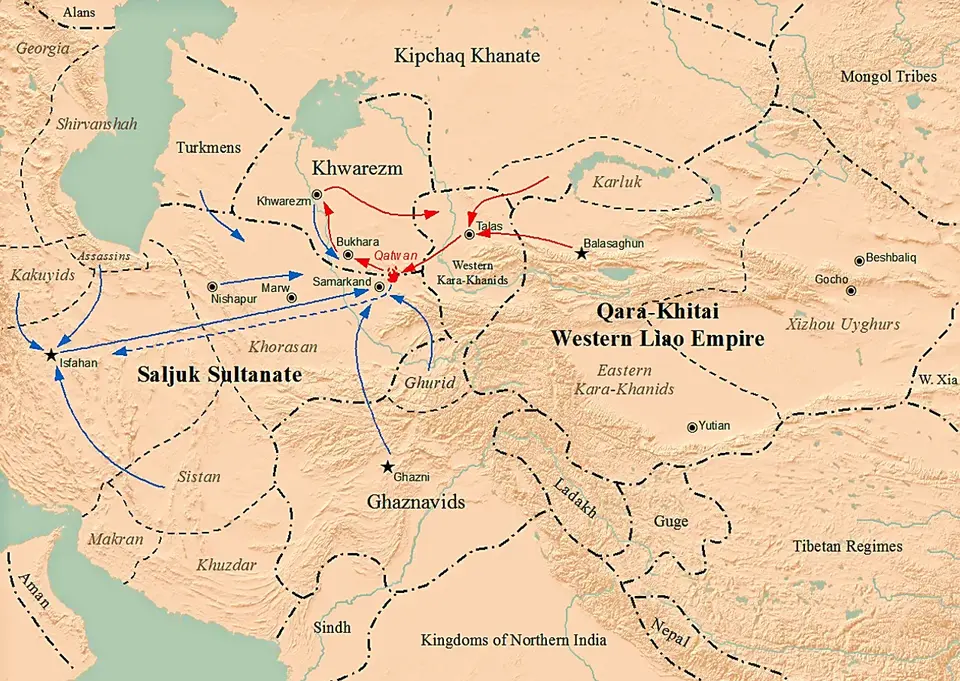
The Battle of Qatwan (卡特万之战, 1141 CE) was a monumental military encounter in medieval Central Asian and world history. Following the fall of the Liao Dynasty in northern China, imperial scion Yelü Dashi migrated westward to found the Western Liao Empire (Qara Khitai). After expanding into Transoxiana, Western Liao was drawn into conflict with the Seljuk Empire, the dominant power of Western Asia, over localized clashes between the Western Karakhanids and the nomadic Qarluqs. Seljuk Sultan Ahmad Sanjar mobilized over 100,000 Islamic allied troops across the Amu Darya to eradicate the Khitan presence. In September 1141, the opposing forces clashed upon the Qatwan Steppe north of Samarkand. Employing superior tactical coordination, feigned retreats, and decisive double flanking maneuvers across the Darghom gorge, Yelü Dashi shattered the Seljuk heavy cavalry formations, inflicting catastrophic casualties. Sultan Sanjar escaped with only a few riders, while his queen and imperial ministers were taken prisoner. This victory shattered Seljuk hegemony in the east, elevated Western Liao to undisputed mastery over Central Asia for nearly a century, and profoundly altered Eurasian geopolitical dynamics.
Amid the collapse of the Liao Dynasty, Yelü Dashi leads loyal cavalry to Kedun City to preserve the state and prepare westward expansion.
Yelü Dashi crosses the Tianshan ranges, assumes the imperial title Gür Khan at Emil, and founds the Western Liao Empire.
Western Liao captures Balasagun from Eastern Karakhanids, renaming it Husiorado and instituting Chinese bureaucratic governance.
Western Liao troops defeat Mahmud Khan at Khujand, extending Khitan imperial influence into Transoxiana.
Sanjar issues ultimatums to Yelü Dashi and marches over 100,000 allied soldiers across the Amu Darya into the Zeravshan basin.
Yelü Dashi executes a three-pronged envelopment, routing the Seljuk coalition and forcing Sanjar to flee in disguise.
Yelü Dashi enters Samarkand, guarantees civil and religious protections for Muslim subjects, and confirms Karakhanid vassal status.
Khwarazm Shah Atsiz capitulates to Western Liao suzerainty, completing the establishment of an enduring century of Khitan dominance.
During the Tianqing era of the Liao Dynasty, the Jurchen Jin Dynasty arose in northeastern Manchuria, dealing catastrophic defeats to the Liao imperial armies. In 1124 CE (the fourth year of Baoda), recognizing the impending collapse of the dynastic house, imperial scion and military commander Yelü Dashi led an elite vanguard of two hundred horsemen northwest to Kedun City in the Orkhon River basin, where he rallied garrison troops and rebuilt his military forces.
Yelü Dashi assumed the sovereign title of Gür Khan (Universal Ruler), establishing a grand strategy to march into Central Asia and reclaim ancient Han-Tang territories. Moving westward, Western Liao subdued the Kingdom of Qocho (Gaochang Uyghurs), crossed the Tianshan Mountains, and established an initial stronghold at Emil (modern Emin, Xinjiang).
Continuing their westward offensive, Khitan forces defeated the Eastern Karakhanid Khanate, captured its capital at Balasagun (near modern Tokmok, Kyrgyzstan), and renamed it Husiorado, formally proclaiming it their imperial capital under the reign era Kangguo. Yelü Dashi founded an imperial state that synthesized Khitan nomadic military traditions with Chinese central bureaucratic administrative structures.
The Great Seljuk Empire was a vast Turco-Persian Islamic empire founded in the 11th century, spanning at its peak from the borders of China across Central Asia and the Iranian plateau to the Mediterranean shores of Anatolia. By the early 12th century, Sultan Ahmad Sanjar governed the eastern realms from Khorasan, subduing the Western Karakhanids in Transoxiana and the Ghaznavid Dynasty in modern Afghanistan.
Reigning for over four decades without a major battlefield defeat, Sanjar was revered throughout the Islamic world as the "Last Great Seljuk Sultan." However, the sprawling empire harbored deep tribal and regional fractures beneath its imperial surface.
Transoxiana (the fertile lands between the Amu Darya and Syr Darya) was nominally ruled by the Western Karakhanid monarch Mahmud Khan as a Seljuk vassal. The pastoral Qarluq Turks living across the steppe frequently clashed with Karakhanid authorities over pasture lands, water rights, and tax extortions, generating explosive unrest.
In 1137 CE (the fourth year of Kangguo), Yelü Dashi led Western Liao armies into the Fergana Valley, inflicting a severe defeat on the Western Karakhanids at the Battle of Khujand. Mahmud Khan retreated to Samarkand, nominally accepting tributary submission to Western Liao while secretly plotting vengeance.
Shortly thereafter, Mahmud Khan launched punitive campaigns against the nomadic Qarluqs, who resisted vigorously. Hard-pressed, Mahmud Khan dispatched envoys across the Amu Darya pleading for direct military intervention from his sovereign, Sultan Sanjar. Concurrently, desperate Qarluq chieftains sent urgent appeals to Husiorado seeking imperial protection from Yelü Dashi.
Seeking to maintain regional commercial stability, Yelü Dashi sent an official dispatch to Sanjar urging diplomatic restraint and clemency for the Qarluqs. Conceiving Western Liao as pagan interlopers, the arrogant Sultan returned a haughty ultimatum boasting that his armies "could pierce the eyes of needles with arrows and split hairs with lances," demanding that Yelü Dashi immediately convert to Islam and surrender the Qarluq leaders or face total destruction. Yelü Dashi mobilized the imperial army, determined to dismantle Sanjar's arrogance on the battlefield.
Infuriated by Yelü Dashi's refusal to capitulate, Sultan Sanjar decreed general mobilization throughout the eastern Islamic domains in early 1141 CE. He assembled veteran cavalry contingents from Khorasan and requisitioned auxiliary armies from his vassals, including the Ghurids, Ghaznavids, Sistan, and Mazandaran.
According to chronicler Ibn al-Athir in The Complete History, the allied Seljuk host numbered over 100,000 men. The grand army included elite Seljuk ghulam armored cavalry, Khorasan horse archers, Afghan mountaineer infantry, and extensive camel logistical caravans.
In July 1141, Sanjar led this formidable force across the swollen Amu Darya via pontoon bridges, advancing into the Zeravshan Valley north of Samarkand. Confident in their numeric superiority and heavy armor, Seljuk commanders boasted that the infidel Khitans would be crushed beneath their horses.
Camping along the river valley for miles, Sanjar issued strict orders to advance beyond Transoxiana to capture the Khitan capital at Balasagun. The Seljuk forces operated under an assumption of effortless triumph, viewing the Khitans as isolated invaders cut off from logistical supplies.
Faced with a vastly larger enemy, Yelü Dashi remained composed. Marshaling his core Khitan heavy and light cavalry alongside allied auxiliaries and Qarluq horsemen, an army numbering several tens of thousands, he converged on the Qatwan Steppe near the Darghom gorge north of Samarkand.
Ascending a vantage point to review his formations, Yelü Dashi delivered a stirring address to his commanders: "The enemy is numerous but lacks unified purpose, divided by disparate regional interests; our soldiers are united like solid iron. Their heavy cavalry charges with ferocity but suffers from sluggish mobility. If we draw them forward and strike their flanks, they will inevitably collapse."
Yelü Dashi devised an intricate three-pronged offensive: veteran commanders Xiao Wolila and Yelü Songshan led 2,500 elite cavalry on the right wing, using mountain shadows for concealment; Privy Vice-Commissioner Xiao Chalabu and Yelü Shuxue commanded 2,500 horsemen on the left wing to execute a deep turning movement cut the enemy's rear; Yelü Dashi himself commanded the main central vanguard to engage the Seljuks directly and draw them into the valley.
Furthermore, Yelü Dashi mandated that no warrior advance out of formation for personal glory, enforcing absolute coordination via beacon smoke and horns. Mounted on fresh remounts and armed with heavy recurve bows, the Khitan army maintained unmatched tactical agility.
On the morning of September 9, 1141 CE, horn calls pierced the dense morning fog across the Qatwan Steppe as the historic encounter began.
Sultan Sanjar directed operations from his central pavilion, placing his maternal uncle Qumaj in command of the left wing, the Emir of Sistan on the right, while dense lines of elite armored ghulam cavalry advanced steadily in the center.
Yelü Dashi personally led the Khitan forward echelon. Operating as horse archers, Khitan skirmishers unleashed dense volleys of armor-piercing arrows before executing a classic feigned withdrawal. Interpreting this retrograde movement as signs of rout, commander Qumaj ordered the Seljuk left wing into an aggressive headlong pursuit, entirely disconnecting his cavalry from the central infantry support lines.
The pursuing Seljuk heavy horsemen were lured into the treacherous marshes and ravines along the Darghom River. Horses floundered in muddy ground, compact tactical formations broke apart, and the advancing charge dissolved into chaotic confusion.
With the Seljuk vanguard ensnared in difficult terrain, Western Liao war drums sounded the signal for general counter-attack. The concealed right and left wings under Xiao Wolila and Xiao Chalabu burst forth from the surrounding ridges like lightning, slamming violently into the exposed flanks and rear of the Seljuk army.
Xiao Wolila's right wing severed Qumaj's isolated division from the main army, while the left wing cut off access to the Darghom river crossings. Khitan archers darkened the sky with heavy volleys before closing for close-quarters melee combat with sabers and lances.
The heterogenous Seljuk coalition disintegrated rapidly under multi-directional pressure. Terrified vassals fled in disorder, trampling their own infantry. Sensing the turning point, Yelü Dashi swung his central heavy cavalry around into a devastating frontal charge, driving the Seljuk host into an inescapable pocket.
Deprived of coherent command, massed thousands of Seljuk soldiers were pressed back toward the precipitous cliffs of the Darghom gorge. Men, horses, and baggage camels cascaded down the rocky depths, perishing in the torrents below.
Arab chroniclers recorded that between 30,000 and 100,000 Seljuk soldiers lay dead across thirty miles of bloodstained steppe, noting that "never in the annals of Islam had so catastrophic a calamity befallen Khorasan."
Sultan Sanjar, abandoning his royal regalia and cutting his beard to evade capture, fled across the rugged mountain trails toward Termez with only a handful of bodyguards. His royal consort, Queen Terken Khatun, along with the Seljuk grand vizier and leading theologians, were captured alive by Western Liao forces, alongside the entirety of the imperial camp treasury and baggage train.
Following his triumph, Yelü Dashi led his victorious troops into the ancient metropolis of Samarkand. Mahmud Khan and the city notables surrendered unconditionally. Displaying remarkable statesmanship, Yelü Dashi prohibited plundering, slaughter, or desecration.
Remaining ninety days in Samarkand, Yelü Dashi convened assemblies of Muslim qadis, scholars, and clan elders, issuing pacification proclamations guaranteeing personal safety, protecting private property, and confirming religious freedom for Islamic worship and Islamic jurisprudence. He abolished oppressive Karakhanid levies and instituted equitable taxation.
Subsequently, Western Liao detachments advanced down the lower Oxus, forcing Shah Atsiz of Khwarazm to submit as a tributary vassal, obligated to pay an annual tribute of 30,000 gold dinars. From the Syr Darya to the southern boundaries of Transoxiana, Western Liao established undisputed imperial supremacy across Central Asia.
The Battle of Qatwan dealt a fatal blow to the Great Seljuk Empire. The loss of tens of thousands of professional soldiers permanently dismantled Sanjar's aura of invincibility.
Soon after the defeat, nomadic Oghuz tribes revolted within Khorasan, eventually taking Sanjar captive in 1153 CE. With the eastern Seljuk apparatus shattered, regional vassals declared independence, paving the way for the territorial expansion of the Khwarazmian Empire and the Ghurid Dynasty.
Following the victory, Western Liao reigned as the supreme arbiters of Central Asia. From the Aral Sea to Lake Balkhash, local rulers governed under Khitan imperial oversight while paying annual tribute and receiving official imperial credentials (paiza).
Western Liao preserved local religious institutions while implementing Chinese administrative protocols, minting Chinese-inscribed bronze coins, and utilizing Chinese calendar systems. The widespread influence of Khitan rule firmly established the word "Khitai" (Cathay) across Central Asia, the Middle East, and Europe as the universal designation for China.
News of Qatwan traveled swiftly along Silk Road commercial arteries to the crusader states of the Levant and into Western Europe. Confronted by catastrophic reverses during the Second Crusade, Christian Europe received word that a mighty non-Muslim king from the distant Orient had utterly routed the Muslim princes of Persia.
Transmitted through Syrian and Armenian intermediaries, reports of Yelü Dashi's triumph became conflated with ecclesiastical lore, giving rise to the pervasive legend of "Prester John," a Christian priest-king destined to rescue the Holy Land. This enduring myth captivated European imaginations for centuries, fueling the Age of Discovery in search of this legendary eastern sovereign.