Capital Established at Kaifeng
Zhao Kuangyin founds the Northern Song at Kaifeng, leveraging canal logistics for urban expansion.
Northern Song Dynasty (北宋) · HISTORICAL EVENT
汴京城市化
The Urbanization of Bianjing (汴京城市化) was an epochal structural transition during the Northern Song dynasty (960–1127 CE) that revolutionized the spatial layout, commercial mechanisms, and civil social fabric of the imperial capital of Dongjing (Kaifeng). Following the establishment of the capital at Kaifeng, the state capitalized upon an intricate canal network comprising the Bian, Cai, Wuzhang, and Jinshui rivers to transport millions of bushels of…
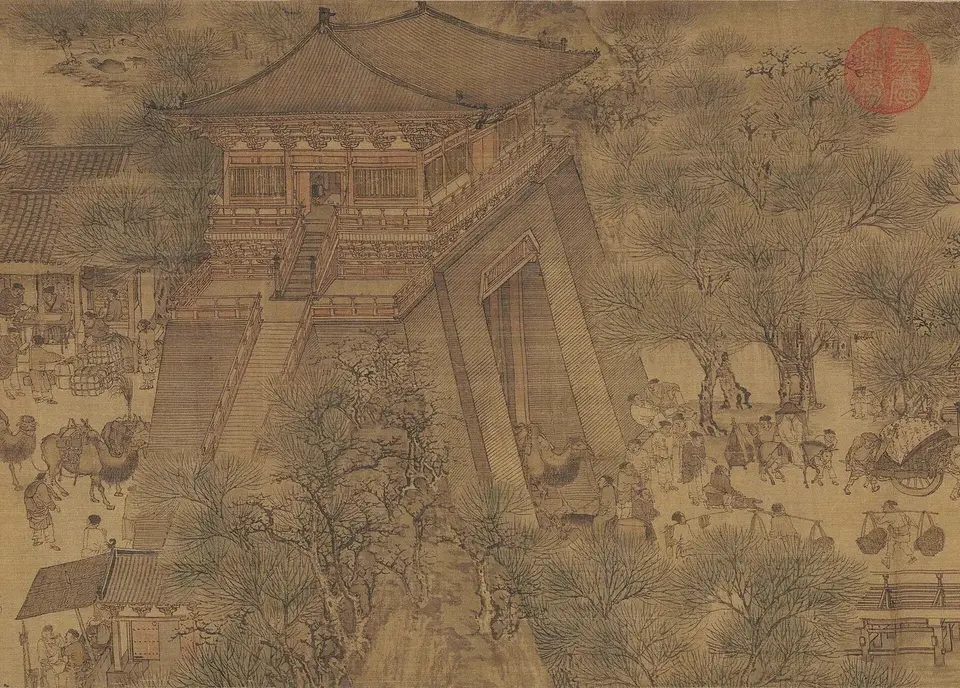
The Urbanization of Bianjing (汴京城市化) was an epochal structural transition during the Northern Song dynasty (960–1127 CE) that revolutionized the spatial layout, commercial mechanisms, and civil social fabric of the imperial capital of Dongjing (Kaifeng). Following the establishment of the capital at Kaifeng, the state capitalized upon an intricate canal network comprising the Bian, Cai, Wuzhang, and Jinshui rivers to transport millions of bushels of grain and vast textiles from the prosperous Yangtze basin. In response to commercial growth, the Northern Song court abolished the walled residential ward (fang) and market (shi) system and repealed nocturnal curfews that had endured for over a millennium since the Qin, Han, and Tang dynasties. Over 160 years, Bianjing developed an open street-grid framework where shops opened directly onto thoroughfares, stimulating vibrant early-morning markets and all-night bazaars. The metropolis swelled to over one million residents, fostering ubiquitous entertainment precincts (washe) with indoor theaters (goulan) hosting ballad singing, drama, storytelling, and shadow plays. To administer this dense urban space, the municipal government instituted a specialized municipal ward administration, fire-watch military garrisons (junxunpu), and state charity hospitals. Master painter Zhang Zeduan's Along the River During the Qingming Festival and Meng Yuanlao's The Eastern Capital: A Dream of Splendor recorded this commercial civilization, celebrating Bianjing as the most populous and commercially sophisticated metropolis in the medieval world.
Zhao Kuangyin founds the Northern Song at Kaifeng, leveraging canal logistics for urban expansion.
Emperor Taizu repeals the nighttime curfew, granting citizens the legal right to engage in nocturnal trade.
The court dredges the Bian and Wuzhang rivers and completes the outer city wall, establishing a three-tier urban defense layout.
Emperor Renzong legalizes street-facing storefronts and dismantles ward walls, instituting street-encroachment taxation.
The municipal fire-watch post network is standardized, alongside the rollout of public charity dispensaries.
Urban population surpasses one million; Zhang Zeduan paints his famous scroll and Meng Yuanlao documents urban splendor.
Jurchen Jin armies sack Kaifeng, devastating the urban infrastructure and shifting political gravity south.
Following the Sui excavation of the Grand Canal, Kaifeng served as the central junction linking the Central Plains with southern agrarian wealth. During the Five Dynasties period, several successor regimes established their capitals at Kaifeng due to these waterborne logistics. Upon founding the Northern Song, the central civil administration and imperial standing armies gathered in the capital, relying annually on the Bian River to ship over six million bushels of grain alongside silk, porcelain, and tea. This waterborne access made Kaifeng the convergence point of global merchandise and itinerant merchants, providing immense physical capital for unprecedented urban expansion.
Imperial capitals of the Sui and Tang, such as Chang'an and Luoyang, enforced rigid segregation between residential wards and commercial markets. Inhabitants lived in walled compounds with gates barred at dusk under strict curfews, while commerce was confined to regulated Eastern and Western markets that shuttered at nightfall. As Northern Song private enterprise and consumer demands surged, the narrow confines of official markets proved utterly incapable of handling expanding volume. Citizens began tearing down ward walls and building storefronts directly into the streets, rendering traditional curfew governance obsolete.
During the early decades of the Northern Song, Kaifeng magistrates repeatedly prosecuted merchants who encroached upon royal streets. However, the commercial impulse proved irreversible. Under Emperors Zhenzong and Renzong, the imperial court accepted reality, officially abolishing the interior ward gates, demolishing residential walls, and establishing an open street system where storefronts faced public roads.
Commerce spilled out along major avenues such as Imperial Boulevard, Panlou Street, and Maxing Street. Apothecaries, butcheries, goldsmiths, teahouses, and cloth merchants lined every street corner. The government replaced bans with an "encroachment rental tax" based on storefront width, conferring full legal legitimacy upon street-facing commercial enterprise. Chinese cities abandoned medieval castle compartmentalization, stepping into an open, modern commercial landscape.
Spatial emancipation was accompanied by temporal liberation. In 965 CE, Emperor Taizu formally promulgated an imperial decree abolishing ancient nocturnal curfews in the capital, legalizing trade throughout the night.
This legislation gave birth to an unceasing night economy. Bianjing developed day-and-night cycles of trade without interruption. At the fifth night watch before dawn, morning markets opened to serve steaming buns, soups, and fresh fruit; at dusk, major night markets along Maxing Street and Panlou Street bustled with dazzling lanterns, serving regional delicacies until the third watch; and after the fourth watch, "ghost markets" conducted trade in antiques and curiosities. Even amid winter snowstorms and pouring rain, markets operated through the night, transforming Bianjing into a true "city that never sleeps."
Urban growth generated a massive civil class. The permanent residents, imperial guards, visiting merchants, and specialized artisans swelled past 1.2 million, creating an active civil population dependent upon market commerce. These citizens generated an immense demand for popular, secular entertainment.
To satisfy this market, commercial operators constructed more than fifty entertainment compounds (washe) across the inner and outer city. Inside each washe were enclosed theater stalls (goulan), the largest of which seated several thousand spectators. Goulan stages presented musical suites (zhugongdiao), variety plays (zaju), historical lectures, shadow puppetry, acrobatic tumbling, and female wrestling throughout the year. This commercial environment democratized literature and theater, transforming classical poetry into vernacular song lyrics (ci) and incubating mature urban drama.
Confronting the challenges of a million-strong metropolis, the Northern Song state engineered advanced municipal institutions. Administratively, the Kaifeng government abolished rural village systems, organizing the city into eight inner-city and four suburban municipal wards, appointing dedicated magistrates to supervise civil order, household registration, taxation, and street cleaning.
In public safety and firefighting, because Kaifeng featured timber architecture and night market lanterns, the court stationed fire-watch police posts (junxunpu) every three hundred paces, augmented by watchtowers manned around the clock. Watchmen were equipped with leather water buckets, ladders, fire hooks, and hemp ropes, ready to mobilize immediately at the first sight of smoke. This created the earliest permanent professional municipal firefighting network in world history. Concurrently, the state operated compassionate homes (juyangyuan) for the elderly and orphaned, medical dispensaries (anjifang) for the impoverished sick, and public cemetery plots (louzeyuan) for destitute burials, erecting a comprehensive urban social safety net.
The urbanization of Bianjing fundamentally transformed urban history. It liberated Chinese cities from their classical orientation as inward-facing military citadels, evolving into dynamic metropolises centered around commercial exchange, civic consumption, and municipal services. This open street architecture and commercial density directly informed the design of the Southern Song capital Lin'an (modern Hangzhou) and served as the administrative template for Ming and Qing commercial metropolises, including Beijing, Nanjing, Suzhou, and Yangzhou.
The concentration of over one million citizens nurtured an assertive urban mercantile class with independent aesthetic sensibilities. The rise of this civil society challenged aristocratic monopolies over high culture, propelling vernacular literature, popular drama, professional storytelling, and lyric poetry into the mainstream of Chinese intellectual life. This secular, humanistic momentum injected vibrant vitality into Chinese literature and society, marking the dawn of Chinese early modernity centuries ahead of the Western Renaissance.
In his preface to The Eastern Capital: A Dream of Splendor, Northern Song refugee Meng Yuanlao recalled the lost metropolis with profound emotion: "In former days I entered the capital, arriving during an era of peace and universal tribute. Rare curiosities from the four seas filled the markets, and exquisite delicacies from across the realm stocked the kitchens. Peace endured, populations multiplied, spring outings filled the flower-lined avenues, and music echoed through the night. Truly, it was the supreme spectacle of an age of great peace."
Renowned modern economic historian Li Bozhong evaluated in Studies in Chinese Urban History: "The urbanization of Northern Song Bianjing was a genuine revolution in the development of Chinese urban civilization. The collapse of the ward system, the repeal of curfews, the emergence of a merchant class, and sophisticated municipal specialization allowed Bianjing to reveal the dawn of early modern urban civilization long before the castle towns of medieval Europe."