Lü Zuqian's Invitation
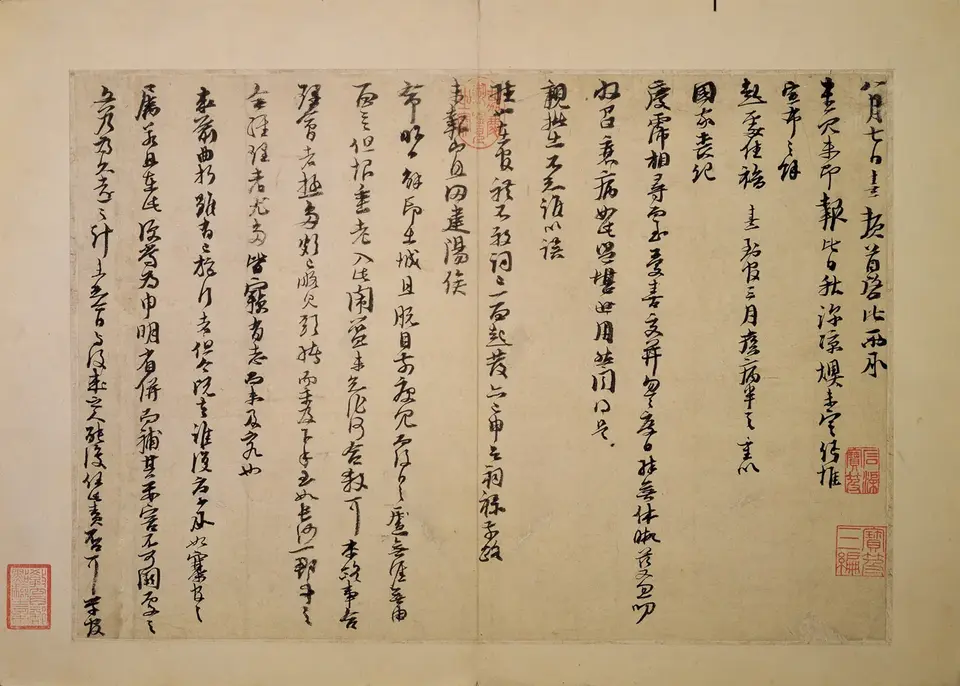
Lü Zuqian writes to Zhu Xi and the Lu brothers, arranging a theological summit at Xinzhou.
Southern Song Dynasty (南宋) · HISTORICAL EVENT
鹅湖之会
The Meeting at Goose Lake (鹅湖之会) occurred in the sixth lunar month of 1175 AD (the second year of the Chunxi era) at Goose Lake Temple in Qianshan, representing an illustrious academic convention organized by scholar Lü Zuqian to reconcile philosophical divergences between Zhu Xi's School of Principle and Lu Jiuyuan's School of Mind. In the mid-Southern Song, Zhu Xi championed the investigation of things and the pursuit of knowledge through extensive…
The Meeting at Goose Lake (鹅湖之会) occurred in the sixth lunar month of 1175 AD (the second year of the Chunxi era) at Goose Lake Temple in Qianshan, representing an illustrious academic convention organized by scholar Lü Zuqian to reconcile philosophical divergences between Zhu Xi's School of Principle and Lu Jiuyuan's School of Mind. In the mid-Southern Song, Zhu Xi championed the investigation of things and the pursuit of knowledge through extensive textual commentary to comprehend heavenly principle, while the Lu brothers advocated honoring moral nature by illuminating one's innate mind. Seeking to unify Confucian learning, Lü Zuqian invited both factions to Goose Lake Temple. During the debate, Lu Jiuyuan presented poetry criticizing Zhu's empirical study as fragmented, praising his own inward intuition as profound and concise; Zhu Xi retorted that Lu's neglect of classic texts was akin to wild Chan Buddhist mysticism. Although three days of debate yielded no formal compromise, it inaugurated an era of open, egalitarian academic discourse, establishing the enduring intellectual polarity between Zhu and Lu that profoundly shaped Chinese intellectual history through Wang Yangming.
Lü Zuqian writes to Zhu Xi and the Lu brothers, arranging a theological summit at Xinzhou.
Scholars gather at Goose Lake Temple to formally establish the debate framework.
Lu Jiuling and Lu Jiuyuan present verses branding Zhu Xi's classical methodology as fragmented.
Zhu Xi rebukes Lu's intuitionist approach as unsubstantiated Buddhist Chan mysticism.
Lü Zuqian fails to achieve theoretical synthesis, concluding the debate with two distinct schools established.
During the Qiandao and Chunxi eras of the Southern Song, Neo-Confucian metaphysics reached unprecedented conceptual sophistication. Building upon foundational cosmological theories formulated by northern thinkers such as the Cheng brothers and Zhang Zai, southern scholars organized distinct intellectual lineages that interpreted the classical canon through contrasting epistemological approaches.
The Min School, led by Zhu Xi, maintained that cosmic principle precedes concrete matter and that human nature is identical with cosmic principle. Zhu Xi posited that individuals must acquire moral virtue by investigating the principle inherent in all things, embarking upon disciplined, cumulative classical reading. He defined this curriculum through the phrase following the path of inquiry and study from the Doctrine of the Mean, emphasizing philological rigor and gradual enlightenment.
In direct opposition arose the School of Mind formulated by the brothers Lu Jiuling and Lu Jiuyuan of Jinxi in Jiangxi. The Lu brothers advanced the celebrated propositions that the universe is identical with one's mind, and that mind is principle. They argued that every individual intrinsically possesses flawless innate moral knowledge, rendering pedantic textual annotations and bookish learning superfluous. Instead, they urged disciples to honor moral nature through immediate introspection and the illumination of the original mind.
Lü Zuqian, head of the pragmatic Jinhua School in eastern Zhejiang, maintained close personal friendships with both Zhu Xi and the Lu brothers. Alarmed by escalating sectarian factionalism among their students that threatened to fracture the Confucian communion, Lü conceived the visionary project of convening both intellectual titans for a direct, face-to-face symposium to bridge their differences. In the sixth lunar month of 1175, at Lü's urging, Zhu Xi and the Lu brothers gathered at Goose Lake Temple.
In early summer of 1175, Zhu Xi, Lü Zuqian, Lu Jiuling, Lu Jiuyuan, and scholars like Liu Qingzhi assembled at Goose Lake Temple, accompanied by cohorts of disciples. To open the colloquium, Lü Zuqian formulated the primary question: whether the cultivation of sagehood should prioritize honoring moral nature or following inquiry and study.
To elucidate their pedagogical approach, the elder brother Lu Jiuling composed an introductory poem, asserting that an infant knows love and respect by nature, and that undue emphasis on external ritual traces simply creates artificial habits. Reading his brother's verse, Lu Jiuyuan felt its tone lacked decisive philosophical force. He stepped forward and composed a responsive stanza that astonished the assembly, proclaiming that the human mind remains indestructible through eternity, that Zhu's gradual method of accumulating streams of textual learning was a fragmented enterprise destined to sink in futility, while his own intuitive method was concise, durable, and grand.
Lu Jiuyuan's poem directly castigated Zhu Xi's lifelong dedication to classical commentary as fragmented, asserting that students drowned in minutiae rather than attaining spiritual liberation. During subsequent verbal debates, Lu posed his famous rhetorical challenge to Zhu: what books did Emperors Yao and Shun read prior to the invention of written classics? Lu emphasized that ancient sage-kings governed and attained supreme virtue purely through innate conscience, questioning why modern scholars needed to bury themselves in paper commentaries.
Listening to this frontal assault, Zhu Xi's expression darkened with profound displeasure. Zhu vigorously counter-argued that all things under heaven possess inherent principles, requiring students to investigate one object today and another tomorrow until comprehensive illumination is achieved. Zhu insisted that discarding the Six Classics and ancestral commentaries to rely purely on subjective inner contemplation mirrored the Chan Buddhist practice of sudden enlightenment, dismissing Lu's doctrine as arrogant, groundless wild meditation. Zhu cautioned that while Lu's method seemed seductive and simple, its lack of textual moorings would foster intellectual superficiality and moral anarchy.
Over the next three days, the disputants engaged in exhaustive philosophical exchanges regarding the relationship between mind and principle, the primacy of knowledge versus action, and methods of self-cultivation. Disciples from both academies joined the debate with great passion. Lu Jiuyuan argued with magnetic eloquence, asserting that no principle existed outside the human heart; Zhu Xi responded with meticulous textual citations, insisting that intellectual inquiry must precede moral practice.
Throughout the proceedings, moderator Lü Zuqian attempted to formulate a synthetic middle ground, suggesting that one should honor moral nature through inquiry and study. However, both Zhu and Lu were supreme intellectual masters utterly convinced of their foundational truths, and neither yielded an inch of theoretical ground. When the symposium concluded, both masters retained their opposing convictions. While they departed with deep mutual respect for each other's erudition, they left Goose Lake Temple with their philosophical divergence unbridged.
Although the Meeting at Goose Lake failed to synthesize the two philosophical traditions, it permanently codified the twin pillars of Southern Song Confucian metaphysics: following the path of inquiry and study versus honoring moral nature. Thereafter, the School of Principle and the School of Mind stood as twin summits of Chinese intellectual life, engaging in centuries of theoretical polemics that profoundly enriched Confucian epistemology and moral psychology.
The Goose Lake assembly established an enduring institutional model for public, egalitarian academic disputation across private academies such as White Deer Grotto and Yuelu Academy. Most significantly, the philosophical spark ignited by Lu Jiuyuan at Goose Lake was systematically inherited, refined, and institutionalized three centuries later by Wang Yangming in the Ming dynasty, culminating in the nationwide dominance of the Yangming School of Mind.