Creation and Early Transmission of Romance of the Three Kingdoms (《三国演义》成书与早期传播)
《三国演义》成书与早期传播
The Creation and Early Transmission of Romance of the Three Kingdoms (《三国演义》成书与早期传播) refers to the pivotal historical and cultural process during the late Yuan and Ming dynasties in which novelist Luo Guanzhong compiled China's first full-length chapter-structured historical romance, Sanguozhi Tongsu Yanyi, on the foundation of Chen Shou's Records of the Three Kingdoms, Pei Songzhi's annotations, and Song-Yuan oral storytelling prompt-books, followed…
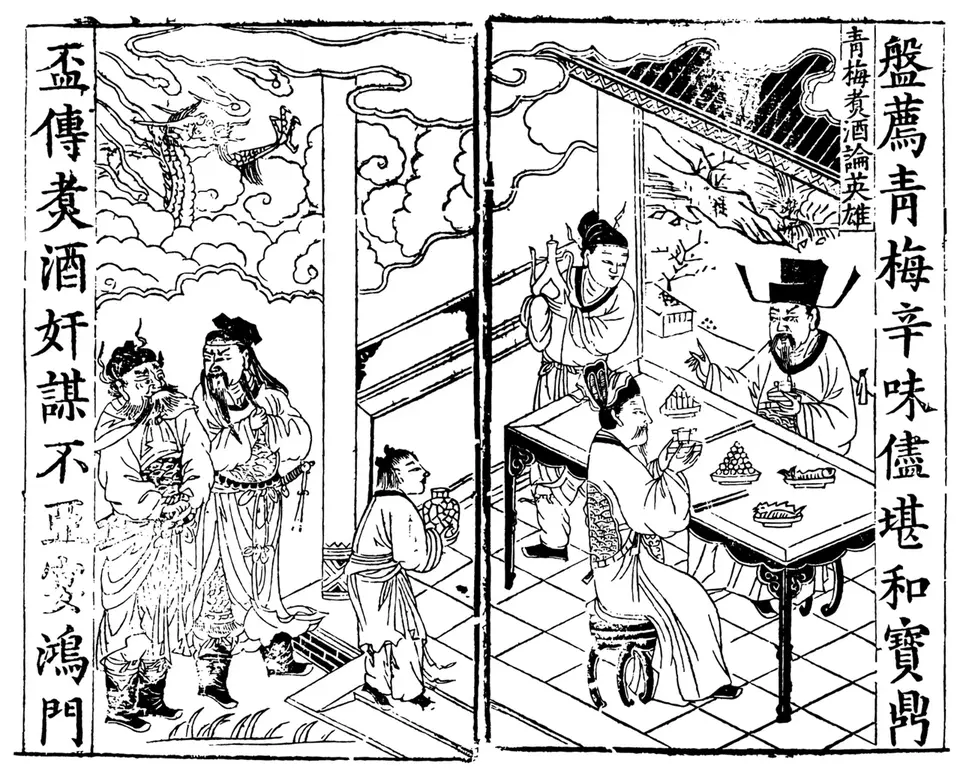
Historical document / edition related to The Romance of the Three KingdomsImage creditsAnonymousUnknown author · Public domainImage source
OVERVIEW
The Creation and Early Transmission of Romance of the Three Kingdoms (《三国演义》成书与早期传播) refers to the pivotal historical and cultural process during the late Yuan and Ming dynasties in which novelist Luo Guanzhong compiled China's first full-length chapter-structured historical romance, Sanguozhi Tongsu Yanyi, on the foundation of Chen Shou's Records of the Three Kingdoms, Pei Songzhi's annotations, and Song-Yuan oral storytelling prompt-books, followed by its widespread woodblock printing and commercial dissemination in mid-Ming China. The monumental narrative was largely completed in manuscript form during the Hongwu reign of the early Ming dynasty, initially circulating within select literati circles across the Jiangnan region.
Amid the flourishing commercial economy and booming woodblock printing industry of the mid-Ming dynasty, publisher Zhang Shangde in 1522 (Jiajing 1st year) issued the complete work based on old circulating manuscripts, prefaced by the 1494 essay of Jiang Daqi (styled Yongyuzi) and an introductory note by Xiuranzi. Historically designated as the Jiajing edition, the book comprised twenty-four volumes and two hundred forty sections. Subsequent commercial reprints and annotated editions produced by printing houses in Jianyang and Jinling brought the saga from private scholar studios into the public sphere, creating the archetypal model for imperial Chinese historical fiction and exerting an enduring influence on vernacular literature throughout the East Asian Sinosphere.
EVENT TIMELINE
Initial Composition
Taking refuge in Jiangnan during the dynastic transition, Luo Guanzhong began compiling the monumental Sanguozhi Tongsu Yanyi, drawing upon Chen Shou's Records of the Three Kingdoms, Pei Songzhi's commentary, and folk oral storytelling.
Manuscript Completion
Luo Guanzhong completed the full twenty-four-volume, two hundred forty-section epic manuscript, titled Sanguozhi Tongsu Yanyi, which circulated in hand-copied form among Jiangnan scholars.
Preface by Yongyuzi
Scholar Jiang Daqi (styled Yongyuzi) acquired the hand-copied manuscript and authored a celebrated preface praising its balance of historical truth and literary appeal, setting the intellectual tone for its future publication.
Printing of the Jiajing Edition
Publisher Zhang Shangde supervised the first woodblock printing of the twenty-four-volume Sanguozhi Tongsu Yanyi, featuring an introduction by Xiuranzi, producing the earliest extant printed edition of the novel.
Jianyang Commercial Edition
Publisher Ye Fengchun in Jianyang, Fujian, published the twenty-volume illustrated edition Xinkan Tongsu Yanyi Sanguozhi Shichuan, pioneering the popular format of illustrations above and narrative below.
Wanjuanlou Edition
Zhou Yuejiao of Jinling published the large-character phonetic and annotated edition Xinkan Jiaozheng Guben Dazi Yinshi Sanguozhi Tongsu Yanyi, enhancing textual accessibility and fine woodcut illustrations for a broad readership.
Relationship graph
FULL ACCOUNT
Background
Origins in Folk Storytelling and Dramatic Performance
Historical tales of the Three Kingdoms era had been developing among Chinese commoners for centuries. By the mid-to-late Tang dynasty, street entertainers in Chang'an and Luoyang were already recounting anecdotes of the Three Kingdoms; poet Li Shangyin famously captured this early oral tradition in his verse noting how audiences ridiculed Zhang Fei's beard or mocked Deng Ai's stutter. During the Song dynasty, the expansion of urban commerce and the rise of a prosperous merchant and artisan class led to the institutionalization of storytelling booths in urban entertainment quarters known as washe goulan. Specialized storytellers dedicated to "Three Kingdoms storytelling" (shuo sanfen), such as the renowned performer Huo Sijiu recorded in Meng Yuanlao's The Eastern Capital: A Dream of Splendor (Dongjing Meng Hua Lu), captivated massive urban audiences with their dramatic and suspenseful recitations.
During the Jin and Yuan dynasties, Three Kingdoms theatrical plays proliferated, with dozens of titles created by master dramatists such as Guan Hanqing and Bai Pu. In the Zhizhi reign of the Yuan dynasty, the Yu family publishing house of Jian'an printed the Fully Illustrated Plain Tales of the Records of the Three Kingdoms (Quanxiang Sanguozhi Pinghua). Although this work prefigured the structural outline of full-length historical fiction, its prose was crude and interspersed with street vulgarisms, while its storylines frequently deviated into historical absurdities and folklore fantasies. It failed to satisfy the refined aesthetic tastes and demand for serious historical gravitas felt by educated gentry and discerning urban readers alike.
Official Historiography and Song Neo-Confucian Thought
During the Song and Yuan periods, the rise of Neo-Confucianism, exemplified by Zhu Xi's Outlines and Details of the Comprehensive Mirror for Aid in Government (Zizhi Tongjian Gangmu), fundamentally reshaped Chinese historical consciousness and moral philosophy by asserting the orthodox legitimacy of the Shu Han state over Cao Wei. Chen Shou's original third-century Records of the Three Kingdoms (Sanguo Zhi) had treated Cao Wei as the legitimate successor to the Han dynasty, while Pei Songzhi's fifth-century commentary extensively gathered lost histories, regional records, and unofficial anecdotes from the Eastern Han and Six Dynasties, vastly enriching the factual and narrative texture of the era. Under Mongol Yuan rule, Chinese intellectuals subjected to alien ethnic domination frequently channeled their nostalgia for past dynasties and Confucian values of loyalty and righteousness into the heroic, tragic struggles of Liu Bei and Zhuge Liang to restore the fallen Han house.
Consequently, during the chaotic interregnum of the late Yuan dynasty when rival warlords contested the realm, literati scholars felt an urgent imperative to consult authoritative official histories—chiefly Chen Shou's Records of the Three Kingdoms, Pei Songzhi's extensive commentary, and Sima Guang's Comprehensive Mirror for Aid in Government (Zizhi Tongjian)—to purge crude folkloric fabrications. They sought to produce a monumental literary narrative that would remain firmly anchored in historical veracity while expounding orthodox Confucian moral principles and dynastic legitimacy.
Commercial Printing Boom and Demand for Vernacular Literature
Entering the mid-Ming dynasty, particularly across the Chenghua, Hongzhi, and Jiajing reigns, the Jiangnan region experienced unprecedented commercial growth, marked by booming market towns and the vibrant cultural life of townspeople. The woodblock printing industry underwent a profound structural transformation, expanding beyond state-sponsored imperial organs and private family academies into commercial, market-oriented publishing houses.
In major printing centers such as Jiangnan and Jianyang in Fujian, an abundance of skilled block-carvers, high-grade paper, and ink supplies enabled commercial publishers to recognize the enormous commercial potential of vernacular historical novels. High-quality manuscripts that had circulated exclusively among literati networks for decades now found the material conditions and entrepreneurial capital necessary for conversion into mass-produced printed editions, providing powerful momentum for the widespread circulation of vernacular fiction.
Course of the Event
Luo Guanzhong's Authorial Compilation
Luo Guanzhong (c. 1330–c. 1400), named Ben and styled Huhai Sanren, was an ancestral native of Taiyuan who resided for extended periods in Hangzhou and throughout the Jiangsu-Zhejiang region. In his early years, he lived through the violent uprisings and warlord rivalries of the late Yuan, gaining intimate knowledge of military strategy and political intrigue. Disillusioned with officialdom in his later years, he dedicated himself entirely to vernacular storytelling and dramatic composition. Luo Guanzhong adopted Chen Shou's Records of the Three Kingdoms as his narrative backbone, systematically incorporated the rich anecdotes from Pei Songzhi's commentary, and absorbed the chronological rigor of Sima Guang's Zizhi Tongjian and Zhu Xi's Zizhi Tongjian Gangmu, along with the dramatic staging techniques of Song and Yuan theater and prompt-books.
Commencing his intensive writing in the early Hongwu reign of the Ming dynasty, Luo spent years condensing nearly a century of turbulent history into a monumental, meticulously structured chapter-driven novel. He skillfully balanced historical documentation with literary dramatization, establishing the creative canon of "relying on authentic history while elaborating its subtle intricacies." His completed work comprised twenty-four volumes divided into two hundred forty individual narrative sections, titled Sanguozhi Tongsu Yanyi.
Manuscript Transmission in the Early Ming Dynasty
Immediately following its completion, the novel encountered the strict literary surveillance of the early Ming court. Elite scholars still regarded vernacular long-form fiction as a trivial vulgar art, preventing the manuscript from being carved into print immediately. Luo Guanzhong's original draft was preserved and transmitted primarily through hand-copied manuscripts (chaoben) among Jiangnan literati and bibliophiles, circulating within private literary salons and scholarly gatherings.
During the Chenghua and Hongzhi reigns, scholar Jiang Daqi obtained a complete hand-copied manuscript and was deeply impressed by its grand geopolitical strategies and balanced literary style that reconciled classical gravitas with popular accessibility. In 1494 (Hongzhi 7th year), Jiang composed an influential theoretical preface under the pseudonym Yongyuzi, systematically elaborating the moral and historiographical value of Sanguozhi Tongsu Yanyi as a historical mirror. This celebrated preface became the foundational critical text of the subsequent Jiajing printed edition.
Definitive Woodblock Printing of the 1522 Jiajing Edition
In the early winter of 1522 (Jiajing 1st year), publisher Zhang Shangde officially sponsored the first woodblock printing of the long-concealed twenty-four-volume manuscript, either through Beijing commercial publishers or Directorate of Ceremonial channels. The edition maintained the structural layout of twenty-four volumes and two hundred forty sections. Alongside Jiang Daqi's 1494 preface, the front of the book featured a newly composed introductory essay by the eminent scholar Xiuranzi, which explicitly commended Luo Guanzhong's historiographical skill in pruning trivia, filling documentary gaps, and rectifying dynastic legitimacy.
The 1522 Jiajing edition featured eleven lines per page, twenty-eight characters per line, with black-mouthed double fishtail margins, exemplifying a classical, austere Ming typography. Its text preserved the authentic, unadorned linguistic texture of the late Yuan and early Ming. The publication of the 1522 edition marked the decisive transformation of Romance of the Three Kingdoms from fragile, scattered hand-copied manuscripts into a permanent, standardized woodblock master text, serving as the common ancestor for all subsequent commercial reprints and commentary editions.
Late Ming Commercial Publishing and the Commentary Tradition
Following the appearance of the 1522 edition, Romance of the Three Kingdoms rapidly swept across China. In 1548 (Jiajing 27th year), Fujian publisher Ye Fengchun issued the earliest surviving illustrated reprint, Xinkan Tongsu Yanyi Sanguozhi Shichuan, in twenty volumes. Featuring an innovative layout with illustrations on the upper register and text below, this edition significantly lowered the reading threshold, propelling the novel deep into grassroots urban and rural society.
During the Wanli reign, Jinling printing houses such as Zhou Yuejiao's Wanjuanlou, the Fuchuntang, and the Shidetang, alongside Yu Xiangdou's Santaitang in Jianyang, competed fiercely to issue large-character annotated editions, revised editions, and fully illustrated volumes. From the late Wanli through the Tianqi era, the commentary edition attributed to Li Zhi (Li Zhuowu Xiansheng Piping Sanguozhi) gained immense popularity, inaugurating a golden age of novel commentary and literary criticism. This intellectual movement established Romance of the Three Kingdoms alongside Water Margin as supreme literary masterpieces hailed as "marvelous books" (qishu) by Ming intellectuals.
Key Figures
Author
Luo Guanzhong: Given name Ben, courtesy name Guanzhong, styled Huhai Sanren, an outstanding novelist and playwright of the late Yuan and early Ming. He synthesized official historical records from Chen Shou's Records of the Three Kingdoms with Song and Yuan oral storytelling traditions to pioneer the full-length chapter-structured historical romance, authoring Sanguozhi Tongsu Yanyi.
Scholars, Prefacers, and Publishers
Jiang Daqi: Styled Yongyuzi, a scholar of the Hongzhi era of the Ming dynasty. In 1494 (Hongzhi 7th year), he authored the foundational preface for the manuscript edition of the novel, systematically articulating its narrative method of expounding historical truth through vernacular elaboration and its didactic moral value.
Xiuranzi: A Ming dynasty scholar and author of the introductory essay for the 1522 Jiajing edition. He comprehensively analyzed Luo Guanzhong's historiographical principles in reconciling official dynastic records with popular oral accounts, praising his commitment to moral rectification and loyalty.
Zhang Shangde: A Ming dynasty publisher who in 1522 organized the inaugural woodblock printing of the long-concealed twenty-four-volume Sanguozhi Tongsu Yanyi, acting as the critical catalyst in the novel's transition into print culture.
Ye Fengchun: A prominent commercial publisher from Jianyang, Fujian, during the Jiajing reign. In 1548, he carved and printed the twenty-volume illustrated edition Sanguozhi Shichuan, greatly accelerating the widespread popularization of the novel across southeastern China.
Results and Impact
Establishment and Flourishing of the Chapter-Structured Historical Novel
The composition of Romance of the Three Kingdoms and the printing of the Jiajing edition formally established the definitive generic standards and structural conventions of the full-length chapter-structured historical romance (zhanghui xiaoshuo) in imperial Chinese literature. Through its grand panoramic depictions of military campaigns, intricate political statecraft, and vivid character dialogue, the novel dismantled the traditional barrier between elite classical tales and vulgar urban prompt-books. It served as the seminal archetype and direct creative model for subsequent historical romances, including Romance of the Sui and Tang (Sui Tang Yanyi), Investiture of the Gods (Fengshen Yanyi), and Chronicles of the Eastern Zhou Kingdoms (Dongzhou Lieguo Zhi).
Codification of Loyalty Ethics and Cultural Archetypes
The extensive circulation of Romance of the Three Kingdoms across the Ming dynasty deeply transformed Chinese popular ethics, civic values, and historical consciousness. The novel's vivid characterizations—Zhuge Liang as the paragon of selfless loyalty and sagacious statecraft who served his lord unto death, Guan Yu as the supreme embodiment of martial valor and steadfast righteousness who traversed a thousand li alone, and Liu Bei as the benevolent Confucian sovereign who cherished the common people and honored worthy scholars—crystallized into enduring cultural archetypes of the Chinese nation. This widespread cultural embrace directly catalyzed the empire-wide elevation of Guan Yu worship to its peak during the Ming and Qing dynasties.
Transnational Dissemination Across the East Asian Sinosphere
Shortly after its woodblock publication, Romance of the Three Kingdoms crossed national borders to reach neighboring East Asian nations, including the Korean Peninsula, Japan, and Vietnam. Envoys of the Joseon dynasty brought the Jiajing edition back to Hanyang, where it became essential reading for royal courtiers, aristocrats, and Confucian literati. In Edo-period Japan, Buddhist monks of Tenryu-ji such as Gitetsu translated Ming printed editions into Japanese as Tsūzoku Sangokushi, winning immense acclaim among samurai elites and urban townspeople alike. Its military and political strategies were even adopted by warring daimyo as tactical guides, representing a glorious chapter in the history of East Asian cultural exchange.
Historical Assessment
Ming Dynasty Assessments
Ming scholar Jiang Daqi evaluated the novel in his Preface to Sanguozhi Tongsu Yanyi: "Works such as Sanguozhi Tongsu Yanyi carry on the legacy and moral intent of Sima Qian. Its diction is neither overly arcane nor unduly vulgar, harmonizing faithfully with historical substance and aligning with moral instruction. Opening the volume is like gazing into a bright mirror, wherein true virtues and vices cannot escape notice."
Ming scholar Xiuranzi commended in his Introduction to Sanguozhi Tongsu Yanyi: "Master Luo Guanzhong relied upon standard histories, gathered vernacular accounts, corroborated them with Zhou and Qin philosophers, and abridged them according to Sima Guang's Comprehensive Mirror. Pruning away trivialities and supplying what was missing, he composed this enduring work."
Ming philosopher Li Zhi recorded in his commentary Li Zhuowu's Criticism of the Three Kingdoms: "The sublime artistry of literature reaches its ultimate perfection in Romance of the Three Kingdoms. The events unfold with intricate twists and turns, and human temperaments are portrayed with consummate realism. None but those whose minds encompass heaven and earth could have composed it."
Qing Dynasty Assessments
Qing historian Zhang Xuecheng noted in his Bingchen Notes (Bingchen Zhaji): "Only Romance of the Three Kingdoms consists of seven parts historical fact and three parts fiction, to the extent that readers are frequently led into confusion by it."
The Qing imperial editorial commission observed in the Annotated Catalog of the Complete Library of the Four Treasuries (Siku Quanshu Zongmu Tiyao): "Luo Guanzhong of the Ming compiled Sanguozhi Tongsu Yanyi with lucid diction that appeals to both refined scholars and common readers. Although it occasionally falls into historical anachronism and forced dramatization, its grand narrative exposition and vigorous brushwork truly inaugurated the modern tradition of vernacular fiction."
Qing literary critic Mao Zonggang concluded in his Preface to the First of the Four Masterworks: "Surveying books ancient and modern, those that achieved lasting fame are numerous; yet seeking one whose supreme strategic wisdom, dazzling literary brilliance, vital relevance to moral teachings, and instructive maxims rival Romance of the Three Kingdoms, none has ever been seen."
Related Entries
Luo Guanzhong
Records of the Three Kingdoms
Chen Shou
Pei Songzhi
Sanguozhi Pinghua
Jiang Daqi
Mao Zonggang
Chapter-Structured Vernacular Novel
Bibliography
Records of the Three Kingdoms (Sanguo Zhi /, by Chen Shou, annotated by Pei Songzhi)
Popular Romance of the Records of the Three Kingdoms (Sanguozhi Tongsu Yanyi /, 1522 Jiajing woodblock edition, preface by Jiang Daqi)
General Principles of Literature and History (Wenshi Tongyi /, by Zhang Xuecheng)
History of Ming: Treatise on Literature (Ming Shi: Yiwen Zhi /, compiled by Zhang Tingyu et al.)