Courier Revolt
Shaanxi suffers catastrophic famine; courier Li Zicheng loses his livelihood, slays debt collectors, and joins the rebellion.
Ming Dynasty (明朝) · HISTORICAL EVENT
李自成起义
The Li Zicheng Rebellion (李自成起义) was the most expansive and consequential peasant war in late imperial Chinese history, spanning 1629 CE to 1645 CE. In the late 1620s, northern Shaanxi suffered catastrophic climatic droughts and nationwide tax surcharges known as the "Three Levies," reducing millions of peasants to starvation. Li Zicheng, an unemployed government courier from Mizhi County, killed his abusive creditors and corrupt magistrates, taking up…
The Li Zicheng Rebellion (李自成起义) was the most expansive and consequential peasant war in late imperial Chinese history, spanning 1629 CE to 1645 CE. In the late 1620s, northern Shaanxi suffered catastrophic climatic droughts and nationwide tax surcharges known as the "Three Levies," reducing millions of peasants to starvation. Li Zicheng, an unemployed government courier from Mizhi County, killed his abusive creditors and corrupt magistrates, taking up arms in 1629 CE. Serving initially as the "Dashing General" under Gao Yingxiang, Li Zicheng weathered devastating defeats, including the near-total destruction of his army at the Battle of Nanyuan in Tongguan, surviving by hiding in the rugged Shangluo Mountains with only eighteen cavalrymen. In 1640 CE, amid catastrophic famine across the Central Plains, Li Zicheng surged out of Shangluo into Henan, adopting the transformative political slogans "Equalize Land and Abolish Taxes" and "Welcome the Dashing King and Pay No Grain." Hundreds of thousands of desperate peasants rallied to his banner. The rebel army captured Luoyang, executed Prince of Fu Zhu Changxun, and annihilated the last elite Ming field armies under Sun Chuanting at the battles of Zhuxian Town and Jiaxian. On the New Year's Day of 1644 CE, Li Zicheng proclaimed the Dashun Dynasty in Xi'an, marching on Beijing and capturing the imperial capital on the nineteenth day of the third month, where Emperor Chongzhen committed suicide on Jingshan. However, Dashun forces suffered a crushing defeat at the Battle of Shanhai Pass against the allied forces of the Qing Dynasty and Wu Sangui. Forced to abandon Beijing, Li Zicheng retreated southward, dying in an ambush by local militia at Jiugong Mountain in 1645 CE, leaving an indelible imprint on the dynastic transition of China.
Shaanxi suffers catastrophic famine; courier Li Zicheng loses his livelihood, slays debt collectors, and joins the rebellion.
Rebel leaders convene in Henan; Li Zicheng proposes decentralized multi-front thrusts, followed by the sacking of Fengyang.
Sun Chuanting and Hong Chengchou ambush the rebels at Tongguan; Li Zicheng escapes with eighteen riders into the Shangluo Mountains.
Severe famine strikes Henan; Li Zicheng surges out of Shangluo, adopting the "Equalize Land and Abolish Taxes" doctrine to mobilize millions.
Rebel troops storm Luoyang, execute Prince of Fu Zhu Changxun, and distribute palace silver and grain stores to the populace.
At the Battle of Jiaxian, Li Zicheng destroys Sun Chuanting's army; Sun dies at Tongguan, eliminating the last Ming field army.
Li Zicheng proclaims the Dashun Dynasty in Xi'an, establishing administrative organs and initiating his grand eastern campaign.
Dashun forces capture Beijing; Emperor Chongzhen commits suicide on Jingshan, terminating the Ming Dynasty.
Qing Eight Banner cavalry and Wu Sangui route the Dashun army at the Shi River; Li Zicheng retreats from Beijing.
Li Zicheng is ambushed and killed by local militia at Jiugong Mountain in Hubei; Dashun remnants ally with Southern Ming forces.
During the reign of Emperor Chongzhen, China experienced the coldest and driest phase of the Little Ice Age. Northern Shaanxi suffered severe uninterrupted droughts; fields cracked into barren dust, crops withered entirely, and desperate peasants subsisted on tree bark, weeds, and white clay, culminating in widespread starvation and cannibalism. Concurrently, confronting military aggression from the Manchus in Liaodong alongside domestic insurgencies, Emperor Chongzhen repeatedly imposed emergency tax surcharges—the Liaodong Levy, Pacification Levy, and Training Levy.
These crushing financial burdens were shifted by provincial elites onto impoverished peasant households, driving millions of smallholders into insolvency. Born into a poor peasant lineage in Mizhi County, Shaanxi, Li Zicheng worked as an imperial courier at the Yinchuan postal relay station. In 1629 CE, the Chongzhen court carried out sweeping nationwide cuts to courier stations to conserve imperial silver, casting Li Zicheng into destitute unemployment. Burdened by usurious debts owed to local magistrate Ai Zhao, Li was arrested, shackled with heavy irons, and publicly flogged. Aided by friends, Li broke his chains, killed Ai Zhao and corrupt clerks, and fled into the hills to join the rebel bands of Wang Zuogua, beginning his revolutionary career.
During the early 1630s, rebel bands proliferated across northern Shaanxi under chieftains such as Wang Er, Wang Jiayin, Gao Yingxiang, and Zhang Xianzhong. Recognizing Li Zicheng's bravery and tactical acumen, Gao Yingxiang appointed him as his chief vanguard commander, bestowing upon him the title "Dashing General". Employing fluid mobile tactics to evade encirclement by imperial commander Hong Chengchou, the rebels marched across Shaanxi, Shanxi, Henan, and Huguang.
In the first month of 1635 CE, facing coordinated encirclement operations by five imperial provincial divisions, thirteen major rebel armies comprising seventy-two distinct regiments convened at the historic Xingyang Conference in Henan. When factional rivalries threatened to shatter the alliance, Li Zicheng took the podium to champion a unified operational blueprint: "Divide our forces along clear axes; let each command a single front." The council adopted his proposal, launching synchronized thrusts eastward that surprised and burned the Ming ancestral tombs and auxiliary capital at Fengyang, shaking the empire to its core.
Following the sacking of Fengyang, imperial authorities escalated anti-rebel operations. In the seventh month of 1636 CE, chief rebel leader Gao Yingxiang attempted an audacious march through the rugged Ziwu Gorge to seize Xi'an, but was ambushed by Shaanxi Governor Sun Chuanting at Heishuiyu. Gao was captured and subsequently executed by slow slicing in Beijing. Following his death, rebel regiments unanimously elected Li Zicheng as the new "Dashing King".
Between 1637 CE and 1638 CE, War Minister Yang Sichang coordinated a massive multi-provincial encirclement operation. In the winter of 1638 CE, Sun Chuanting and Hong Chengchou laid a lethal double ambush at Nanyuan in Tongguan. Trapped in narrow defiles under heavy cannon fire, the rebel army was virtually annihilated, and Li Zicheng's family was scattered in the chaos. Displaying iron resolve, Li Zicheng broke through enemy cordons with only eighteen loyal cavalrymen, including Liu Zongmin and Tian Jianxiu, retreating deep into the primeval forests of the Shangluo Mountains to farm, hunt, and bide his time for more than a year.
In 1640 CE, devastating droughts and locust plagues ravaged Henan and Shandong, triggering catastrophic famine. Discerning that imperial garrisons were deployed elsewhere, Li Zicheng led his surviving cavalry out of the Shangluo Mountains into the Central Plains. Opening local grain storehouses to feed millions of starving refugees, Li Zicheng was joined by thousands of commoners each day, swelling his ranks to hundreds of thousands within months.
During this dramatic revival, educated gentry defectors, including scholar Li Yan, failed examination candidate Niu Jinxing, and astrologer Song Xiance, joined the rebel headquarters. Li Zicheng embraced their administrative counsel, imposing rigid discipline that prohibited pillaging civilian homes and executing soldiers who harassed women. Crucially, the rebel leadership unveiled the revolutionary doctrine of "Equalize Land and Abolish Taxes," promising to exempt peasantry from all agricultural levies for several years.
The slogan spread like wildfire: "Eat your grain, wear your clothes, if you run short the Dashing King will provide; open your gates to welcome the Dashing King, and when he arrives you will pay no grain!" In the first month of 1641 CE, Li Zicheng stormed the strategic fortress of Luoyang, capturing the opulent Prince of Fu Zhu Changxun. Li Zicheng executed the prince, distributed his enormous grain reserves to the starving population, and handed out imperial silver, cementing the unyielding devotion of the populace.
The loss of Luoyang stunned Beijing. Between 1642 CE and 1643 CE, Li Zicheng laid three massive sieges to Kaifeng. At the Battle of Zhuxian Town, Li Zicheng utilized deep trenches and defensive works to cut enemy supply lines, routing one hundred and eighty thousand soldiers under senior Ming general Zuo Liangyu. In the autumn of 1642 CE, the Yellow River dikes burst, flooding Kaifeng and drowning tens of thousands.
In 1643 CE, Emperor Chongzhen released veteran general Sun Chuanting from prison, naming him supreme commander to lead a newly trained army of one hundred thousand troops from Shaanxi. Aware that his raw recruits lacked operational cohesion, Sun Chuanting favored holding the Tongguan passes, but Chongzhen bombarded him with urgent imperial edicts ordering an immediate offensive.
Sun Chuanting marched into Henan, clashing with Li Zicheng's main force at Jiaxian. Employing scorched-earth tactics and feigned retreats, Li Zicheng lured the imperial divisions into mud-choked terrain without food. Concentrated rebel cavalry charges shattered the imperial lines, killing over forty thousand Ming soldiers and seizing all artillery. Sun Chuanting retreated to Tongguan, where he fell in battle as rebel columns breached the mountain passes, obliterating the last operational field army of the Ming dynasty.
Having eliminated all organized resistance in the northwest, Li Zicheng occupied Xi'an in the tenth month of 1643 CE. On New Year's Day of 1644 CE, Li Zicheng formally proclaimed the founding of the Dashun Dynasty, adopting the reign title Yongchang, appointing cabinet ministers, and minting imperial currency.
In the second month of 1644 CE, Li Zicheng mobilized a grand army of hundreds of thousands across the Yellow River toward Beijing. Advancing through Shanxi, imperial commanders at Taiyuan, Datong, and Xuanfu surrendered without resistance. By mid-March, rebel columns captured the strategic Juyong Pass, arriving outside the northern walls of Beijing.
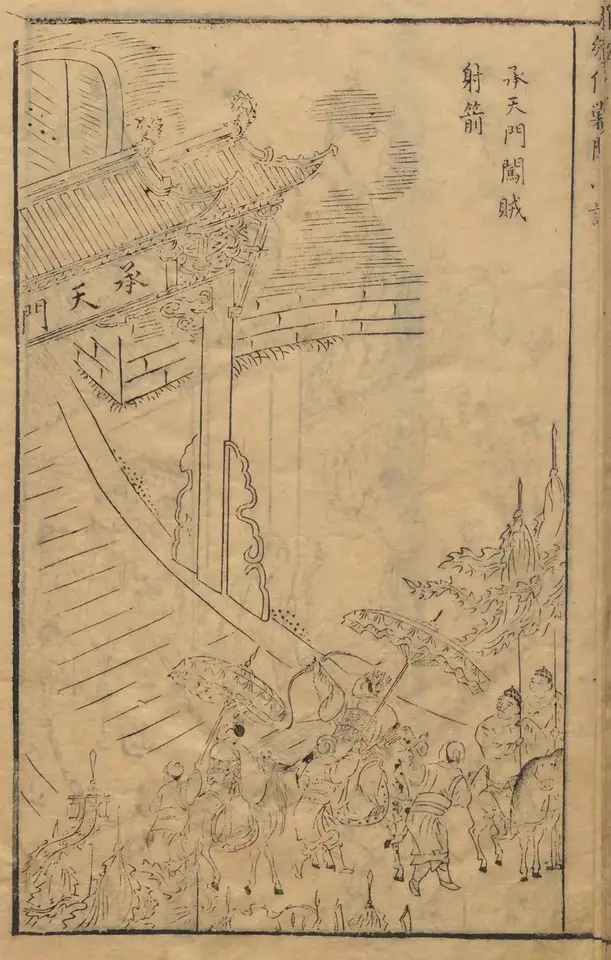
On the seventeenth day of the third month, Dashun siege artillery opened fire on the western ramparts. On the nineteenth day, eunuch Cao Huachun opened the gates, and rebel divisions flooded the inner city. Despairing of rescue, Emperor Chongzhen climbed Jingshan hill behind the Forbidden City and hanged himself from a pagoda tree, leaving an imperial blood-testament asking that his body be dismembered rather than harm the common folk. Li Zicheng rode through the Meridian Gate into the Forbidden City, bringing 276 years of Ming dynastic rule to an absolute close.
Upon capturing Beijing, the Dashun regime confronted severe governance breakdowns. Senior generals succumbed to overconfidence, and General Liu Zongmin conducted aggressive torture campaigns against captured Ming grandees to extort hidden wealth, alienating the scholar-gentry class. Frontier general Wu Sangui at Shanhai Pass initially weighed surrender, but upon hearing that his father had been detained and his favorite concubine Chen Yuanyuan seized, Wu broke with the rebels and aligned with Prince Regent Dorgon of the Qing Dynasty.
On the twenty-first day of the fourth month of 1644 CE, Li Zicheng led one hundred thousand troops to Shanhai Pass, confronting Wu Sangui at the Battle of Shanhai Pass along the Shi River. As Dashun and Guanning troops fought to mutual exhaustion, tens of thousands of Qing Eight Banner cavalrymen launched a surprise flank assault through a blinding dust storm. Shattered by the charge, Dashun forces routed in catastrophic disorder. Li Zicheng fled back to Beijing, hurriedly held an enthronement ceremony, and evacuated westward after burning portions of the imperial palaces.
Pursued relentlessly by Qing armies, Li Zicheng was forced out of Xi'an in early 1645 CE, retreating through Shaanxi into Huguang. On the seventeenth day of the fifth month of 1645 CE, while reconnoitering terrain with a handful of bodyguards at Jiugong Mountain in Tongshan County, Hubei, Li Zicheng was ambushed and killed by local landlord militia led by Cheng Jiubo, dying at age thirty-nine. Following his death, surviving Dashun divisions under Li Guo and Gao Yigong joined hands with Southern Ming loyalists to wage an enduring guerrilla resistance against the Qing Empire that spanned two decades.
The rebellion culminated in the overthrow of the Ming Dynasty, the suicide of Emperor Chongzhen, and the capture of Beijing. However, internal governance failures and the defeat at Shanhai Pass prevented the Dashun regime from consolidating nationwide authority. Following Li Zicheng's death at Jiugong Mountain, over one hundred thousand surviving Dashun soldiers reorganized as the "Loyal and Resolute Army" to resist the Qing invasion alongside Southern Ming loyalists.
The Li Zicheng Rebellion was a monumental socio-political turning point in Chinese history. Socially, the rebellion's call for "Equalize Land and Abolish Taxes" struck at the institutional heart of imperial land tenure, pushing classical peasant egalitarian aspirations to their historical peak. Geopolitically, the destruction of the Ming state created a profound power vacuum that facilitated the Qing conquest of China, permanently altering the historical trajectory of East Asia and inaugurating nearly three centuries of Qing imperial rule.