Imperial Decree to Launch Campaign
Emperor Wu mobilizes over two hundred thousand troops along six routes to invade Eastern Wu under Jia Chong's command.
Western Jin Dynasty (西晋) · HISTORICAL EVENT
西晋灭吴统一
The Western Jin's Conquest of Eastern Wu and Unification (西晋灭吴统一) was the decisive strategic campaign from late 279 to early 280 that eliminated the last rival regime of the Three Kingdoms and reunified China under the Western Jin Dynasty. Following the fall of Shu Han in 263 and Sima Yan's ascension in 265, Western Jin held the northern heartland and Sichuan basin, while Eastern Wu relied upon the natural barrier of the Yangtze River to sustain its…
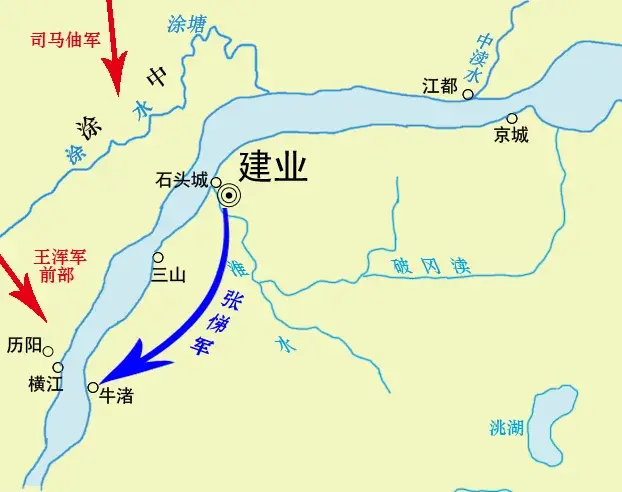
The Western Jin's Conquest of Eastern Wu and Unification (西晋灭吴统一) was the decisive strategic campaign from late 279 to early 280 that eliminated the last rival regime of the Three Kingdoms and reunified China under the Western Jin Dynasty. Following the fall of Shu Han in 263 and Sima Yan's ascension in 265, Western Jin held the northern heartland and Sichuan basin, while Eastern Wu relied upon the natural barrier of the Yangtze River to sustain its southern autonomy. Orchestrated by strategist Yang Hu and continued by Du Yu, Western Jin secretly constructed a colossal riverine armada under Wang Jun in Yizhou. In the winter of 279, Emperor Wu of Jin seized the opportunity of Sun Hao's tyrannical rule and demoralized forces, deploying more than two hundred thousand troops along six coordinated amphibious axes. Jin forces advanced with swift synchronization; Wang Jun's naval vanguard descended the Yangtze, melting iron chain barrages with oiled torches to take Danyang and Xiling, while Du Yu surprised Jiangling and Wang Hun secured the northern riverbanks. A desperate counteroffensive led by Wu Chancellor Zhang Ti was crushed at the Battle of Banchao, obliterating Wu's imperial guards. On April 30, 280 (the fifteenth day of the third month), Jin warships arrived at the Stone Fortress in Jianye, prompting Sun Hao to surrender with bound hands, marking the formal downfall of Eastern Wu. This campaign unified the realm and stood as a celebrated milestone in ancient Chinese amphibious warfare.
Emperor Wu mobilizes over two hundred thousand troops along six routes to invade Eastern Wu under Jia Chong's command.
Wang Jun's river fleet burns defensive iron chains and uproots spikes, storming Danyang and Xiling.
Du Yu's night commandos infiltrate Jiangling and capture Sun Xin, prompting southern commanderies to submit.
Wu Chancellor Zhang Ti leads thirty thousand troops across the Yangtze and falls in total defeat at Banchao.
Wang Jun's armada arrives at the Stone Fortress; Sun Hao formally yields, concluding the Three Kingdoms era.
Since the Yellow Turban Rebellion and the chaos of Dong Zhuo in 184, China had fragmented into warlord coalitions that crystallized into the Three Kingdoms: Cao Wei, Shu Han, and Eastern Wu. In 263, Wei destroyed Shu Han, fundamentally disrupting the geopolitical equilibrium. In 265, Sima Yan established the Western Jin Dynasty, ruling over the Central Plains, Guanzhong, and Sichuan, thereby controlling the vast majority of China's agricultural land, population, and military manpower. Reclaiming southern territories became an inevitable historical objective. In contrast, Eastern Wu was restricted to eastern Jingzhou, Yangzhou, and Jiaozhou, possessing a fraction of Jin's economic output and relying precariously upon naval defense along the Yangtze River.
From its inception, Western Jin planned a deliberate long-term strategy of securing governance and constructing a massive naval fleet before launching the southern invasion. Commander Yang Hu presided over Xiangyang in Jingzhou for a decade, maintaining an enlightened policy of cross-border conciliation and trade that won widespread popular affection. Yang Hu also petitioned the throne to appoint Wang Jun as Governor of Yizhou to construct large multi-decked warships and train riverine sailors. Following the death of Wu's defensive stalwart Lu Kang in 274 and Yang Hu's death in 278, Du Yu assumed command and urged immediate action. Meanwhile, Sun Hao's reign in Eastern Wu descended into paranoia, arbitrary executions, and ruinous taxation, driving officials and garrison commanders into rebellion or defection. In late 279, Du Yu and Zhang Hua successfully persuaded Sima Yan to mobilize the grand invasion.
In the eleventh month of 279, Emperor Wu of Jin issued the imperial edict to invade Eastern Wu, mobilizing over two hundred thousand elite infantry, cavalry, and riverine sailors divided into six synchronized routes. In the eastern sector, Prince of Langya Sima Zhou marched from Xiapi toward Tuzhong to tie down Wu garrisons in Yangzhou; Senior General Wang Hun pushed from Huainan toward Hengjiang and Liyang to threaten Jianye's river approaches; General Wang Rong advanced through Yuzhou toward Wuchang to sever communication between upstream and downstream Wu forces.
Along the central and western fronts, General Hu Fen advanced from Jiangxia toward Zhuxian; Senior General Du Yu moved south from Xiangyang to eliminate the principal Wu field army in Jingzhou; and General Wang Jun joined forces with Tang Bin to lead more than twenty thousand naval personnel down the Yangtze from Yizhou. Grand Commandant Jia Chong served as supreme marshal, while Zhang Hua coordinated logistics and grain transport. Although Jia Chong initially raised doubts due to northwestern border instability, Sima Yan threatened to command in person, securing compliance. Commanders were granted imperial autonomy to adjust tactics locally, ensuring high operational flexibility.
Years earlier, Wang Jun had overseen the construction of colossal multi-decked warships in Yizhou, each stretching over one hundred and twenty paces and capable of carrying two thousand troops, complete with wooden parapets and gateways broad enough for cavalry drills. Floating wood shavings drifting down the river had alerted Wu Commander Wu Yan, who urged Sun Hao to fortify Jianping, but the warning went unheeded. To protect against naval incursions, Eastern Wu stretched massive iron chain booms across the Three Gorges at Xiling and planted concealed iron spikes over ten feet tall in shallow waters.
In the first month of 280, Wang Jun's fleet sailed out of the gorges. Anticipating these obstacles, Wang Jun had crafted dozens of giant wooden rafts manned by straw effigies in armor. Pushed downriver, the rafts struck and dislodged the underwater spikes, which embedded themselves into the floating logs. For the chain booms, Wang Jun fashioned oil-soaked torches hundreds of feet long fixed to the bows of his vanguard vessels. As ships drew near, the blazing torches melted the iron links within moments. Wang Jun and Tang Bin swept through the defiles unobstructed, storming Danyang and Xiling, capturing Wu General Sheng Ji. Earlier, Jin's diplomatic subterfuge had prompted Sun Hao to dismiss the capable Wu commander Zhang Zheng, leaving the Three Gorges defenses completely unprepared.
Simultaneously, Du Yu launched a rapid blitz in central Jingzhou. Du Yu dispatched sub-commanders Guan Ding and Zhou Zhi with eight hundred commandos across the Yangtze by night. They covertly took positions on Baling Mountain outside Jiangling, planting numerous banners and lighting vast fires along the ridge. Western Wu Commander Sun Xin, astonished by the sudden appearance of torches in his rear, panicked and believed his communications were cut.
Du Yu launched a direct frontal assault with the main army, driving Sun Xin's forces into hasty retreat. Zhou Zhi's ambushers mingled with the fleeing soldiers as they rushed through the gates, penetrating the inner encampment and capturing Sun Xin inside his command tent. Following the fall of Jiangling, some Jin courtiers argued that rising spring floods and heat required a seasonal retreat. Du Yu adamantly countered that Jin forces were like bamboo being split, which easily parts after the initial joints are cracked. Sima Yan approved his petition, and Du Yu sent cavalry southward, accepting the peaceful surrender of Lingling, Guiyang, and Hengyang. Wang Jun sailed toward Wuchang, where Wu defenders Meng Tai and Tao Jun surrendered without resistance.
As victories mounted in the west, eastern Jin forces under Wang Hun established control over Liyang, seizing river outposts and pressing toward the northern shore of the Yangtze. Panicked, Sun Hao ordered Chancellor Zhang Ti, Danyang Governor Shen Ying, and General Sun Zhen to lead thirty thousand elite imperial guards across the river to Niuzhu. Prior to crossing, Vice Strategist Zhuge Jing warned Zhang Ti that the expedition was suicidal and urged him to preserve himself. Zhang Ti replied that all subjects knew the dynasty was doomed, but as imperial chancellor, duty demanded he sacrifice his life for the state rather than desert his sovereign.
Shen Ying led five thousand fierce troops from Danyang in three desperate charges against the Jin line. Jin commander Zhang Qiao held firm while flanking cavalry detached by Sima Zhou encircled the Wu rear. Exhausted and surrounded, the Wu ranks collapsed into stampeding panic. Jin troops routed the army, killing over ten thousand men and felling Chancellor Zhang Ti, Shen Ying, and Sun Zhen on the battlefield. The slaughter at Banchao destroyed Eastern Wu's remaining regular forces, opening the final approaches to Jianye.
Following Banchao, Wang Jun's armada advanced triumphantly from Wuchang down the Yangtze. Thousands of sails and tens of thousands of armed troops blanketed the river surface. Wang Hun attempted to halt Wang Jun's advance from the northern bank to consolidate forces, but Wang Jun invoked his imperial mandate and pressed onward directly to the Stone Fortress of Jianye. Sun Hao attempted to dispatch Tao Jun with twenty thousand reserve marines, but the troops dispersed overnight upon seeing the approaching Jin armada.
Left without troops or relief allies, Sun Hao accepted the counsel of Secretariat Hu Chong and followed the precedent of Liu Shan's surrender to Wei. On April 30, 280, Sun Hao led his heir, imperial consorts, and court ministers out of the Stone Fortress, appearing with hands bound behind his back, holding jade in his mouth, and accompanied by a funeral bier. Wang Jun personally untied the captive emperor, burned the bier, and took custody of state seals and archives. All four provinces, forty-three commanderies, and three hundred thirteen districts surrendered to Western Jin. Upon receiving the triumph report in Luoyang, Emperor Wu raised his goblet in tears, attributing the accomplishment to the late Yang Hu.
The campaign lasted under four months, rapidly dismantling the riverine defense system built over sixty years. Sun Hao was escorted to Luoyang, where Sima Yan granted him the title of Marquis Guiming, while Wu noble clans and ministers were largely incorporated into the Jin administrative apparatus. Western Jin absorbed four provinces, forty-three commanderies, three hundred and thirteen districts, five hundred twenty-three thousand registered households, and two hundred thirty thousand soldiers. This victory completely extinguished the last autonomous regime, formally concluding the nearly century-long division since 184.
Following reunification, Sima Yan proclaimed a general amnesty and changed the era name to Taikang, initiating the prosperous "Taikang Governance." The court promulgated the Land Allocation and Household Tax system (Zantian Ketian and Hudiaoshi), reduced local standing armies, and encouraged agricultural resettlement. These measures accelerated the economic cultivation of the Yangtze Valley and fostered deep cultural integration between north and south. Militarily, the operation established a timeless model for combined amphibious warfare and large-scale long-distance riverine offensive operations in imperial Chinese history.