Inaugural Imperial Rite
Qin Shi Huang ascends Mount Tai to sacrifice to Heaven and perform rites at Liangfu, erecting Li Si's inscribed seal-script stele
Northern Song Dynasty (北宋) · HISTORICAL EVENT
泰山封禅
The Mount Tai Fengshan Ceremony (泰山封禅) was the supreme sacrificial rite, most elaborate state ritual, and most profound political ceremony in imperial China. The term feng signified erecting a circular mound of earth on the highest peak of Mount Tai to offer solemn sacrifices to Heaven, thanking the celestial sphere for conferring the imperial mandate and protective blessings; shan referred to clearing ground on adjacent foothills, such as Mount…
The Mount Tai Fengshan Ceremony (泰山封禅) was the supreme sacrificial rite, most elaborate state ritual, and most profound political ceremony in imperial China. The term feng signified erecting a circular mound of earth on the highest peak of Mount Tai to offer solemn sacrifices to Heaven, thanking the celestial sphere for conferring the imperial mandate and protective blessings; shan referred to clearing ground on adjacent foothills, such as Mount Liangfu or Mount Sheshou, to venerate Earth in gratitude for sustaining agricultural fertility and humanity. Originating from ancient mountain cults and Warring States theological cosmology, the ritual was formally institutionalized in 219 BCE following Qin Shi Huang's unification of China. Over two millennia of dynastic history, only rulers who unified the realm, secured domestic peace, or orchestrated remarkable dynastic revivals were deemed qualified to perform this ceremony. Historical records confirm that Qin Shi Huang, Emperor Wu of Han, Emperor Guangwu of Han, Emperor Gaozong of Tang (with Empress Wu Zetian participating), Emperor Xuanzong of Tang, and Emperor Zhenzong of Song conducted authentic fengshan ceremonies atop Mount Tai. Beyond cosmic communion, the ceremony was the ultimate state political instrument for proclaiming divine sanction and demonstrating cultural cohesion. Following the Treaty of Shanyuan, Emperor Zhenzong orchestrated fraudulent heavenly revelations to justify his performance, which thoroughly desacralized the institution. Consequently, the Ming and Qing dynasties permanently abolished fengshan, replacing it with standard imperial pilgrimages and seasonal offerings.
Qin Shi Huang ascends Mount Tai to sacrifice to Heaven and perform rites at Liangfu, erecting Li Si's inscribed seal-script stele
Emperor Wu conducts secret rites atop Mount Tai, inaugurates the Yuanfeng era, and holds foreign receptions at the Mingtang
Emperor Guangwu performs the ceremony, interring an inscribed jade tablet within a stone reliquary to confirm the restored Han mandate
Emperor Gaozong and Wu Zetian conduct the ceremony; Wu Zetian acts as secondary officiant in the presence of foreign envoys
Emperor Xuanzong performs fengshan, publishes the imperial prayer text, and carves the monumental Inscription on Mount Tai
Emperor Zhenzong uses forged celestial letters to justify fengshan, discrediting the ritual and permanently terminating the institution
Mount Tai rises precipitously from the plains of Shandong in eastern China. In archaic cosmology, the east was venerated as the birthplace of the rising sun and the generative origin of all living entities. Mount Tai was consequently exalted as the paramount among the Five Great Mountains, viewed as a colossal pillar bridging Heaven and Earth. The ancient treatise Guanzi states that seventy-two prehistoric rulers, from Shennong and the Yellow Emperor down to King Cheng of Zhou, ascended Mount Tai to announce their achievements, reflecting deep-rooted archaic veneration.
During the Warring States period, the dissemination of Yin-Yang and Five Elements cosmological theories led Confucian scholars and ritual specialists in Qi and Lu to construct a systematic political theology of the Mandate of Heaven. They asserted that only an authentic Son of Heaven—one who had harmonized the four seas, restored imperial peace, and received celestial omens—could scale the sacred peak to report his achievements to Heaven and receive divine confirmation of sovereign legitimacy.
In imperial Chinese history, the initiative to perform the fengshan ceremony was invariably driven by profound political imperatives. Following dynastic transitions or the conclusion of widespread civil warfare, newly established regimes had to assert supreme authority over regional aristocracies and regional populations.
From Qin Shi Huang's creation of the unified empire to Emperor Wu of Han's expansionist triumphs, Emperor Guangwu's restoration of the Han house, and the Tang consolidation of imperial hegemony, sovereign rulers utilized the grand ceremony to transform earthly military triumphs into divinely ordained cosmic mandates. The ceremony transcended conventional ritual offerings, serving as a political mechanism to forge civilizational unity, advertise state strength, and bind the realm to the reigning imperial lineage.
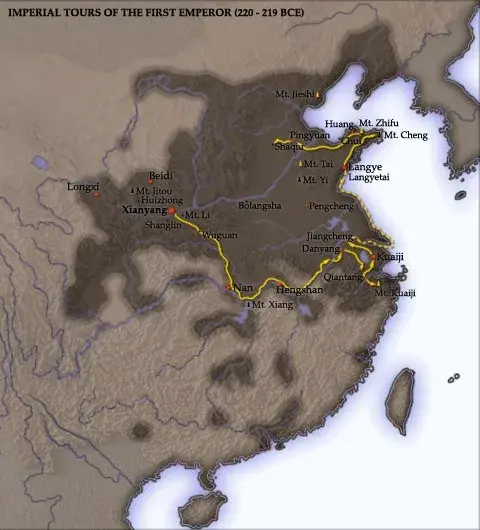
In 221 BCE, King Zheng of Qin annexed the six rival states to establish the Qin dynasty. To declare universal pacification and conciliate former eastern elites, Qin Shi Huang embarked on an eastern inspection tour in 219 BCE, accompanied by high ministers and seventy Confucian scholars from Qi and Lu.
When deliberating ritual protocols, the scholars presented impractical proposals, including wrapping chariot wheels in rushes to avoid disturbing the sacred grass. Dismissing their counsel as pedantic, the First Emperor formulated an imperial protocol based on Qin ancestral state rites. He ascended Mount Tai along the southern ridge, erected a sacrificial earthen altar on the peak, and conducted solemn sacrifices to Heaven. He then descended along the northern slope and performed the shan rite on Mount Liangfu. Chancellor Li Si erected the celebrated Mount Tai Stele on the summit, inscribed in refined Small Seal script to proclaim Qin's unification of China, establishing the standard model of imperial sacrifice coupled with monumental stone inscriptions.
During the early Western Han dynasty, domestic recovery precluded such undertakings. After Emperor Wu crushed the nomadic Xiongnu confederacy and integrated the southern borderlands, Han power reached its zenith. In the spring of 110 BCE, Emperor Wu inspected the northern frontiers with 180,000 cavalry before proceeding to Mount Tai.
Emperor Wu commissioned court ritualists to design ceremonial music and constructed the Mingtang Palace at the eastern foot of the mountain. In the fourth month, the emperor ascended the summit in the company of a single imperial attendant, Huo Ziyan, to perform esoteric rites and inter an inscribed jade tablet within a sealed stone reliquary. Returning to the foot of the peak, he conducted the shan sacrifice on Mount Suran and received congratulations from feudal lords and foreign envoys at the Mingtang. Emperor Wu issued a general amnesty, granted regional tax exemptions, and designated his new reign era as Yuanfeng (Origin of Fengshan), marking the synthesis of Confucian state rites and imperial cosmology.
Following years of civil warfare against rival warlords and Xin usurpation, Emperor Guangwu of the Eastern Han dynasty reunited China. In 54 CE, court officials petitioned the emperor to perform fengshan, but Guangwu declined, citing the ongoing need for popular economic recovery.
By 56 CE, officials submitted renewed petitions citing prophetic portents and societal stabilization. Acknowledging that the restoration was complete, Emperor Guangwu organized the expedition. In the second month, the emperor scaled Mount Tai, raised an altar to Heaven, and buried an inscribed golden jade tablet encased within a stone chest. He then proceeded to Mount Liangfu to venerate Earth. Emperor Guangwu utilized the ceremony to demonstrate the unbroken continuation of the Han mandate. He inaugurated the Zhongyuan era shortly thereafter, solidifying the dynastic legitimacy of the Eastern Han regime.
In the early Tang dynasty, Emperor Taizong contemplated fengshan but was dissuaded by Chancellor Wei Zheng, who prioritized fiscal recovery. In 666, Emperor Gaozong and Empress Wu Zetian led an elaborate imperial procession to Shandong to perform the first fengshan ceremony of the Tang dynasty.
The ritual introduced an institutional innovation. Empress Wu presented a memorial noting that because Earth was an yin divinity, having male officials perform the secondary offering violated cosmic balance. She argued that the empress should lead imperial consorts and noblewomen to perform the second offering. Emperor Gaozong consented. During the shan ceremony at Mount Sheshou, Empress Wu served as the secondary officiant, witnessed by ambassadors and tribal chieftains from Goguryeo, Persia, Central Asia, and India. Following the rites, Emperor Gaozong granted tax exemptions to Shandong, pardoned prisoners, and enfeoffed the Mount Tai deity as the King Equal to Heaven.
In 725, Emperor Xuanzong commemorated the Kaiyuan era by conducting fengshan. Abandoning the secretive jade casket tradition, Xuanzong published the prayer texts to the public. He had the colossal Inscription on Mount Tai carved into the Cliff of Grand View, measuring over thirteen meters in height, exhibiting refined Eight-Part clerical calligraphy that represented the artistic pinnacle of imperial Tang statecraft.
In 1004, the Northern Song signed the Treaty of Shanyuan with the Liao dynasty. Although it brought border stability, court officials felt humiliated by annual indemnities. Chancellor Wang Qinruo exploited Emperor Zhenzong's wounded vanity, advising him to orchestrate divine portents to suppress domestic criticism and elevate dynastic prestige.
In 1008, Emperor Zhenzong and his ministers orchestrated the fraudulent appearance of celestial letters descending upon the palace gates. Proclaiming divine favor, the court allocated substantial treasury funds to conduct fengshan on Mount Tai. Emperor Zhenzong led an extensive cortege from Kaifeng, performed the rites, distributed imperial titles, and expanded the Dai Temple complex. However, the transparent deceit drew derision from scholar-officials and subsequent generations. The moral authority of the ceremony was discredited, leading Ming founder Zhu Yuanzhang and the Qing Kangxi and Qianlong emperors to renounce fengshan, reducing Mount Tai rituals to conventional imperial sacrifices.
The Mount Tai Fengshan Ceremony synthesized ancient eastern mountain cults with Warring States cosmological doctrines, transforming Mount Tai into the supreme geographical emblem of imperial legitimacy. By ascending the summit, Chinese emperors acquired celestial endorsement as Sons of Heaven ruling with divine sanction. This liturgical ceremony fostered shared civilizational identity across disparate regions, reinforcing the ideological cohesion of the unified Chinese state.
In institutional terms, the transparent fabrication of portents during Emperor Zhenzong's reign destroyed the moral and sacred premise of fengshan. Subsequent dynasties recognized that performing the ceremony invited historical ridicule rather than reverence.
The Yuan, Ming, and Qing dynasties discarded fengshan. Ming founder Zhu Yuanzhang stripped Mount Tai deities of imperial princely titles, designating the site simply as the Spirit of Eastern Peak Mount Tai within standardized state offerings. While Qing emperors such as Kangxi and Qianlong frequently visited Mount Tai, they strictly adhered to seasonal sacrifices and ancestral homage without reviving the fengshan rite. The ceremony permanently evolved from an esoteric tool of dynastic propaganda into standardized cultural and religious pilgrimages.
Sima Qian records in the Records of the Grand Historian: "From antiquity, of the monarchs who received the mandate, who among them did not perform the fengshan? Yet there were those who lacked celestial omens and pressed forward in haste. Their traces are faint and fleeting; the boundary between Heaven and man is profound and demanding."
Ban Gu critiques in the Book of Han: "The ritualists of Qi and Lu, drawn to arts of immortality, claimed that Mount Tai was where monarchs reported accomplishment; Qin Shi Huang and Emperor Wu of Han were captivated and enacted it. Though they refined rites to declare merit, it was intertwined with deceitful quests for longevity."
Gu Yanwu reflects in Records of Daily Knowledge: "The fengshan of Mount Tai since the Qin and Han was the most solemn ceremony for a sovereign of universal peace to report virtue and divine mandate. Yet Emperor Zhenzong of Song enacted it with fabricated heavenly letters, deceiving himself and others while the whole court complied. Rites disintegrated, the gods withdrew, and none dared to emulate it thereafter."