Emperor Xuan Dies and Yang Jian Assumes Regency
Northern Zhou sovereign dies; Yang Jian takes office as Senior Chancellor and seizes control of the imperial administration.
Northern Dynasties (Northern Zhou), Sui Dynasty, Chen Dynasty · HISTORICAL EVENT
杨坚代周与隋统一
The Yang Jian Usurping Zhou and Sui Unification (杨坚代周与隋统一) was a historic process of dynastic transition and national reunification spanning 580 CE to 589 CE that brought an end to centuries of division across China. In the fifth month of 580 CE, Emperor Xuan of Northern Zhou died prematurely, leaving the throne to his six-year-old heir. Duke of Sui Yang Jian stepped forward as Senior Chancellor, assuming control of the military and civil administration.…
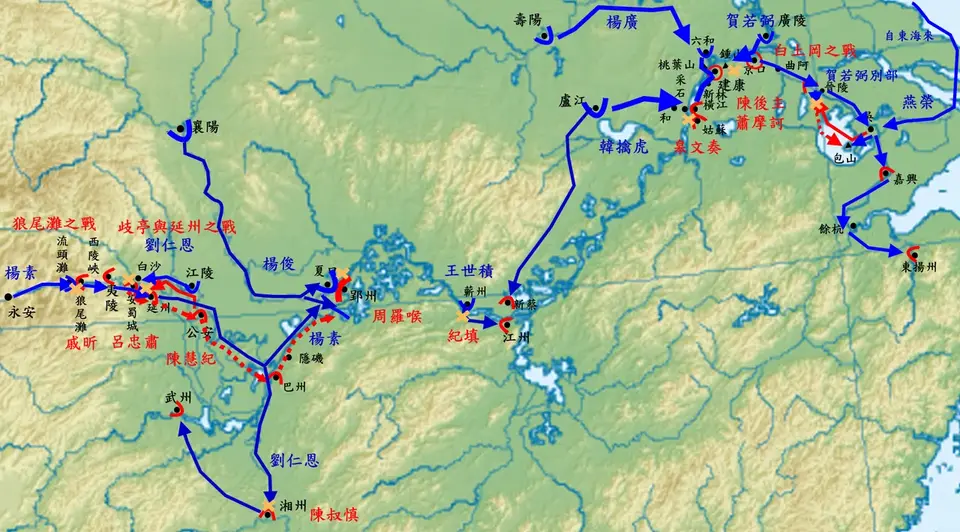
The Yang Jian Usurping Zhou and Sui Unification (杨坚代周与隋统一) was a historic process of dynastic transition and national reunification spanning 580 CE to 589 CE that brought an end to centuries of division across China. In the fifth month of 580 CE, Emperor Xuan of Northern Zhou died prematurely, leaving the throne to his six-year-old heir. Duke of Sui Yang Jian stepped forward as Senior Chancellor, assuming control of the military and civil administration. Employing seasoned commanders Wei Xiaokuan and Gao Jiong, Yang Jian crushed the Rebellion of the Three Commandants led by Yuchi Jiong and purged the imperial Yuwen princes. In the second month of 581 CE, Emperor Jing abdicated, and Yang Jian formally ascended the throne as Emperor Wen, founding the Sui Dynasty with Chang'an as capital. Upon establishing the dynasty, Emperor Wen promulgated the Three Departments and Six Ministries system, the Kaihuang Code, and equitable land systems, revitalizing the economy. To eliminate the northern threat, Yang Jian adopted Zhangsun Sheng's diplomatic strategy of playing off rival factions, successfully dividing the powerful Turkic Khaganate into Eastern and Western branches and securing their submission. In the winter of 588 CE, Yang Jian mobilized 518,000 soldiers under Prince of Jin Yang Guang and commander Gao Jiong, launching an eight-pronged assault across the Yangtze. Commander Yang Su broke through the Three Gorges with massive multi-decked warships, while Han Qinhu and Heruo Bi crossed the river and captured the southern capital of Jiankang, taking the hedonistic Chen Shubao prisoner. This campaign brought a definitive end to 272 years of North-South division since the Western Jin, laying the political and institutional foundations for the Tang Dynasty.
Northern Zhou sovereign dies; Yang Jian takes office as Senior Chancellor and seizes control of the imperial administration.
Wei Xiaokuan crushes Yuchi Jiong at Yecheng, while Yang Jian purges the Yuwen princes, securing total control.
Emperor Jing abdicates; Yang Jian mounts the throne in Chang'an as Emperor Wen, promulgating the Three Departments and Six Ministries.
Sui forces launch multi-pronged strikes; Zhangsun Sheng's diplomatic maneuvers split the Turks into Eastern and Western branches, securing Ishbara Khagan's submission.
Emperor Wen orders 518,000 troops under Yang Guang and Gao Jiong to advance across the Yangtze along eight separate avenues.
Han Qinhu and Heruo Bi capture Jiankang and seize Chen Shubao, ending 272 years of territorial division.
In the late Northern and Southern Dynasties period, Emperor Wu of Northern Zhou unified northern China by conquering Northern Qi in 577 CE. However, Emperor Wu died in 578 CE, and his successor, Emperor Xuan, was erratic and despotic, establishing five concurrent empresses and abdicating after a single year to live in palace indulgence. In the fifth month of 580 CE, Emperor Xuan died suddenly, leaving the throne to six-year-old Emperor Jing (Yuwen Chan).
Amid acute political instability, Duke of Sui Yang Jian, father of the late emperor's empress, seized the initiative with backing from senior courtiers Liu Fang and Zheng Yi. Appointed Senior Chancellor and Commander-in-Chief of All Military Affairs, Yang Jian secured control of the imperial bodyguard and state archives, consolidating executive authority in his hands.
Yang Jian's rapid concentration of power provoked armed resistance from senior frontier commanders and imperial princes of Northern Zhou. Commander of Xiangzhou Yuchi Jiong, a venerable military leader connected by marriage to the royal house, mobilized over one hundred thousand soldiers in Yecheng to overthrow Yang Jian. Commander Wang Qian in Sichuan and Sima Xiaonan in Henan rose in simultaneous revolt, an insurrection known as the Rebellion of the Three Commandants. Concurrently, imperial princes led by Prince of Zhao Yuwen Zhao plotted Yang Jian's assassination in the capital.
Confronting this existential crisis, Yang Jian responded with strategic resolve. He dispatched veteran general Wei Xiaokuan with the Guanzhong field army to crush Yuchi Jiong, sending chief counselor Gao Jiong to oversee the decisive battle outside Yecheng. He directed Liang Rui to subdue Sichuan and Yang Su to disperse Sima Xiaonan's forces. Within Chang'an, Yang Jian ruthlessly executed the imperial princes descended from Northern Zhou founder Yuwen Tai, eliminating dynastic rivals and clearing the way for his ascension.
On the jiazi day of the second month in 581 CE (the first year of the Dading era), nine-year-old Emperor Jing was compelled to issue an imperial abdication decree. After observing the ritual of thrice declining the mandate, Yang Jian mounted the throne at the Linguang Hall in Chang'an. He proclaimed the founding of the Sui Dynasty, adopted the reign title Kaihuang, and honored his late father Yang Zhong as Martial Emperor, with Dugu Qieluo consecrated as Empress. Shortly thereafter, the deposed Emperor Jing was demoted to Duke of Jie and secretly executed, bringing the Northern Zhou to an absolute close.
Upon taking the throne, Emperor Wen executed sweeping structural reforms. He dismantled the archaic Six Offices system of Northern Zhou, establishing the Three Departments (Shangshu, Menxia, and Neishi) alongside Six Ministries (Personnel, Rites, War, Justice, Revenue, and Works), laying the blueprint for imperial governance through the Qing Dynasty. He promulgated the lenient Kaihuang Code, implemented the Equal-Field System, and instituted comprehensive household census registrations that enrolled millions of peasants onto tax rolls, rapidly inaugurating the prosperity of the Kaihuang Era.
At its founding, the Sui faced perilous threats on two fronts: the nomadic Turkic Khaganate in the north and the Chen Dynasty across the Yangtze. Under Ishbara Khagan (Shabolüe), the Turks commanded hundreds of thousands of mounted archers across the northern steppes, launching devastating incursions across the Great Wall under the pretext of avenging Northern Zhou.
Emperor Wen adopted a grand strategy formulated by Gao Jiong and military diplomat Zhangsun Sheng: "Prioritize the north before the south; maintain defensive peace in the south while defeating the Turks." In 583 CE, Sui armies launched an eight-pronged counter-offensive, routing Ishbara Khagan at Baidao. Concurrently, Zhangsun Sheng exploited long-standing jealousies among Ishbara, Apa, and Tardu Khagans, instigating civil war that permanently split the nomadic confederation into Eastern and Western Turkic Khaganates. In 584 CE, exhausted by internal strife, Ishbara Khagan formally acknowledged Sui suzerainty, removing the northern existential menace.
With the steppes subdued, Emperor Wen mobilized all national resources toward the annexation of the Chen Dynasty. Under Emperor Chen Shubao (Houzhu), the southern regime was crippled by court corruption and administrative decay. Indifferent to governance, Chen Shubao composed poetry and indulged in banquets with favored consorts Zhang Lihua and Kong Guibin, confident that the wide waters of the Yangtze formed an impenetrable natural barrier.
Emperor Wen adopted a systematic attrition strategy devised by Gao Jiong. During harvest seasons in the south, Sui divisions assembled along the north bank of the Yangtze, simulating imminent amphibious crossings. When panicked Chen forces mobilized peasants to man the ramparts, Sui troops withdrew, only to repeat the feint as soon as southern conscripts disbanded. Furthermore, covert agents infiltrated southern cities to set fire to grain stores and military storehouses, leaving the Chen treasury depleted. Simultaneously, at the Yong'an naval yards on the upper Yangtze, commander Yang Su constructed hundreds of massive "Five-Fang" multi-decked warships capable of carrying seven hundred marines each, equipped with six towering battering booms.
In the tenth month of 588 CE, Emperor Wen published an imperial indictment cataloging twenty capital crimes committed by Chen Shubao, distributing three hundred thousand copies across the south. In the eleventh month, 518,000 elite troops advanced in an eight-pronged amphibious offensive: twenty-year-old Prince of Jin Yang Guang served as supreme commander, Grand Chancellor Gao Jiong as operational chief of staff, and Prince of Qin Yang Jun as secondary commander.
In the first month of 589 CE, the offensive commenced along the entire river front. On the upper Yangtze, Yang Su led his colossal naval flotilla through the Three Gorges, annihilating the southern river fleet at Langweitan. On the lower Yangtze, veteran commander Heruo Bi executed a stealth crossing at Guangling, seizing the fortress of Jingkou, while general Han Qinhu led five hundred cavalry across the river at night, capturing the strategic outpost of Gushu without shedding a drop of blood. On the twentieth day of the first month, Heruo Bi smashed the main Chen army at Baimapo, capturing famed southern general Xiao Mohe.
On the same evening, Han Qinhu's five hundred cavalry rode through the unattended Zhuque Gate into the imperial capital of Jiankang. Courtiers fled in terror, and Chen Shubao hid at the bottom of a dry well in the Jingyang Palace alongside consorts Zhang Lihua and Kong Guibin. When Sui soldiers prepared to drop heavy boulders down the shaft, the terrified sovereign cried out for mercy and was hauled up with ropes. In the second month of 589 CE, Gao Jiong entered Jiankang, executed Zhang Lihua to prevent court corruption, pacified the populace, and ordered the imperial palaces leveled to farmland. The Chen Dynasty was extinguished, and Madame Xian of Lingnan submitted to Sui rule, consummating the reunification of China.
The campaign culminated in the establishment of the Sui Dynasty, the pacification of the northern nomadic frontier, and the extinction of the Southern Chen. Emperor Wen unified more than four hundred prefectures and nearly ten million households under direct civil administration from his capital at Daxing (Chang'an), consolidating northern and southern populations into a single realm.
The event constitutes one of the grandest milestones in pre-modern Chinese civilization. Geopolitically, it terminated 272 years of structural division dating to the Disaster of Yongjia in 311 CE, preventing China from fracturing into permanent regional nation-states like post-Roman Europe and cementing the cultural imperative of universal dynastic unity. Economically, the integration of northern agricultural strength with the burgeoning wealth of the Yangtze Basin laid the foundation for the construction of the Grand Canal. Institutionally, the administrative structures codified by Yang Jian—the Three Departments and Six Ministries, codified legal statutes, and meritocratic examinations—served as the enduring structural foundations for the Tang Golden Age.