Debut of the Wooden Ox
Zhuge Liang undertakes the fourth Northern Expedition to Mount Qi, deploying the Wooden Ox across the Qinling plank roads and defeating Sima Yi at Lucheng.
Shu Han (蜀汉) · HISTORICAL EVENT
木牛流马
The Wooden Ox and Flowing Horse (木牛流马) refers to a pair of innovative mountain transport mechanical devices developed and deployed by Chancellor Zhuge Liang of Shu Han between 231 CE and 234 CE to overcome acute supply transport challenges during his Northern Expeditions against Cao Wei. The mountain trails of Shu were famously perilous; military advances from Hanzhong across the Qinling Mountains relied on narrow wooden plank roads suspended over…
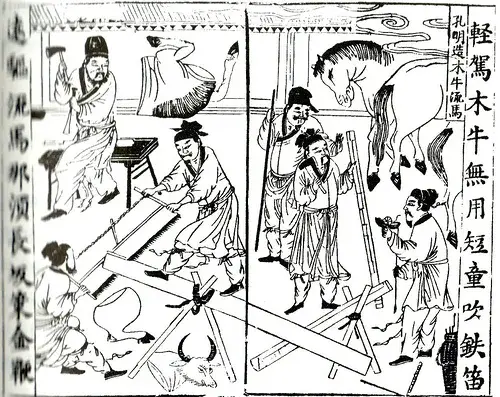
The Wooden Ox and Flowing Horse (木牛流马) refers to a pair of innovative mountain transport mechanical devices developed and deployed by Chancellor Zhuge Liang of Shu Han between 231 CE and 234 CE to overcome acute supply transport challenges during his Northern Expeditions against Cao Wei. The mountain trails of Shu were famously perilous; military advances from Hanzhong across the Qinling Mountains relied on narrow wooden plank roads suspended over vertical precipices. Standard horse-drawn carriages and heavy wagons could not traverse these rugged cliff trails, while relying solely on human porters carrying sacks resulted in carriers consuming most of the provisions en route, making logistics the greatest strategic vulnerability of Shu Han. Renowned for his inventive genius and mechanical craftsmanship, Zhuge Liang established engineering workshops in Huangsha Town near Hanzhong. During the fourth Northern Expedition to Mount Qi in 231 CE, he introduced the "Wooden Ox", an articulated mountain handcart operated by single handlers carrying several hundred pounds of grain. During the fifth expedition in 234 CE through the rugged Xie Gorge to the Wuzhang Plains, he deployed an upgraded and more agile transport vehicle known as the "Flowing Horse". Capable of navigating sharp turns and steep rocky inclines, the Flowing Horse sustained tens of thousands of frontline troops during months of standoff against Sima Yi south of the Wei River. The deployment of the Wooden Ox and Flowing Horse stood as a landmark milestone in ancient Chinese mechanical engineering and military logistics.
Zhuge Liang undertakes the fourth Northern Expedition to Mount Qi, deploying the Wooden Ox across the Qinling plank roads and defeating Sima Yi at Lucheng.
Due to grain distribution delays engineered by Li Yan, Shu forces retreat, ambushing and killing Wei general Zhang He at Mumen Pass.
Zhuge Liang assesses the cornering limitations of the Wooden Ox in Hanzhong, initiating design work on the more agile Flowing Horse.
Flowing Horse prototypes complete structural testing, exhibiting reduced center-of-gravity and standardized enclosed cargo boxes.
Zhuge Liang leads one hundred thousand troops through Xie Gorge, employing the Flowing Horse to establish fortified camps and farmland on the Wuzhang Plains.
Zhuge Liang passes away from exhaustion on the Wuzhang Plains; Shu forces withdraw safely to Hanzhong, after which the specialized transport machines gradually fell into disuse.
Shu Han occupied the fertile Sichuan Basin, ringed on all sides by towering mountain barriers. Launching military expeditions northward against Cao Wei necessitated marching north from Hanzhong across the jagged Qinling mountain ranges. The Qinling terrain was exceptionally steep; ancient engineers had constructed plank roads by boring sockets into vertical rock faces and supporting narrow wooden pathways hovering over roaring gorges. These precarious roads were only wide enough for a single porter or pack animal at a time, entirely precluding the two-horse wagons commonly used across the flat plains of northern China.
During Zhuge Liang's earlier Northern Expeditions, grain transport repeatedly determined the outcome of military campaigns. Moving supplies required mobilizing tens of thousands of civilian porters who traversed hundreds of miles across treacherous passes. Porters inevitably consumed more than half of the grain they carried during transit, and seasonal downpours regularly washed away sections of plank roads, leaving frontline armies facing sudden starvation and compelling premature withdrawals. When Zhuge Liang prepared for the fourth expedition to Mount Qi in 231 CE, securing uninterrupted grain flow across the mountains remained the primary strategic imperative.
Faced with severe geographic bottlenecks, Chancellor Zhuge Liang harnessed his extraordinary talent for engineering and mechanical design. In the Records of the Three Kingdoms, historian Chen Shou noted that Zhuge Liang "excelled in ingenious thinking," having previously redesigned the repeating crossbow to discharge ten iron bolts simultaneously.
To overcome the transport impasse, Zhuge Liang conducted extensive agricultural garrisons while establishing specialized manufacturing centers in Huangsha Town and other logistics depots around Hanzhong. Analyzing mountain mechanics, leverage equilibrium, and turning dynamics, he sought to create a transport machine that a single porter could easily maneuver while carrying substantial cargo over steep inclines with automatic locking brakes to prevent backward slippage. The Wooden Ox and Flowing Horse were engineered specifically to meet this urgent operational demand.
In the spring of 231 CE (the ninth year of the Jianxing era), Zhuge Liang led Shu Han forces on the fourth Northern Expedition, laying siege to Mount Qi. To address the long-distance supply bottleneck, Zhuge Liang introduced his newly invented mountain transport vehicle, the "Wooden Ox," for the first time in history.
According to the treatise Method for Making the Wooden Ox and Flowing Horse preserved in Pei Songzhi's annotations to the Records of the Three Kingdoms, the Wooden Ox possessed a unique mechanical structure featuring "a square belly and curved neck, with a single wheel and four supporting legs, its head fitting into the throat and its tongue connected to the belly." Mechanically, it integrated double shafts, a load-bearing frame, and articulated locking legs. The porter moved forward six paces while the cart advanced four, carrying enough grain to nourish an adult soldier for an entire year while traveling twenty Chinese miles a day without exhausting the driver.
Deployed along the narrow plank passes of Mount Qi, convoys of Wooden Oxen substantially improved transport efficiency. Shu Han armies crushed Sima Yi's forces in the Battle of Lucheng, taking several thousand enemy heads. Although logistical controller Li Yan ultimately fabricated military reports and delayed supply convoys, forcing Zhuge Liang to execute a phased withdrawal, Shu forces ambushed and killed the veteran Wei general Zhang He at Mumen Pass during the retreat. The Wooden Ox demonstrated unprecedented practical utility over mountainous terrain.
Following the Mount Qi campaign, Zhuge Liang evaluated the performance of the Wooden Ox, determining that while it possessed superior carrying capacity, its frame remained somewhat cumbersome along sharply winding plank paths. Between 232 CE and 233 CE, Zhuge Liang directed his engineers in Hanzhong to refine the design, creating a more agile, compact, and maneuverable second-generation mountain transport mechanism designated the "Flowing Horse."
The Method for Making the Wooden Ox and Flowing Horse set down meticulous technical specifications for the Flowing Horse: its side ribs measured three feet five inches long, three inches wide, and two inches two tenths thick; front axle sockets were positioned four inches from the head; and two square wooden side boxes were mounted along the hubs, each holding three bushels of grain. Resembling an elephant in stance with a lowered center of gravity, a single operator could guide the cart carrying dozens of bushels of grain over twenty miles per day. This refined architecture provided superior cornering capability and balance on narrow cliffside walkways.
In the spring of 234 CE (the twelfth year of the Jianxing era), Zhuge Liang mobilized a grand army of one hundred thousand men via the rugged Xie Gorge, relying entirely on the Flowing Horse to haul grain supplies. Convoys of Flowing Horses continuously delivered harvests from Hanzhong directly to the frontline, enabling Shu forces to fortify positions on the Wuzhang Plains south of the Wei River. Setting up agricultural garrisons alongside military camps, Shu troops confronted Sima Yi for more than one hundred days. Unlike previous campaigns that collapsed due to supply depletion, the Flowing Horse successfully maintained uninterrupted food supplies throughout the prolonged standoff.
As a revolutionary military invention, the Wooden Ox and Flowing Horse became shrouded in legend after Zhuge Liang's death due to the loss of original mechanical diagrams. However, careful examination of historical texts reveals their true nature as advanced single-wheeled or two-wheeled mountain barrows. Song Dynasty scholar Chen Shidao noted in Houshan Tancong that single-wheeled carts carrying eight stone of grain with ox-head fronts and larger four-person carts observed in Sichuan were direct evolutionary survivals of Zhuge Liang's transport machinery. Song encyclopedist Gao Cheng similarly affirmed in Origins of Things: "The Wooden Ox is modern small wheelbarrows equipped with front shafts; the Flowing Horse is modern single-wheeled pushcarts."
Modern historians and mechanical engineers analyzing ancient dimensions and the geometry of the Qinling plank roads conclude that the Wooden Ox was an advanced wheelbarrow fitted with double shafts and drop-down support legs that functioned as automatic friction brakes on steep slopes to prevent downhill runaway accidents. The Flowing Horse was an upgraded, lower-center-of-gravity pushcart with articulated boxes and ergonomic harness attachments. By integrating leverage balance and automatic self-locking mechanisms, Zhuge Liang attained the zenith of traditional Chinese mechanical engineering during the Three Kingdoms era.
The deployment of the Wooden Ox and Flowing Horse yielded unprecedented transport efficiency during the 231 CE and 234 CE Northern Expeditions. In particular, during the 234 CE campaign, one hundred thousand Shu troops sustained operations on the Wuzhang Plains for over one hundred days without suffering supply collapse. Although the devices gradually disappeared from standard military registers following Zhuge Liang's death due to the absence of official engineering manuals, their battlefield efficacy remained undeniable.
The Wooden Ox and Flowing Horse constituted a pioneering landmark in the history of mechanical engineering and military logistics. By ingeniously combining balance, wheel rotation, and anti-slip mountain braking mechanisms, the design inaugurated specialized transport equipment for steep terrain. It directly inspired the development and standardization of traditional Chinese wheelbarrows, leaving an enduring legacy in ancient Chinese engineering and mountain transportation history.