Wei River Alliance
Illig Qaghan threatens Chang'an; Taizong concludes a treaty, swearing to avenge the humiliation.
Tang Dynasty (唐朝) · HISTORICAL EVENT
灭东突厥
The Tang Campaign Against the Eastern Turks (灭东突厥), fought during the winter of 629 and the spring of 630, was a climactic military counteroffensive that culminated in the total destruction of the Eastern Turkic Khaganate. Following decades of devastating nomadic border raids and the crisis of the Wei River in 626, Emperor Taizong bided his time, instituting agrarian reforms, replenishing imperial coffers, and rigorously training elite horse cavalry.…
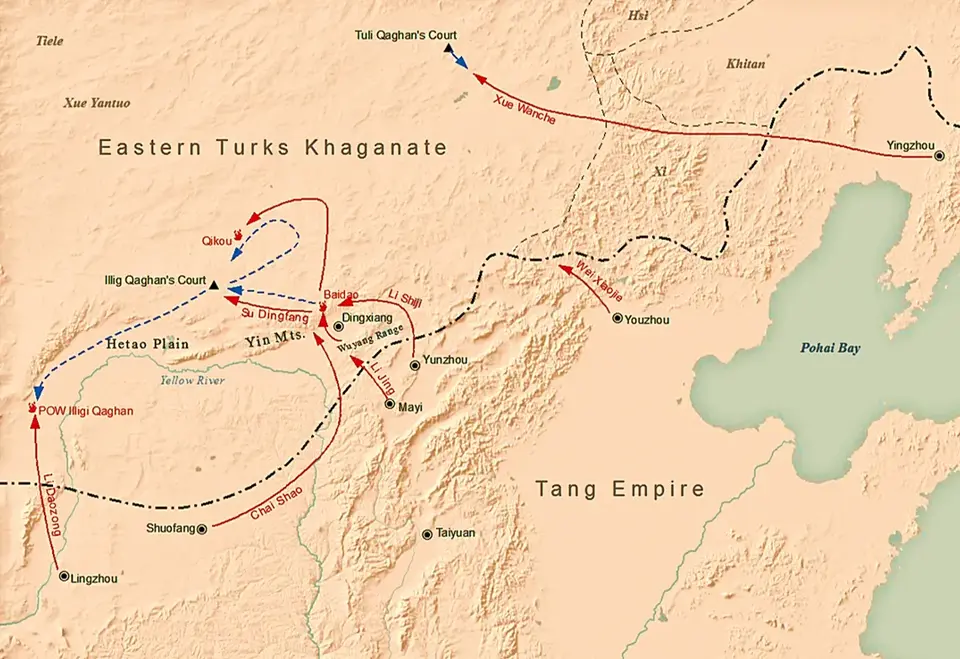
The Tang Campaign Against the Eastern Turks (灭东突厥), fought during the winter of 629 and the spring of 630, was a climactic military counteroffensive that culminated in the total destruction of the Eastern Turkic Khaganate. Following decades of devastating nomadic border raids and the crisis of the Wei River in 626, Emperor Taizong bided his time, instituting agrarian reforms, replenishing imperial coffers, and rigorously training elite horse cavalry. When severe blizzards devastated the steppe herds in 628 and vassal tribes revolted against Illig Qaghan, Taizong launched a massive six-pronged invasion under Minister of War Li Jing, deploying over one hundred thousand seasoned troops. Executing a daring winter offensive, Li Jing led three thousand cavalry through blinding snowstorms to seize Dingxiang, driving the panic-stricken Qaghan into the Yin Mountains. Utilizing peace parleys as a diplomatic screen, Li Jing and General Li Ji launched a surprise dawn raid on the Qaghan's headquarters at Mount Tieshan. The nomadic army was decimated, losing over ten thousand dead and one hundred thousand captured. Illig Qaghan was captured in the desert by General Zhang Baoxiang. The swift triumph dissolved the nomadic empire, paving the way for nomadic leaders to hail Emperor Taizong as the Heavenly Qaghan.
Illig Qaghan threatens Chang'an; Taizong concludes a treaty, swearing to avenge the humiliation.
Massive blizzards strike Mongolia; Tiele tribes rebel, and Tolis Qaghan defects to Tang.
Taizong commissions Li Jing to coordinate one hundred thousand troops to invade the north.
Li Jing takes three thousand cavalry through snow to seize Dingxiang; Illig flees.
Li Ji intercepts retreating nomads at Baidao, securing the Yin Mountains.
Li Jing and Su Dingfang execute a surprise dawn attack in the fog, wiping out the nomadic army.
General Zhang Baoxiang captures Illig Qaghan alive in the desert, concluding the campaign.
Steppe chieftains convene in Chang'an, hailing Emperor Taizong as the Heavenly Qaghan.
Throughout the collapse of the Sui Dynasty and early Tang unification, the Eastern Turkic Khaganate enjoyed supreme military hegemony across northern Eurasia, fielding hundreds of thousands of mounted archers. Northern Chinese warlords including Liu Wuzhou and Liang Shidu submitted as vassals, while Emperor Gaozu paid tribute to safeguard the dynasty's northern flanks. In September 626, Illig Qaghan capitalized on the Xuanwu Gate coup by marching to the outskirts of Chang'an, forcing Emperor Taizong into a humiliating financial settlement at the Bian Bridge over the Wei River. Burning with shame, Taizong resolved to dismantle the steppe empire.
Beginning in 627, intense polar cold and record blizzards froze the Mongolian steppe, causing massive livestock mortality and widespread starvation. Illig Qaghan responded by arbitrarily increasing levies, provoking widespread rebellions among subordinate Tiele confederations, including the Xueyantuo and Uyghurs. Furthermore, bitter discord erupted between Illig and his nephew Tolis Qaghan, who surrendered his eastern tribes to the Tang. Perceiving that the nomadic state was on the verge of internal collapse, Emperor Taizong declared that the moment for decisive retaliation had arrived.
In November 629 (the third year of Zhenguan), Emperor Taizong issued the grand mobilization decree. Six armies totaling over one hundred thousand infantry and cavalry mobilized: General-in-Chief Li Jing commanded the Dingxiang Route, Li Ji commanded the Tonghan Route, Chai Shao secured the Jinhe Route, Li Daozong advanced via the Datong Route, Wei Xiaojie held Heng'an, and Xue Wanche drove through Changwu.
In January 630, amidst sub-zero blizzards, Li Jing took a calculated gamble. Leading a vanguard of three thousand elite cavalry, he plunged across the frontier from Mayi, seized the strategic defile of Eyang Ridge, and fell upon the Turkic headquarters at Dingxiang (modern Horinger, Inner Mongolia) under cover of night. Illig Qaghan was stunned, crying out: "Unless the Tang forces have mobilized their entire national army, how could Li Jing dare advance alone!" Terrified by the unexpected assault, the Qaghan abandoned his palace tent and fled into the desert defiles.
Simultaneously, Li Ji's eastern columns ambushed the retreating nomadic hordes at Baidao (north of modern Hohhot), cutting down thousands and capturing vast herds of camels and horses. The coordinated strikes shattered the Turkic defenses south of Mount Yin.
Having lost half his forces, Illig Qaghan regrouped tens of thousands of warriors at Mount Tieshan in the Yin Mountains. Realizing his vulnerability, the Qaghan dispatched General Zhishi Sili to Chang'an, professing repentance and offering to submit as a vassal. Emperor Taizong dispatched envoy Tang Jian to negotiate submission terms.
However, Li Jing perceived that the Qaghan was playing for time to rest his horses and escape across the Gobi to regroup with northern tribes. Meeting Li Ji at Baidao, Li Jing declared: "Tang Jian's diplomatic mission will induce complete complacency among the nomads. If we launch an immediate surprise strike, we can destroy them in a single morning, just as Han Xin crushed Qi!"
In late February, Li Jing selected ten thousand elite horsemen, ordering each rider to carry twenty days of rations. Advancing under dense mountain fog, the strike force crossed the rocky ridges of Mount Yin undetected. Vanguard commander Su Dingfang led two hundred mounted shock troops through the mist, reaching within one li of the royal encampment before the guards sounded the alarm.
Su Dingfang charged the grand pavilion while Li Jing's ten thousand heavy cavalry crashed through the tents like a tempest. Caught completely off guard in their morning slumber, the Turkic forces collapsed into hysteria. Tang troopers cut down over ten thousand warriors, captured one hundred thousand prisoners, and seized hundreds of thousands of sheep, horses, and cattle. Imperial envoy Tang Jian escaped through the confusion.
Illig Qaghan mounted his swift stallion and fled toward the desert, attempting to seek refuge with the Tuyuhun in Qinghai. Tang pursuit cavalry pursued relentlessly. Deputy Commander Zhang Baoxiang trapped the isolated monarch in the arid wastelands, capturing Illig Qaghan alive. The Eastern Turkic Khaganate, which had dominated the steppes for over a century, was extinguished.
The conquest of the Eastern Turks permanently eliminated the existential threat that had menaced the Chinese agrarian heartland since the collapse of the Han Dynasty. The entire expanse of Inner Mongolia and the southern Gobi was pacified, extending direct Tang authority north to Lake Baikal. Freed from the perennial burdens of northern defense, the empire directed its immense vitality toward establishing trade networks, cultural patronization, and central administrative consolidation.
Rejecting conservative proposals to disperse the conquered nomads into agricultural servitude, Emperor Taizong adopted Chancellor Wen Yanbo's enlightened policy to preserve tribal autonomy under loose rein (Jimi) protectorates. Tang administrative commanderies were established across the steppes, headed by indigenous chieftains appointed as imperial governors. Tens of thousands of nomadic families settled peacefully in Chang'an, with prominent chieftains such as Ashina She'er and Qibi Heli serving as celebrated Tang generals. Steppe leaders journeyed to Chang'an to bestow upon Taizong the sacred title of Heavenly Qaghan, marking the emergence of China as the supreme cosmopolitan hegemon of Eurasia.