Formation of the Maritime Alliance
Song and Jin agree to launch a joint campaign against Liao and negotiate the recovery of Yanshan
Song Dynasty / Jin Dynasty · HISTORICAL EVENT
金灭北宋之战
The Jin Conquest of Northern Song (金灭北宋之战) was a major strategic campaign waged between 1125 (the seventh year of the Xuanhe era of Song) and 1127 (the second year of the Jingkang era of Song), through which the rising Jurchen Jin Dynasty completely destroyed the Northern Song Dynasty. During the Xuanhe era of Emperor Huizong, Song and Jin forged the Maritime Alliance to launch a coordinated pincer attack against the crumbling Khitan Liao Dynasty. In the…
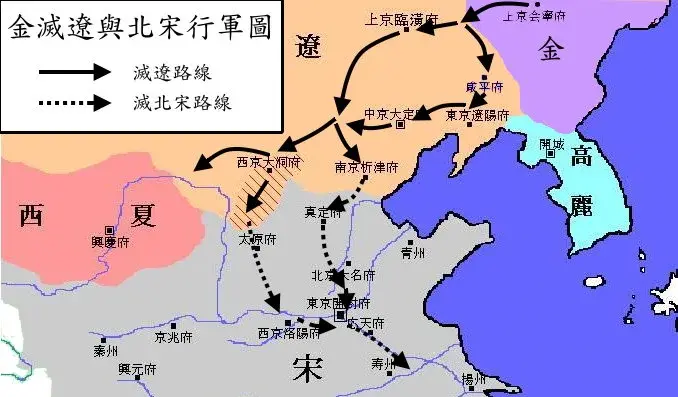
The Jin Conquest of Northern Song (金灭北宋之战) was a major strategic campaign waged between 1125 (the seventh year of the Xuanhe era of Song) and 1127 (the second year of the Jingkang era of Song), through which the rising Jurchen Jin Dynasty completely destroyed the Northern Song Dynasty. During the Xuanhe era of Emperor Huizong, Song and Jin forged the Maritime Alliance to launch a coordinated pincer attack against the crumbling Khitan Liao Dynasty. In the campaign, Song's military ineptitude and chronic administrative decay were laid bare to the Jurchen leadership. Following Liao's collapse, Song diplomats committed repeated diplomatic errors over border negotiations, covertly harboring surrendered generals and sending secret overtures to Khitan remnants. In October 1125, Emperor Taizong of Jin mobilized two field armies to invade Song territory. The eastern force under Wanyan Zongwang drove directly toward Bianjing, prompting Emperor Huizong to abdicate and flee south. Although newly enthroned Emperor Qinzong and minister Li Gang successfully repelled the initial siege through determined resistance and territorial concessions, Jin forces renewed their offensive in the autumn of 1126. Wanyan Zonghan captured Taiyuan and joined Zongwang to besiege Bianjing. Betrayed by incompetent defense preparations and charlatans, Bianjing fell in early 1127. Both emperors and over three thousand imperial kin were carried into northern captivity during the catastrophic Jingkang Incident, bringing a tragic conclusion to Northern Song rule.
Song and Jin agree to launch a joint campaign against Liao and negotiate the recovery of Yanshan
Jin forces launch dual offensives under Zongwang and Zonghan; Huizong abdicates and flees southward
Zongwang besieges Bianjing; Li Gang leads successful resistance before Qinzong signs a humiliating peace treaty
Taiyuan falls after heroic resistance; eastern and western Jin armies converge to envelop Bianjing
Jin armies sack Bianjing and carry both emperors and imperial clan into northern captivity, ending Northern Song rule
Ever since its founding, the Northern Song Dynasty had yearned to recover the strategic Sixteen Prefectures along the northern frontier. During the late reign of Emperor Huizong, the Jurchen Wanyan clan established the Jin Dynasty in Manchuria and inflicted crushing defeats on the Liao army. Seeking to exploit Liao's collapse, Song envoys crossed the Bohai Sea to negotiate the Maritime Alliance, agreeing that both empires would launch simultaneous strikes on Liao, after which Song would transfer its annual tributes from Liao to Jin in exchange for the Sixteen Prefectures.
However, during actual military operations, several hundred thousand Song soldiers were thoroughly routed by desperate Liao garrison units. Song was ultimately forced to plead for Jin assistance to take Yanjing. This fiasco completely exposed Northern Song's internal military vulnerability and administrative feebleness to the ambitious Jurchen generals.
After regaining control of Yanjing through financial negotiations, Song authorities failed to strengthen frontier fortifications and instead committed a series of grave diplomatic blunders. When Zhang Jue, a former Liao commander who had surrendered to Jin, revolted in Pingzhou and sought Song protection, Song officials secretly welcomed him. Upon receiving Jin ultimatums, Song authorities panicked, executed Zhang Jue, and sent his severed head to the Jin camp, severely alienating border garrisons.
Furthermore, Jin intelligence intercepted clandestine letters dispatched by Song officials attempting to incite the defeated Liao Emperor Tianzuo to mount an insurgency against Jin. Convinced that Northern Song was untrustworthy and militarily defenseless, Emperor Taizong of Jin issued an imperial declaration in October 1125 to launch an all-out southern punitive invasion.
In October 1125, the Jin high command launched a coordinated two-pronged offensive against the Song heartland. The Eastern Army was commanded by Prince Wanyan Zongwang, driving south from Pingzhou through Yanshan, while the Western Army was led by Chief Minister Wanyan Zonghan, advancing from Datong toward Taiyuan.
The Eastern Army made rapid progress. The Song frontier general Guo Yaoshi surrendered Yanshan and guided the invaders through undefended passes. Zongwang swept through Zhending and Zhongshan, reaching the north bank of the Yellow River by December. Paralyzed by panic, Emperor Huizong hastily abdicated to Crown Prince Zhao Huan (Emperor Qinzong) and fled south to Zhenjiang. Zongwang crossed the frozen Yellow River and laid siege to Bianjing. Meanwhile, the Western Army was pinned down beneath the walls of Taiyuan, where Song defender Wang Bing mounted an epic defense spanning over 250 days. Inside Bianjing, Qinzong appointed Li Gang to orchestrate city defenses, successfully beating back repeated Jin assaults with ballistas and catapults. However, Qinzong sued for peace, agreeing to cede the strategic prefectures of Zhongshan, Taiyuan, and Hejian while paying enormous indemnities of gold and silver. Satisfied with these concessions, Zongwang withdrew northward.
Following the retreat of the Eastern Army, conservative peace factions at the Song court regained influence and orchestrated the dismissal of resolute ministers Li Gang and Zhong Shidao. The Song court vacillated wildly regarding territorial cessions, failing to fulfill terms while neglecting defensive preparations and foolishly inciting border insurrections.
In August 1126, Emperor Taizong ordered both Jin armies to resume full-scale hostilities. Wanyan Zonghan launched relentless assaults against Taiyuan, which was reduced to famine after nine months of isolation; Wang Bing fought bravely until the walls fell and drowned himself in the Fen River. The Western Army crossed the Yellow River unobstructed, while Zongwang's Eastern Army advanced through Hebei. In December 1126, both Jin armies linked up outside the walls of Bianjing, establishing a complete siege that severed the capital from provincial relief armies.
Besieged by superior forces amid freezing winter conditions, Emperor Qinzong fell victim to superstitious deceit, placing blind trust in a mystic named Guo Jing, who claimed his "Six-Jia Divine Soldiers" could annihilate the enemy. In late December, Guo Jing ordered the Xuanhua Gate opened for a ritual charge; Jin cavalry immediately stormed the gateway, routing the defenders and seizing the outer walls.
Emperor Qinzong was coerced into surrendering at the Jin camp, where he was detained as a hostage. Jin commanders systematically looted the imperial treasury, temples, and private residences, extorting gold, silver, horses, and silk. Famine and plague ravaged the population. In the spring of 1127 (second year of the Jingkang era), Jin declared the deposition of the Song emperors, establishing the puppet Chu state under Zhang Bangchang. In April, Jin forces departed northward, dragging Emperors Huizong and Qinzong, empresses, imperial concubines, princes, princesses, high ministers, and skilled artisans—numbering over three thousand people—into northern captivity, alongside massive collections of imperial treasures and cultural archives. The Northern Song Dynasty was completely extinguished.
The campaign ended in an absolute Jin victory, resulting in the complete collapse of Northern Song central authority. The central plains of North China and the Yellow River basin were annexed into Jin administrative territory. Two reigning emperors and thousands of imperial family members were dragged into captivity, and Bianjing was thoroughly despoiled.
Known in Chinese history as the Jingkang Incident or the Humiliation of Jingkang, this catastrophe concluded Northern Song's 167-year rule over China. The war devastated northern agriculture and urban economies, prompting the southward migration of millions of northern refugees, scholars, and officials. Emperor Huizong's surviving son, Zhao Gou (Prince Kang), fled south to establish the Southern Song Dynasty at Lin'an (modern Hangzhou), commencing a century-long military standoff across the Huai River.