Founding of the Cao Wei Dynasty
Cao Pi accepts the abdication of Emperor Xian of Han, proclaims the Wei dynasty, and establishes Luoyang as capital.
Cao Wei (曹魏) · HISTORICAL EVENT
魏文帝改革与中央集权
Emperor Wen of Wei's Reforms and Centralization (魏文帝改革与中央集权) occurred between 220 AD and 226 AD (the Huangchu era of Cao Wei), representing a pivotal series of systemic reforms instituted by Emperor Wen (Cao Pi) after supplanting the Han dynasty to consolidate monarchical authority. Confronted with the disastrous memory of late Han eunuch and consort autocracy, alongside fierce succession disputes among imperial siblings, Cao Pi initiated…
Emperor Wen of Wei's Reforms and Centralization (魏文帝改革与中央集权) occurred between 220 AD and 226 AD (the Huangchu era of Cao Wei), representing a pivotal series of systemic reforms instituted by Emperor Wen (Cao Pi) after supplanting the Han dynasty to consolidate monarchical authority. Confronted with the disastrous memory of late Han eunuch and consort autocracy, alongside fierce succession disputes among imperial siblings, Cao Pi initiated comprehensive institutional restructuring. He elevated the Imperial Secretariat, appointing supervisors and directors to handle confidential decrees and divide executive power away from senior chancellors, firmly placing policy drafting under direct imperial purview. Furthermore, he codified strict prohibitions preventing empresses, dowagers, and consort relatives from interfering in statecraft, capped eunuch ranks, and placed imperial princes under rigorous surveillance while stripping them of troops. Emperor Wen's institutional measures established the foundations of the medieval Chinese bureaucratic apparatus, though his excessive suppression of royal princes left the throne defenseless when Sima Yi launched his coup decades later.
Cao Pi accepts the abdication of Emperor Xian of Han, proclaims the Wei dynasty, and establishes Luoyang as capital.
Cao Pi creates the Imperial Secretariat to draft edicts and divide the authority of senior chancellors.
Supervisory commissioners are assigned to royal estates, disarming princely households.
Cao Pi issues decrees barring imperial maternal kin and palace eunuchs from statecraft.
Cao Pi dies in Luoyang, succeeded by Cao Rui, ensuring the longevity of his centralization policies.
In the tenth lunar month of 220 AD (the first year of Yankang), Emperor Xian of Han was compelled to abdicate the imperial throne to Cao Pi, King of Wei. Cao Pi ascended the throne at Fanyang, proclaimed the founding of the Great Wei dynasty, changed the era name to Huangchu, and established Luoyang as the imperial capital. This coronation brought a definitive conclusion to the four-century reign of the Han dynasty and formally commenced the Three Kingdoms era.
As the founding monarch of a newly established regime, Cao Pi faced severe domestic and external tribulations. Externally, Shu Han claimed the legitimate mantle of the Han dynasty while Eastern Wu vacillated between submission and open rebellion. Internally, the memory of rampant palace eunuchs and imperial in-laws paralyzing governance remained vivid. The new administration integrated former Han bureaucrats and founding Cao generals, requiring coherent administrative discipline and institutional legitimacy.
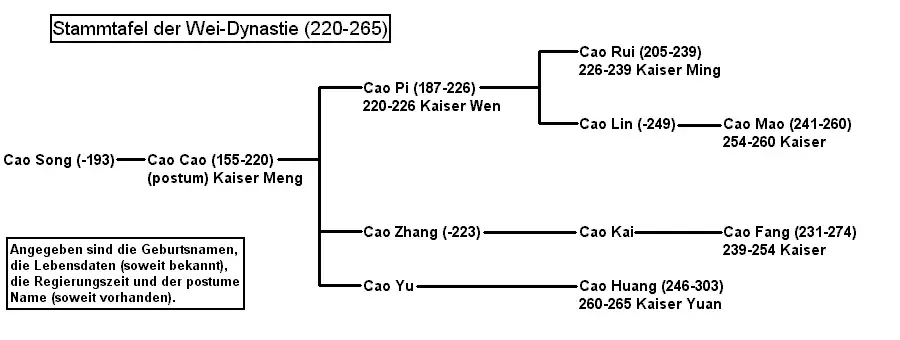
During the twilight of Cao Cao's rule, a bitter political struggle for the heir-apparency erupted between Cao Pi, his younger brother Cao Zhi (Marquis of Linzi), and Cao Zhang (King of Rencheng). Cao Zhi possessed peerless literary prestige and commanded a loyal coterie of influential scholars, while Cao Zhang was a renowned cavalry general who had pacified northern Wuhuan tribes and marched troops to Luoyang demanding the royal seals upon Cao Cao's demise.
The specter of fratricidal conflict and militarized princes instilled deep suspicion and dread within Cao Pi. He recognized that without institutional safeguards governing the central executive, the imperial bedchamber, and royal appanages, the newly founded Wei dynasty would repeat the historical tragedies of the Han dynasty's fall and the Rebellion of the Seven States.
Immediately upon his accession in 220 AD, Cao Pi enacted sweeping reforms of central decision-making organs. Under the Eastern Han system, administrative authority resided primarily in the Department of State Affairs, which remained under the oversight of senior ministers and the Three Excellencies who retained significant power to block royal policies.
Cao Pi restructured the archival Palace Library into the independent Imperial Secretariat, appointing a Secretariat Supervisor and a Secretariat Director, each holding substantial official rank, reporting exclusively to the throne. He appointed intimate policy advisers Liu Fang and Sun Zi to these offices, empowering them to draft imperial edicts, manage state correspondence, and participate directly in national strategy. The emergence of the Imperial Secretariat created an executive body strictly subordinate to the monarch outside the traditional chancellery. This effectively curtailed the power of the chancellor, shifting core decision-making into the inner court and setting a precedent that lasted for centuries.
The horrors of Eastern Han warlords and palace eunuchs manipulating the court remained indelibly etched in Cao Pi's consciousness. In the ninth lunar month of 222 AD (the third year of Huangchu), Cao Pi promulgated a historic imperial decree, inscribing it upon bronze tablets preserved in stone vaults to bar consorts and maternal relatives from political office.
The decree strictly mandated that imperial consorts and their families could not participate in governance, court ministers were forbidden from presenting petitions to the Empress Dowager, and imperial maternal relatives could neither serve as regents nor receive noble fiefs, with any violations punishable by death. Concurrently, Cao Pi restricted eunuchs to lower palace clerical rankings and barred them from receiving noble titles, participating in court councils, or holding military commands. Through statutory codification, Cao Pi severed the institutional avenues through which palace favorites and consort clans had historically dismantled dynastic authority.
Simultaneously, Cao Pi moved with ruthless determination to neutralize potential threats from his royal brothers. He stripped imperial princes of judicial and military authority within their nominal fiefdoms, decreeing that regional administration be managed exclusively by state-appointed chancellors and commandery governors.
Furthermore, Cao Pi established the Supervisory Bureau, stationing imperial commissioners within each princely estate to monitor daily movements and report alleged improprieties. Princes were strictly barred from crossing domain boundaries, communicating privately, or visiting one another. Cao Pi repeatedly demoted Cao Zhi, banishing him across marginal commanderies such as Juancheng, Dong'e, and Chenxian while drastically slashing his revenue households. Following the sudden death of Cao Zhang during an audience in Luoyang, the imperial princes lived under perpetual surveillance, stripped of armed guards and political relevance.
Emperor Wen's creation of the Imperial Secretariat marked an indispensable transition in Chinese governance from the Qin-Han Two Excellencies and Nine Ministers system toward the Sui-Tang Three Departments and Six Ministries system. The institutional division between decree-drafting secretariats and executive departments significantly enhanced monarchical efficiency and consolidated direct control over regional tax registers and judicial circuits. This structural framework was adopted by Western Jin and successive southern and northern regimes.
However, Emperor Wen's excessive paranoia toward his own siblings undermined the longevity of the dynasty. By completely disarming imperial princes and treating them as suspects, the Cao Wei crown was left devoid of armed royal champions. When Sima Yi staged the Incident at Gaoping Tombs decades later against regent Cao Shuang, not a single imperial prince possessed the troops or political influence to rally forces in defense of the throne, leaving the house of Cao helpless before the Sima usurpation.