Accession of Emperor Huai
Sima Chi becomes emperor under the Yongjia era title while Prince of Donghai Sima Yue retains autocratic control.
Western Jin Dynasty (西晋) · HISTORICAL EVENT
永嘉
The Disaster of Yongjia and Southward Migration (永嘉) was a catastrophic political and military collapse of the Western Jin dynasty accompanied by a colossal exodus of northern elites and commoners to the Yangtze River basin. Following the devastating sixteen-year War of the Eight Princes during the reign of Emperor Hui, the military might of the Central Plains was depleted, while inner frontier nomadic groups such as the Xiongnu and Jie rose in…
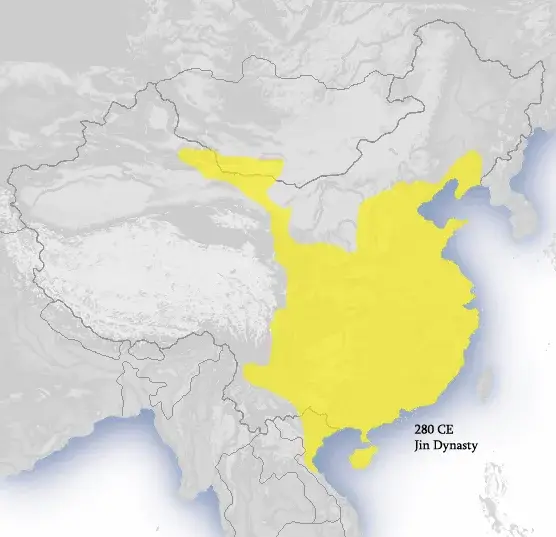
The Disaster of Yongjia and Southward Migration (永嘉) was a catastrophic political and military collapse of the Western Jin dynasty accompanied by a colossal exodus of northern elites and commoners to the Yangtze River basin. Following the devastating sixteen-year War of the Eight Princes during the reign of Emperor Hui, the military might of the Central Plains was depleted, while inner frontier nomadic groups such as the Xiongnu and Jie rose in widespread rebellion. In 306, Emperor Huai (Sima Chi) ascended the throne and adopted the Yongjia era title, yet intense power struggles between the emperor and Grand Tutor Sima Yue paralyzed the central government. In 311, Sima Yue died of illness while on campaign. Jie general Shi Le pursued and encircled the retreating Jin army at Ku County, slaughtering over 100,000 elite troops and capturing Chancellor Wang Yan. Two months later, Han Zhao commanders Liu Yao and Huyan Yan stormed the capital Luoyang, torching imperial palaces, taking Emperor Huai captive, and slaughtering more than 30,000 residents. The fall of Luoyang triggered the first mass migration in Chinese history, known as the "Southward Migration of the Robes and Caps," which laid the foundation for the Eastern Jin dynasty and permanently shifted the cultural and economic landscape of southern China.
Sima Chi becomes emperor under the Yongjia era title while Prince of Donghai Sima Yue retains autocratic control.
Han Zhao establishes its capital at Pingyang, stepping up campaigns to dismantle the Western Jin.
Sima Yue departs Luoyang with 40,000 elite guards and over 100,000 followers, leaving the capital defenseless.
Sima Yue dies of illness at Xiangcheng, prompting a disorganized retreat led by Chancellor Wang Yan.
Shi Le ambushes and annihilates the Jin army at Ku County, capturing and executing Wang Yan and core aristocrats.
Han Zhao forces storm Luoyang, slaughter 30,000 people, burn palaces, and capture Emperor Huai.
Northern aristocrats and refugees re-establish the dynasty at Jiankang, elevating Sima Rui to the throne.
Upon founding the Western Jin, Emperor Wu enfeoffed numerous imperial princes with large personal armies, embedding deep structural instability. Following Emperor Hui's accession, violent power struggles among imperial regents, Empress Jia, and rival princes ignited sixteen years of fraternal warfare. Hundreds of thousands of soldiers and civilians perished, agricultural fields were laid waste, and the imperial treasury was emptied. The Western Jin aristocracy became infamous for hedonism and rigid nine-rank patronage, provoking intense social and ethnic resentment across the empire.
Since the Eastern Han and Three Kingdoms periods, imperial courts had forcibly resettled hundreds of thousands of Xiongnu, Jie, Di, Qiang, and Xianbei peoples into Shanxi and Guanzhong as tenant laborers and auxiliary troops. Subjected to harsh exploitation and legal discrimination, these groups harbored deep hostility toward Jin officials. As civil war crippled Jin authority, nomadic chieftains seized the opportunity to declare independence. Xiongnu noble Liu Yuan founded the Han Zhao dynasty in Shanxi, claiming descent from the Han imperial line and conquering northern commanderies, steadily tightening an encirclement around the Jin capital Luoyang.
Ascending the throne in 307, Emperor Huai attempted to restore royal prerogative, but supreme power was monopolized by Grand Tutor Sima Yue (Prince of Donghai). Paranoid and ruthless, Sima Yue purged dissenters and executed prominent courtiers, exacerbating mutual suspicion within the palace. Concurrently, Han Zhao forces led by Liu Cong, Liu Yao, and Shi Le launched repeated offensives across Shanxi and Henan, severing overland grain supplies to Luoyang. The capital suffered severe famine, with historical records documenting widespread starvation and cannibalism.
In the eleventh month of 310, realizing that Luoyang was untenable and facing isolation, Sima Yue made the fateful decision to march out of the capital. Taking over 40,000 elite palace guards, civil ministers, and over 100,000 accompanying royals and civilians, he established camp at Xiangcheng, leaving the young emperor and the imperial capital undefended.
In the third month of 311, Sima Yue died of anxiety and illness in camp. The assembled ministers elected Chancellor Wang Yan to lead the demoralized army on a retreat toward the Donghai principality. Informed of the retreat, Jie cavalry commander Shi Le led elite light cavalry in relentless pursuit. In the fourth month, Shi Le intercepted the cumbersome Jin convoy at Zhecheng in Ku County (modern Luyi, Henan).
Shi Le's horse archers encircled the dense mass of troops and refugees, unleashing devastating showers of arrows. Panic swept through the trapped crowds, and imperial resistance collapsed completely. More than 100,000 Jin soldiers and civilians were slaughtered or trampled to death. Wang Yan, Prince Sima Fan of Xiangyang, and dozens of high-ranking aristocrats were captured. During interrogation, Wang Yan sought to evade blame and urged Shi Le to claim the throne; disgusted by his spineless flattery, Shi Le ordered soldiers to push down a mud wall upon him during the night. This catastrophe annihilated the last mobile field army of the Western Jin.
With Jin military strength extinguished, Han Zhao ruler Liu Cong launched a three-pronged final assault on Luoyang. In the fifth month of 311, vanguard general Huyan Yan defeated peripheral garrisons and torched the outer gates. In the sixth month, Liu Yao and Wang Mi arrived with reinforcements, breaching Pingchang Gate and swarming into the city center.
Han Zhao troops plundered the capital, burning imperial palaces, defiling the dynastic ancestral temples, and pillaging imperial tombs. Over 30,000 princes, courtiers, and commoners were massacred. Emperor Huai attempted to flee through the rear gardens in disguise but was captured by enemy soldiers. The crown prince and remaining court officials were executed. Emperor Huai and the imperial jade seal were transported to the Han Zhao capital at Pingyang, reducing the storied imperial capital of Luoyang to smoldering ruins and extinguishing Western Jin governance across the north.
The Disaster of Yongjia struck a fatal blow to the Western Jin. Although Emperor Min was temporarily crowned at Chang'an, he was captured by Liu Yao in 316, marking the formal extinction of the Western Jin. The Yellow River valley fractured into chaotic warfare between rival Xiongnu, Jie, Di, Qiang, and Xianbei factions during the Sixteen Kingdoms era. Northern agricultural civilization suffered devastating disruption, and imperial unification was fractured for nearly three centuries.
To escape the devastating violence, hundreds of thousands of royal relatives, aristocratic clans, and common families fled south across the Huai and Yangtze rivers. This mass demographic shift infused the sparsely populated southern provinces with abundant skilled labor, advanced iron smelting technology, and intensive farming techniques. The influx catalyzed rapid agricultural and commercial development throughout the middle and lower Yangtze valley, fostering deep cultural synthesis between northern migrants and indigenous southern populations.
In the Book of Jin (Jin Shu, Basic Annals of Emperor Huai), Fang Xuanling reflected: "Emperor Huai honored ancestral laws and attended to state affairs, showing the traits of an average monarch. Yet amid supreme national catastrophe, Sima Yue monopolized authority and slaughtered kin while barbarian armies struck from without. Shi Le ravaged the Heluo plain and Liu Cong surged across Bingzhou; the collapse of the state cannot be blamed upon a single man."
In Zizhi Tongjian, Song historian Sima Guang bitterly noted: "Men like Wang Yan held high ministerial office yet failed to rescue the realm, prioritizing frivolous metaphysical debates until the sacred land was submerged in ruin. Never in history has a dynasty collapsed so swiftly and brutally." This highlighted how intellectual vanity and abdication of practical governance brought tragedy upon Chinese civilization.