Imperial Mandate
Möngke Khan designates Hulagu to command the Third Western Campaign, mobilizing ten percent of the empire's warriors.
Mongol Empire · HISTORICAL EVENT
旭烈兀西征
Hulagu's Western Expedition (旭烈兀西征), traditionally designated the Third Mongol Western Campaign, was a momentous imperial military offensive conducted from 1252 to 1260 in which Möngke Khan dispatched his younger brother Hulagu at the head of a one-hundred-thousand-strong army to subjugate West Asia. Following the western conquests of Genghis Khan and Batu, the Nizari Ismaili state (the Assassins) continued assassinating Mongol officials from mountain…
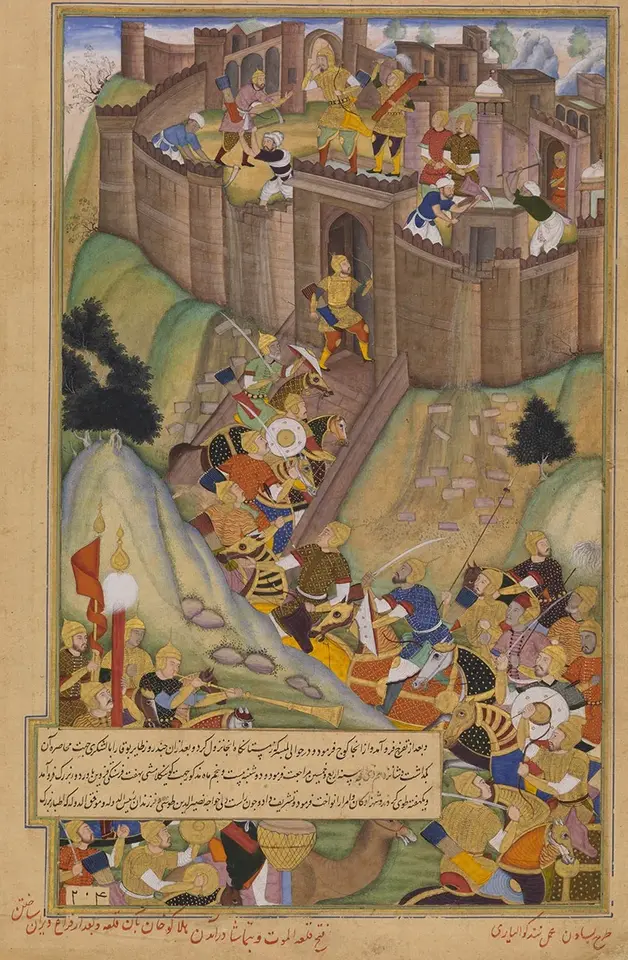
Hulagu's Western Expedition (旭烈兀西征), traditionally designated the Third Mongol Western Campaign, was a momentous imperial military offensive conducted from 1252 to 1260 in which Möngke Khan dispatched his younger brother Hulagu at the head of a one-hundred-thousand-strong army to subjugate West Asia. Following the western conquests of Genghis Khan and Batu, the Nizari Ismaili state (the Assassins) continued assassinating Mongol officials from mountain strongholds, while the Abbasid Caliph in Baghdad repeatedly refused to surrender. In 1252, Möngke ordered two out of every ten warriors across the empire to form an elite strike force, accompanied by Chinese siege engineers and counterweight trebuchet specialists. In 1256, Hulagu crossed the Amu Darya, systematically reducing mountain fortresses like Alamut and dismantling the Assassin order. In late 1257, Mongol columns encircled Baghdad; in February 1258, siege corps directed by Chinese general Guo Kan breached the walls, capturing and executing Caliph Al-Musta'sim and terminating the five-century-old Abbasid Caliphate. Continuing westward in 1259, Hulagu toppled the Ayyubid Dynasty, capturing Aleppo and Damascus. Following Möngke Khan's death at Diaoyu Castle in 1259, Hulagu withdrew his main army to contest imperial succession, leaving general Kitbuqa, who was defeated at the Battle of Ain Jalut in 1260. Hulagu established the Ilkhanate across the Iranian Plateau, permanently altering Middle Eastern history.
Möngke Khan designates Hulagu to command the Third Western Campaign, mobilizing ten percent of the empire's warriors.
Kitbuqa leads vanguard divisions into Persia, followed by Hulagu's siege trains.
Mongol divisions cross the Amu Darya, systematically reducing Alamut and eradicating the Nizari Ismaili state.
Three converging Mongol columns besiege Baghdad, pounding its defenses with heavy siege engines.
Baghdad capitulates; Caliph Al-Musta'sim is executed, ending five centuries of Abbasid rule.
Mongol armies take Aleppo and Damascus, collapsing the Syrian Ayyubid Dynasty.
Following Hulagu's departure due to Möngke's death, Kitbuqa is defeated and killed by Mamluk forces.
Hulagu assumes the title of Ilkhan in Tabriz, establishing the Ilkhanate across West Asia.
In the early 13th century, Genghis Khan launched the First Western Campaign, annihilating the Khwarazmian Empire and securing control over Central Asia and eastern Persia. Subsequently, during Ögedei Khan's reign, Batu Khan commanded the Second Western Campaign, subduing the Kipchak Steppe and Russian principalities to establish the Golden Horde. However, across the western Iranian Plateau, Mesopotamia, and Syria, powerful indigenous Islamic polities remained defiant.
Among these, the Nizari Ismaili state (known in Europe as the Order of Assassins) commanded hundreds of formidable mountain citadels across the Alborz mountain range, routinely dispatching assassins against regional governors and plotting attacks against Mongol royalty. Simultaneously, the Abbasid Caliphate in Baghdad enjoyed preeminent spiritual prestige as the nominal supreme authority of the Sunni Muslim world, repeatedly rebuffing imperial ultimatums to render vassal submission.
In 1251, Tolui's eldest son Möngke ascended the throne as the fourth Khagan of the Mongol Empire. Möngke formulated an ambitious dual-theater expansion strategy: entrusting Kublai with conquering the Southern Song Dynasty, while directing imperial resources toward the total conquest of Southwest Asia.
In 1252 (Möngke Khan 2), Persian regional commissioners reported that Assassin agents had infiltrated the steppe to assassinate the Khagan. Möngke convened an imperial Kurultai and formally inaugurated the Third Western Campaign. He designated his brother Hulagu as supreme commander, decreeing: "From every ten warriors across the thousands of Genghis Khan's lineages, two shall march." He reinforced the host with a thousand Chinese trebuchet engineers, sappers, and gunpowder specialists, forging a formidable multi-arms expeditionary force.
In the autumn of 1253, Hulagu held grand sacrificial departures along the Onon River, dispatching vanguard general Kitbuqa with twelve thousand cavalry to establish frontline outposts in the Iranian Plateau. Hulagu followed deliberately with the main army, escorting hundreds of thousands of supply wagons, herds, siege engines, and artillery trains.
Chagatai and Ögedei princely domains along the route smoothed roadways, erected timber bridges, and stockpiled grain reserves. In late 1255, Hulagu's main host reached Samarkand; in early 1256, pontoon bridges spanned the Amu Darya into Iran, where regional Persian feudal lords submitted without resistance.
The initial campaign objective targeted the impregnable Nizari Ismaili state. Assassin grand master Rukn al-Din Khurshah relied on precipitous crags at Maymun-Diz and Alamut, boasting perennial water cisterns and provisions to withstand prolonged siege.
Hulagu applied systematic sapping and artillery barrages. Chinese commander Guo Kan directed laborers in cutting zig-zag mountain trails, hoisting dismantled trebuchets and heavy ballistas onto high summits to rain boulders and incendiary bombs into the forts.
In November 1256, facing relentless bombardment and starvation, Rukn al-Din descended Maymun-Diz to surrender. Hulagu compelled him to sign edicts ordering all Assassin garrison commanders to dismantle their fortresses. Rukn al-Din was dispatched toward Karakorum and executed en route, extinguishing the Assassin order after 160 years of regional dominance.
Turning west, Hulagu issued an ultimatum to the thirty-seventh Abbasid Caliph, Al-Musta'sim, in September 1257, demanding the demolition of Baghdad's defenses and personal submission. Confident in his veteran garrison and Baghdad's historic prestige, the Caliph arrogantly refused.
Hulagu mobilized three convergent columns: the right wing under Kitbuqa and Baiju advanced from northern Iraq; the left wing swung through Khuzestan; and Hulagu advanced directly along the Kermanshah corridor. By January 1258, the three columns formed an unbreakable ring around Baghdad. Heavy trebuchets directed by Guo Kan battered the brick ramparts, while fire-arrows ignited palace quarters.
On February 10, 1258, following the collapse of the eastern battlements, Caliph Al-Musta'sim surrendered alongside three thousand officials. The Mongol army entered the metropolis, executing the garrison and scattering imperial libraries into the Tigris. Respecting nomadic taboos against spilling royal blood on the earth, Hulagu had Al-Musta'sim wrapped in a thick wool rug and trampled to death by horses, terminating the 508-year-old Abbasid Caliphate.
Following the sack of Baghdad, Hulagu crossed the Euphrates into Syria in late 1259, targeting the Ayyubid Dynasty. Mongol siege engines encircled Aleppo, breaching its thick masonry within seven days.
Ayyubid Sultan An-Nasir Yusuf fled south in panic. In March 1260, Damascus opened its gates without resistance. General Kitbuqa led Christian and Mongol detachments into the ancient city, projecting Mongol authority to the Mediterranean coast and threatening Mamluk Egypt.
As Hulagu prepared to cross the Sinai Desert, word arrived that Möngke Khan had fallen in battle at Diaoyu Castle in Sichuan, igniting a civil war between Kublai and Ariq Böke for the imperial succession.
Fearing for his political interests, Hulagu marched the bulk of his veteran army eastward back to Persia, leaving Kitbuqa with only twenty thousand troops to hold Syria. Sensing opportunity, Mamluk Sultan Qutuz and commander Baybars marched northward from Egypt.
On September 3, 1260, the armies clashed at the Battle of Ain Jalut in northern Palestine. Mamluk cavalry feigned retreat to lure Kitbuqa's forces into an ambush. Kitbuqa fought tenaciously to the end, falling in battle as his army disintegrated. Ain Jalut halted Mongol expansion into North Africa, establishing the western frontier of the Mongol world.
Retaining vast domains from the Amu Darya to Mesopotamia, Hulagu established the Ilkhanate with its capital at Tabriz in 1260, governing West Asia for generations.
Hulagu's Western Expedition eradicated two ancient Islamic powers: the Nizari Ismaili Assassins were systematically uprooted from their mountain bastions, and the 508-year-old Abbasid Caliphate in Baghdad was destroyed. Hulagu founded the Ilkhanate centered in Tabriz, establishing administrative governance across modern Iran, Iraq, Azerbaijan, and eastern Anatolia.
The expedition transformed the geopolitical landscape of the Islamic world, shifting the religious and political center of gravity from Baghdad to Cairo and later Ottoman Istanbul. Culturally, the Ilkhanate integrated Chinese, Persian, and Arabic civilizations under a unified imperial trade network, disseminating Chinese block-printing, artillery, and astronomy into the Middle East while transmitting Islamic mathematics and medicine to Yuan-era China.
Modern historians view Hulagu's Western Expedition as a pivotal turning point in world history. While inflicting tremendous military destruction, it breached long-standing geopolitical barriers across Eurasia. By combining mobile nomadic cavalry with advanced Chinese siege technologies, the campaign dismantled archaic theocratic structures and forged early transcontinental commercial networks that spurred the Persian cultural renaissance.