Mount Changbai Uprising
Wang Bo launches armed resistance in Shandong, composing the anti-conscription ballad that ignites empire-wide rebellion.
Sui Dynasty (隋朝) · HISTORICAL EVENT
隋末农民大起义
The Peasant Uprisings of the Late Sui Dynasty (隋末农民大起义) were a massive wave of popular armed rebellions from 611 to 624 (from the seventh year of the Daye era of Sui to the seventh year of the Wude era of Tang) triggered by state extortion, crushing military drafts, and continuous frontier warfare. Following his ascension, Emperor Yang of Sui indulged in lavish architectural undertakings, conscripting millions to construct the eastern capital of…
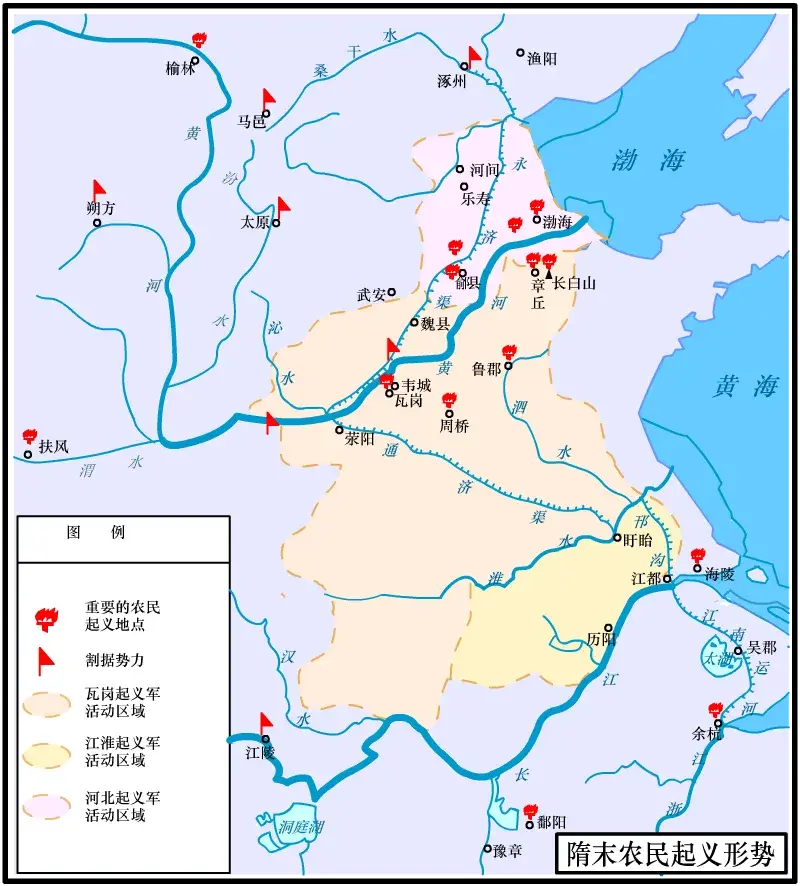
The Peasant Uprisings of the Late Sui Dynasty (隋末农民大起义) were a massive wave of popular armed rebellions from 611 to 624 (from the seventh year of the Daye era of Sui to the seventh year of the Wude era of Tang) triggered by state extortion, crushing military drafts, and continuous frontier warfare. Following his ascension, Emperor Yang of Sui indulged in lavish architectural undertakings, conscripting millions to construct the eastern capital of Luoyang and the Grand Canal, while simultaneously launching three catastrophic campaigns against the kingdom of Goguryeo. In 611, Wang Bo raised the banner of rebellion at Mount Changbai in Shandong, composing the ballad Song of Not Dying Meaninglessly in Liaodong, which ignited rebellions across China. Three formidable rebel coalitions emerged: the Wagang Army in Henan led by Zhai Rang and Li Mi, Dou Jiande's forces in Hebei, and Du Fuwei's forces across Jianghuai. The Wagang Army seized the imperial Luokou Granary to feed impoverished peasants, inflicting crushing defeats on elite Sui garrison divisions. In 618, Emperor Yang was assassinated during the Jiangdu mutiny, bringing about the formal collapse of the Sui. This widespread insurrection destroyed despotic Sui rule, liberated vast numbers of agricultural dependents, and prompted early Tang monarchs to adopt benevolent, low-tax policies that fostered the Zhenguan Reign.
Wang Bo launches armed resistance in Shandong, composing the anti-conscription ballad that ignites empire-wide rebellion.
Minister of Rites Yang Xuangan rebels at Liyang, shattering political cohesion among the ruling aristocracy.
The Wagang Army ambushes and slays Sui commander Zhang Xutuo at Dahaisi, establishing dominance in Henan.
Wagang forces capture the imperial grain reserves at Luokou and distribute grain, expanding their force to hundreds of thousands.
The Jiangdu palace mutiny terminates Emperor Yang's life, resulting in the formal dissolution of the Sui dynasty.
The Tang military completes the subjugation of rival regional contenders, restoring peace across China.
Although Emperor Wen unified China and established the prosperous Kaihuang Reign, centralized taxation and corvée demands remained burdensome. Upon ascending the throne, Emperor Yang accelerated imperial spending. Throughout the Daye era, he conscripted millions of peasants to erect the palaces of Luoyang, construct the imperial pleasure parks of Xiyuan, and excavate over 2,700 kilometers of the Grand Canal. Relentless corvée levies tore agricultural laborers away from their fields, plunging the rural populace into acute distress.
In 611, Emperor Yang decreed a total mobilization to conquer the Korean kingdom of Goguryeo, requisitioning millions of conscripts, cavalry mounts, provisions, and naval transports nationwide. Imperial magistrates compelled women to push supply carts across vast distances, while shipyard laborers worked submerged in water until their lower bodies suffered from severe gangrenous infections. Compounding these burdens, severe droughts and floods struck the Yellow and Huai river valleys, leaving millions destitute and driving desperate farming populations toward organized armed insurrection.
In the autumn of 611, Wang Bo gathered an insurgent force at Mount Changbai in Qijun (modern Zhangqiu, Shandong). Proclaiming himself the "Man Who Knows the World," he composed the vernacular ballad Song of Not Dying Meaninglessly in Liaodong, inciting the populace to resist military conscription. Wang Bo's defiance triggered uprisings across the realm: Liu Badao rose in Douzikeng, Sun Anzu and Dou Jiande mobilized in Gaojibo, and Du Fuwei took up arms in the Jianghuai basin.
Among these insurgent groups, the Wagang Army expanded rapidly across the Central Plains. In 611, Zhai Rang gathered hundreds of outlaws at the Wagang Redoubt in Dongjun. In 616, aristocratic strategist Li Mi joined the movement, and Zhai Rang made him chief operational planner. Li Mi advised seizing major imperial granaries to win over famine-stricken populations. In the spring of 617, the Wagang Army launched a surprise assault on the Xingluo Granary (Luokou Granary), opening its stores to the public. Hundreds of thousands of peasants joined their ranks. The Wagang Army ambushed and killed senior Sui general Zhang Xutuo at Dahaisi near Xingyang, subsequently advancing on Luoyang and routing imperial armies commanded by Wang Shichong.
While fierce combat raged in the Central Plains, Dou Jiande proclaimed himself King of Changle in Hebei, establishing the Xia state and earning widespread popular support through disciplined governance. In the south, Du Fuwei established dominance across Jianghuai, seizing Liyang and severing grain transit along the Grand Canal. As Sui local administration collapsed, frontier generals and Guanlong aristocrats formed autonomous regional regimes.
In the autumn of 616, recognizing that northern rebellions had spiraled out of control, Emperor Yang fled south on the imperial dragon barge to Jiangdu (modern Yangzhou, Jiangsu). In the fifth month of 617, Li Yuan, the garrison commander of Taiyuan, rose in rebellion at Jinyang, advanced into Guanzhong, captured Chang'an, and installed puppet emperor Yang You. In the third month of 618, rebellious palace guards led by Yuwen Huaji assassinated Emperor Yang at Jiangdu, extinguishing direct Sui dynastic rule. Two months later, Li Yuan deposed the puppet monarch and proclaimed the Tang dynasty. Through major campaigns at Luoyang and the Battle of Hulao, the Tang defeated rival contenders, including Wang Shichong, Dou Jiande, and Du Fuwei, restoring national unity by 624.
The late Sui peasant rebellions dismantled the institutional structure of the Sui dynasty. Emperor Yang was murdered in Jiangdu, and imperial command over provinces and garrisons evaporated. While primary insurgent forces such as the Wagang Army were eventually ground down by internal divisions and defeated by the emerging Tang military, their campaigns destroyed the old dynastic machinery and cleared the path for a new imperial order.
The late Sui rebellions transformed early medieval Chinese society. Aristocratic lineages and hereditary magnate houses that had dominated politics since the Northern and Southern dynasties suffered severe losses, while vast numbers of bonded agricultural dependents gained free status as registered imperial smallholders. Terrified by the destructive power of popular uprisings, Emperor Taizong and his advisors internalized the political maxim: "The ruler is like a boat, and the common people are like water; water can carry the boat, but it can also overturn it." This political awareness fostered benevolent governance, light taxation, and agricultural rehabilitation, laying the foundations for the Zhenguan Reign.