Catastrophe at Fei River
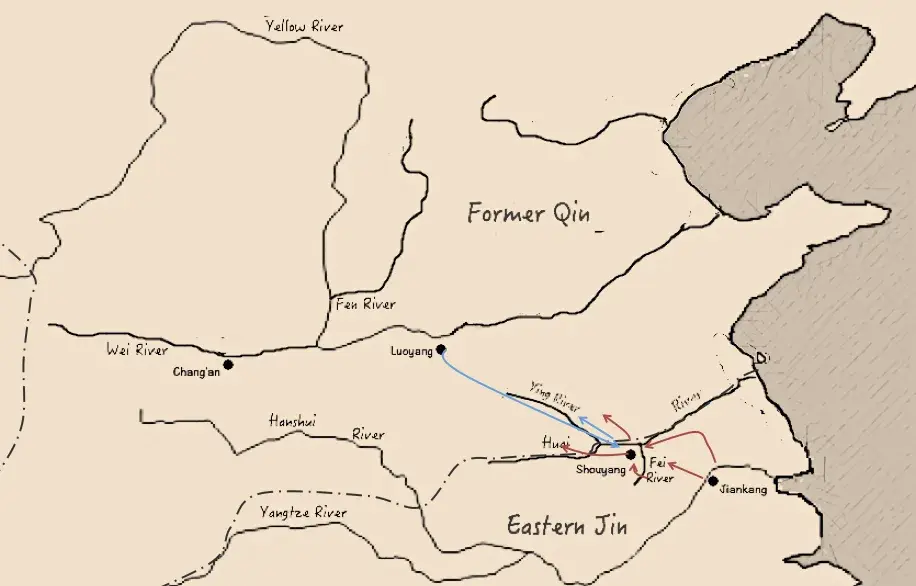
Former Qin imperial forces are routed at Fei River, destroying central coercive authority and dissolving imperial order
Former Qin, Later Yan, Later Qin, Western Yan, Northern Wei (Sixteen Kingdoms Period) · HISTORICAL EVENT
淝水战后北方再分裂
The Fragmentation of Northern China after the Battle of Fei River (淝水战后北方再分裂) refers to the rapid collapse of the Former Qin Empire and the subsequent fragmentation of northern China into rival ethnic states following Emperor Fu Jian's defeat in 383 CE. In the aftermath of the military debacle at the Fei River, former tribal aristocracies who had submitted to Di authority rebelled to reclaim sovereign independence. In the eastern plains, Xianbei general…
The Fragmentation of Northern China after the Battle of Fei River (淝水战后北方再分裂) refers to the rapid collapse of the Former Qin Empire and the subsequent fragmentation of northern China into rival ethnic states following Emperor Fu Jian's defeat in 383 CE. In the aftermath of the military debacle at the Fei River, former tribal aristocracies who had submitted to Di authority rebelled to reclaim sovereign independence. In the eastern plains, Xianbei general Murong Chui founded Later Yan and captured Ye. In the Guanzhong heartland, Murong Chong founded Western Yan, sacking the imperial capital of Chang'an. Concurrently, Qiang chieftain Yao Chang established Later Qin in northern Shaanxi and executed Fu Jian at the Xinping Buddhist Temple in 385. In the northern frontier steppes, Tuoba Gui revived the Tuoba state as Northern Wei, while Qifu Guoren founded Western Qin in Longyou and Lu Guang carved out Later Liang in the Hexi Corridor. Although Former Qin loyalists under Fu Pi and Fu Deng resisted in the western mountains, Later Qin eliminated the final remnants in 394. The fragmentation shattered the fragile peace established by Former Qin, returning the Yellow River basin to prolonged warfare during the late Sixteen Kingdoms period until Northern Wei under Emperor Taiwu reunified northern China.
Former Qin imperial forces are routed at Fei River, destroying central coercive authority and dissolving imperial order
Murong Chui declares the restoration of Yan at Yingyang, besieging Ye and conquering the eastern commanderies of Hebei
Yao Chang rallies Qiang warriors at Baimayuan, proclaiming himself King of Ten Thousand Years and founding Later Qin
Murong Chong's Western Yan forces breach Chang'an, sacking the city and forcing Fu Jian to flee to Mount Wujiang
Yao Chang captures Fu Jian and executes him inside the Xinping Buddhist Temple after he refuses to surrender the imperial seal
Tuoba Gui convenes the Niuchuan assembly to revive the state as Northern Wei, as Western Qin and Later Liang establish independence
Yao Xing kills Fu Deng at Mount Maomao, extinguishing the final Former Qin loyalist forces and entrenching northern fragmentation
Following the conquest of Liangzhou and the Tuoba Dai state in 376 CE, the Former Qin Empire under Emperor Fu Jian unified northern China for the first time since the collapse of the Western Jin dynasty. However, this imperial unification was founded primarily upon Fu Jian's personal military prestige and lenient political accommodations rather than administrative or cultural integration.
Emperor Fu Jian practiced an exceptional policy of clemency toward vanquished aristocracies. Upon annexing rival kingdoms such as Former Yan and Former Liang, he refrained from disbanding their private armies, retaining their princes in high-ranking administrative offices with their retinues intact. Prominent non-Di figures, including Murong Chui and Murong Chong of the Xianbei and Yao Chang of the Qiang, were stationed near the imperial capital of Chang'an and in vital commanderies throughout Hebei. The Han prime minister Wang Meng had repeatedly urged Fu Jian to execute these potential dynastic challengers, but the emperor dismissed his warnings, preserving destabilizing elements at the core of the state.
In August 383, Fu Jian mobilized hundreds of thousands of multi-ethnic conscripts to conquer the Eastern Jin dynasty. However, at the Battle of the Fei River in November, the diverse Qin vanguard dissolved into uncontrollable panic when ordered to withdraw along the riverbanks. The army disintegrated, Field Commander Fu Rong was killed, and Fu Jian escaped wounded with remnants of his cavalry.
The defeat annihilated the core Di imperial guards that maintained dynastic order. The aura of invulnerability surrounding Fu Jian was destroyed, eliminating the coercive authority of the central court. Across northern China, regional garrisons and tribal leaders recognized that imperial authority had vanished, unleashing longstanding ambitions to restore autonomous ethnic realms.
Following the rout at the Fei River, while other army divisions disintegrated, Murong Chui's detachment of thirty thousand elite Xianbei cavalry remained intact. In the retreat, Murong Chui sheltered the fleeing Fu Jian. Although his son Murong Bao urged him to assassinate the defeated emperor, Murong Chui declined, citing gratitude for past imperial shelter, and requested permission to march east to pacify regional unrest in Hebei.
Fu Jian granted his request, releasing his most capable adversary. Upon arriving in the eastern plains, Murong Chui rallied Xianbei retainers and local gentry around Anyang. In January 384, Murong Chui assumed the title of King of Yan at Yingyang, adopting the era name Yanxuan and establishing the Later Yan dynasty. He besieged Fu Jian's son Fu Pi in the regional bastion of Ye. After a protracted siege, Murong Chui captured Ye and conquered the Hebei and Shandong plains, dismantling Former Qin authority throughout the lower Yellow River basin.
Simultaneously, Xianbei uprisings erupted in the Guanzhong heartland. Murong Hong, a son of the former Emperor of Yan, mobilized thousands of Xianbei horsemen at Huayin, proclaiming himself Prince of Jibei; his younger brother Murong Chong rebelled in Pingyang to join him. After Murong Hong was assassinated by officers, Murong Chong assumed supreme military command, leading over one hundred thousand Xianbei cavalry and displaced civilians toward Chang'an.
Harboring deep grievances against Former Qin for the destruction of his ancestral kingdom and his imperial captivity, Murong Chong instituted brutal retributive warfare. He assumed imperial titles at Afang Palace, founding the Western Yan state, and laid siege to Chang'an. The siege lasted for months, exhausting food supplies and causing widespread cannibalism among the trapped populace. In May 385, recognizing that the capital was lost, Fu Jian broke through the lines toward Mount Wujiang. Murong Chong's forces breached the city walls and sacked Chang'an, reducing its monumental palaces and residential quarters to ruins.
While Murong Chong devastated Chang'an, Qiang chieftain Yao Chang initiated an insurrection in northwestern Shaanxi. Having served as a Qin military commander, Yao Chang had fled into Beidi Commandery to avoid punishment following a defeat against Murong Hong, rallying thousands of Qiang warriors.
In April 384, tribal leaders gathered at Baimayuan, proclaiming Yao Chang Grand General, Grand Chanyu, and King of Ten Thousand Years of Qin, founding the Later Qin dynasty. Yao Chang established his military base in the northern Wei River valley, letting Western Yan exhaust Fu Jian's remaining resources in Chang'an while consolidating his own administrative strength.
In August 385, Later Qin cavalry captured Fu Jian at Mount Wujiang, transporting him to Xinping (modern Binzhou, Shaanxi). Yao Chang demanded that Fu Jian yield the imperial jade seal and execute an imperial abdication decree. Fu Jian refused, denouncing Yao Chang as an ungrateful traitor. Realizing that the fallen emperor would not submit, Yao Chang ordered his officers to strangle the forty-eight-year-old monarch inside the Xinping Buddhist Temple on the twenty-sixth day of August.
Following Fu Jian's death, his eldest son Fu Pi, who had escaped from Ye to Jinyang, assumed the imperial title, taking the era name Tai'an to maintain the dynastic succession. However, Murong Chui mounted a western offensive, forcing Fu Pi south into Shanxi, where Eastern Jin commander Feng Gai intercepted and killed him in battle.
Following Fu Pi's demise, imperial general Fu Deng was proclaimed emperor by loyalist armies in Longyou. Fu Deng waged eight years of war against Yao Chang's Later Qin in the mountains of eastern Gansu and western Shaanxi. Fu Deng's forces fought tenaciously, relying on fallen enemies for provisions during famines. However, Later Qin gradually expanded under Yao Chang and his successor Yao Xing. In July 394, Yao Xing ambushed and killed Fu Deng at Mount Maomao; Fu Deng's heir Fu Chong sought asylum with Qifu Qiangui of Western Qin, who killed him shortly thereafter. The Former Qin dynasty was eliminated.
Beyond the central warzones, the outer territories of the empire fragmented into independent regimes. In the far west, general Lu Guang, who had pacified the Western Regions under Fu Jian's orders, returned to Liangzhou upon hearing of the emperor's death, establishing the Later Liang dynasty at Guzang to control the Hexi Corridor. In Longyou, Xianbei commander Qifu Guoren organized local clans to establish Western Qin.
The most enduring geopolitical development occurred in the northern frontier steppes. In January 386, Tuoba Gui, an heir of the Tuoba royal line, assembled a tribal diet at Niuchuan, declaring the restoration of the Dai state before changing the dynastic name to Wei, establishing his capital at Pingcheng. Tuoba Gui instituted civil reforms, agrarian expansion, and military training, creating the power that would eliminate rival northern kingdoms over the subsequent half-century.
The fragmentation following the Battle of Fei River destroyed the brief political stability created by Former Qin. Within three years, the unified northern territory dissolved into more than ten rival kingdoms, including Later Yan, Later Qin, Western Yan, Western Qin, Later Liang, and Northern Wei.
These regimes engaged in continuous territorial warfare and inter-ethnic conflict. The central plains of Shaanxi, Henan, and Hebei were converted into battlegrounds, depopulating agricultural communities and inflicting severe demographic destruction across northern China.
Concurrently, this era of fragmentation set in motion the political processes that culminated in the reunification of northern China. While Later Yan and Later Qin exhausted their resources in the central plains, the Tuoba Xianbei developed their administrative and military institutions in the northern steppes under Tuoba Gui.
Over the subsequent half-century, Northern Wei systematically annexed Later Yan, crushed Later Qin, subdued Xia, and conquered Northern Liang, completing the reunification of northern China in 439 CE and inaugurating the Northern Dynasties period.
The Book of Jin critiques in the Record of Fu Jian: "Fu Jian subverted the proper order and indulged his suspicions. Harboring a wolfish disposition beneath a mask of clemency, his forces collapsed in a single battle along the Huai and Fei rivers, leaving households desolate throughout Guanzhong. Murong Chui seized the east to carve out Yan, while Yao Chang rebelled to usurp Qin. Dying at the hands of rebels with his state reduced to ruins, was this not the natural outcome of his own errors!"
Sima Guang observes in the Comprehensive Mirror in Aid of Governance: "The fall of King Jian of Qin was not due to the defeat at the Fei River, but originated from his failure to judge men. Murong Chui and Yao Chang were exceptional heroes who harbored ambitions of restoration; yet Jian treated them like kin, granted them military commands, and kept them beside him. Once the panic of Fei River struck, his commanders turned against him, destroying the state. The fragmentation of the north was rooted in his initial reliance on rival princes."
Qing historian Zhao Yi reflects in Notes on the Twenty-Two Dynastic Histories: "Former Qin unified the north with formidable armies and abundant wealth, yet it dissolved as swiftly as it formed. Because Fu Jian harbored ambitious men, when the edifice fell, Murong struck in the east while Yao attacked in the west, creating divisions worse than the late Han. The fragmentation of the north was sown when Fu Jian elevated rival chieftains."