Demolition of Internal Walls
Qin unifies China and dismantles internal feudal walls that divided former Warring States.
Qin Dynasty (秦朝) · HISTORICAL EVENT
秦始皇修筑长城
Qin Shi Huang's Construction of the Great Wall (秦始皇修筑长城) was an epic military defense project executed by the Qin Dynasty following the unification of China. In 215 BCE, alarmed by northern nomadic incursions and the ominous prophecy that "Qin shall be destroyed by Hu," Qin Shi Huang dispatched General Meng Tian with an army of 300,000 troops to expel the Xiongnu from the Ordos Loop (Henandi). Following this victory, the First Emperor ordered the…
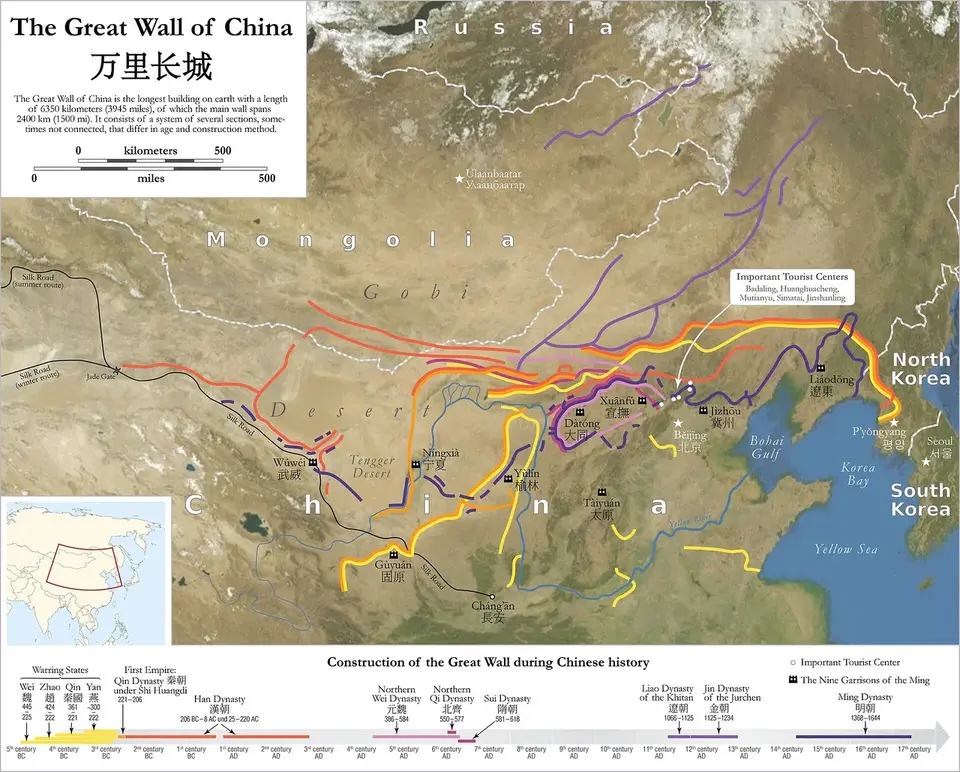
Qin Shi Huang's Construction of the Great Wall (秦始皇修筑长城) was an epic military defense project executed by the Qin Dynasty following the unification of China. In 215 BCE, alarmed by northern nomadic incursions and the ominous prophecy that "Qin shall be destroyed by Hu," Qin Shi Huang dispatched General Meng Tian with an army of 300,000 troops to expel the Xiongnu from the Ordos Loop (Henandi). Following this victory, the First Emperor ordered the demolition of internal defensive walls between former Warring States while systematically connecting, repairing, and extending the northern border fortifications of Qin, Zhao, and Yan. Spanning over 10,000 li from Lintao in Gansu to Liaodong, the Great Wall integrated watchtowers, garrisons, and beacon relay networks supported by the Qin Straight Road (Qin Zhidao). The fortification permanently consolidated China's agrarian frontier and emerged as an enduring monument to Chinese architectural resilience.
Qin unifies China and dismantles internal feudal walls that divided former Warring States.
Alarmed by the prophecy "Qin shall be destroyed by Hu," Meng Tian leads 300,000 troops to expel the Xiongnu.
Meng Tian reclaims the Hetao region, establishing Jiuyuan Commandery and settling thirty thousand peasant households.
Qin Shi Huang commissions Meng Tian to link and extend Warring States northern walls into an imperial barrier.
Meng Tian cuts through mountain ranges to construct the 1,800-li Qin Straight Road connecting Xianyang to Jiuyuan.
The 10,000-li fortification from Lintao to Liaodong is completed, stabilizing the northern frontier.
Qin Shi Huang dies; Zhao Gao and Huhai murder Meng Tian and Fusu, destabilizing northern border garrisons.
During the Warring States period, rival states constructed defensive walls along their shared frontiers to repel neighboring armies and contain nomadic incursions. In 221 BCE, Qin annihilated the six rival powers, establishing China's first centralized autocratic empire. Upon unification, Qin Shi Huang ordered the nationwide demolition of internal moats, checkpoints, and defensive ramparts that had previously separated the feudal states, promoting domestic trade and bureaucratic integration.
However, as the central government consolidated authority across the central plains and expanded southward into Lingnan, the nomadic Xiongnu confederation unified under Touman Chanyu along the northern steppes. Master horse archers, Xiongnu warbands repeatedly surged across the Yin Mountains into the fertile agricultural lands of the Ordos Loop. Frontier populations were displaced, harvests plundered, and the security of the new imperial capital at Xianyang directly threatened.
In 215 BCE (the thirty-second year of his reign), Qin Shi Huang inspected the northern frontier at Jieshi. An emissary named Lu Sheng returned from sea and presented an esoteric text containing the fateful omen: "That which shall destroy Qin is Hu (the northern barbarians)."
Fearing northern nomadic expansion, the First Emperor resolved to eliminate the steppe peril. He appointed Senior Minister Meng Tian as Commander-in-Chief, assigning him an elite army of 300,000 veteran troops. Advancing rapidly with disciplined crossbow formations and armored cavalry, Meng Tian shattered Xiongnu tribal forces, driving them north of the Yin Mountains. The Qin court established Jiuyuan Commandery over forty-four newly organized counties and resettled thirty thousand civilian households to cultivate the reclaimed frontier.
Recognizing that maintaining hundreds of thousands of expeditionary troops in desert terrain was economically unsustainable, Qin Shi Huang determined that an unbroken defensive barrier was essential to secure the border with minimal garrison garrisons.
In 214 BCE, the emperor issued an imperial decree commissioning Meng Tian to design and oversee the unification of the northern defensive perimeter, with Crown Prince Fusu dispatched to Shangjun to supervise the project.
Meng Tian formulated a design philosophy based on terrain adaptation: "Following the contours of the earth, utilizing natural barriers to construct defensible bottlenecks." Instead of building entirely new lines on flat plains, Meng Tian surveyed the preexisting northern walls constructed by King Zhaoxiang of Qin, King Wuling of Zhao, and King Zhao of Yan. He ordered the demolition of rearward sections facing southward while reinforcing and heightening northward-facing walls. In gaps separating mountain valleys, rivers, and plains, massive crews constructed new rammed-earth ramparts and stone ramparts, forging an unbroken barrier.
Constructing the Great Wall across thousands of kilometers of rugged wilderness required extraordinary engineering mobilization. Meng Tian's 300,000 frontier soldiers formed the skilled administrative and protective core of the workforce. They were reinforced by hundreds of thousands of state conscripts (minfu) and penal laborers condemned to castle-building servitude (chengdan), totaling nearly one million workers.
Confronting diverse geographical terrains, Meng Tian and his master artisans practiced strict adherence to local materials: Across the Loess Plateau and plains of Gansu, Ningxia, and northern Shaanxi, workers utilized wooden shuttering forms, ramming layers of cohesive loess clay mixed with red willow or reeds until rock-hard; Across the rocky Yin Mountains and Yanshan ranges, crews quarried native granite and slab stone, dry-stacking blocks and filling crevices with gravel mortar along steep ridges; In the desert sands and gravel washes of the Gobi, engineers layered bundled tamarisk branches, reeds, and compacted gravel, creating durable composite defenses resistant to wind erosion.
The Qin Great Wall was an integrated defense in depth rather than a solitary barrier.
Meng Tian established fortified passes at critical choke points, erecting elevated beacon towers and watchtowers at intervals of several miles along high ridges. Guarded day and night by garrison sentries, these towers utilized smoke signals by day and fire beacons by night, capable of relaying urgent military warnings across thousands of miles to regional command posts at Jiuyuan, Shangjun, and the capital at Xianyang within hours.
To resolve logistical bottlenecks and enable rapid troop deployment, Qin Shi Huang ordered Meng Tian in 212 BCE to construct the Qin Straight Road (Qin Zhidao). Carved through mountains and spanning ridges along the Ziwu Mountain range from Linguang Palace near Xianyang to Jiuyuan Commandery over a distance of 1,800 li (approximately 700 kilometers), this paved arterial highway enabled imperial cavalry reinforcements to reach the northern wall from the capital within three days.
In 210 BCE (the thirty-seventh year of the First Emperor), following five years of intensive construction, the entire frontier fortification system was joined.
Spanning from Lintao in Longxi (modern Min County, Gansu) in the west, crossing the Yellow River into Ningxia and the Ordos Loop, following the southern slopes of the Yin Mountains, and traversing Hebei through the Yanshan Mountains to the Liaodong Peninsula in the east, the fortified wall extended over 10,000 li. It became universally celebrated as the "Ten-Thousand-Li Great Wall."
Shielded by this barrier and protected by lethal repeating crossbows, Qin garrison forces deterred steppe incursions. Nomadic warriors retreated into the northern desert, securing peace along the northern border for over a decade.
The construction successfully unified isolated regional ramparts into a continuous defensive front, compelling the Xiongnu to withdraw north of the Gobi Desert. However, the relentless conscription of hundreds of thousands of laborers, combined with palace and mausoleum construction projects, pushed the empire toward financial and demographic exhaustion, contributing directly to the peasant uprisings that toppled the Qin Dynasty shortly after Qin Shi Huang's death.
First, the Qin Great Wall permanently demarcated the ecological and geopolitical boundary separating the agricultural civilizations of the central plains from the pastoral nomadic confederacies of the northern Eurasian steppe. Second, it established an architectural and strategic paradigm inherited by subsequent dynasties: the Han expanded the wall westward into the Hexi Corridor, while the Northern Wei, Northern Qi, Sui, and Ming dynasties rebuilt extensive fortifications along Meng Tian's original alignments. Third, the monument evolved into a cultural and spiritual emblem of Chinese national identity, embodying enduring tenacity and collective resilience.
In the Records of the Grand Historian (Shiji), Sima Qian recorded: "When Qin unified the realm, it dispatched Meng Tian with 300,000 men north to expel the barbarians and reclaim the Ordos. Constructing the Great Wall, he utilized the terrain and fortified bottlenecks, spanning from Lintao to Liaodong over ten thousand li... Meng Tian's prestige shook the northern tribes."
Statesman Jia Yi observed in The Faults of Qin: "He sent Meng Tian north to construct the Great Wall and guard the frontiers, pushing the Xiongnu back over seven hundred li. Thereafter, nomadic horsemen dared not ride south to graze their horses, and their warriors dared not draw bows in vengeance."
Historian Sima Guang evaluated in Zizhi Tongjian: "Qin Shi Huang drove the empire to construct the Great Wall, exhausting the people with grievous oppression; yet once the wall stood, northern borders enjoyed tranquil security, shielding subsequent generations. Its merits and faults cannot be judged simply."