Uprising at Caozhou
Salt trader Huang Chao takes up arms, joining Wang Xianzhi in widespread rebellion across Guandong.
Tang Dynasty (唐朝) · HISTORICAL EVENT
黄巢之乱
The Huang Chao Rebellion (黄巢之乱) took place between 875 AD and 884 AD (spanning the Qianfu to Zhonghe eras of the late Tang dynasty), representing a colossal nationwide peasant insurrection that fatally dismantled the ruling foundations of the Tang Empire. In the late ninth century, autocratic palace eunuchs, predatory regional warlords, and severe salt monopolies exacerbated a devastating drought across eastern China. In 875 AD, illicit salt traders…
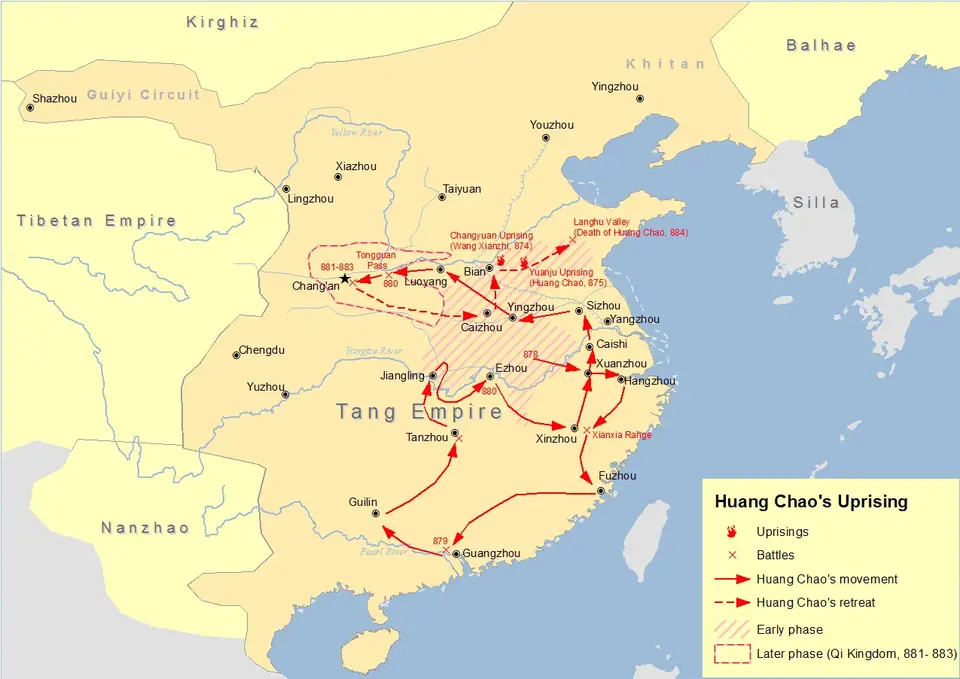
The Huang Chao Rebellion (黄巢之乱) took place between 875 AD and 884 AD (spanning the Qianfu to Zhonghe eras of the late Tang dynasty), representing a colossal nationwide peasant insurrection that fatally dismantled the ruling foundations of the Tang Empire. In the late ninth century, autocratic palace eunuchs, predatory regional warlords, and severe salt monopolies exacerbated a devastating drought across eastern China. In 875 AD, illicit salt traders Wang Xianzhi and Huang Chao mobilized hundreds of thousands of starving farmers. Following Wang's death, Huang Chao assumed supreme leadership, adopting wide-ranging mobile warfare that swept through southern China to capture Guangzhou before striking northward across the Yangtze and Huai rivers. In 880 AD, the rebels seized Luoyang, stormed the Tong Pass, and drove Emperor Xizong into flight to Chengdu. Huang Chao entered Chang'an and ascended the throne of the Da Qi state. However, chronic food shortages and the defection of rebel general Zhu Wen allowed Shatuo chieftain Li Keyong's cavalry to retake the capital. Huang Chao retreated east and was killed in Langhu Valley in 884 AD. The rebellion shattered central monarchical control, plunging China into the warlord anarchy of the Five Dynasties.
Salt trader Huang Chao takes up arms, joining Wang Xianzhi in widespread rebellion across Guandong.
Wang Xianzhi falls at Huangmei; Huang Chao is acclaimed Soaring Sky General and crosses the Yangtze.
Insurgents capture Guangzhou, replenishing provisions before mounting an ambitious northward expedition.
Rebels storm Tong Pass, driving Emperor Xizong to Sichuan; Huang Chao establishes the Da Qi dynasty.
Shatuo cavalry and turncoat Zhu Wen crush the rebel armies; Huang Chao dies in the shadows of Mount Tai.
Following the devastating An Lushan Rebellion, the central authority of the Tang dynasty entered an irreversible decline, resulting in an entrenched triumvirate of eunuch dictatorship at court, autonomous regional military governors (jiedushi) in the provinces, and vicious bureaucratic factionalism. During the reigns of Emperor Yizong and his teenage successor Emperor Xizong, imperial governance descended into outright venality, with palace eunuchs such as Tian Lingzi auctioning high ministerial offices while squandering national treasuries on polo matches and extravagant diversions.
This administrative decay inflicted crushing economic burdens upon common agrarian households. The traditional Twice-Yearly Tax mutated into arbitrary levies, while government salt commissioners ruthlessly monopolized the salt trade, imposing death sentences for minor contraband while selling bitter, sand-filled state salt at extortionate prices. In 874 AD (the first year of Qianfu), a catastrophic drought coupled with dense clouds of locusts struck Henan and Shandong. Farmlands yielded nothing, yet magistrate tax collectors extracted levies with merciless corporal punishment, driving destitute farming populations into absolute despair.
Across the Guandong plains, an armed counter-society of private salt smugglers operated outside imperial laws. Highly organized, armed with blade weapons, and intimately familiar with transportation waterways, these salt bands commanded formidable underground networks.
In the late winter of 874, Wang Xianzhi gathered thousands of impoverished outlaws in Puzhou, raising the banner of revolt at Changyuan as Heavenly-Compensating Equalizing General. In the sixth lunar month of 875 AD, Huang Chao, a wealthy salt merchant hailing from Yuanju in Caozhou, led several thousand kinsmen in armed rebellion to join him. Having repeatedly failed imperial civil service examinations in the capital despite exceptional classical and martial literacy, Huang harbored deep animus against the dynastic establishment. The combined armies rallied the peasantry under slogans of wealth equalization, sweeping across Henan and Shandong.
During the initial phase of the insurrection, the rebel armies engaged in continuous fluid warfare across Henan and Shandong against imperial garrisons. In 878 AD (the fifth year of Qianfu), Wang Xianzhi was killed in action at Huangmei. The surviving forces elected Huang Chao as their unified supreme commander, acclaiming him Soaring Sky General and declaring the Wangba era.
Confronted by heavy concentrations of imperial forces encircling the Central Plains, Huang Chao demonstrated remarkable tactical fluidity. Abandoning static siege operations, he adopted a strategy of long-range evasion, marching hundreds of thousands of followers south across the Yangtze River. The rebel hosts swept across Jiangxi and Zhejiang, hacking a seven-hundred-li roadway through the mountainous jungle into Fujian to capture Jianzhou and Fuzhou. In the ninth lunar month of 879 AD, Huang Chao captured Guangzhou, the paramount maritime commercial hub of southern China, executing military governor Li Tiao. In Guangzhou, the rebels rested their troops, expanded their arsenals, and requisitioned coastal trade wealth.
Afflicted by tropical fevers and unfamiliar humidity in the south, Huang Chao's northern soldiers clamored to return home. In the winter of 879 AD, Huang launched an audacious northward offensive along the Xiang River, overrunning Guizhou, Tanzhou, and Jiangling. Exploiting the self-serving timidity of Huainan Governor Gao Pian, who held back his elite troops to preserve private autonomy, Huang Chao bypassed Yangzhou and crossed the Yangtze and Huai rivers with unstoppable momentum.
In the eleventh lunar month of 880 AD (the first year of Guangming), the rebel legions took East Capital Luoyang without significant bloodshed. Moving westward, Huang Chao overwhelmed the legendary fortress of Tong Pass, where ill-equipped imperial palace guards disintegrated on contact. Paralyzed with terror, eunuch Tian Lingzi smuggled Emperor Xizong out the western gates of Chang'an, fleeing to Chengdu in Sichuan. On the thirteenth day of the twelfth lunar month, Huang Chao rode into Chang'an in a gilded carriage, acclaimed by crowds of impoverished residents. Days later, he ascended the imperial throne at the Hall of Containing Elements in Daming Palace, proclaiming the Da Qi dynasty with the era title Jintong.
Following the coronation, the Da Qi administration suffered from severe structural limitations. Lacking an experienced administrative bureaucracy or stable rural grain-producing hinterlands, the capital fell victim to acute food shortages as surrounding Tang warlords cut off supply routes. In desperation, rebel units resorted to violent requisitions, executing thousands of Tang imperial aristocrats and prominent scholar-officials, which alienated the local gentry and populace.
Meanwhile, from his refuge in Sichuan, Emperor Xizong mobilized provincial warlords to mount a counteroffensive. Li Keyong, the young chieftain of the Shatuo nomadic tribes, marched forty thousand elite Black-Crow cavalrymen south from Hedong. Simultaneously, Huang Chao's premier division commander Zhu Wen (Zhu Quanzhong) recognized the shifting tide, defected to the Tang, and turned his armies against his former master. Between 882 and 883 AD, besieged by Shatuo horsemen and imperial columns, the Da Qi army was starved out of Chang'an. In the fourth lunar month of 883 AD, Huang Chao abandoned the scorched capital and retreated eastward.
Pursued relentlessly by Li Keyong and Zhu Wen, the rebel forces disintegrated during a brutal, unsuccessful three-hundred-day siege of Chenzhou. In the sixth lunar month of 884 AD (the fourth year of Zhonghe), cornered by imperial scouts at Langhu Valley in Mount Tai (near modern Laiwu, Shandong), Huang Chao committed suicide with his sword (or was slain by his nephew Lin Yan in hopes of pardon), concluding a ten-year civil war.
The Huang Chao Rebellion completely destroyed the political and economic foundations of central monarchical rule in China. The two historic capitals of Chang'an and Luoyang were systematically pillaged, burned, and depopulated, with palaces, archives, and imperial residences leveled to ash. Crucially, the ancestral Guanlong aristocracy and elite medieval lineages that had dominated imperial politics since the Northern and Southern Dynasties were physically liquidated during the purges. Although Emperor Xizong returned to Chang'an, the imperial treasury was empty, the palace guards were dispersed, and the emperor became a powerless puppet.
The prolonged military campaigns shattered the administrative framework of the Tang state. To defeat Huang Chao, the desperate imperial court granted unfettered fiscal and military autonomy to regional warlords, nurturing aggressive regional satrapies headed by figures such as Li Keyong, Zhu Wen, Qian Liu, and Wang Jian. Possessing vast territories gained from crushing the rebels, Zhu Wen ultimately deposed the last Tang sovereign in 907 AD, initiating the fragmented Five Dynasties and Ten Kingdoms epoch.