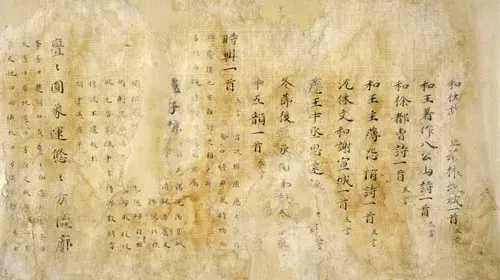
Course of the Event
Establishment of the Eastern Palace Administration and Gathering of Scholars
In the first month of 515 CE (the fourteenth year of the Tianjian era), Xiao Tong reached adulthood and formally underwent the capping ceremony at the Eastern Palace in Jiankang, assuming active participation in state affairs and leadership of the crown prince's cultural academy. Endowed with a gentle disposition and an ardent love for historical and literary archives, Xiao Tong received imperial authorization to acquire rare books and manuscripts nationwide. Under royal patronage, the Eastern Palace library quickly expanded to nearly 30,000 fascicles.
Within this rich intellectual milieu, Xiao Tong recruited the most celebrated scholars of the realm into the Eastern Palace. Renowned literary figures such as Liu Xiaochuo, Wang Yun, Lu Chui, Dao Qia, Yin Yun, and Liu Xian joined his retinue, serving as companions, household counselors, and academic advisors. Xiao Tong treated them with fraternal courtesy and intellectual humility, frequently soliciting their insights on textual variants and classical interpretations.
The Xuanpu Garden and Chongzheng Hall in the Eastern Palace became the paramount centers of scholarly discourse in Southern China. In their leisure hours following official duties, Xiao Tong and his scholars wandered through palace gardens, composing poetry, declaiming rhapsodies, and debating the merits of ancient and contemporary masterpieces. Liu Xiaochuo possessed unmatched poetic speed and brilliant phrasing; Wang Yun excelled in classical bibliography, editions, and phonology; Lu Chui mastered dynastic institutions and formal state documents; and Yin Yun brought encyclopedic knowledge of historical anecdotes.
The convergence of these preeminent minds provided an irreplaceable intellectual foundation for the anthology project. Convinced that earlier compilations were fragmentary and failed to capture the full spectrum of literary achievement, Xiao Tong initiated the monumental collation project in the late Tianjian era. He designed the overarching organizational blueprint, assigned specific research responsibilities, and directed the exhaustive examination of Eastern Palace collections.
Xiao Tong maintained an open and egalitarian atmosphere within his scholarly circle, encouraging frank exchanges of opinion on literary selection. Although Liu Xiaochuo was known for his aristocratic pride, he dedicated his full talents to the prince, while Wang Yun drew extensively upon the multi-generational library of the prominent Langye Wang clan to supply rare editions. The Eastern Palace academy thus fostered a rigorous, harmonious, and highly effective editorial team.
During this period, Xiao Tong also directed the compilation of encyclopedias and personal literary works. Liu Xiaochuo had earlier edited a ten-fascicle edition of Xiao Tong's youthful writings, acquiring intimate familiarity with the prince's editorial philosophy. Under their collective labor, the systematic collection of historical writings proceeded with remarkable cohesion.
Formulating the Editorial Principles and Aesthetic Standards
At the inception of the compilation project, Xiao Tong and his scholars held extensive deliberations to establish the ultimate aesthetic and theoretical criteria for the anthology. Later scholars have identified several intersecting interpretations of the Wen Xuan's editorial standards, including the principle that "literature arises from profound contemplation and culminates in refined rhetoric," the influence of Shen Yue's phonetic tonal theories, and the Confucian ideal of "a harmonious balance between substance and ornament." In practice, Xiao Tong skillfully synthesized these perspectives.
The criterion of "arising from profound contemplation" demanded that selected works exhibit genuine emotional resonance, rigorous conceptual structure, and substantive intellectual depth, firmly rejecting superficial verbiage. Conversely, "culminating in refined rhetoric" required that works demonstrate exquisite diction, polished phrasing, and harmonious phonetic cadence, avoiding crude and unadorned expression. This dual requirement definitively separated purely literary art from ordinary functional writing.
Regarding the relationship between moral substance and rhetorical ornament, Xiao Tong rejected both the dogmatic moralism of archaist reactionaries and the frivolous decadence of contemporary palace-style poets. He maintained that literature naturally evolves and deepens across historical epochs, famously observing that "as objects naturally develop, literature follows suit." True literature must embody both intellectual gravitas and stylistic elegance.
While certain commentators argued that the Wen Xuan was overly indebted to Shen Yue's Yongming tonal regulations, Xiao Tong refused to be bound by rigid mechanical rules. His selections encompassed not only metrically regulated verse by Shen Yue and Xie Tiao, but also primitive Han and Wei ballads, the vigorous Jian'an style, and the unadorned, spontaneous poetry of Tao Yuanming. This catholic aesthetic vision endowed the anthology with enduring balance and dignity.
In his general preface, Xiao Tong elevated this dual standard into the guiding principle of the entire anthology. Whether evaluating a monumental rhapsody on an imperial capital or a short personal letter between friends, each entry had to pass the dual test of emotional authenticity and rhetorical distinction. This rigorous standard marked the emergence of literary criticism as an autonomous intellectual discipline.
Xiao Tong declined to include writings that offered conventional moralizing without stylistic refinement, while generously including works of intense emotional candor and poetic brilliance, even if unconventional in subject matter. This prioritization of artistic autonomy greatly expanded the horizons of the literary anthology.
Delineating Boundaries Among the Four Traditional Bibliographic Categories
With clear aesthetic principles established, Xiao Tong and his scholars undertook the decisive task of defining the boundaries between literature and other traditional written archives. In earlier Chinese scholarship, literary, historical, and philosophical texts were frequently conflated; Zhi Yu's Treatise on the Flow of Literary Genres, for instance, had included extensive exegeses on the Confucian classics. Xiao Tong resolved to dismantle this ambiguity and establish a pure literary canon.
Xiao Tong held the Confucian Classics in supreme reverence, but deliberately excluded them from the anthology. He maintained that the Six Classics represented the transcendent moral architecture of civilization, whose unvarnished prose aimed at ethical instruction. To intermingle canonical scriptures with personal literary compositions would compromise canonical sanctity while obscuring the distinct nature of literary art.
Similarly, Xiao Tong excluded the vast writings of the pre-Qin and Han philosophical masters. Although figures such as Zhuangzi and Mencius wrote with dazzling rhetorical vitality, their fundamental purpose was philosophical disputation, institutional reform, and ethical instruction, rather than aesthetic creation. Xiao Tong determined that texts devoted primarily to doctrinal argument had no place in an anthology of pure literature.
Xiao Tong's treatment of historical writing was particularly nuanced. Historical annals, he noted, were dedicated to factual veracity and chronological record-keeping, falling under the purview of historiography. However, the prefatory essays, evaluations, and discursive judgments within historical works often gathered dazzling rhetorical splendor and profound philosophical reflections.
Accordingly, Xiao Tong broke with rigid bibliographic conventions by incorporating historical appraisals, such as Ban Gu's evaluations in the Book of Han, Gan Bao's general treatises in the Jin Annals, and Fan Ye's commentary in the Book of Later Han. This innovative compromise preserved the aesthetic purity of the anthology while incorporating the finest philosophical prose of the historical tradition.
Crucially, Xiao Tong enforced the strict principle of "excluding living authors." No matter how celebrated contemporary Liang dynasty writers were, their works were excluded from the anthology, with selections strictly limited to deceased masters. This policy insulated the editorial process from personal flattery and court patronage, securing the collection's enduring impartiality and scholarly authority.
Under this rule, Xiao Tong excluded recent writings by favored associates like Liu Xiaochuo and Wang Yun, as well as celebrated contemporary royals like Xiao Gang and Xiao Yi. Only deceased early Liang luminaries, such as Gao Shuang and Lu Chui, were admitted, ensuring universal respect for the anthology's integrity.
Gathering Ancient Texts and Textual Collation Across Historical Editions
Following the establishment of editorial guidelines, Xiao Tong directed his scholars in an exhaustive campaign of textual acquisition and collation. The historical scope spanned over eight centuries, from the pre-Qin era, Western and Eastern Han, the Three Kingdoms, Western and Eastern Jin, Liu Song, and Southern Qi, through the early years of the Southern Liang, eventually yielding over 700 individual works by 130 authors alongside several anonymous compositions.
Centuries of warfare and migration had scattered ancient libraries, and hand-copied manuscripts were plagued by textual omissions, transpositions, and scribal errors. Xiao Tong guided his staff in drawing upon imperial palace reserves while soliciting rare private manuscripts from prominent aristocratic families in Jiankang. The scholars subjected the elegies of Qu Yuan and Song Yu, the rhapsodies and memorials of Jia Yi, Sima Xiangru, Yang Xiong, and Ban Gu, the poetry of the Three Caos and Seven Scholars of Jian'an, and the masterpieces of Pan Yue, Lu Ji, Xie Lingyun, Bao Zhao, and Shen Yue to exhaustive collation.
The Eastern Palace scholars applied meticulous philological rigor. Wang Yun and Liu Xiaochuo compared divergent recensions against imperial archives, systematically checking titles, phrasing, and contextual continuity. When encountering archaic characters or obscure readings, they cross-referenced classical commentaries and dynastic biographies to ensure textual soundness. For ancient yuefu folk songs and anonymous ballads, the editorial board verified metrical schemes and melodic structures.
In evaluating individual authors, Xiao Tong avoided dogmatic bias. Although he critiqued Yang Xiong's Han rhapsodies for failing to achieve meaningful moral admonition, he nevertheless preserved masterworks like the Yu Lie Fu and Chang Yang Fu as unrivaled paradigms of expansive imperial description. Similarly, he held the recluse Tao Yuanming in the highest esteem, including The Peach Blossom Spring and Returning Home alongside his pentasyllabic poetry.
The editorial team also engaged in critical authentication. Confronted with questionable poems traditionally attributed to Li Ling and Su Wu, as well as dubious Han rhapsodies, the scholars cross-checked historical administrative titles and linguistic patterns to excise spurious texts, markedly elevating the reliability of the anthology.
This meticulous selection process extended over several years, sifting through hundreds of thousands of candidate characters. Xiao Tong convened daily review sessions in Chongzheng Hall, debating difficult inclusions with his scholars. The resulting 700 works represented time-tested gems uniting conceptual depth with formal beauty.
The search for texts also embraced marginalized voices outside officialdom. The Eastern Palace academy gathered writings by Daoist hermits, Buddhist scholars, and distinguished women authors such as Ban Jieyu and Cai Yan, providing an exceptionally comprehensive portrait of Six Dynasties literary culture.
Establishing the Dominance of Poetry and Rhapsody with Genre Subdivisions
Within the structural framework of the Wen Xuan, poetry and rhapsody formed the vast artistic and quantitative core. In Li Shan's sixty-fascicle recension, rhapsodies and poems occupy thirty-one fascicles, representing more than half the entire anthology. In his general preface, Xiao Tong traced the origins of literary genres back to the Six Principles of the Classic of Poetry, providing an extensive account of their historical development.
The rhapsody section offered a panoramic display of poetic evolution from the Han through the Six Dynasties. Xiao Tong divided rhapsodies into topical categories, including capitals, suburban sacrifices, imperial plowing, hunting, natural scenery, flora and fauna, personal aspiration, mourning, literature, and music. The capital category featured Ban Gu's Two Capitals, Zhang Heng's Two Metropolises, and Zuo Si's Three Capitals, illustrating the monumental scale of Han and Jin court descriptions. In contrast, sections on nature, music, and mourning preserved intimate gems like Cao Zhi's Rhapsody on the Goddess of the Luo, Xiang Xiu's Rhapsody on Remembering the Past, and Lu Ji's Rhapsody on Literature.
The poetry section constituted the living heart of the anthology. Xiao Tong devised more than a dozen thematic rubrics, including commemorative verse, moral encouragement, friendship, Daoist transcendence, recluse life, meditations on history, mourning, exchange of verses, travel, military campaigns, and folk ballads (yuefu). Within each rubric, poems were arranged in strict chronological order, illustrating the historical transition from four-character archaic verse to mature five-character lyric poetry.
Xiao Tong maintained an ecumenical approach to poetic lineages. The collection embraced the unvarnished directness of the Nineteen Old Poems, the passionate gravitas of Cao Cao, Cao Zhi, and Ruan Ji, the polished parallelism of Western Jin masters Pan Yue and Lu Ji, the transcendental simplicity of Tao Yuanming, the scenic dynamism of Xie Lingyun, the vigorous emotional power of Bao Zhao, and the melodious elegance of Shen Yue and Xie Tiao.
Xiao Tong introduced the innovative category of "imitative verse" (zani), placing Lu Ji's Twelve Imitations of Ancient Poems and Zhang Zai's Imitation of the Four Sorrows Poem at the forefront. Xiao Tong recognized that creative emulation of classical models was an essential pedagogical step in mastering traditional styles, observing that Lu Ji and Zhang Zai achieved exceptional art by infusing personal emotion into ancestral forms.
Through this deep curation of poetry and rhapsody, Xiao Tong preserved the monumental achievements of eight centuries while directly inspiring the codification of Tang regulated verse and the emergence of High Tang landscape and frontier poetry.
In selecting landscape poetry, Xiao Tong emphasized the aesthetic communion between humanity and the natural world. The landscape masterpieces of Xie Lingyun and Xie Tiao were generously represented, showcasing their delicate depictions of rivers and mountains alongside meditations on the transience of life, establishing the enduring spiritual tradition of Chinese landscape literature.
In their exploration of poetic prosody, Xiao Tong and his scholars carefully evaluated the merits and defects of the Yongming tonal theories. While rejecting the rigid mechanical dogmatism of Shen Yue's "eight defects," they equally avoided the unadorned prose tendencies of Ren Fang, advocating a natural, flowing cadence characterized by harmonious modulation. This balanced prosodic philosophy directly informed the development of Tang seven-syllable song-verse and regulated poetry.
Incorporating Practical Administrative Prose and Societal Mourning Genres
Beyond lyric verse and rhapsodies, the Wen Xuan accorded remarkable importance to pragmatic state documents and societal mourning rituals. Xiao Tong did not dismiss these genres as lifeless administrative formalities; instead, he uncovered their deep emotional pathos and rhetorical majesty, reflecting the Six Dynasties impulse to elevate functional writing into high art.
In the realm of statecraft, the anthology included twelve functional genres: edicts, imperial mandates, administrative orders, instructions, memorials, petitions, impeachment charges, formal notes, and declarations. Xiao Tong selected enduring masterworks such as Li Si's Memorial on the Expulsion of Guest Officials, Zou Yang's Letter Submitted from Prison to the Prince of Liang, Zhuge Liang's Former Memorial on the Expedition, and Li Mi's Memorial Expressing My Feelings. These works harmonized intellectual conviction with intense personal devotion, offering supreme models of political prose.
In the categories of correspondence and military declarations, the anthology preserved Sima Qian's Letter in Reply to Ren An, Ji Kang's Letter Breaking off Relations with Shan Tao, and Chen Lin's Declaration against Cao Cao on Behalf of Yuan Shao. These texts articulated profound personal despair, unyielding moral defiance, and thunderous political indictment, representing the zenith of Han and Wei expository prose.
Societal mourning literature attained extraordinary artistic prominence, particularly in the curation of elegies (lei). The Wen Xuan preserved eight celebrated elegies, including Cao Zhi's elegy for Wang Can, Pan Yue's elegies for his father-in-law, nephew, friend, and General Ma, Yan Yanzhi's elegy for Tao Yuanming, and formal elegies for official martyrs and imperial consorts.
Each of these eight elegies was animated by genuine, profound grief. Cao Zhi mourned Wang Can as a brother, Pan Yue grieved for his deceased kin with visceral sorrow, Yan Yanzhi commemorated a spiritual soulmate, and Pan Yue's tribute to General Ma celebrated a tragic hero. By emphasizing emotional authenticity, Xiao Tong demonstrated how ritualized mourning could achieve the highest levels of literary purity.
Furthermore, funeral orations, stele inscriptions, epitaphs, biographies, and laments—such as Jia Yi's Lament for Qu Yuan, Pan Yue's Mourning My Wife, and Xiang Xiu's Remembering the Past—interwove factual commemorative details with universal reflections on historical change and mortality, significantly enriching the emotional depth of traditional Chinese prose.
Official impeachment documents and state memoranda, such as Ren Fang's impeachment of Liu Zheng, demonstrated how legal precision and rhetorical brilliance could reinforce one another. The comprehensive inclusion of administrative and ritual genres transformed the Wen Xuan into an indispensable stylistic manual for drafting state documents and epigraphic memorials.
Constructing a Flat Thirty-Eight Category Taxonomic System
The structural taxonomy of the Wen Xuan stands as its most enduring intellectual contribution. As outlined in the general preface and detailed table of contents, Xiao Tong organized the anthology into thirty-eight distinct genres (or thirty-nine in subsequent sub-classifications), arranged horizontally without nested structural hierarchies.
Compared to Liu Xie's The Literary Mind and the Carving of Dragons, the Wen Xuan embodied a contrasting structural philosophy. While Liu Xie employed a conceptual hierarchical classification that paired closely related genres together—such as "Eulogies and Appraisals," "Inscriptions and Admonitions," and "Laments and Condolences"—Xiao Tong placed rhapsodies, poetry, elegies, memorials, letters, declarations, treatises, and funeral orations as equal, autonomous entities on a single taxonomic plane.
Although this flat structure may appear less conceptually rigorous by modern taxonomic standards, it possessed supreme pedagogical utility for traditional scholars. By isolating each genre independently, it highlighted the distinct formal rules, rhetorical conventions, and social functions of each style, enabling students to quickly master specific compositional techniques.
Xiao Tong adopted an empirical approach to genre nomenclature. Some categories were named for expressive techniques (fu, lun, song, zhen); others for material formats (stele, imperial mandate); some for social functions (ai, lei, diao, ji); and others directly inherited official administrative terminology (biao, qi, danshi, xi). This practical taxonomy mirrored the actual administrative and literary life of the Six Dynasties.
Within each genre or sub-genre, Xiao Tong rigorously observed chronological arrangement. Pre-Qin texts stood first, followed by Western and Eastern Han, Three Kingdoms, and Six Dynasties writings. This historical sequencing allowed readers to trace the morphological evolution, stylistic shifts, and thematic developments of each genre across time.
The thirty-eight genres formed an integrated, majestic pantheon of ancient literature. This system not only codified literary standards for the Northern and Southern Dynasties, but also provided the foundational blueprint for Tang encyclopedias (leishu), imperial anthologies, and later collections of classical prose.
Furthermore, Xiao Tong's decision to treat sao (Chuci elegies) as an independent genre reflected his deep reverence for southern poetic traditions. By separating Qu Yuan's Li Sao from both rhapsodies and lyric poetry and honoring it as the progenitor of southern lyrical verse, Xiao Tong firmly installed Chu literature at the core of the orthodox Chinese literary canon.
Xiao Tong also recognized that literary genres follow a historical trajectory of continuous elaboration. By systematically detailing the origins and peak achievements of each genre, he created not merely an anthology of model compositions, but an expansive historical morphology of medieval Chinese literary forms.
Personal Editorial Review by Xiao Tong and Finalization in 526
Following the exhaustive gathering, collation, and taxonomic arrangement of texts, the compilation enterprise entered its decisive phase of final review and synthesis under Xiao Tong's personal supervision. Over several years, Xiao Tong presided daily over editorial deliberations in Chongzheng Hall, reviewing submitted manuscripts and arbitrating disputed inclusions.
Xiao Tong upheld demanding standards of textual accuracy, often debating obscure passages with Wang Yun and Liu Xiaochuo late into the night. In ordering works by different authors within the same genre, he examined not only chronological dates, but also thematic harmony and rhythmic transitions, ensuring that the anthology formed a cohesive artistic whole free from uneven editorial compromises.
According to dynastic records and modern scholarship, the last surviving author included in the Wen Xuan was Lu Chui, who passed away in 526 CE (the seventh year of the Putong era). Lu Chui's death provides definitive historical evidence that the anthology could only have been completed after this date, fulfilling Xiao Tong's rule against including living writers.
In the winter of that same year, Xiao Tong's personal life suffered a catastrophic blow. In the eleventh month of 526 CE, his mother, Noble Consort Ding, passed away in Jiankang. A man of profound filial piety, Xiao Tong spent three years in devastating mourning, abstaining from literary and intellectual pursuits. Textual evidence indicates that the final thirty-fascicle manuscript of the Wen Xuan was finalized immediately prior to his mother's illness in late 526 CE.
Upon completing the manuscript, Xiao Tong composed his celebrated Preface to the Selections of Refined Literature (Wen Xuan Xu). Written in majestic parallel prose, the preface surveyed the history of literature from the mythical origins of the Eight Trigrams through the Han and Six Dynasties, articulating the vital relationship between emotion and intellect, substance and ornament, and formally proclaiming the autonomy of literary aesthetics.
In his preface, Xiao Tong articulated an evolutionary view of literary history, observing that "literature alters with the times in ways difficult to recount in full," celebrating the progressive rhetorical refinement achieved across successive eras. He avoided uncritical praise of archaic simplicity, affirming the profound contributions of Qu Yuan, Han rhapsodists, and Six Dynasties poets. The completion of the thirty-fascicle Wen Xuan marked the pinnacle of Southern Dynasties literary theory and textual scholarship.
Following the finalization of the text, the Eastern Palace commissioned expert scribes to produce calligraphic copies for the Xuanpu Library and the imperial archives, presenting a master copy for Emperor Wu's personal perusal. Emperor Wu warmly commended the compilation, and scholars throughout the court revered it as an unmatched treasure of literary art.
Early Circulation and Manuscript Transmission from the Eastern Palace
Upon its completion in thirty fascicles, the Wen Xuan circulated extensively among the Liang court, Eastern Palace scholars, and the aristocratic families of Southern China. Xiao Tong's royal stature and literary fame, combined with the immense prestige of scholars like Liu Xiaochuo and Wang Yun, established the Eastern Palace text as the supreme arbiter of literary taste, transforming Jiankang's culture from superficial frivolity toward classical elegance.
Disaster struck the southern realm shortly thereafter. In the fourth month of 531 CE (the third year of the Zhongdatong era), Xiao Tong died prematurely at the age of thirty after falling into an icy pond, receiving the posthumous title "Crown Prince Zhaoming." Years later, the Hou Jing Rebellion erupted, devastating Jiankang, burning the imperial archives, and destroying the Eastern Palace collections.
Fortunately, numerous manuscript copies of the thirty-fascicle Wen Xuan had already been transcribed by southern aristocratic lineages and carried into Jingzhou, Sichuan, and Lingnan. In 554 CE, when Jiangling fell to Western Wei forces, the Liang libraries and over 100,000 southern scholars were forcibly transferred north to Chang'an, transplanting the Wen Xuan into the cultural heartland of Northern Zhou.
Following the reunification of China under the Sui Dynasty, Xiao Tong's nephew, the renowned scholar Xiao Gai, drew upon ancestral traditions to master the anthology. During the Kaihuang era, Xiao Gai authored the Sound and Meaning of the Wen Xuan (Wen Xuan Yinyi), providing phonetic glosses and philological commentaries on archaic terms. Xiao Gai's work popularized the text across the Central Plains, igniting an intellectual craze that established the foundation for Tang Wen Xuan Studies.
Under the Tang emperors Taizong and Gaozong, classical literature and civil examinations flourished. The Jianghuai scholar Cao Xian became renowned as the foremost master of the Wen Xuan, teaching hundreds of disciples and earning veneration as the founding patriarch of Wen Xuan Studies. His pupils Xu Yan, Li Shan, and Gongsun Luo opened celebrated academies, transforming the anthology into an essential intellectual requirement for imperial elites.
Catalyzed by the civil service examinations, the poetic innovations of the Four Paragons of the Early Tang and the supreme poetry of Li Bai and Du Fu were deeply rooted in the Wen Xuan. Du Fu's famous injunction to his son to "master thoroughly the principles of the Wen Xuan" epitomized the universal consensus among Tang literati that Xiao Tong's anthology was the foundational gateway to literary mastery.