Shangdang Ceded to Zhao
Qin severs Han's communication with Shangdang; Feng Ting surrenders seventeen towns to Zhao, sparking conflict
Warring States (Qin / Zhao) · HISTORICAL EVENT
长平之战
The Battle of Changping (长平之战) was an unprecedented strategic encirclement campaign fought between 262 BCE (the forty-fifth year of King Zhaoxiang of Qin) and 260 BCE (the forty-seventh year of King Zhaoxiang of Qin), in which the Qin and Zhao states contested the strategic high ground of Shangdang Commandery, culminating in the largest and bloodiest battle of annihilation in ancient Chinese history. In 262 BCE, Qin forces seized Yewang, cutting off the…
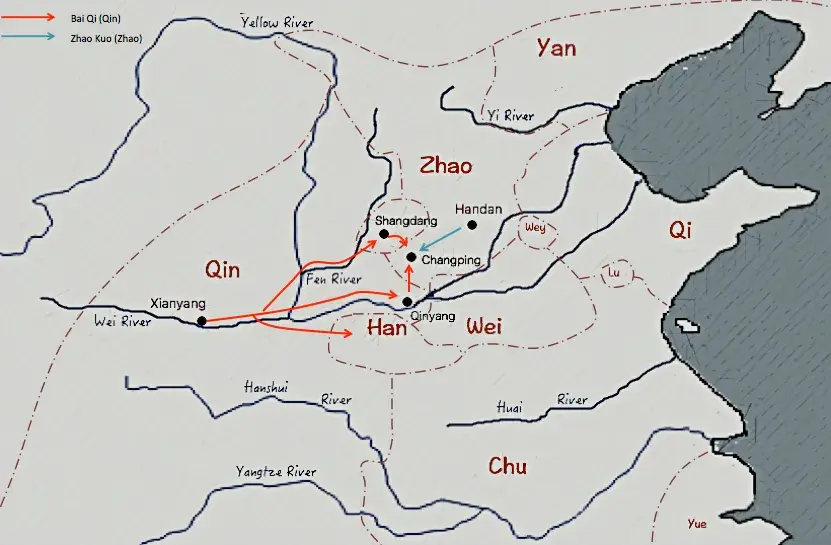
The Battle of Changping (长平之战) was an unprecedented strategic encirclement campaign fought between 262 BCE (the forty-fifth year of King Zhaoxiang of Qin) and 260 BCE (the forty-seventh year of King Zhaoxiang of Qin), in which the Qin and Zhao states contested the strategic high ground of Shangdang Commandery, culminating in the largest and bloodiest battle of annihilation in ancient Chinese history. In 262 BCE, Qin forces seized Yewang, cutting off the Han state from Shangdang. Refusing to submit to Qin, Shangdang governor Feng Ting surrendered seventeen walled towns to Zhao. Tempted by territory, King Xiaocheng of Zhao accepted Shangdang, infuriating Qin. Qin general Wang He stormed Shangdang and pushed toward Changping. Zhao commander Lian Po absorbed initial tactical setbacks and fortified the Dan River line with deep moats and stone ramparts, maintaining a three-year war of attrition. Qin chancellor Fan Ju countered with an espionage scheme, spreading rumors in Handan that Qin feared only Zhao She's theoretical son, Zhao Kuo. Impatient for victory, the Zhao king dismissed Lian Po and gave supreme command to the untested Zhao Kuo. Qin secretly appointed Bai Qi, Lord Wu'an, as supreme commander. When Zhao Kuo launched a reckless general offensive across the Dan River, Bai Qi feigned retreat, luring the Zhao host into mountain defiles. Twenty-five thousand Qin cavalry severed Zhao's retreat, while five thousand light cavalry split the enemy army. King Zhaoxiang mobilized all males over fifteen across Henei to cut off supplies. Besieged without food for forty-six days, Zhao troops resorted to cannibalism. Zhao Kuo was killed by arrows while attempting a breakout, and Bai Qi ordered the burial alive of all four hundred thousand surrendered troops, establishing Qin's military supremacy.
Qin severs Han's communication with Shangdang; Feng Ting surrenders seventeen towns to Zhao, sparking conflict
Qin troops take Shangdang and advance on Changping; Lian Po constructs stone ramparts along the Dan River
Fan Ju spreads false rumors in Handan; King Xiaocheng replaces Lian Po with Zhao Kuo, while Qin secretly appoints Bai Qi
Zhao Kuo crosses the Dan River in pursuit; Bai Qi's cavalry cuts off retreat and bisects the Zhao army
Besieged Zhao troops resort to cannibalism; Zhao Kuo dies in breakout, and Bai Qi buries alive 400,000 surrendered prisoners
During the late Warring States period, the State of Qin, empowered by the legalist reforms of Shang Yang and generations of aggressive expansion, possessed the preeminent military apparatus among the Seven Warring States. Under the strategic counsel of Chancellor Fan Ju, Qin pursued the doctrine of "befriending distant states while attacking nearby ones," concentrating on chipping away at the Three Jin states.
In 262 BCE, Qin armies under general Bai Qi captured Yewang (modern Qinyang, Henan), completely severing Shangdang Commandery from the State of Han. Shangdang occupied the commanding heights of the Taihang Mountains, acting as a strategic shield overlooking the North China plain. Faced with imminent defeat, the King of Han offered to cede Shangdang to appease Qin. However, the governor of Shangdang, Feng Ting, recognized that Qin rule would enslave the populace. Rather than yield to Qin, Feng Ting dispatched envoys offering all seventeen fortified cities of Shangdang to the State of Zhao, aiming to divert Qin's wrath onto their northern neighbor.
Confronted with the sudden windfall of seventeen cities, King Xiaocheng of Zhao summoned his ministers. Lord Pingyang (Zhao Bao) presciently warned that accepting unearned windfalls would invite Qin's boundless fury. However, Lord Pingyuan (Zhao Sheng) and King Xiaocheng were dazzled by territorial expansion. The king accepted the offer, granting Feng Ting the title of Lord Huayang and dispatching troops to garrison Shangdang.
Qin was outraged by Zhao's intervention. In 261 BCE, King Zhaoxiang ordered general Wang He to march on Shangdang with hundreds of thousands of veteran troops, quickly overrunning the towns. Flushed with victory, the Qin columns swept eastward into Zhao territory, threatening the approaches to Changping (modern Gaoping, Shanxi). King Xiaocheng dispatched renowned general Lian Po with two hundred thousand infantry and cavalry to establish frontline defenses.
In the summer of 260 BCE (forty-seventh year of King Zhaoxiang of Qin), Qin and Zhao vanguards clashed violently along the outskirts of Changping. Qin shock troops repeatedly routed Zhao screening units, killing several field lieutenants and capturing Guanglang Castle.
Evaluating the operational reality, Lian Po recognized that Qin forces possessed superior shock combat capability and were operating far from home, meaning their doctrine favored a rapid decision. Conversely, Zhao enjoyed secure logistical lines from Handan. Lian Po withdrew his divisions behind the Dan River, erecting stone parapets and deep earthworks along Mount Kongcang and the Hundred-Li Stone Wall. Maintaining defensive discipline, Lian Po forbade his troops from engaging in open field battles. For three grueling years, both armies remained deadlocked across the Dan River. As logistical transit across the Taihang mountain passes strained Qin's granaries, the Qin court grew desperate to break the stalemate.
Recognizing that military force alone could not penetrate Lian Po's defenses, Qin chancellor Fan Ju orchestrated a psychological warfare campaign. He dispatched covert agents laden with gold into Handan to circulate rumors: "Qin fears nothing that old Lian Po can do; the only general Qin dreads is Zhao Kuo, the brilliant son of legendary general Zhao She!"
Exhausted by three years of war expenditures and impatient for decisive victory, King Xiaocheng took the bait and resolved to replace Lian Po. Minister Lin Xiangru, though gravely ill, hurried to court to remonstrate: "Your Majesty appoints Kuo merely because of his family name, which is like gluing the bridge pegs when tuning a zither! Kuo can only recite his father's books; he knows nothing of adaptation!" Zhao Kuo's own mother petitioned the throne, warning that her son treated war like a trivial game and hoarded imperial stipends. Deaf to all counsel, King Xiaocheng entrusted supreme command over four hundred thousand troops to Zhao Kuo.
Upon learning that Zhao Kuo had replaced Lian Po, King Zhaoxiang moved swiftly. He appointed the undefeated martial master Bai Qi, Lord Wu'an, as supreme commander, demoting Wang He to deputy and enforcing an absolute blackout order: "Whoever reveals that Lord Wu'an is in command shall be decapitated immediately!"
Arriving at Changping, Zhao Kuo overturned Lian Po's defensive regulations, replaced veteran officers, and ordered his entire host of over four hundred thousand men to cross the Dan River in a massive frontal charge. Bai Qi instructed his frontline formations to feign panic and retreat toward prepared fortified positions. Overconfident, Zhao Kuo pursued the retreating Qin units directly against Bai Qi's main stone redoubts. When the Zhao army crashed fruitlessly against the fortifications, Bai Qi sprang his trap. A detachment of twenty-five thousand elite Qin heavy cavalry swept around Zhao's flanks and severed their retreat to the Dan River. Simultaneously, five thousand shock light cavalry penetrated between Zhao's assault divisions and rear supply camps, bisecting the army into two isolated pockets. King Zhaoxiang traveled to Henei in person, granting one step of aristocratic rank to all households and drafting every able-bodied male aged fifteen and older to form an impenetrable blockade sealing off all Zhao relief convoys.
Trapped in rugged mountain ravines without provisions or water, the Zhao army suffered catastrophe. For forty-six days, the encircled soldiers endured famine, eventually descending into mutual slaughter and cannibalism.
In September, Zhao Kuo divided his remaining elite troops into four assault columns, launching repeated suicidal breakout attempts. Each wave was cut down by Qin crossbow batteries. In a desperate final charge, Zhao Kuo personally led mounted shock troops against the Qin lines, only to be riddled with arrows and slain on the battlefield. Shattered by their commander's death and starved of sustenance, the four hundred thousand surviving Zhao soldiers cast down their arms and surrendered to Bai Qi. Contemplating the volatile disposition of Shangdang's people and the immense burden of feeding hundreds of thousands of prisoners, Bai Qi resolved on ruthless extermination. Through treacherous deceit, Qin forces disarmed the captives and buried alive all four hundred thousand surrendered Zhao soldiers in the ravines of Changping, releasing merely 240 juvenile youths back to Handan to spread terror. Over 450,000 Zhao men perished in the campaign, shocking all of China.
The Battle of Changping resulted in an absolute Qin triumph and the total annihilation of the Zhao armed forces. Zhao lost over 450,000 seasoned warriors; Zhao Kuo was slain, and four hundred thousand surrendered troops were buried alive in mountain ravines, plunging the entire Zhao state into national mourning.
The Battle of Changping was the definitive strategic watershed of the Warring States era. Zhao, the sole rival state with the military capacity and martial traditions to contest Qin's hegemony, was permanently broken, reduced to an exhausted second-rate principality. The remaining eastern states were thoroughly demoralized and incapable of forming effective defensive coalitions. Qin's uncontested strategic superiority over the Central Plains was permanently solidified, dismantling the final obstacle to imperial unification under Qin Shi Huang three decades later.