Youthful Travels and Hydrological Studies
Li Daoyuan accompanies his father to provincial postings in Shandong, studying regional waterways.
Northern Wei Dynasty (北魏) · HISTORICAL EVENT
水经注
Compilation of the Commentary on the Water Classic (水经注) designates the monumental achievement between the late fifth and early sixth centuries when Northern Wei geographer and litterateur Li Daoyuan compiled the forty-volume geographical masterpiece Shui Jing Zhu. The original Han-Jin Water Classic was a brief text of barely ten thousand characters recording 137 streams with numerous errors. Serving in diverse administrative posts, Li Daoyuan…
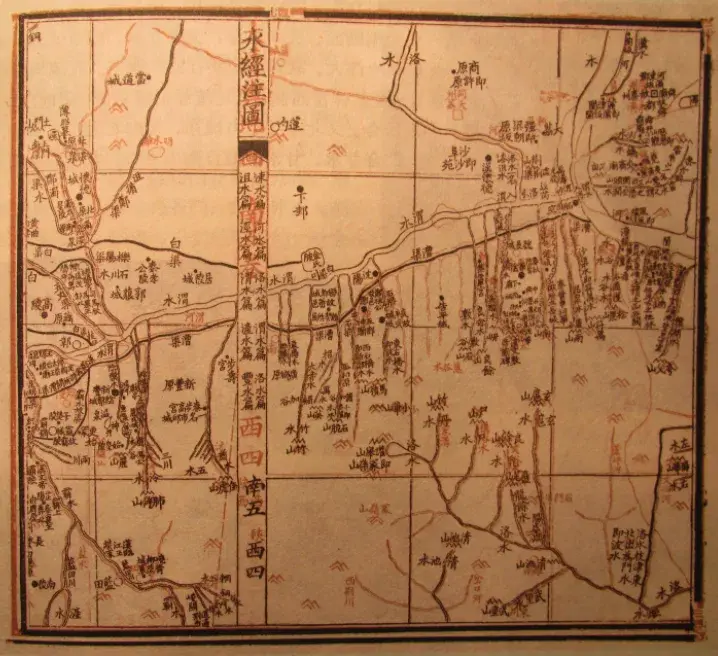
Compilation of the Commentary on the Water Classic (水经注) designates the monumental achievement between the late fifth and early sixth centuries when Northern Wei geographer and litterateur Li Daoyuan compiled the forty-volume geographical masterpiece Shui Jing Zhu. The original Han-Jin Water Classic was a brief text of barely ten thousand characters recording 137 streams with numerous errors. Serving in diverse administrative posts, Li Daoyuan established the principle of "utilizing waters to verify lands, and examining lands to preserve antiquity," expanding the brief text into an expansive regional survey. Comprising over three hundred thousand characters, the compendium documents 1,252 rivers, systematically chronicling hydrological topographies, urban settlements, strategic defiles, hydraulic engineering, regional mineral deposits, and folklore, while citing 437 ancient volumes and over 400 stone inscriptions. Shui Jing Zhu stands not only as classical China's most exhaustive comprehensive geographical text, establishing the structural framework for physical and cultural geography, but also as a masterpiece of Six Dynasties landscape prose, giving rise to centuries of specialized scholarly inquiry known as "Lixue."
Li Daoyuan accompanies his father to provincial postings in Shandong, studying regional waterways.
Following the transfer of the capital to Luoyang, Li Daoyuan enters court service, consulting imperial libraries.
Appointed provincial inspector and judicial censor, he conducts field surveys across the Yellow River and Taihang Passes.
Synthesizing 437 ancient treatises and field journals, he begins writing the thirty-volume geographical survey.
Completes the forty volumes of Shui Jing Zhu, documenting 1,252 rivers and establishing an encyclopedic framework.
Appointed commissioner to pacify western rebels, Li Daoyuan is assassinated at age fifty-eight; his disciples preserve the manuscript.
The Song imperial government publishes the first print edition, noting that five of the forty volumes were lost, leaving thirty-five extant.
Scholars Quan Zuwang and Dai Zhen publish critical editions, while Yang Shoujing creates detailed historical maps of the text.
Since the Tribute of Yu and the Treatise on Geography in the Book of Han, Chinese geographical scholarship had functioned as an adjunct to dynastic histories, focusing on administrative units, taxation registries, and imperial census data, while lacking systematic inquiry into dynamic physical river networks. The Water Classic, appearing between the Han and Jin dynasties, established the precedent of organizing topography along river corridors. However, the text comprised barely ten thousand characters, cataloging only 137 primary waterways.
The original Water Classic was excessively terse, recording streams with brief notations such as "Stream X rises in Mountain Y and enters River Z." It omitted tributaries, channel variations, seasonal fluctuations, and cultural settlements along river banks, while containing geographical errors. As trade routes developed, the brief work proved inadequate for irrigation engineering, administrative planning, and scholarly inquiry, demanding systematic expansion.
Upon assuming personal rule, Emperor Xiaowen of Northern Wei moved the dynastic capital south to Luoyang, launching sweeping Sinicization reforms. The court embraced Central Plains heritage, assembling imperial libraries and reconstructing dynastic archives, creating an environment favorable to scholarship. As the ancient capital of Zhou, Han, Wei, and Western Jin, Luoyang offered access to epigraphic inscriptions and library archives.
Originating from the prominent Li clan of Fanyang, Li Daoyuan received a classical education, developing an inquiring intellect and passion for rare texts. While serving in provincial and court posts across the Northern Plains, he witnessed the political division between North and South. Aspiring toward cultural unity, Li Daoyuan resolved to utilize natural river systems to compile a compendium spanning the entire realm, transcending military frontiers.
In authoring Shui Jing Zhu, Li Daoyuan transformed the conventional commentary format, establishing an autonomous and innovative literary genre. He recognized that surface hydrological networks form the foundational connective tissue linking topography, climate, natural resources, and human civilization. Using the 137 waterways of the ancient Water Classic as a skeleton, he expanded the scope to 1,252 waterways, expanding the text thirty-fold from ten thousand to over three hundred thousand characters.
Li Daoyuan adopted the principle of "using water to verify territory, and using territory to preserve antiquity." For each river, he chronicled its headwaters, tributaries, directional flow, rapids, subterranean reaches, and terminal estuaries. Radiating outward from each watercourse, he recorded adjacent peaks, basins, springs, historic monuments, administrative shifts, urban settlements, battles, and regional myths. This design broke free from static administrative gazetteers, establishing a dynamic discipline of regional historical geography.
Li Daoyuan maintained scholarly rigor by combining archival synthesis with field investigation. He consulted imperial collections in the capital and collected rare manuscripts during his provincial administrative tenures. Scholars estimate that he directly cited 437 ancient works, including dynastic annals, regional gazetteers, local topographies, illustrated river treatises, mythological collections, and private travel diaries. Because the majority of these volumes perished during medieval warfare, Shui Jing Zhu serves as an indispensable repository preserving ancient Chinese literature.
Furthermore, Li Daoyuan conducted extensive field research. Throughout decades of administrative postings across Northern Wei domains, he conducted direct surveys of natural terrain. He inspected the gorges of Sanmenxia, measured the defiles of the Taihang Eight Passes, explored subterranean limestone caverns, and interviewed riverboatmen regarding seasonal water depths, shifting silt bars, and historic flood cycles. For southern river systems beyond his administrative reach, he collated southern cartographic records and interrogated arriving envoys, ensuring reliable geographic descriptions.
In physical geography, Shui Jing Zhu demonstrated precision unique in medieval scientific literature. The hydrological accounts encompass river lengths, channel profiles, seasonal discharge variations, sediment content, winter ice cycles, rapids, waterfalls, and mineral springs. The text records over 500 lakes and wetlands, nearly 300 subterranean springs, more than 30 underground streams, and over 60 waterfalls, illustrating early Chinese hydrological knowledge.
In geomorphology, the compendium cataloged landform categories, distinguishing upland mountains, plateaus, peaks, ridges, escarpments, knolls, and rocks, alongside lowland valleys, floodplains, and marshes. It documented nearly 2,000 mountain names and over 70 karst caves. In biogeography, it detailed more than 140 varieties of medicinal and economic flora and over 100 species of fauna. In paleoclimatology, it recorded over 30 major historic river floods, nearly 20 earthquakes, and numerous droughts and locust infestations, providing empirical data for reconstructing ancient climatic variations.
In human geography, Shui Jing Zhu documented historical settlement patterns. It surveyed administrative evolution from antiquity through the Northern and Southern Dynasties, recording 2,800 county-level cities, 180 historic capitals, and over 1,000 minor settlements such as rural townships, relay postal stations, villages, and fortified hamlets. Li Daoyuan also included urban settlements in South Asia and Mainland Southeast Asia, such as Varanasi, Kapilavastu, and Rajagriha in India, as well as Dianchong in Champa, preserving data for the history of maritime and overland exchanges.
The work mapped communication and hydraulic infrastructure, recording approximately 100 bridges and nearly 100 ferry crossings along the Yellow and Yangtze Rivers. It documented civil irrigation networks, including Dujiangyan, the Zhengguo Canal, Bai Canal, Mulan Embankment, and numerous weirs, dams, sluices, and stone spillways. In mineral resources, it noted deposits of gold, silver, copper, iron, tin, mercury, sulfur, rock salt, graphite, and mica, providing an early written account of petroleum exploitation in Shaanxi (termed "stone fat water") and the domestic use of coal. Furthermore, it analyzed over 300 historical military engagements, demonstrating the strategic impact of mountain passes and waterway supply routes.
Beyond scientific inquiry, Shui Jing Zhu achieved literary renown through its poetic prose style and preservation of epigraphic monuments. Li Daoyuan employed a refined narrative prose style, avoiding the artificial parallelism of contemporary Six Dynasties literature. His descriptions of the Yangtze Three Gorges—noting "throughout seven hundred li of the gorges, mountains stand contiguous without a single breach; layered cliffs and stacked precipices conceal the heavens and eclipse the sun"—stand among the celebrated passages of classical Chinese literature, influencing later landscape travel writers such as Liu Zongyuan and Xu Xiake.
Simultaneously, Li Daoyuan transcribed ancient stone inscriptions. During his travels, he transcribed stone stelae, cliff inscriptions, bronze bronzes, and tomb epitaphs scattered across rural ruins, transcribing the full or partial texts of over 400 epigraphic monuments. Because these stone monuments weathered away or were destroyed over subsequent centuries, his transcriptions preserved primary historical records that formed the foundation for medieval Chinese epigraphic and historical research.
The publication of Shui Jing Zhu represented an intellectual milestone in Chinese scholarship. It transformed geographical writing from a subsidiary branch of dynastic administrative history into an autonomous discipline organized around natural hydrological networks, spatial analysis, and ecological evolution. Documenting 1,252 waterways, it synthesized physical elements—such as hydrology, geomorphology, climate, and ecology—with human elements—including administration, urban settlement, defensive fortification, irrigation, and mining.
In modern research, the methodology pioneered in Shui Jing Zhu anticipates modern historical geography and fluvial geomorphology. Contemporary scientists and historians investigating ancient river courses (such as the historic migrations of the Yellow River), the desiccation of wetlands, shoreline migration, groundwater table variations, urban archaeological mapping, and paleoclimatic fluctuations rely upon Shui Jing Zhu as an indispensable empirical archive.
Following the social upheaval of the Western Jin collapse, the Northern and Southern Dynasties, and subsequent transitions, classical Chinese literature suffered losses. The 437 ancient titles cited by Li Daoyuan largely perished in later centuries. Due to his systematic transcription, lost works by pre-Qin thinkers, Qin and Han regional records, and Six Dynasties illustrated river treatises survived in excerpted fragments, preserving historical texts for classical philology.
Furthermore, Shui Jing Zhu recorded more than 400 stone stelae, tomb tablets, and cliff inscriptions from the Han, Wei, and Jin periods, transcribing their texts, erection dates, calligraphers, and geographical coordinates. As primary epigraphic records, these transcriptions allowed later scholars to correct errors in transmitted dynastic histories. The epigraphic records in Shui Jing Zhu served as a direct inspiration for the epigraphical revivals of the Song and Qing dynasties.
In literature, Shui Jing Zhu established an enduring model of Chinese descriptive prose through its evocative descriptions of natural scenery. Li Daoyuan avoided the rigid antitheses of Six Dynasties parallel prose, pioneering a naturalistic landscape prose style. Tang litterateur Liu Zongyuan in his Eight Records of Yongzhou, Song masters Ouyang Xiu and Su Shi in their travel accounts, and Ming travelers Yuan Hongdao and Xu Xiake drew inspiration from Li Daoyuan's prose.
From the Ming and Qing dynasties onward, the textual corruption and philological depth of Shui Jing Zhu attracted generations of scholars—including Quan Zuwang, Dai Zhen, Zhao Yiqing, and Yang Shoujing—giving rise to a specialized discipline known as "Lixue" (Shui Jing Zhu Studies). Alongside "Hongxue" (Dream of the Red Chamber Studies), Lixue developed into an enduring field within Chinese textual criticism, enjoying international recognition across East Asia and Western sinology.