Fall of Han
Neishi Teng captures Yangdi, taking King An prisoner; Han is reorganized into Yingchuan Commandery.
Qin Dynasty (秦朝) · HISTORICAL EVENT
秦灭六国
Qin's Wars of Unification (秦灭六国) was the epochal decade-long military campaign from 230 BCE to 221 BCE through which the State of Qin conquered the six rival regional kingdoms—Han, Zhao, Wei, Chu, Yan, and Qi—unifying China under a single sovereign. Following strategic doctrines formulated by Li Si and Wei Liao—combining diplomatic bribery, covert subversion, and the doctrine of "befriending distant states while attacking nearby ones"—King Zheng of Qin…
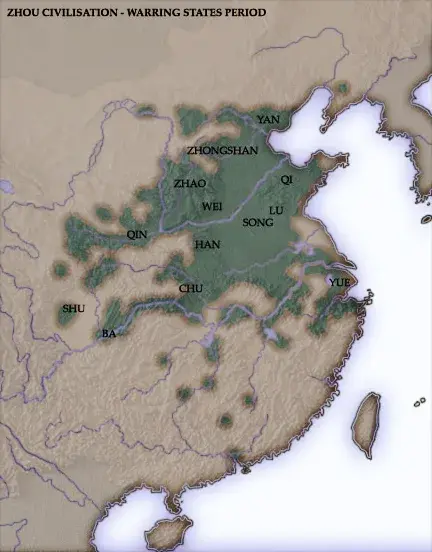
Qin's Wars of Unification (秦灭六国) was the epochal decade-long military campaign from 230 BCE to 221 BCE through which the State of Qin conquered the six rival regional kingdoms—Han, Zhao, Wei, Chu, Yan, and Qi—unifying China under a single sovereign. Following strategic doctrines formulated by Li Si and Wei Liao—combining diplomatic bribery, covert subversion, and the doctrine of "befriending distant states while attacking nearby ones"—King Zheng of Qin deployed formidable field armies commanded by generals Wang Jian and Wang Ben. Qin systematically annexed Han in 230 BCE, seized Handan and destroyed Zhao in 228 BCE after removing General Li Mu via espionage, inundated Daliang to conquer Wei in 225 BCE, mobilized 600,000 troops to annihilate Chu's main army in 223 BCE, overran Yan and Dai in 222 BCE, and caught Qi entirely unprepared through a surprise northern advance in 221 BCE. King Zheng assumed the title of First Emperor (Shi Huangdi), dismantling the feudal order to forge an enduring centralized imperial state.
Neishi Teng captures Yangdi, taking King An prisoner; Han is reorganized into Yingchuan Commandery.
Wang Jian advances on Handan; Qin bribes Guo Kai to orchestrate the execution of general Li Mu.
Wang Jian captures Handan and takes King Qian prisoner; Prince Jia flees to Dai as an exile king.
Wang Ben diverts the Yellow River to flood Daliang; King Jia surrenders, extinguishing Wei.
Li Xin invades Chu with 200,000 men but suffers a devastating ambush by Chu commander Xiang Yan.
Wang Jian commands 600,000 troops, defeating Xiang Yan at Qinan after a year-long war of attrition.
Wang Jian captures Shouchun and King Fuchu, dissolving the Chu state and securing the southern frontier.
Wang Ben captures King Xi in Liaodong, extinguishing Yan, and overruns Dai, eliminating the Zhao line.
Wang Ben launches a surprise march on Linzi; King Jian surrenders, completing the unification of China.
Following King Ping's eastward transfer of the Zhou capital to Luoyang in 770 BCE, the Chinese world entered five centuries of ceaseless warfare during the Spring and Autumn and Warring States periods. Zhou feudal authority deteriorated into nominal ceremony as rival regional states mobilized mass infantry armies, devastated farmland, and erected trade barriers and defensive walls across the landscape.
Amidst endless bloodshed and economic fragmentation, a powerful cultural consensus emerged across the intellectual spectrum demanding unification. Confucian thinkers such as Mencius insisted that "stability lies in unity," while Xunzi argued that "all within the four seas should be as one family." Farmers, merchants, and literati yearned for the eradication of internal frontiers and the restoration of universal peace under a single legitimate central authority.
While eastern states struggled with entrenched aristocratic privileges, the western march state of Qin instituted comprehensive institutional transformations under Duke Xiao and Legalist minister Shang Yang in the fourth century BCE. Shang Yang abolished hereditary fiefs, established standardized counties, rewarded agricultural production, and instituted a twenty-tier military meritocracy where aristocratic status was earned exclusively through battlefield valor.
Over the subsequent century, Qin transformed into a militarized agrarian powerhouse. Exploiting the fertile agricultural surpluses of the newly conquered Sichuan Basin and the hydraulic wealth of the Zhengguo Canal, Qin repeatedly shattered coalition forces in pivotal confrontations such as the Battle of Changping (260 BCE). By the mid-third century BCE, Qin possessed absolute demographic, fiscal, and logistical superiority over the decaying eastern kingdoms.
In 247 BCE, thirteen-year-old Ying Zheng ascended the Qin throne. Reaching adulthood, he crushed internal revolts led by Lao Ai, dismissed Chancellor Lü Buwei, rescinded the ill-conceived Expulsion of Foreigners decree, and gathered talented statesmen including the Legalist theorist Li Si and military strategist Wei Liao.
Li Si and Wei Liao formulated an overarching strategy to prevent the six kingdoms from forming a cohesive coalition (hezong): Diplomatically, Qin dispatched agents with hundreds of thousands of gold taels to bribe venal ministers in foreign capitals, stoking mutual suspicion and paralyzing alliances; Militarily, Qin implemented a sequential doctrine: striking vulnerable neighbors (Han and Zhao) first while placating distant states (Qi and Yan), and isolating central rivals (Wei and Chu) before liquidating them in succession.
Though the smallest among the Seven Warring States, the Kingdom of Han occupied the strategic crossroads of the Central Plains, controlling the eastern approaches of the Hangu Pass. Qin could not safely expand into the eastern heartland without first eliminating Han on its flank.
In 230 BCE (the seventeenth year of King Zheng), Qin initiated the unification war. General Neishi Teng led an army of 100,000 troops across the Yellow River from Nanyang, sweeping aside border garrisons and investing the Han capital of Yangdi (modern Yuzhou, Henan). Recognizing the futility of resistance, King An of Han surrendered without a protracted siege. Qin annexed Han territory, establishing Yingchuan Commandery as its forward military staging ground in the Central Plains.
The Kingdom of Zhao possessed the most formidable military forces among the Three Jin states, led by brilliant field marshal Li Mu, who had repeatedly routed Qin armies at the battles of Fei (233 BCE) and Fanwu (232 BCE).
In 229 BCE, Zhao suffered a catastrophic drought. King Zheng seized this opportunity, ordering General Wang Jian to lead the main army out of Jingxing Pass while Yang Duanhe advanced north across the Zhang River to envelop Handan. Li Mu organized a stubborn positional defense, holding Qin forces at bay for over a year.
Recognizing that Li Mu could not be dislodged by direct assault, Wang Jian implemented a covert subversion scheme. Qin spies bribed the venal Zhao chancellor Guo Kai with thousands of gold taels. Guo Kai falsely informed King Qian of Zhao that Li Mu was conspiring to betray the state. The suspicious monarch stripped Li Mu of command and ordered his assassination. Three months after Li Mu's murder, Wang Jian launched a general offensive, crushing the Zhao army and capturing Handan in October 228 BCE. King Qian was taken prisoner, Zhao was annexed as Handan Commandery, and Prince Jia fled north to Dai (modern Yu County, Hebei) to establish an isolated rump state.
Following the destruction of Zhao, the Kingdom of Wei was hemmed in on three sides by Qin armies, reduced to its capital of Daliang and surrounding territory.
In 225 BCE, General Wang Ben led 100,000 troops to besiege Daliang (modern Kaifeng, Henan). The city possessed massive fortified walls surrounded by deep moats, resisting direct assaults for months.
Observing that Daliang lay on low-lying terrain adjacent to the Yellow River and the Hong Canal, Wang Ben mobilized tens of thousands of soldiers to dig canals, redirecting the floodwaters of the Yellow River directly against the city walls. The deluge submerged Daliang for three months, collapsing the ramparts and causing widespread starvation and disease. King Jia of Wei emerged on a small boat to surrender, extinguishing the State of Wei. Qin reorganized its territory into Dang and Sanchuan commanderies.
Spanning 5,000 li with millions of subjects and extensive strategic depth, the southern superpower of Chu posed the most formidable military challenge of the entire campaign.
In 225 BCE, King Zheng debated commanders for the southern campaign. Confident young general Li Xin claimed he could conquer Chu with 200,000 men, while veteran Wang Jian insisted that no fewer than 600,000 troops were required. King Zheng initially dispatched Li Xin and Meng Wu with 200,000 men. Although initial assaults were successful, Chu commander Xiang Yan tracked the Qin army for three days and nights, executing a surprise flank assault that shattered two Qin encampments and routed Li Xin's expedition.
Confronted with this disaster, King Zheng personally traveled to Wang Jian's estate in Pinyang to apologize and granted him total command over the empire's 600,000 soldiers. In 224 BCE, Wang Jian and Meng Wu marched southward. Recognizing that Chu forces were fighting for national survival, Wang Jian refused to give battle, constructing deep fortifications and spending an entire year training, feasting, and resting his troops.
When Chu forces exhausted their supplies and began retreating eastward, Wang Jian unleashed his rested divisions in an overwhelming pursuit. At the decisive Battle of Qinan (modern Suzhou, Anhui), Qin shattered the Chu army, and Xiang Yan committed suicide on the battlefield. In 223 BCE, Wang Jian stormed the Chu capital of Shouchun, capturing King Fuchu and annexing Chu. The following year, Qin divisions advanced south to subdue the Yue tribes, creating Kuaiji Commandery.
Terrified by Qin's advance to the border river of Yishui, Crown Prince Dan of Yan organized the assassination attempt by Jing Ke in 227 BCE. The plot failed in the Qin palace, unleashing King Zheng's furious vengeance.
In 226 BCE, Wang Jian routed the combined forces of Yan and Dai along the Yishui River, capturing the Yan capital of Jicheng (modern Beijing). King Xi of Yan fled to the Liaodong Peninsula and executed Prince Dan to sue for peace. Qin temporarily paused operations in the north to concentrate on the invasion of Chu.
In 222 BCE, following the fall of Chu, Wang Ben advanced into Liaodong, capturing King Xi and terminating the State of Yan. He then marched west to overrun Dai, capturing King Jia and eliminating the last remnants of Zhao.
Having avoided direct warfare for four decades, the Kingdom of Qi pursued an appeasement policy under the corrupt guidance of Chancellor Hou Sheng, who took massive bribes from Qin to keep Qi neutral while five sister states fell.
By the time Qi recognized its mortal danger, it mobilized troops along its western border. However, Wang Ben bypassed these border fortifications, striking southward from former Yan territory directly toward the undefended capital of Linzi in 221 BCE.
Paralyzed by panic, King Jian of Qi surrendered without offering battle on the advice of Hou Sheng. King Jian was deported to Gong County and starved to death among the pines. With Qi's capitulation, all six eastern states were extinguished, bringing the entire Chinese world under Qin rule.
The ten-year campaign extinguished five centuries of interstate warfare. King Zheng proclaimed himself Shi Huangdi (First Emperor), rejecting the traditional feudal model of enfeoffment in favor of thirty-six centralized commanderies governed by appointed civil magistrates.
First, it permanently established the institutional framework of Chinese governance, replacing hereditary feudal aristocracy with a meritocratic, centralized bureaucratic state that endured until 1911. Second, the First Emperor implemented nationwide standardizations: unifying the written script into small seal characters (Qinzhuan), establishing uniform weights and measures, standardizing axle widths (Che Tong Gui), and issuing circular bronze coins with square centers (Banliang), unifying cultural and commercial networks across China. Third, it forged the enduring geopolitical identity of "China" as a unified civilization, establishing political unity as the supreme historical norm.
In the Records of the Grand Historian (Shiji), Sima Qian observed: "Qin conquered the realm through harsh force, yet the times had changed and its achievement was monumental. Having unified all under heaven, the First Emperor divided the land into thirty-six commanderies, bringing unity to the realm."
Statesman Jia Yi wrote in The Faults of Qin: "Arriving at the First Emperor, he mobilized the accumulated strength of six generations, cracking his long whip to drive the universe, swallowing the two Zhou courts and extinguishing the feudal lords, ascending the supreme throne to command the four corners."
Song essayist Su Xun reflected in On the Six States: "The fall of the six states was not due to flawed weapons or inferior tactics; their ruin lay in bribing Qin. Bribing Qin diminished their power, paving the road to destruction."