Tumu Crisis
Emperor Yingzong's grand army is encircled and destroyed at Tumu Fortress; Wang Zhen is killed and Yingzong is taken prisoner by the Oirats.
Ming Dynasty (明朝) · HISTORICAL EVENT
朱祁钰监国继位
The Zhu Qiyu Regenting and Accession to the Throne (朱祁钰监国继位) was a momentous political transition spanning August and September of 1449 CE (the fourteenth year of the Zhengtong era) that rescued the Ming Dynasty from imminent collapse. In the eighth month, Emperor Yingzong (Zhu Qizhen), reckless under the influence of eunuch Wang Zhen, led a punitive expedition northward that ended in total annihilation at the Battle of Tumu Fortress. The emperor was…
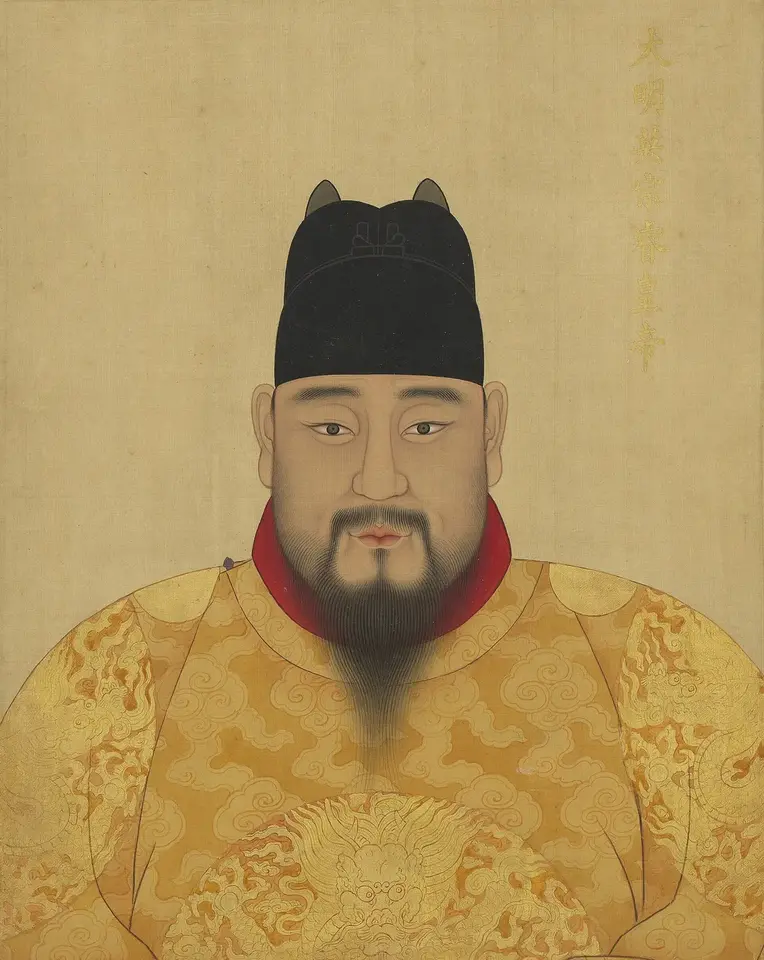
The Zhu Qiyu Regenting and Accession to the Throne (朱祁钰监国继位) was a momentous political transition spanning August and September of 1449 CE (the fourteenth year of the Zhengtong era) that rescued the Ming Dynasty from imminent collapse. In the eighth month, Emperor Yingzong (Zhu Qizhen), reckless under the influence of eunuch Wang Zhen, led a punitive expedition northward that ended in total annihilation at the Battle of Tumu Fortress. The emperor was taken prisoner by Esen Taishi of the Oirat Mongols, leaving the imperial capital virtually defenseless and the central court paralyzed with panic. In this desperate emergency, Empress Dowager Sun appointed the emperor's younger brother, the twenty-one-year-old Prince of Cheng (Zhu Qiyu), as Prince Regent to preside over imperial affairs. When defeatist officials led by Xu Cheng proposed fleeing south to Nanjing, Vice Minister of War Yu Qian forcefully advocated defense, insisting that Beijing was the irreplaceable foundation of the realm. During a volatile court assembly that culminated in the lynching of Wang Zhen's henchman Ma Shun by outraged ministers, Zhu Qiyu, advised by Yu Qian, pardoned the assembly and restored discipline. To permanently neutralize Oirat attempts to extort territory and treasure using the captive monarch, Yu Qian and senior statesmen urged the enthronement of a mature sovereign. On the sixth day of the ninth month of 1449 CE, Zhu Qiyu formally ascended the imperial throne as Emperor Jingtai, honoring the captive Yingzong as Retired Emperor. This decisive transition reconstituted imperial authority and laid the cornerstone for the triumph in the Battle of Beijing.
Emperor Yingzong's grand army is encircled and destroyed at Tumu Fortress; Wang Zhen is killed and Yingzong is taken prisoner by the Oirats.
Word of the disaster reaches Beijing; Empress Dowager Sun appoints Prince of Cheng Zhu Qiyu to assume the regency at the Fengtian Gate.
Yu Qian rebukes proposals to flee to Nanjing; furious ministers beat Wang Zhen's ally Ma Shun to death in the palace courtyard, and Zhu Qiyu pardons the assembly.
Zhu Qiyu promotes Yu Qian to Minister of War, summoning provincial reserve armies to Beijing and replenishing food stores.
Urged by Yu Qian and senior ministers, Zhu Qiyu ascends the throne as Emperor Jingtai, honoring Yingzong as Retired Emperor.
In the summer of 1449 CE, Oirat Mongol cavalry led by Esen Taishi launched a massive coordinated invasion across the northern frontiers of the Ming Empire, pushing directly toward the strategic passes of Datong and Xuanfu. The impetuous twenty-three-year-old Emperor Yingzong, heavily influenced by the chief palace eunuch Wang Zhen, resolved to personally command a punitive expedition of more than two hundred thousand imperial soldiers, disregarding passionate protests from seasoned civil ministers.
Before departing, Yingzong appointed his half-brother, the Prince of Cheng Zhu Qiyu, to remain in Beijing as regent caretaker. Hampered by incompetent logistical planning and torrential rains, the imperial column became disoriented and retreated in disorder. On the fifteenth day of the eighth month, the imperial army was surrounded by Oirat horsemen at Tumu Fortress in Huailai. Deprived of water, the imperial forces collapsed; fifty senior civil and military grandees were killed, Wang Zhen was bludgeoned to death by furious guards, and Emperor Yingzong was taken prisoner.
On the night of the sixteenth day of the eighth month, word of the annihilation of the army and the capture of the sovereign reached Beijing, plunging the court into terror. The three elite capital training camps had been obliterated, leaving fewer than one hundred thousand aged and sickly garrison troops to defend the massive metropolitan perimeter. Rumors proliferated, and wealthy merchants and noble households began secretly liquidating properties to flee to Nanjing.
On the eighteenth day of the eighth month, Empress Dowager Sun commanded the twenty-one-year-old Prince of Cheng Zhu Qiyu to take up the regency at the Fengtian Gate. During the emergency court council, Hanlin Lecturer Xu Cheng (later renamed Xu Youzhen) cited astrological omens to argue that the dynastic fortune had shifted, passionately advocating that the court abandon Beijing and retreat to Nanjing. Vice Minister of War Yu Qian sternly rebuked the proposal: "Those who advocate moving the capital to the south deserve to be executed! The capital is the root of the realm; once it is abandoned, all is lost. Have you forgotten the tragic fate of the Northern Song emperors?" Backed by Minister of Personnel Wang Zhi, Minister of Rites Hu Ying, and the Prince Regent himself, the court adopted the resolute policy of defending Beijing to the death.
On the eighteenth day of the eighth month of 1449 CE, Prince of Cheng Zhu Qiyu formally assumed the regency. During the morning audience at the Fengtian Gate on the twenty-third day, civil ministers and censors led by Censor-in-Chief Chen Yi prostrated themselves on the marble steps, weeping and shouting denunciations against the deceased eunuch Wang Zhen for destroying the army and imperiling the monarch, demanding the immediate confiscation of Wang Zhen's clan estates.
Lacking seasoned statecraft experience, Zhu Qiyu initially hesitated, ordering the memorialists to disperse and await bureaucratic investigation. Outraged by the delay, the officials remained prostrated, their lamentations shaking the palace eaves. At that moment, Commander of the Embroidered Uniform Guard Ma Shun, an arrogant henchman of Wang Zhen, stepped forward and shouted abusively at the kneeling officials, demanding they vacate the courtyard. This insult unleashed decades of accumulated anti-eunuch fury. Supervising Secretary Wang Hong leaped forward, seized Ma Shun by the hair, and bit him on the cheek, while hundreds of civil officials swarmed forward and bludgeoned Ma Shun to death on the spot.
Immediately afterward, the enraged assembly dragged out two additional eunuch confederates, Mao Gui and Wang Changsui, beating them to death and leaving the palace flagstones drenched in blood. Terrified by the unprecedented violence, Zhu Qiyu rose from his throne to seek shelter in the inner palace. At this critical juncture, Vice Minister of War Yu Qian pushed through the throngs, grasped the regent's carriage, and shouted: "Your Highness, please stay! The ministers attacked Ma Shun out of patriotic indignation to rid the state of traitors; they committed no treason! If Your Highness immediately proclaims all officials blameless, order will be restored at once!" Zhu Qiyu halted, publicly declared all courtiers pardoned, and decreed the confiscation of Wang Zhen's property, averting an institutional meltdown and establishing his sovereign authority.
Following the suppression of the courtyard tumult, Zhu Qiyu appointed Yu Qian as Minister of War on the twenty-ninth day of the eighth month, delegating complete authority over defense preparations to him. Yu Qian mobilized reinforcements from Henan, Shandong, and coastal garrisons, while ordering millions of bushels of grain transported from Tongzhou into the capital storehouses, rapidly building a resilient defensive force of over two hundred thousand troops.
Meanwhile, Oirat chieftain Esen Taishi attempted to exploit Emperor Yingzong as a diplomatic hostage, escorting the captive emperor to frontier passes like Datong and Xuanfu to demand immediate surrender and vast ransoms of silver and silk. Although loyal commanders such as Guo Deng and Yang Hong rejected these treasonous demands, the Ming court found itself in an excruciating strategic dilemma: as long as Yingzong retained the imperial title, northern commanders hesitated to fire upon enemy formations accompanying their legitimate monarch.
To permanently strip Esen of his hostage leverage, senior civil leaders Yu Qian, Wang Zhi, and Hu Ying convened secret consultations. Although Empress Dowager Sun had designated Yingzong's two-year-old son Zhu Jianshen as Crown Prince on the twenty-first day of the eighth month, an infant could not command an empire facing existential invasion. A mature sovereign of adult years was indispensable.
Yu Qian and the ministerial body submitted a memorial to Empress Dowager Sun, asserting: "The realm cannot remain without a ruler for a single day; the state is paramount, while the sovereign is secondary. To comfort the hearts of the people and crush the barbarian plot, an adult monarch must ascend the throne." Recognizing the grave national necessity, Empress Dowager Sun granted her assent. On the sixth day of the ninth month of 1449 CE, civil and military officials gathered at the Fengtian Hall to enthrone Zhu Qiyu as the new emperor, known to history as Emperor Jingtai.
Ascending the throne, Zhu Qiyu proclaimed a general amnesty, honored the captive Yingzong with the title of Retired Emperor, and established the reign title Jingtai for the coming year. The accession of Zhu Qiyu reconstituted imperial authority at the apex of government, completely neutralizing Esen's hostage leverage and establishing the organizational command that secured total victory in the ensuing Battle of Beijing.
The accession concluded with Zhu Qiyu enthroned as Emperor Jingtai and Yingzong honored as Retired Emperor. The Ming dynasty averted an imminent power vacuum, purged the corrupt eunuch syndicate of Wang Zhen, and installed an energetic war cabinet under Yu Qian that completed defensive preparations for the defense of the capital within weeks.
The event stood as the most pivotal self-rescue of central authority during the 276-year history of the Ming Dynasty. Tactically, enthroning a new sovereign stripped Esen of his hostage leverage, enabling frontier garrisons to engage the enemy without hesitation and directly facilitating the decisive victory in the Battle of Beijing. Institutionally, the succession elevated the authority of the civil scholar-official class led by the ministries, although it also sowed the bitter seeds of dynastic grievance that erupted eight years later in the 1457 CE South Palace Restoration.