Feudal Partition at Xixia
Xiang Yu proclaims himself Hegemon-King and divides the realm among eighteen princes, exiling Liu Bang to Hanzhong.
Western Han (西汉) · HISTORICAL EVENT
楚汉战争
The Chu-Han Contention (楚汉战争) was an epic strategic war waged between 206 BCE and 202 BCE between Liu Bang, King of Han, and Xiang Yu, Hegemon-King of Western Chu, to determine the supreme ruler of China. Following the fall of Qin in 206 BCE, Xiang Yu partitioned the empire among eighteen regional princes, exiling Liu Bang into the secluded mountain valleys of Hanzhong. In August of that year, Liu Bang appointed Han Xin as supreme commander. Executing the…
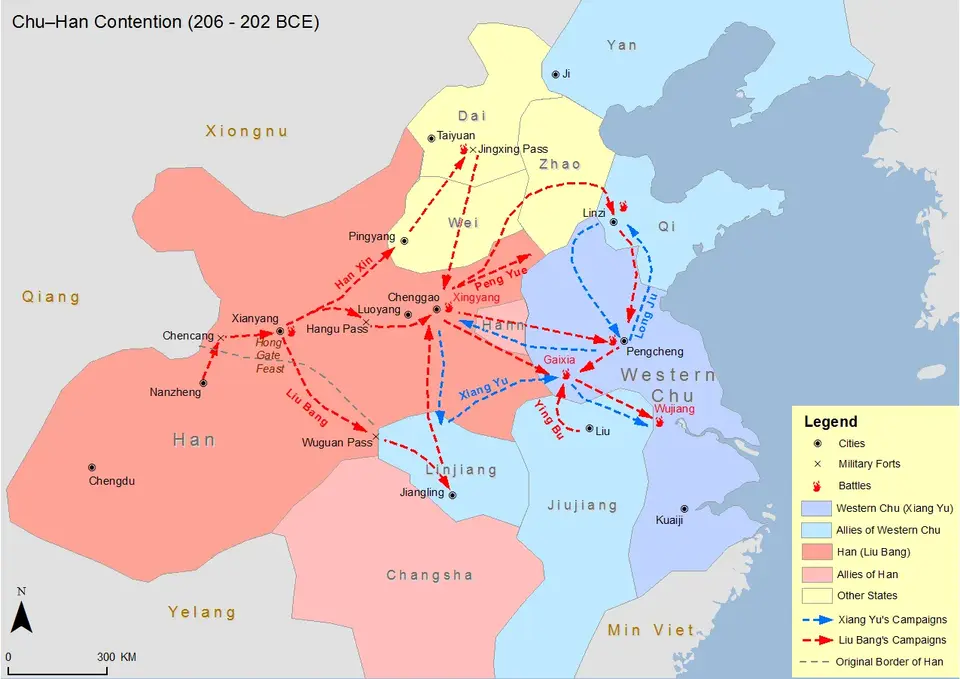
The Chu-Han Contention (楚汉战争) was an epic strategic war waged between 206 BCE and 202 BCE between Liu Bang, King of Han, and Xiang Yu, Hegemon-King of Western Chu, to determine the supreme ruler of China. Following the fall of Qin in 206 BCE, Xiang Yu partitioned the empire among eighteen regional princes, exiling Liu Bang into the secluded mountain valleys of Hanzhong. In August of that year, Liu Bang appointed Han Xin as supreme commander. Executing the stratagem of "openly repairing the gallery roads while secretly marching via Chencang," Han Xin reclaimed Guanzhong in a lightning campaign. Proclaiming a punitive campaign to avenge the regicide of Emperor Yi, Liu Bang mobilized a coalition to march east, igniting the Chu-Han Contention. In the opening phase, Liu Bang marshaled 560,000 allied troops to occupy the Western Chu capital of Pengcheng, only to be routed along the Sui River by Xiang Yu commanding 30,000 elite cavalry. Adopting Zhang Liang's strategic counsel, Liu Bang anchored a stubborn defensive perimeter along Xingyang and Chenggao, sustained logistically by Xiao He's boundless grain shipments from Guanzhong. Simultaneously, Han Xin opened a northern theater, conquering the kingdoms of Wei, Dai, Zhao, Yan, and Qi, while Peng Yue waged relentless guerrilla strikes on Chu granaries. Paralyzed on multiple fronts, Xiang Yu signed the Hong Canal Treaty in 203 BCE to divide the empire. Instigated by Zhang Liang and Chen Ping, Liu Bang broke the truce, uniting his grand field armies under Han Xin at Gaixia. Surrounded by sixty divisions and unnerved by nocturnal Songs of Chu, the Chu army disintegrated, culminating in Xiang Yu's suicide at the Wu River and Liu Bang's coronation as founding emperor of the Han Dynasty.
Xiang Yu proclaims himself Hegemon-King and divides the realm among eighteen princes, exiling Liu Bang to Hanzhong.
Han Xin executes the Chencang stratagem, pacifying the Three Qins and capturing Guanzhong.
Liu Bang proclaims an imperial crusade against Xiang Yu for the murder of Emperor Yi, mobilizing 560,000 allied troops.
Xiang Yu routes the massive allied army with 30,000 cavalry, slaughtering 200,000 men; Liu Bang escapes with family captured.
Zhang Liang designs the Xiayi coalition; Han troops defeat Chu vanguards between Jing and Suo, establishing the Xingyang defense.
Chu and Han battle across the Aocang granaries; Chen Ping uses discord to eliminate Fan Zeng; Ji Xin sacrifices himself to save Liu Bang.
Han Xin executes the "Back-to-the-River" array at Jingxing, crushing Zhao and subduing Yan.
Han Xin drowns the 200,000-man Chu-Qi army at the Wei River and decapitates Long Ju, isolating Xiang Yu from the north.
Famished and surrounded, Xiang Yu agrees to divide the empire along the Hong Canal, releasing Liu Bang's family.
Liu Bang breaks the truce; Han Xin traps 100,000 Chu troops at Gaixia; nocturnal songs dissolve Chu morale.
Xiang Yu breaks through to the Wu River and cuts his throat; Liu Bang ascends the throne as Emperor Gaozu of Han.
In late 207 BCE, Liu Bang's vanguard entered Guanzhong, receiving the unconditional surrender of the last Qin ruler, Ziying, and sealing the extinction of the Qin Dynasty. Entering Xianyang, Liu Bang won the profound allegiance of the Guanzhong populace by abolishing Draconian legal codes, instituting the Threefold Code of Law, and sealing imperial treasuries untouched before withdrawing to Bashang. Weeks later, Xiang Yu arrived at the head of 400,000 allied troops. Following the tense confrontation at the Feast at Hong Gate, Xiang Yu looted Xianyang, slaughtered Ziying, incinerated the Epang Palace, and seized imperial treasures to march east.
In February 206 BCE, Xiang Yu repudiated the original pact declared by King Huai of Chu ("He who first enters Guanzhong shall rule it as king"). Styling himself Hegemon-King of Western Chu with his capital at Pengcheng, Xiang Yu carved the empire into eighteen feudal kingdoms. To contain Liu Bang, Xiang Yu divided Guanzhong among three Qin turncoat generals—Zhang Han (Yong), Sima Xin (Sai), and Dong Yi (Zhai)—collectively known as the Three Qins, while banishing Liu Bang to the rugged valleys of Hanzhong and Bashu as King of Han. Xiang Yu's capricious distribution enriched close comrades while disinheriting traditional royal lineages, igniting universal resentment across northern and central China.
In April 206 BCE, Liu Bang led his reluctant followers through the Qinling Mountains into Hanzhong. Acting upon Zhang Liang's counsel, Liu Bang incinerated the cliffside timber gallery roads along his route, demonstrating to Xiang Yu that he harbored no intentions of returning eastward, thereby disarming Chu vigilance. However, stranded in the damp southern valleys, Han soldiers and officers grew intensely homesick, deserting in escalating numbers.
During this crisis, Chancellor Xiao He famously rode into the night to retrieve Han Xin, an unrecognized fugitive officer, and forcefully persuaded Liu Bang that Han Xin was a peerless military genius without equal. In a formal ceremony, Liu Bang elevated Han Xin to Commander-in-Chief. Han Xin presented his monumental "Hanzhong Dialogue," diagnosing Xiang Yu's fatal flaws—"courage of a brute, mercy of a woman, banishment of his sovereign, and disregard for justice"—and formulated the grand strategy to retake Guanzhong. In August 206 BCE, Han Xin dispatched troops to ostentatiously repair the burnt gallery roads while leading the primary field army through the secluded Chencang pass. Catching Zhang Han completely unprepared, Han Xin smashed the Yong defenses, pacified Sima Xin and Dong Yi, and brought all of Guanzhong into the Han fold.
While Liu Bang solidified control over Guanzhong, the eastern kingdoms dissolved into open rebellion. Tian Rong rebelled in Qi, refusing Chu overlordship, which forced Xiang Yu to lead his main armies north into an exhausting quagmire across Shandong. In winter 206 BCE, Xiang Yu dispatched secret assassins to drown nominal emperor Huai (ennobled as Emperor Yi) in the river near Chenxian.
In March 205 BCE, Liu Bang marched through the Hangu Pass to Xincheng outside Luoyang. Local elder Master Dong advised Liu Bang: "He who complies with virtue flourishes; he who defies righteousness perishes. An army marching without moral cause achieves nothing. Xiang Yu has murdered his sovereign—he is the traitor of the realm. Proclaim a righteous war, clothe your legions in white mourning robes, and the realm will follow." Seizing the moral high ground, Liu Bang conducted three days of imperial funeral rites for Emperor Yi, dispatching envoys to proclaim Xiang Yu a murderous usurper and calling upon all feudal princes to join a grand coalition to overthrow Western Chu.
In April 205 BCE, exploiting Xiang Yu's entanglement in the north, Liu Bang marshaled a staggering allied host of 560,000 troops drawn from five feudal kingdoms, driving uncontested into the Chu capital of Pengcheng. Delighted by the effortless capture of his rival's seat, Liu Bang and his allied commanders abandoned discipline, indulging in continuous wine banquets, looting concubines, and carousing across the city palaces.
Learning of Pengcheng's fall, Xiang Yu demonstrated breathtaking tactical brilliance. Leaving subordinate officers to maintain the siege in Qi, Xiang Yu personally selected 30,000 veteran heavy cavalrymen, riding south through Lu County under cover of darkness. At daybreak, Xiang Yu's strike force smashed into the rear of the allied camp along the Xiao River. Caught unprepared, the massive 560,000-man host collapsed into absolute pandemonium. Charging with unstoppable momentum, the Chu cavalry drove over 100,000 allied soldiers into the Gu and Si rivers. Pursuing the survivors south to the Sui River, Chu horsemen slaughtered another 100,000 allied troops, damming the river with corpses.
Liu Bang escaped accompanied by barely several dozen riders, while his father Liu Taigong and wife Lü Zhi were captured. In the desperate flight, with Chu cavalry breathing down his neck, Liu Bang repeatedly pushed his young son (the future Emperor Hui) and daughter from the carriage to lighten the vehicle, only for charioteer Xiahou Ying to stop repeatedly to hoist the weeping children back inside.
Fleeing to Xiayi, Liu Bang collapsed in despair, lamenting: "Who among the realm's commanders can conquer the empire with me?" Master strategist Zhang Liang presented his historic "Xiayi Plan": "King of Jiujiang Ying Bu is Chu's fiercest general, currently alienated from Xiang Yu; Peng Yue wages rebellion in Liang, threatening Chu's rear; and among Your Majesty's commanders, Han Xin alone is capable of grand operations. If you entrust these three men with independent commands, Western Chu can be destroyed!" Liu Bang immediately acted, dispatching Sui He to subvert Ying Bu, coordinating guerrilla offensives with Peng Yue, and dispatching Han Xin to conquer the north.
Reorganizing shattered remnants at Xingyang, Liu Bang received fresh reinforcements mobilized by Xiao He from Guanzhong and smashed the pursuing Chu vanguards between Jing and Suo, finally stabilizing the defense. From 204 BCE onward, the war centered upon the fortified redoubts of Xingyang and Chenggao on the south bank of the Yellow River. Building fortified corridor causeways to transport grain from the immense Aocang granaries, Liu Bang locked Xiang Yu into an exhausting war of attrition.
Confronting Han defensive resilience, Xiang Yu repeatedly assaulted the fortified corridors under Fan Zeng's direction, severing Liu Bang's logistical connection to Aocang. With supplies expiring inside Xingyang, Liu Bang offered to divide the realm, but Fan Zeng urged Xiang Yu to press the siege to annihilation.
In this mortal peril, advisor Chen Ping proposed an ingenious stratagem of internal discord. Receiving 40,000 catties of gold with unconstrained authority, Chen Ping spread pervasive rumors that senior Chu commanders Zhongli Mo and Long Ju sought autonomous kingdoms through Han alliance, while alleging that Fan Zeng plotted with Liu Bang. Xiang Yu's suspicious nature was easily poisoned. When Chu envoys arrived in the Han camp, Chen Ping served an extravagant banquet, only to feign shock: "I presumed you were Lord Fan's envoys, not the Hegemon-King's!" and replaced the feast with coarse porridge. Deeply humiliated, the envoy reported the slight to Xiang Yu, who stripped Fan Zeng of his military council. Heartbroken, the seventy-five-year-old strategist departed, crying: "The empire's affairs are decided; let the King manage them alone!" and perished from an angry abscess on his journey home.
With Fan Zeng dead, Xiang Yu tightened the siege around Xingyang. In May 204 BCE, with the citadel on the verge of falling, General Ji Xin donned royal robes and mounted the royal carriage, offering his surrender at the eastern gate to draw the entire Chu army into wild celebration. Meanwhile, Liu Bang slipped out the western gate with Chen Ping and several dozen horsemen, escaping to Guanzhong before returning to Chenggao to renew the defense.
While Liu Bang anchored the central front, Han Xin conducted a masterclass in operational warfare across the northern theater. In August 205 BCE, Han Xin crossed the Yellow River in wooden tubs, surprising Anyang, capturing King of Wei Bao, and establishing the commandery of Hedong before subduing the Kingdom of Dai.
In October 204 BCE, Han Xin marched through the precipitous Jingxing Pass to confront 200,000 Zhao defenders under Lord Wu'an Chen Yu. Deploying his legions with their backs to the river to eliminate all possibility of retreat, Han Xin launched a feigned withdrawal, baiting the Zhao defenders into abandoning their fortifications. Elite Han cavalry seized the vacant Zhao camp, planting red Han banners across the ramparts. Trapped between the river and red banners, the Zhao army collapsed; Chen Yu was executed, and King of Zhao Xie was captured. Han Xin respectfully consulted captured Zhao strategist Li Zuoche, adopting his counsel to secure the bloodless submission of King of Yan Zang Tu via diplomatic declaration.
In late 203 BCE, Han Xin invaded Qi, occupying the capital of Linzi. Panicked by the northern collapse, Xiang Yu dispatched his primary general, Long Ju, commanding 200,000 elite Chu troops to relieve Qi. Confronting Long Ju along the Wei River, Han Xin ordered his men to dam the river upstream with 10,000 sandbags. Staging a feigned retreat across the shallows, Han Xin baited Long Ju into wading across in pursuit; at that instant, Han Xin ordered the dam breached. Roaring floodwaters sliced the Chu army in two, and Han counterattacks annihilated the isolated vanguard, decapitating Long Ju. The remaining seventy citadels of Qi submitted, completely enveloping Xiang Yu's northern and eastern perimeter.
Simultaneously, Peng Yue conducted devastating guerrilla maneuvers in Chu's rear, repeatedly incinerating million-bushel depots at Xiapi and forcing Xiang Yu to shuttle desperately across hundreds of miles. In autumn 203 BCE, the antagonists confronted each other across the deep ravines of Mount Guangwu north of Xingyang.
Xiang Yu placed Liu Bang's father upon a chopping block above the ravine, threatening: "Surrender immediately, or I shall boil your father alive!" Liu Bang replied with chilling composure: "You and I swore brotherhood before King Huai; therefore my father is your father. If you insist on boiling your own father, do not forget to send me a cup of the soup!" Enraged, Xiang Yu ordered hidden crossbowmen to loose a volley, striking Liu Bang in the chest. Suppressing agony, Liu Bang grasped his foot, shouting: "The scoundrel shot me in the toe!" to prevent panic among his troops.
By late 203 BCE, Chu troops were starved, exhausted, and strategically isolated. Knowing that victory was impossible, Xiang Yu accepted Liu Bang's diplomatic envoy, signing the Hong Canal Treaty dividing the realm along the canal: lands west belonged to Han, and lands east belonged to Chu. Releasing Liu Bang's captive family, Xiang Yu marched his weary soldiers eastward.
As Xiang Yu withdrew eastward in October 202 BCE, Liu Bang prepared to march home to Guanzhong. Advisers Zhang Liang and Chen Ping objected vehemently: "Han possesses more than half the empire, and the feudal princes are united. Chu troops are famished and broken. This is the moment Heaven destroys Chu! Releasing them now is feeding a tiger to breed future disaster!" Convinced, Liu Bang tore up the treaty and launched an immediate pursuit.
When initial pursuers stumbled at Guling, Liu Bang granted sweeping royal fiefs to Han Xin (Qi) and Peng Yue (Liang). In December 202 BCE, grand field armies totaling 600,000 men converged upon Gaixia (modern Lingbi, Anhui), throwing an unbroken iron perimeter around Xiang Yu's 100,000 surviving soldiers.
Han Xin assumed supreme command, deploying a vast "Ten-Sided Ambush" array. Launching a frontal probe with 30,000 troops, Han Xin executed a controlled retreat, drawing the Chu shock charge forward before his flanking divisions struck both sides, inflicting tens of thousands of casualties and driving Chu remnants into their fortified camp. That evening, Han troops encircled the camp, singing traditional Chu folk melodies. Hearing the music, Xiang Yu gasped in horror: "Has Han conquered all of Chu? Why are there so many Chu men in their ranks?" In despair, Xiang Yu drank his final cup with his consort Consort Yu, singing his famous farewell: "My strength plucked mountains, my might shadowed the earth; the times are unfavorable, and my steed can run no more! Steed, what can I do? Yu, oh Yu, what shall become of you?" Consort Yu danced her final dance before cutting her throat in suicide.
At midnight, Xiang Yu broke through the southern cordon with 800 horsemen, pursued by 5,000 Han cavalry under Guan Ying. Tricked by a local farmer into a swamp near Yinling, Xiang Yu reached Dongcheng with only twenty-eight riders. Turning to his followers, the Hegemon-King lamented: "It is Heaven that destroys me, not my failure in arms!" Launching a final charge, Xiang Yu's twenty-eight horsemen shattered surrounding Han ranks, killing a commander and hundreds of soldiers before riding to the bank of the Wu River.
The Wu River boatman docked his skiff, pleading: "Though Jiangdong is small, its land stretches a thousand li with hundreds of thousands of people—enough to establish a kingdom. I beseech the King to cross quickly!" Xiang Yu laughed bitterly: "Heaven destroys me; why should I cross? Eight thousand Jiangdong sons crossed the river with me, and not one returns alive. Even if their fathers pity me and make me king, what face have I to look upon them?" Xiang Yu gave his warhorse to the boatman, unsheathed his sword, and fought on foot, slaying hundreds of pursuers while taking a dozen wounds. Spotting former comrade Lü Matong among the Han cavalry, Xiang Yu said: "I hear Han offers a thousand pieces of gold and ten thousand households for my head; I shall grant you this bounty!" and cut his own throat. Xiang Yu was thirty-one years old. All Chu territories submitted, bringing the historic Chu-Han Contention to a close.
The Chu-Han Contention permanently averted China's fragmentation into the warring states model. In February 202 BCE, Liu Bang ascended the imperial throne along the Si River at Dingtao, establishing the Han Dynasty and fixing the capital at Chang'an. The centralized imperial bureaucratic apparatus first forged under Qin was revived and legitimized through popular acceptance.
The victory of Han established the dual administrative structure of commanderies and semi-autonomous fiefs, gradually transitioning into unified direct bureaucratic governance. Through four centuries of enduring stability, cultural consolidation, and economic prosperity, the disparate peoples of the Central Plains fused into a unified civilization, giving their name permanently to the primary ethnic identity of China: the Han people.