Fall of Baekje
Su Dingfang captured Sabi and King Uija; five commanderies established with Liu Renyuan left in command
Tang Dynasty (唐朝) · HISTORICAL EVENT
白江口之战
The Battle of Baekgang (白江口之战) was a decisive naval and terrestrial engagement in August 663 (the 3rd year of Longshuo in the Tang Dynasty, the 2nd year of Emperor Tenji in Japan), fought at the mouth of the Baekgang River (the modern Geum River, South Korea) where allied Tang and Silla forces crushed Yamato Japanese fleets and Baekje restoration rebels. This represented the first international military clash between China and Japan. Following the…
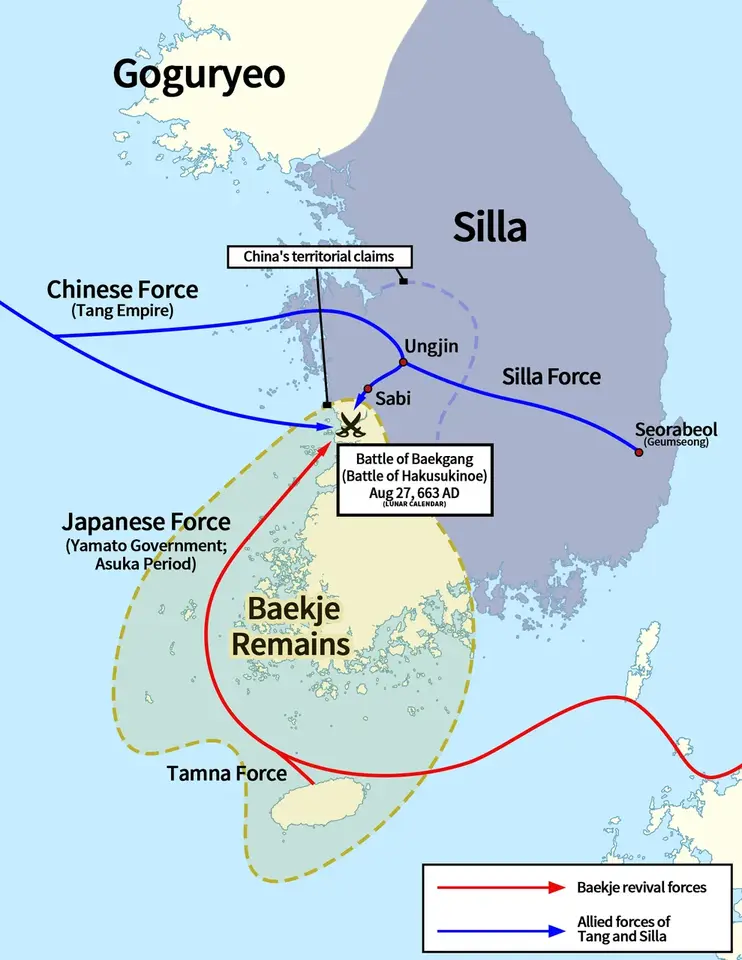
The Battle of Baekgang (白江口之战) was a decisive naval and terrestrial engagement in August 663 (the 3rd year of Longshuo in the Tang Dynasty, the 2nd year of Emperor Tenji in Japan), fought at the mouth of the Baekgang River (the modern Geum River, South Korea) where allied Tang and Silla forces crushed Yamato Japanese fleets and Baekje restoration rebels. This represented the first international military clash between China and Japan. Following the conquest of Baekje by General Su Dingfang in 660, Baekje loyalist Buyeo Boksin rebelled, recalling hostage prince Buyeo Pung from Japan and pleading for Yamato military intervention. The Yamato court mobilized over 40,000 troops and 1,000 warships under Abe no Hirafu to cross the sea. Tang naval commander Liu Rengui met the massive armada at Baekgang with 170 large warships. Exploiting their superior vessel size, solid formation, and tactical fire attacks, the Tang fleet won four straight victories, incinerating over 400 Japanese ships and turning the seawater red. Over 10,000 Yamato troops drowned or perished, and Baekje rebel forces surrendered. The victory extinguished Japanese imperial ambitions on the peninsula, deterred Japanese aggression against China for a thousand years, and catalyzed the Taika Reform's adoption of Tang institutional culture.
Su Dingfang captured Sabi and King Uija; five commanderies established with Liu Renyuan left in command
Buyeo Boksin crowned prince Buyeo Pung and besieged Woongjin; Liu Rengui urged holding the peninsula
Liu Rengui executed a daring night assault on Jinhyeon Castle, securing the Silla grain supply line
Buyeo Pung ambushed Buyeo Boksin; Tang sent 7,000 reinforcements under Sun Renshi
Sun Renshi marched overland toward Juryu while Liu Rengui navigated naval forces out to sea
Tang's 170 heavy warships encountered Yamato's armada of 1,000 vessels at the mouth of Baekgang
Japanese vanguard launched an uncoordinated charge; Tang warships held the channel with missile fire
Tang forces executed an encirclement and fire attack, winning four clashes and burning 400 ships
Buyeo Pung fled to Goguryeo; Juryu garrison surrendered, ending the Baekje restoration war
Defeated Yamato forces returned to Japan; Tenji built border fortresses and embraced Tang cultural suzerainty
During the mid-seventh century, Yamato Japan initiated the Taika Reform to build a centralized bureaucratic monarchy. However, factional discord plagued the court. Geopolitically, the Yamato state viewed southern Korea—particularly the ancient Gaya Confederacy (Mimana) and Baekje—as vital spheres of influence, consistently backing Baekje to counterbalance Silla's rise.
In 660 (the 5th year of Xianqing), Tang Emperor Gaozong dispatched General Su Dingfang with over 100,000 naval and terrestrial troops in alliance with King Muyeol of Silla. Tang forces captured Sabi, capturing King Uija and Crown Prince Yung, bringing about the downfall of Baekje. Tang established five commanderies, leaving General Liu Renyuan to garrison the former capital. The extinction of Baekje eliminated Japan's continental bridgehead, provoking severe criticism against the imperial court. Prince Naka no Oe (later Emperor Tenji) and Empress Saimei resolved to commit national military resources to reverse the loss.
Shortly after the conquest, Baekje loyalist Buyeo Boksin and monk Dochim rallied tens of thousands of insurgents at Juryu Fortress (modern Buan), recalling prince Buyeo Pung from Japan to proclaim him king. In 661, Su Dingfang marched north against Goguryeo but was forced to withdraw by severe winter blizzards. Baekje rebels capitalized on this, besieging Liu Renyuan's isolated garrison inside Woongjin.
Emperor Gaozong initially contemplated evacuating the peninsula, but Liu Rengui submitted a memorial strongly opposing withdrawal, arguing that abandoning Baekje would leave Goguryeo unchecked and isolate Silla. Convinced, Gaozong ordered Liu Rengui to lead reinforcements to hold the position. Demonstrating tactical agility, Liu executed a night assault against the fortified position of Jinhyeon Castle, severing rebel lines and restoring the vital grain supply route from Silla.
While the military conflict hung in the balance, a violent leadership struggle erupted within the Baekje restoration camp. The suspicious Buyeo Pung grew resentful of General Buyeo Boksin's overbearing military authority. In the summer of 663, Buyeo Pung ambushed and executed Boksin. The internal purge demoralized rebel forces and severely degraded their defensive cohesion, forcing Buyeo Pung to appeal for expanded Japanese naval intervention.
The Tang court capitalized on this opening. Emperor Gaozong dispatched General Sun Renshi with 7,000 elite troops from Laizhou across the sea to reinforce Woongjin. After consolidating forces, Tang generals deliberated on strategy. Liu Rengui advocated targeting the rebel stronghold: "Garim Fortress is rugged and difficult to assault; Juryu Fortress is the core insurgent lair. If Juryu falls, all peripheral outposts will collapse."
Tang commanders formulated a synchronized amphibious operation: Sun Renshi, Liu Renyuan, and King Munmu of Silla led the main land army across mountain passes toward Juryu; meanwhile, Liu Rengui, Du Shuang, and surrendered Baekje prince Buyeo Yung commanded a fleet of 170 heavy warships down the Woongjin River into the sea, converging at the mouth of the Baekgang River to encircle the fortress from land and sea.
To restore its continental influence, the Yamato court issued a nationwide mobilization, dispatching three expeditionary forces. The third wave, led by Abe no Hirafu, comprised 27,000 elite troops and over 1,000 light vessels. On the 17th day of the 8th lunar month, Tang vanguard ships encountered the massive Yamato fleet entering the Baekgang River.
The Yamato fleet was vast, numbering over 1,000 vessels and nearly 40,000 men, holding overwhelming numerical superiority. However, Japanese ships were predominantly light, shallow-draft wooden craft lacking defensive plating, long-range heavy artillery, and coordinated tactical command. In contrast, Liu Rengui's 170 Tang warships were massive multi-decked tower ships (louchuan) and assault vessels (mengchong). High, sturdy, and equipped with iron-tipped ramming spurs and trebuchets, they carried superior archers, catapults, and combustible pitch.
On August 27, vanguard units clashed in the narrow estuary. Confident in their numbers, Yamato commanders charged forward. Liu Rengui deployed his heavy warships in the deep-water channels, maintaining an unyielding defensive wall while unleashing volleys of heavy crossbow bolts. Unable to close the distance, the Japanese vanguard was repulsed.
At dawn on August 28, the decisive engagement erupted. Overconfident Japanese generals declared: "If we advance aggressively, the enemy must give way!" Lacking centralized formation, Japanese vessels rushed forward in a disorganized mass, colliding with each other in the confined waters.
Perceiving their chaotic deployment, Liu Rengui ordered his wings to envelop the enemy, trapping the Japanese fleet against the shallows. Taking advantage of favorable river breezes, Tang tower ships rained down flaming arrows, incendiary pitchpots, and dry firewood. Flames swept across the wooden Yamato vessels; official annals recorded that "dense smoke engulfed the sky, and seawater turned crimson."
Tang vessels used heavy rams to smash through and capsize burning enemy craft. Japanese soldiers were consumed by flames or drowned in the estuary. The Tang navy executed four consecutive tactical envelopments, achieving total victory. Over 400 Japanese ships were burned, and more than 10,000 Yamato troops perished. Seeing his allied fleet destroyed from the shore, Buyeo Pung abandoned his family and escaped in a single skiff to Goguryeo, disappearing from history.
Following the catastrophic defeat at Baekgang, Baekje rebel morale collapsed. On September 7, surviving insurgent commanders Buyeo Chungseung and Buyeo Chungji led the garrison of Juryu Fortress to surrender to the Tang army. Peripheral fortresses throughout the region followed suit and opened their gates.
Meanwhile, Abe no Hirafu gathered roughly a hundred surviving vessels, carrying defeated troops and Baekje refugees in headlong flight back to the Japanese archipelago. Outnumbered by more than five to one, Tang forces scored an overwhelming amphibious triumph, permanently extinguishing the Baekje restoration movement and securing southern Korea under direct Tang administrative control, paving the way for the northern campaign against Goguryeo.
The Battle of Baekgang ended in a decisive triumph for the Tang-Silla alliance and the total destruction of the Yamato expeditionary force. Despite significant numerical inferiority, the Tang navy won four consecutive engagements, incinerating over 400 Japanese ships and eliminating tens of thousands of enemy combatants. The Baekje restoration movement was extinguished, and Baekje permanently vanished as an independent political entity. The Yamato fleet fled back to Japan in disarray.
The battle laid the foundation for the political and diplomatic architecture of East Asia for a millennium. First, it eliminated the southern threat to Tang forces, enabling Emperor Gaozong to dispatch Li Ji and Xue Rengui to conquer Goguryeo in 668, reshaping the peninsula under Tang and Silla administration. Second, the crushing defeat halted early Japanese expansionism; Emperor Tenji fortified the Kyushu coast with water fortresses, fearing a Tang invasion. Third, recognizing Tang China's military and cultural supremacy, Japan abandoned military confrontation and pursued diplomatic alignment, dispatching massive embassies (Kentoshi), student scholars, and monks to Chang'an. This cultural transmission invigorated the Taika reforms and spurred Japan's classical civilization under the Chinese tributary system.