Outbreak of the Second Opium War
Britain exploits the Arrow Incident while France joins over Chapdelaine's execution, attacking Guangzhou.
Qing Dynasty (清朝) · HISTORICAL EVENT
北京条约
The Convention of Peking (北京条约) refers collectively to three unequal treaties concluded in October and November 1860 between the Qing dynasty of China and Great Britain, France, and the Russian Empire in the aftermath of the Second Opium War. Following the outbreak of hostilities in 1856 and the forced signing of the 1858 Treaties of Tianjin, military conflict flared anew when allied fleets attacked Dagu in 1859. In the summer of 1860, Anglo-French…
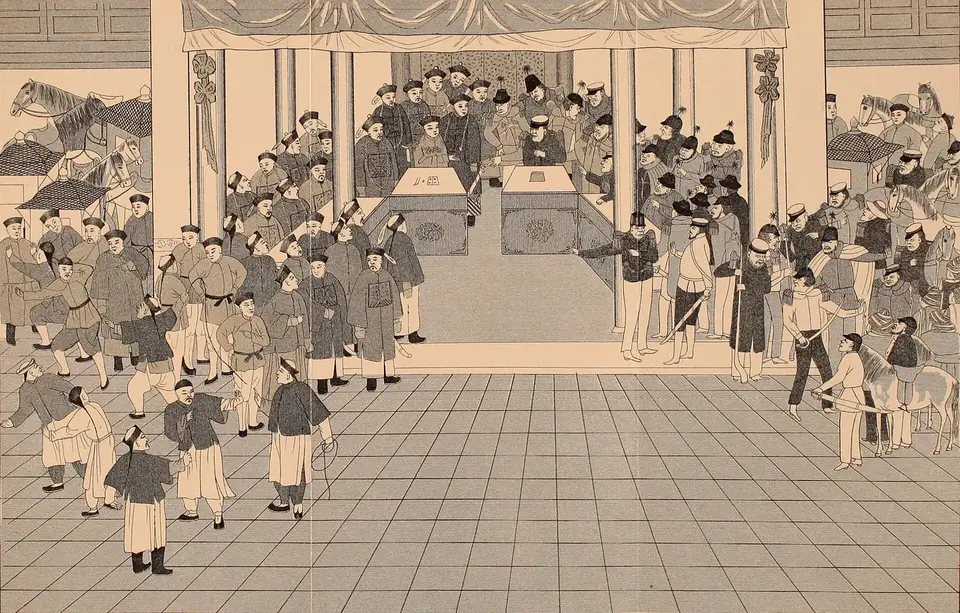
The Convention of Peking (北京条约) refers collectively to three unequal treaties concluded in October and November 1860 between the Qing dynasty of China and Great Britain, France, and the Russian Empire in the aftermath of the Second Opium War. Following the outbreak of hostilities in 1856 and the forced signing of the 1858 Treaties of Tianjin, military conflict flared anew when allied fleets attacked Dagu in 1859. In the summer of 1860, Anglo-French forces deployed overwhelming naval and land armies, seizing Dagu and Tianjin before routing elite Qing cavalry at the Battle of Baliqiao. The Xianfeng Emperor fled north to the Rehe mountain resort in Chengde, delegating desperate peace negotiations to his younger brother, Prince Gong Yixin. Allied troops looted and incinerated the architectural wonder of the Old Summer Palace and occupied the Andingmen gate, aiming cannons directly at the Forbidden City. Under military coercion, Prince Gong signed bilateral conventions with Lord Elgin of Britain on October 24 and Baron Gros of France on October 25. Exploiting the crisis under the guise of neutral mediation, Russian envoy Nikolay Ignatyev coerced Prince Gong into signing the Sino-Russian convention on November 14. The agreements confirmed the Treaties of Tianjin, ceded southern Kowloon to Britain, ceded over 400,000 square kilometers of coastal territory east of the Ussuri River to Russia, increased indemnities to eight million taels of silver each for Britain and France, opened Tianjin as a treaty port, and legalized the overseas coolie trade, inflicting catastrophic damage upon Chinese sovereignty.
Britain exploits the Arrow Incident while France joins over Chapdelaine's execution, attacking Guangzhou.
Allied forces capture Dagu, forcing the Qing government to sign the Treaties of Tianjin.
Sengge Rinchen repels British and French fleets attempting to force passage along the Hai River.
Allied expeditionary armies land at Beitang, outflank coastal forts, and occupy Tianjin.
Allied rifled artillery crushes Mongol cavalry; Anglo-French forces open the path to Beijing.
The Xianfeng Emperor flees to Chengde, appointing Prince Gong to oversee negotiations.
Allied forces loot the Old Summer Palace and occupy the Andingmen gate.
Lord Elgin orders the three-day burning of the imperial palace complexes.
Prince Gong signs the convention with Lord Elgin, ceding southern Kowloon and paying eight million taels.
Prince Gong signs with Baron Gros, paying eight million taels and granting missionary land rights.
Russia coerces the cession of 400,000 square kilometers east of the Ussuri River, severing access to the Sea of Japan.
In 1856, Britain and France exploited the Arrow Incident and the execution of French missionary Auguste Chapdelaine as pretexts to launch the Second Opium War against the Qing dynasty. Allied squadrons captured Guangzhou before sailing north to bombard the Dagu forts in May 1858, forcing the Qing court to sign the Treaties of Tianjin with Britain, France, Russia, and the United States.
These treaties granted foreign envoys the right to reside in Beijing, opened interior treaty ports along the Yangtze, conceded inland navigation rights to foreign warships, and permitted Christian missionaries to propagate within the empire.
However, the Xianfeng Emperor regarded foreign embassies in the capital and imperial audiences without kowtow as intolerable humiliations. He secretly instructed Grand Secretary Guiliang during subsequent Shanghai tariff negotiations to offer complete customs tariff waivers in exchange for canceling foreign residency in Beijing, but Western diplomats rejected the proposal, setting the stage for renewed hostilities.
In June 1859, British minister Frederick Bruce and French minister Bourboulon arrived off the Zhili coast with a powerful allied armada to exchange ratifications. The Qing government, having heavily fortified Dagu under the command of Mongol general Sengge Rinchen, directed the allied ministers to land at Beitang to travel under Chinese military escort to Beijing.
Arrogantly refusing the designated route, allied warships attempted to force the defensive boom across the Hai River estuary. Sengge Rinchen ordered the Dagu coastal batteries to open fire; artillery strikes sank several gunboats and inflicted over four hundred allied casualties, severely wounding British admiral James Hope.
The repulse at Dagu temporarily checked allied aggression, but the governments of London and Paris resolved to mobilize massive colonial armies from Britain, France, and British India to execute overwhelming retaliation.
In July 1860, an allied force of over two hundred warships and twenty thousand veteran troops returned to northern China. Landing unopposed at Beitang, allied columns bypassed the fortified seaward batteries and attacked Dagu from the rear, storming the ramparts and occupying Tianjin in August.
Allied armies advanced toward Tongzhou. Negotiations collapsed when allied interpreter Harry Parkes behaved provocatively and Qing authorities detained Parkes and thirty-eight companions as hostages.
On September 21, Sengge Rinchen assembled thirty thousand Mongol cavalry and provincial infantry at Baliqiao outside Tongzhou. Charging against British Armstrong rifled artillery and French minié rifles, the Qing cavalry was decimated. The outer defenses of the capital disintegrated.
The following morning, the Xianfeng Emperor fled the Forbidden City with his concubines and court favorites, retreating under the pretext of an imperial hunting tour to Rehe in Chengde, leaving his twenty-seven-year-old half-brother, Prince Gong Yixin, behind in Beijing with plenipotentiary authority to sue for peace.
Following the rout at Baliqiao, Anglo-French columns advanced upon the undefended suburbs of Beijing. Prince Gong evacuated his remaining guards southwest toward Lugou Bridge, leaving the imperial capital virtually unfortified.
On October 6, allied regiments reached the northwestern outskirts of the capital. French units were the first to enter the Old Summer Palace, accompanied shortly by British contingents. The soldiers embarked upon an unprecedented spree of looting, plundering centuries of imperial treasures, including ancient jades, imperial porcelain, bronze vessels from the Shang and Zhou dynasties, and irreplaceable imperial library manuscripts. What could not be carried was deliberately smashed.
On October 13, Qing garrison officers surrendered the Andingmen gate, allowing allied artillery to be mounted on the city battlements commanding the northern avenues. Learning that several British captives had died of mistreatment in imperial prisons, Lord Elgin resolved to administer a punitive psychological blow against the dynasty while concealing evidence of allied plunder.
On October 18, Elgin ordered three thousand British cavalrymen to set fire to the entire Old Summer Palace complex alongside surrounding imperial gardens at Wanshoushan, Jingmingyuan, and Xiangshan. The fire burned uninterrupted for three days and nights, enveloping the capital in black smoke and reducing hundreds of ornate wooden pavilions and bridges to ash.
Confronted with the destruction of the imperial palaces and the immediate threat of total assault upon the Forbidden City, Prince Gong completely abandoned resistance. On October 20, he informed allied ministers that the imperial court accepted all terms without reservation.
On the afternoon of October 24, 1860, Lord Elgin proceeded through the city from Andingmen to the Ministry of Rites, escorted by one thousand British redcoats and Sikh cavalrymen with banners flying and drums beating.
Inside the ceremonial hall, Prince Gong received the British delegation in full court robes, trembling visibly. The diplomats first exchanged ratifications of the 1858 Treaty of Tianjin.
Immediately thereafter, Prince Gong signed and sealed the Sino-British Convention of Peking drafted by Elgin. The following afternoon, October 25, French plenipotentiary Baron Gros entered the Ministry of Rites under French marine escort, completing ratification exchanges and signing the Sino-French Convention of Peking.
The Sino-British Convention comprised nine articles: Article 1 reaffirmed the validity of the 1858 Treaty of Tianjin, officially establishing permanent British diplomatic residency in Beijing; Article 2 rescinded previous restrictions agreed at Shanghai regarding diplomatic itineraries; Article 3 increased the war indemnity to eight million taels of silver, to be paid in quarterly installments deducted from regional maritime customs revenues; Article 4 declared the metropolitan port of Tianjin open to foreign commerce, allowing British subjects to reside, trade, and establish foreign concessions; Article 5 authorized foreign merchants to recruit Chinese laborers across all treaty ports, legalizing the overseas coolie trade that subjected tens of thousands of Chinese emigrants to virtual slavery; Article 6 ceded the southern tip of Kowloon Peninsula up to Boundary Street, together with Stonecutters Island, in perpetuity to the British Crown, incorporating them into colonial Hong Kong.
The Sino-French Convention contained ten articles: it increased the French war indemnity to eight million taels, opened Tianjin as a treaty port, and mandated the restitution of all Roman Catholic properties seized since early Qing bans.
Crucially, in Article 6 of the Chinese version, French translator Louis Delamarre secretly inserted a clause absent from the official French text, stating that French missionaries were permitted to lease and purchase land in all interior provinces and erect buildings at will, granting Western religious missions unprecedented extra-territorial territorial rights across the Chinese mainland.
While British and French armies battered down imperial defenses, Russian envoy Nikolay Ignatyev executed a masterful campaign of diplomatic duplicity. Ignatyev provided allied commanders with intelligence and secret maps of Beijing's defenses, while presenting himself to Prince Gong as an indispensable intermediary who could convince allied forces to evacuate Beijing without further destruction.
Once the British and French treaties were signed and allied troops prepared to withdraw before winter, Ignatyev dropped his mask. He claimed that imperial mediation had saved Beijing and threatened that Russian armies would occupy northern frontiers if his demands were not met immediately.
Broken in spirit, Prince Gong capitulated to Russian demands. On November 14, 1860, Prince Gong and Ignatyev signed the Sino-Russian Convention of Peking at the Ministry of Rites.
The treaty extracted staggering territorial concessions: First, the Qing court formally recognized the 1858 Treaty of Aigun, officially ceding over 600,000 square kilometers north of the Heilongjiang River to Russia; Second, it permanently ceded all territory east of the Ussuri River to the sea, encompassing over 400,000 square kilometers—including the ice-free port of Vladivostok and the major island of Sakhalin—thereby completely severing Manchuria's direct maritime outlet to the Sea of Japan; Third, it established broad boundary principles for the northwest frontier based on permanent patrol posts, providing the legal foundation for the 1864 Treaty of Tarbagatai that severed 440,000 square kilometers around Lake Balkhash; Fourth, it granted Russia consulates and duty-free commercial rights in Kulun and Kashgar. Without firing a single shot, the Tsarist Empire annexed more Chinese territory than any other power.
The Convention of Peking inflicted irreparable territorial mutilation upon China. The cession of Kowloon secured British military dominance over Victoria Harbour.
Far more catastrophic, the Sino-Russian convention severed the entire northeastern coastline along the Sea of Japan, incorporating Primorsky Krai, Vladivostok, and Sakhalin permanently into Russian imperial territory. China's landlocked northeastern provinces lost all direct maritime trade routes into the Sea of Japan.
The astronomical indemnities of sixteen million taels drained imperial reserves, forcing increased tax levies upon an impoverished peasantry already battered by the Taiping Rebellion.
The opening of Tianjin brought foreign garrisons, gunboats, and merchants to the gates of the capital. The legalization of the coolie trade initiated decades of maritime human trafficking, while unauthorized clauses permitting missionaries to purchase property sparked virulent anti-foreign riots across provincial towns.
The humiliation of 1860 shattered the traditional cosmological world order of the Qing dynasty. Following Xianfeng's death in Rehe, Prince Gong allied with Empress Dowager Cixi in the Xinyou Coup of 1861 to overthrow reactionary regents.
Confronted by Western military superiority, Prince Gong, Wenxiang, Zeng Guofan, and Li Hongzhang established the Zongli Yamen, the first specialized foreign affairs ministry, and launched the Self-Strengthening Movement to manufacture modern weaponry and build a modern fleet.