Uprising at Wagang
Zhai Rang escapes prison to Wagang Stockade, joining Shan Xiongxin and Xu Shiji to intercept canal grain
Sui Dynasty (隋朝) · HISTORICAL EVENT
瓦岗军
The Wagang Army (瓦岗军) was the most powerful and influential insurgent force during the agrarian uprisings of the late Sui dynasty, active between 611 and 618 (Daye 7 to Daye 14). Exhausted by Emperor Yang's reckless infrastructure projects and three disastrous Goguryeo campaigns, the Central Plains erupted in revolt. In 611, Zhai Rang escaped from prison to the marshlands of Wagang in Dong Commandery, joining regional stalwarts Shan Xiongxin and Xu Shiji…
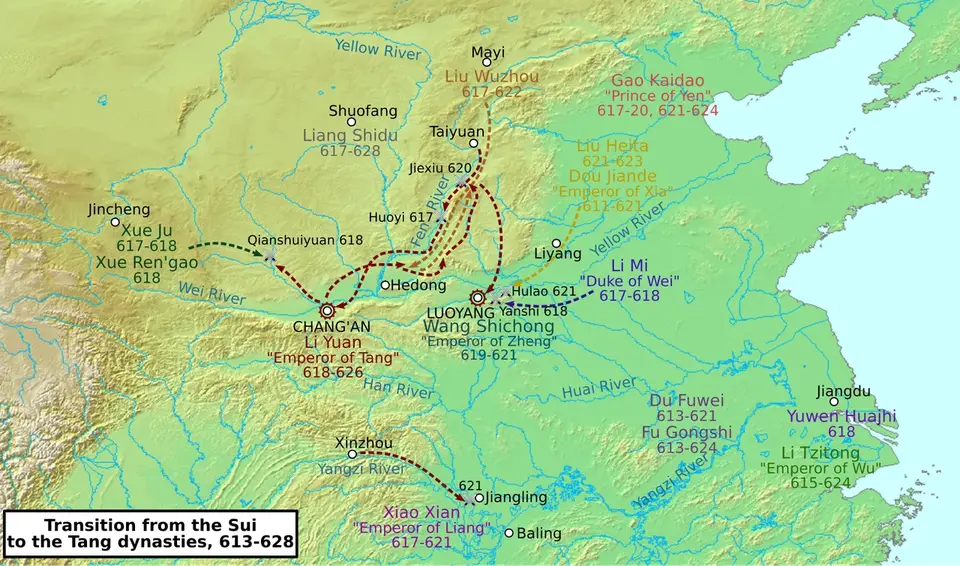
The Wagang Army (瓦岗军) was the most powerful and influential insurgent force during the agrarian uprisings of the late Sui dynasty, active between 611 and 618 (Daye 7 to Daye 14). Exhausted by Emperor Yang's reckless infrastructure projects and three disastrous Goguryeo campaigns, the Central Plains erupted in revolt. In 611, Zhai Rang escaped from prison to the marshlands of Wagang in Dong Commandery, joining regional stalwarts Shan Xiongxin and Xu Shiji to intercept government grain barges along the Grand Canal. In 616, aristocratic strategist Li Mi joined the movement, orchestrating the capture of Xingyang and ambushing Sui general Zhang Xutuo at Dahai Monastery. In 617, the army captured the empire's premier grain reserve, the Xingluo (Luokou) Granary, distributing millions of bushels to starving peasants, swelling the rebel ranks to hundreds of thousands. Li Mi assumed the title of Duke of Wei and besieged the eastern capital of Luoyang. However, the assassination of co-founder Zhai Rang fractured command cohesion. In 618, exhausted from a grueling victory against Yuwen Huaji's elite guards, the Wagang Army suffered a fatal surprise defeat against Wang Shichong at Mount Mang. Following its dissolution, Li Mi surrendered to the Tang, while premier generals Qin Shubao, Cheng Yaojin, and Xu Shiji became the military backbone of the burgeoning Tang dynasty.
Zhai Rang escapes prison to Wagang Stockade, joining Shan Xiongxin and Xu Shiji to intercept canal grain
Li Mi joins Wagang, ambushing and slaying renowned Sui general Zhang Xutuo at Dahai Monastery
Wagang troops capture Luokou Granary, feeding hundreds of thousands of famine refugees
Zhai Rang yields leadership; Li Mi assumes the title of Duke of Wei and establishes government offices
Wagang troops capture Huiluo Granary, advancing to the gates of Luoyang and encircling the capital
Li Mi murders Zhai Rang at a banquet, shattering military unity and morale
Wagang forces defeat Yuwen Huaji's Xiaoguo guards along the Qi River at ruinous human cost
Wang Shichong ambushes the exhausted Wagang Army at Mount Mang, forcing Li Mi to flee and surrender to the Tang
Following the prosperous Kaihuang reign of Emperor Wen, the Sui empire commanded unprecedented treasury reserves and grain stocks. However, Emperor Yang squandered this imperial inheritance through megalomaniacal ambition: constructing the extensive Grand Canal network, building the lavish eastern capital at Luoyang, and undertaking continuous tours of Jiangdu and the northern frontiers, working millions of peasant laborers to death.
Between 612 and 614, Emperor Yang mobilized over a million troops in three catastrophic invasions of Goguryeo. The Central Plains bore the catastrophic burden of shipbuilding and military transport. When severe droughts and Yellow River floods struck Shandong and Henan, the fields lay fallow. Imperial authorities refused to release state grain reserves and enforced harsh tax collections. Facing starvation and legal execution, the desperate agrarian populace rose in spontaneous armed rebellion.
In 611 (Daye 7), Wang Bo raised the first rebel banner at Mount Changbai in Shandong. In the same year, Zhai Rang, a low-ranking judicial official in Dong Commandery, was imprisoned on criminal charges. Sympathetic prison warden Huang Junhan secretly released him.
Zhai Rang took refuge in the reeds of Wagang Stockade near the Yongji Canal, the primary transport artery carrying grain and military provisions to the northern frontier. Zhai Rang gathered dozens of outlaws, raising a rebel standard against the Sui court. He was soon joined by local martial champion Shan Xiongxin and brilliant young strategist Xu Shiji (later granted the imperial surname Li as Li Ji). By raiding grain barges and merchant flotillas, the Wagang rebels acquired abundant supplies, rapidly expanding into a battle-hardened force of over ten thousand men.
In 616 (Daye 12), Li Mi, an aristocratic strategist who had participated in Yang Xuangan's failed revolt, sought refuge at Wagang. Li Mi urged Zhai Rang to abandon minor canal raiding: "Emperor Yang is isolated in Jiangdu, leaving the Central Plains exposed. If Wagang remains in the swamps, it will stay a bandit band; to contend for the empire, we must first seize Xingyang, control the massive Luokou Granary, and threaten Luoyang!" Zhai Rang adopted the strategy, appointing Li Mi chief strategist.
In late 616, the Wagang Army captured the strategic city of Xingyang, controlling the passage to Hulao Pass. Enraged, Emperor Yang dispatched his premier commander, Zhang Xutuo, with twenty thousand veteran troops to crush the insurgency.
Anticipating Zhang Xutuo's aggressive nature, Li Mi set a trap. Zhai Rang engaged the imperial vanguard and feigned retreat, luring Zhang Xutuo ten li north of Xingyang into dense woods near Dahai Monastery. Li Mi's hidden shock troops struck the exposed Sui column from all sides. Trapped in the marshes, Zhang Xutuo fought bravely, breaking through the perimeter multiple times to rescue trapped subordinates before falling in battle. The annihilation of his army broke the military aura of the Sui in Henan.
Following the Dahai Monastery triumph, Li Mi proposed a bold strike against Xingluo Granary (also known as Luokou Granary, near modern Gongyi). Containing three thousand underground silos storing millions of bushels of grain gathered across two reigns, it was the largest food depot in China.
In the second month of 617, Li Mi led seven thousand shock troops on a night raid, capturing the granary. Li Mi immediately opened the gates, inviting the starving populace to take as much grain as they could carry without restriction. Hundreds of thousands of famine refugees surged to Luokou daily from across Henan.
Capitalizing on popular gratitude, Li Mi recruited tens of thousands of able-bodied men into the ranks, expanding the Wagang Army into a host of over three hundred thousand. Independent rebel chieftains like Hao Xiaode and Sun Xuan pledged allegiance, while Sui commanders Pei Renji, Qin Shubao (Qin Qiong), Luo Shixin, and Cheng Yaojin (Cheng Zhijie) surrendered their regiments, elevating Wagang into the dominant power of northern China.
Recognizing Li Mi's superior strategic intellect, Zhai Rang voluntarily yielded supreme leadership. In late February 617, the commanders acclaimed Li Mi as Duke of Wei (Wei Gong). Li Mi established administrative bureaus, created his elite personal guard, the Bushan Cohorts, and enfeoffed Zhai Rang as Grand Minister of Works and Duke of Dong Commandery.
Li Mi constructed the fortified city of Luokou, forty li in circumference. In April, Sui general Liu Changgong marched seventy thousand troops from Luoyang to recapture the granary; Li Mi ambushed them at the Shizi River, routing the imperial army. In May, Wagang troops captured the Huiluo Granary just outside Luoyang, advancing to the Shangdong Gate. Luoyang was completely isolated, cut off from food supplies and external relief.
At the apex of its military glory, the Wagang leadership was fractured by internal jealousy. Although Li Mi held supreme command, Zhai Rang, his brother Zhai Hong, and confidant Wang Ruxin resented their eclipse. Wang Ruxin urged Zhai Rang to seize executive power, while Zhai Hong declared that Zhai Rang should claim the throne himself.
Informed of these conspiracies, Li Mi resolved to purge his co-founder. In November 617, Li Mi hosted a banquet for Zhai Rang, Shan Xiongxin, and Xu Shiji. During the dinner, Li Mi presented an exquisite bow, inviting Zhai Rang to test its draw. As Zhai Rang drew the bowstring, Li Mi's bodyguard Cai Jiande emerged from behind a screen and slashed Zhai Rang from behind, killing him instantly.
Chaos erupted in the hall. Shan Xiongxin kowtowed for mercy, while Xu Shiji was severely wounded by slashing guards before being rescued by Wang Bodang. Although Li Mi spared Shan and Xu and integrated Zhai Rang's troops, the assassination shattered internal trust. The moral prestige of the movement evaporated, breeding pervasive paranoia among frontline commanders.
In March 618 (Daye 14), General Yuwen Huaji orchestrated a mutiny in Jiangdu, assassinating Emperor Yang and marching over one hundred thousand elite Xiaoguo guards northward toward Chang'an.
Trapped between Wagang forces and Yuwen Huaji's army, the Sui court in Luoyang under young Yang Tong offered Li Mi supreme office, appointing him Grand Commandant and Prime Minister if he would intercept the invaders. Desiring formal dynastic legitimacy, Li Mi accepted, marching his main army north to Liyang.
The Wagang Army engaged Yuwen Huaji's Xiaoguo divisions along the Qi River in a succession of ferocious battles. Li Mi was struck in the chest by a stray arrow and saved by Qin Shubao. After months of grueling combat, Wagang forces exhausted Yuwen Huaji's supplies and crushed his army. However, the victory was pyrrhic: Wagang lost its veteran shock troops, emptied its granaries, and left its surviving soldiers exhausted and demoralized.
Observing Wagang's exhaustion, general Wang Shichong executed a coup in Luoyang, seizing absolute authority. In September 618, Wang Shichong led twenty thousand veteran soldiers across the Luo River in a night assault against Li Mi's encampment.
Ignoring Xu Shiji's prudent counsel to remain behind fortifications, Li Mi deployed his troops at Mount Mang near Yanshi. During the engagement, Wang Shichong staged a deceptive ruse, parading a captive officer who resembled Wagang general Pei Xingyan and shouting that Li Mi had been captured. Panic swept through the Wagang formations, turning into an uncontrollable rout.
Over one hundred thousand Wagang soldiers were killed or captured. Wang Shichong occupied Yanshi and Luokou Granary, and Shan Xiongxin defected. Seeing his cause lost, Li Mi retreated to Hulao Pass with two thousand cavalry and fled west into Guanzhong to surrender to Emperor Gaozu of Tang (Li Yuan). Later attempting to rebel against the Tang, Li Mi was ambushed and killed at Mount Xiong'er. Meanwhile, Xu Shiji surrendered all his five commanderies to the Tang, while Qin Shubao and Cheng Yaojin deserted Wang Shichong to join Li Shimin, becoming foundational commanders of the Tang empire.
The Wagang Army expanded from a bandit band of dozens into a massive confederation of hundreds of thousands controlling the Central Plains, before collapsing due to internal strife and tactical errors. Although the movement failed to establish an enduring imperial dynasty, its seven-year war bore the brunt of the Sui military response. Wagang decimated the frontline armies of Zhang Xutuo, the capital guards of Liu Changgong, and the elite Xiaoguo corps of Yuwen Huaji, stripping the Sui dynasty of its defensive core. Following the defeat at Mount Mang, the elite commanders of the Wagang Army—including Li Ji, Qin Shubao, Cheng Yaojin, and Luo Shixin—transferred their allegiance to the House of Tang, providing Li Shimin with the veteran core needed to pacify China.
The Wagang Uprising occupies a central place in the history of Chinese peasant rebellions. Strategically, it pioneered the approach of capturing imperial granaries to convert starving refugees into disciplined armies. Tactically, Li Mi's fluid ambushes at Dahai Monastery and the Shizi River remain classic textbook examples of deep envelopment. Politically, the rapid collapse of the movement following Zhai Rang's assassination demonstrated the fatal peril of elite factional violence within insurgent coalitions. The survival of its military cadre directly enriched the founding institutions of the Tang dynasty, heavily influencing early Tang military organization and frontier expansion.