Uprising at Dazexiang
Nine hundred conscripts are stranded by floods; Chen Sheng and Wu Guang slay officers and initiate the revolt
Qin Dynasty (秦朝) · HISTORICAL EVENT
陈胜吴广起义
The Chen Sheng and Wu Guang Uprising (陈胜吴广起义), also known as the Dazexiang Uprising, was the first major nationwide peasant rebellion in Chinese history, erupting between the autumn of 209 BCE (the first year of Emperor Ershi of Qin) and the winter of 208 BCE (the second year of Emperor Ershi of Qin) under the leadership of conscripted commoners Chen Sheng and Wu Guang. Following the unification of China, the First Emperor of Qin enforced draconic penal…
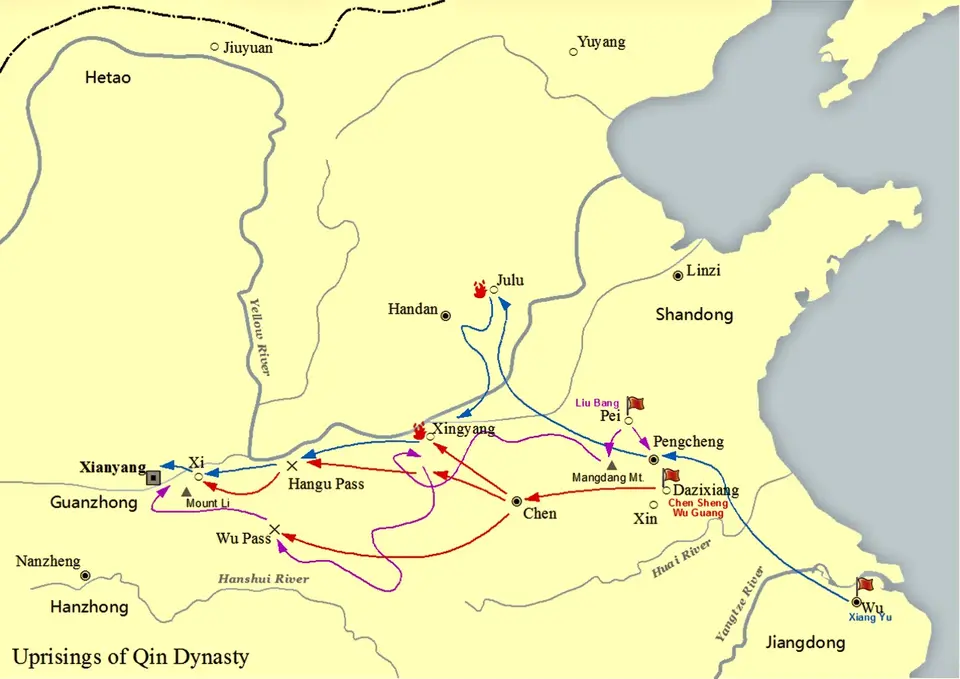
The Chen Sheng and Wu Guang Uprising (陈胜吴广起义), also known as the Dazexiang Uprising, was the first major nationwide peasant rebellion in Chinese history, erupting between the autumn of 209 BCE (the first year of Emperor Ershi of Qin) and the winter of 208 BCE (the second year of Emperor Ershi of Qin) under the leadership of conscripted commoners Chen Sheng and Wu Guang. Following the unification of China, the First Emperor of Qin enforced draconic penal codes and massive labor drafts, impoverishing the population. Upon his accession, Emperor Ershi deepened the tyranny through bloody purges and corruption orchestrated by eunuch Zhao Gao. In July 209 BCE, nine hundred impoverished commoners were conscripted to garrison the northern frontier at Yuyang. Bivouacking at Dazexiang in Qi County, they were stranded by relentless rains that submerged highways. Facing execution under Qin law for failing to arrive on schedule, squad leaders Chen Sheng and Wu Guang executed the supervising officers, used planted silk inscriptions and nocturnal fox calls to rally the men, and raised the standard of revolt under the immortal cry: "Can kings, dukes, generals, and ministers truly be born of noble stock?" The rebels captured surrounding towns and established the Zhangchu regime at Chen County. Rebel armies swept westward under General Zhou Wen, piercing the Hangu Pass and reaching the Xishui River merely a hundred li from Xianyang. In panic, the Qin court commissioned Privy Council Director Zhang Han to arm hundreds of thousands of convict laborers from Mount Li. Zhang Han crushed Zhou Wen and drove eastward; Wu Guang was murdered during mutiny at Xingyang, and Chen Sheng was assassinated by his charioteer Zhuang Jia at Xiachengfu. The uprising initiated the ultimate overthrow of the Qin Dynasty.
Nine hundred conscripts are stranded by floods; Chen Sheng and Wu Guang slay officers and initiate the revolt
Insurgents take Chen County; Chen Sheng is proclaimed King and dispatches columns across China
Zhou Wen's rebel army breaks Hangu Pass and reaches Xishui; Zhang Han mobilizes penal legions
Zhang Han defeats Zhou Wen and lifts the siege of Xingyang; Wu Guang is assassinated by mutineers
Zhang Han storms Chen County; Chen Sheng is murdered by Zhuang Jia at Xiachengfu, ending the uprising
Following the eradication of the Six Warring States, Qin Shi Huang erected an unyielding Legalist totalitarian state. Over two million adult males were conscripted for mammoth construction projects, including the Epang Palace, the Mount Li imperial necropolis, and the Great Wall. Draconic taxation extracted more than half of all agricultural yields, while minutely detailed criminal statutes subjected commoners to branding, nose-cutting, and execution for trivial offenses.
In 210 BCE, Qin Shi Huang passed away at Shaqiu. Palace eunuch Zhao Gao and Chancellor Li Si conspired to forge imperial edicts, compelling Crown Prince Fusu to commit suicide and installing the dissolute prince Huhai as Emperor Ershi. Ershi intensified executions of imperial siblings and upright ministers, unleashing unrestrained exploitation across the realm and pushing public endurance to the breaking point.
In July 209 BCE, the Qin administration levied an emergency draft of nine hundred destitute laborers from the "left of the village lane" (the poorest urban and rural class) to march north and defend the garrison bastion of Yuyang (near modern Miyun, Beijing). Chen Sheng, a farm laborer from Yangcheng, and Wu Guang of Yangxia were conscripted and appointed squad leaders by the imperial officers due to their physical stature.
The column marched across modern Anhui under the guard of two imperial officers. Upon arriving at Dazexiang in Qi County, the sky broke into a relentless monsoon deluge. Rivers overflowed and roads were swallowed by mud, rendering movement impossible. Under the Qin Statute on Corvee, missing arrival deadlines incurred mandatory decapitation, leaving the conscripts facing certain execution regardless of the natural catastrophe.
Confronting imminent death, Chen Sheng proposed armed insurrection to Wu Guang: "To flee means death; to initiate an uprising means death; since death is certain either way, is it not far better to die in the great cause of founding a nation?" Gauging that the populace longed for deliverance, they resolved to rally under the names of Crown Prince Fusu and beloved Chu general Xiang Yan.
To galvanize the superstitious troops, Chen Sheng inscribed "King Chen Sheng" in cinnabar on white silk and stuffed it inside a fish purchased by soldiers; when the fish was prepared, the silk parchment was discovered in awe. At night, Wu Guang hid within a derelict temple, lighting torches and crying out like a fox: "The Great Chu shall rise, and Chen Sheng shall be King!" The following day, Wu Guang deliberately mocked a drunken officer until the official struck him and drew his sword. Chen Sheng and Wu Guang sprang forward, slaying the officers. Ascending an earthen platform, Chen Sheng cried out: "If a brave man cannot avoid death, let him die winning immortal renown! Can kings, dukes, generals, and ministers truly be born of noble stock?" The nine hundred men shouted their assent, cutting timber for spears and hoisting poles for banners.
The rebel host rapidly captured Dazexiang and stormed Qi County. Commoners flocked to the banner with farm tools, swelling the insurgent force into an army of tens of thousands of infantry, hundreds of war chariots, and over a thousand cavalry. In late July, the army captured the strategic metropolis of Chen County (modern Huaiyang, Henan).
At Chen County, local gentry proclaimed Chen Sheng as King of "Zhangchu" (symbolizing the expansion of Chu). Chen Sheng immediately launched multi-pronged strategic offensives: Wu Guang was dispatched as Acting King to besiege the vital transport hub of Xingyang; General Zhou Wen marched west with hundreds of thousands of volunteers through Hangu Pass directly on Xianyang; other detachments were sent to liberate the ancestral territories of Zhao, Yan, and Wei. Across the empire, peasant uprisings and former aristocrats erupted in open insurrection, with Liu Bang rising in Pei County and Xiang Liang marching from Jiangnan. Zhou Wen advanced rapidly, storming mountain fortifications and encamping at the Xishui River only a hundred li from Xianyang, throwing the imperial court into panic.
With imperial guard forces dispersed, Qin Privy Council Director Zhang Han proposed a desperate measure: "The rebels have reached our throat while regular armies are far away; let Your Majesty pardon the convicts at Mount Li and arm them to crush the bandits!" Emperor Ershi granted general amnesty to hundreds of thousands of penal laborers, forming a shock army under Zhang Han's command.
Zhang Han caught Zhou Wen's irregular formations off guard at Xishui, routing the insurgents. Zhou Wen fought stubbornly for months before cutting his own throat at Caoyang. Zhang Han surged eastward, breaking the siege of Xingyang. Fractured by internal dissent, rebel officer Tian Zang murdered Wu Guang and seized command, only to be overwhelmed and slain by Zhang Han's cavalry. In December 208 BCE, Zhang Han converged upon Chen County. Chen Sheng fought valiantly at the gates before retreating toward Xiachengfu. There, his treacherous charioteer Zhuang Jia murdered Chen Sheng in his carriage to claim an imperial bounty. Despite ending after six months, the uprising ignited the revolution that doomed the Qin state.
Due to organizational inexperience, internal officer factionalism, and the professional battlefield superiority of Zhang Han's forces, the uprising was suppressed within six months, resulting in the martyrdom of Chen Sheng and Wu Guang and the collapse of the Zhangchu regime.
The Chen Sheng and Wu Guang Uprising was a seismic milestone in Chinese civilization. It represented the first mass popular uprising against imperial tyranny, decisively debunking the mythological inviolability of hereditary ruling elites through the egalitarian maxim: "Can kings, dukes, generals, and ministers truly be born of noble stock?" By gutting the myth of Qin invincibility and shattering imperial garrisons, the uprising opened the floodgates for regional rebel commanders, most notably Xiang Yu and Liu Bang, to mobilize veteran armies and extinguish the Qin Dynasty three years later. Emperor Gaozu of Han later honored Chen Sheng's historical service by dedicating an imperial shrine and thirty hereditary households to maintain his ancestral rites in perpetuity.