Guangtong Canal Completed
Emperor Wen directs Yuwen Kai to build the Guangtong Canal, enhancing grain transit between Guanzhong and the Yellow River.
Sui Dynasty (隋朝) · HISTORICAL EVENT
隋唐大运河开凿
The Construction of the Sui-Tang Grand Canal (隋唐大运河开凿) took place between 584 and 610 (from the fourth year of the Kaihuang era to the sixth year of the Daye era), representing the most extensive hydraulic engineering project undertaken in pre-modern history to consolidate imperial centralized rule and resolve severe grain shortages in the Guanzhong metropolitan region. Following the founding of the Sui dynasty, the capital in Guanzhong faced a…
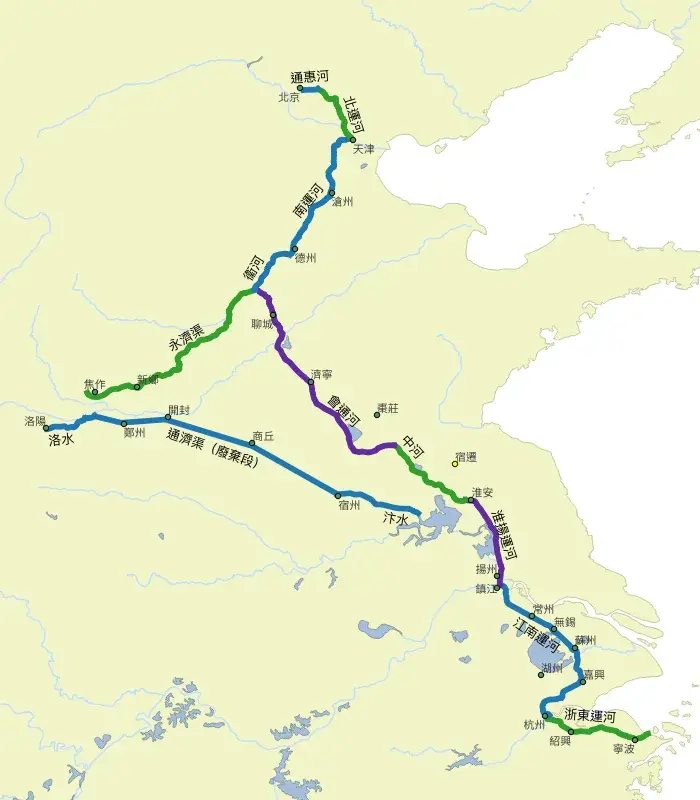
The Construction of the Sui-Tang Grand Canal (隋唐大运河开凿) took place between 584 and 610 (from the fourth year of the Kaihuang era to the sixth year of the Daye era), representing the most extensive hydraulic engineering project undertaken in pre-modern history to consolidate imperial centralized rule and resolve severe grain shortages in the Guanzhong metropolitan region. Following the founding of the Sui dynasty, the capital in Guanzhong faced a restricted arable hinterland and chronic grain conveyance bottlenecks. Meanwhile, following centuries of southern agricultural expansion, the economic and agrarian gravity of the empire had decisively shifted toward Jiangnan. Emperor Wen initiated canal construction by commissioning imperial architect Yuwen Kai to excavate the Guangtong Canal. After ascending the throne, Emperor Yang relocated the imperial seat to Luoyang and mobilized millions of corvée laborers to construct the Tongji Canal, dredge the ancient Han Conduit, excavate the Yongji Canal toward the northeast, and extend the Jiangnan Canal. Spanning over 2,700 kilometers, this unified waterway integrated the Hai, Yellow, Huai, Yangtze, and Qiantang river systems. By transcending traditional west-to-east natural river courses, the Grand Canal created a north-south transportation artery that fostered imperial unity and economic prosperity for centuries.
Emperor Wen directs Yuwen Kai to build the Guangtong Canal, enhancing grain transit between Guanzhong and the Yellow River.
Emperor Yang mobilizes one million laborers to excavate the Tongji Canal and dredge the Han Conduit, joining the Yellow, Huai, and Yangtze basins.
Conscripted labor excavates the Yongji Canal northward to Zhuojun, securing logistics for northern military garrisons.
Excavation of the Jiangnan Canal to Yuhang completes the continuous national Grand Canal network.
Emperor Yang moves the imperial armies along the Grand Canal for the Goguryeo campaigns, deploying the waterway as a strategic artery.
During the Western Wei, Northern Zhou, and early Sui dynasties, the imperial capital at Daxing (Chang'an) struggled with an escalating demographic burden in the Guanzhong plain that outstripped local agricultural production. During famine years, the imperial court was repeatedly compelled to relocate to Luoyang to avoid starvation. The treacherous rapids of the Sanmenxia gorge severely impeded upstream grain shipments along the Yellow River toward the capital. Conversely, sustained agricultural development throughout the Southern dynasties had transformed the Jiangnan and Jianghuai plains into China's foremost granaries and textile centers. Transporting southern agricultural surplus efficiently to the central and northwestern capitals became an indispensable strategic imperative.
Following the conquest of the southern Chen dynasty in 589, aristocratic resistance simmered across the south, prompting the Sui dynasty to require rapid logistical conduits to deploy garrison troops and suppress rebellions. Simultaneously, the rise of the Goguryeo kingdom along the northeastern frontier and persistent nomadic raids by the Göktürks required massive movements of provisions and military supplies from central and southern provinces to northern frontier headquarters. Establishing a continuous inland waterway linking the major river systems emerged as a central pillar of Sui grand strategy.
The initial phase of the canal system began under Emperor Wen. In 584 (the fourth year of the Kaihuang era), facing the shallow, winding channels of the Wei River that frequently ran aground, Emperor Wen appointed imperial engineering master Yuwen Kai to direct excavation works. Yuwen Kai channeled the Wei River eastward from the capital across the Guanzhong plain to connect with the Yellow River, creating the 300-li Guangtong Canal (subsequently designated the Fumin Canal). This waterway bypassed natural shallows, allowing grain barges to navigate smoothly and securing metropolitan grain provisioning while providing invaluable technical expertise for subsequent canal operations.
In 605, Emperor Yang ascended the throne, relocated the capital to Luoyang, and launched the full-scale excavation of the national canal network. In the third month of that year, the court mobilized more than one million corvée laborers from Henan and Huaibei under the supervision of the Ministry of Works to dig the Tongji Canal. This artery comprised two branches: a western section connecting the Luo and Gu rivers to the Yellow River at Luoyang, and an eastern section diverting the Yellow River along ancient Bian River channels into the Si River and the Huai River. In the fifth month, Emperor Yang mobilized over 100,000 laborers from Huainan to overhaul the ancient Han Conduit, leading the Huai River from Shanyang to the Yangtze River at Yangzi. The canal channel measured forty paces wide, flanked by imperial carriage roads planted with weeping willows. The completion of the Tongji Canal and the Han Conduit seamlessly joined the Yellow, Huai, and Yangtze systems.
In the first month of 608, Emperor Yang issued decrees conscripting over one million men and women across Hebei commanderies to excavate the Yongji Canal. Diverting the Qin River southward toward the Yellow River and northward along the Wei River, the channel terminated at Zhuojun (modern Beijing), serving as the principal transport route for military campaigns in the northeast. In 610, the emperor conscripted southern laborers to construct the Jiangnan Canal. Measuring over ten zhang in width, the channel crossed the Lake Tai drainage basin from Jingkou (modern Zhenjiang, Jiangsu) to Yuhang (modern Hangzhou, Zhejiang), extending for more than 800 li. With the integration of these four main branches, the Grand Canal established Luoyang as its central crossroads, radiating northward and southward across the imperial realm.
Through twenty-six years of sustained excavation, the Sui dynasty completed the longest artificial waterway in antiquity. Centered upon the eastern capital of Luoyang, the Grand Canal linked five major hydrological basins, supported by monumental state granaries including Liyang, Luokou, and Hanjia. This infrastructure enabled imperial authorities to concentrate southern grain revenues and swiftly dispatch troops throughout the realm.
The Grand Canal permanently altered China's geopolitical landscape. Economically, the waterway became the indispensable commercial lifeline of the Tang and Song dynasties, channeling southern agricultural abundance to northern political centers and fostering the rise of commercial metropolises including Bianzhou (Kaifeng), Yangzhou, and Hangzhou. Culturally, it bridged northern and southern geographic barriers, accelerating the exchange of literature, customs, and commercial practices. Politically, while the onerous labor levies demanded by Emperor Yang sparked widespread agrarian revolts that precipitated the fall of the Sui, the canal network remained the foundational infrastructure that underpinned imperial unity for subsequent dynasties.