Korean Petition
Donghak Revolution erupted; Qing forces deployed to Asan while Japan dispatched large invasion troops
Qing Dynasty (清朝) · HISTORICAL EVENT
甲午战争
The First Sino-Japanese War (甲午战争) was a decisive modern naval and terrestrial conflict fought between the Qing Empire and the Empire of Japan from 1894 to 1895 (the 20th to 21st years of the Guangxu reign). Following the Meiji Restoration, Japan established its Continental Policy targeting the conquest of Korea and China. In 1894, the Donghak Peasant Revolution broke out in Korea. When the Qing court sent troops to aid the Korean royal government at its…
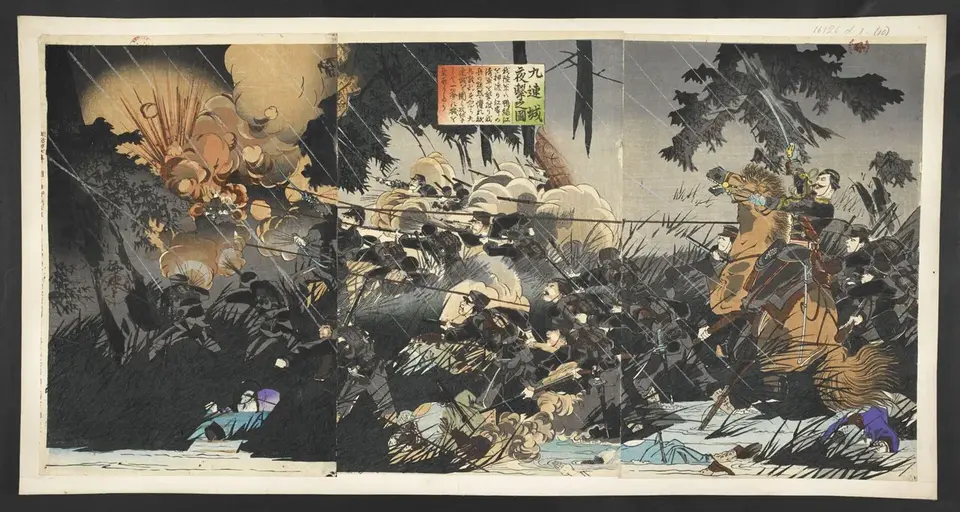
The First Sino-Japanese War (甲午战争) was a decisive modern naval and terrestrial conflict fought between the Qing Empire and the Empire of Japan from 1894 to 1895 (the 20th to 21st years of the Guangxu reign). Following the Meiji Restoration, Japan established its Continental Policy targeting the conquest of Korea and China. In 1894, the Donghak Peasant Revolution broke out in Korea. When the Qing court sent troops to aid the Korean royal government at its request, Japan dispatched large forces, launched an undeclared surprise attack on Qing transport ships off Pungdo, and formally declared war on August 1. The war unfolded across major land and maritime theaters. On land, Zuo Baogui died heroically defending Pyongyang while supreme commander Ye Zhichao fled in panic. At the Battle of the Yalu River, Captain Deng Shichang of the cruiser Zhiyuan led a valiant ramming attack against the enemy before sinking. Subsequently, Japanese forces crossed the Yalu River, breached Qing defenses in Liaodong, captured Port Arthur, and perpetrated a horrific four-day massacre of civilian residents. In early 1895, during the Battle of Weihaiwei, Admiral Ding Ruchang committed suicide rather than surrender, and the Beiyang Fleet was completely wiped out. Defeated, the Qing court dispatched Li Hongzhang to Shimonoseki to sign a humiliating treaty, ceding Taiwan and the Penghu Islands and paying an indemnity of 200 million taels of silver. The defeat shattered the achievements of the Self-Strengthening Movement, accelerated the partition of China by imperialist powers, and sparked unprecedented national awakening across the Chinese nation.
Donghak Revolution erupted; Qing forces deployed to Asan while Japan dispatched large invasion troops
Japanese fleet ambushed Kowshing transport ship; war officially declared on August 1
Zuo Baogui died defending Xuanwu Gate; Ye Zhichao fled 500 li abandoning Korea
Battle of the Yalu River occurred; Deng Shichang sank with Zhiyuan; Qing lost maritime supremacy
Japanese First Army breached the border river line and occupied Dandong and Fenghuangcheng
Japanese Second Army stormed Port Arthur and committed a four-day slaughter of over 20,000 civilians
Japanese landed at Rongcheng and surrounded Liugong Island; Ding Ruchang refused surrender
Ding Ruchang took poison; Liugong Island fell, sealing the total destruction of the Beiyang Navy
Li Hongzhang signed the Treaty of Shimonoseki, ceding Taiwan and Penghu with huge indemnities
Liu Yongfu and Xu Xiang led local volunteer militias in the fierce 1895 Yiwci War against Japanese annexation
In 1868, Japan embarked on capitalist modernization and militarist expansion through the Meiji Restoration. Confronted with domestic feudal remnants, severe economic tensions, and restricted domestic markets, the Japanese ruling elite rapidly embraced aggressive foreign expansion. Under Emperor Meiji, Japan formulated its grand Continental Policy: first absorbing the Ryukyu Kingdom, second subjugating the Korean Peninsula, third invading Northeast China and Taiwan, and ultimately dominating the entire Asian continent.
In 1879, Japan unilaterally annexed the Ryukyu Kingdom, converting it into Okinawa Prefecture. In 1884, Japan instigated the Gapsin Coup in Hanseong (Seoul) in an unsuccessful attempt to sever Korea from its traditional tributary relationship with the Qing Empire. Over the following decade, Japan mobilized national resources to build up its imperial army and navy. Emperor Meiji contributed substantial funds annually from his private purse to purchase modern, rapid-firing cruisers. Consequently, Japan's Combined Fleet gained marked advantages in speed and quick-firing artillery over the Beiyang Fleet. Meanwhile, Japanese General Staff intelligence officers extensively mapped coastal defenses and strategic passes throughout China in preparation for war.
From the 1860s onward, the Qing Empire pursued the Self-Strengthening Movement, creating the Beiyang Army and Navy under the leadership of Li Hongzhang. When initially commissioned, the Beiyang Fleet was celebrated as the foremost naval power in East Asia, boasting two German-built 7,000-ton ironclads, Dingyuan and Zhenyuan. However, the Qing feudal autocracy suffered from systemic institutional corruption and political inertia. Empress Dowager Cixi diverted millions of taels of naval funds toward the reconstruction and enlargement of the Summer Palace for her upcoming 60th birthday celebration.
Severe factional strife between Li Hongzhang and Minister of Revenue Weng Tonghe brought naval development to a complete standstill. Following the formal organization of the Beiyang Navy in 1888, the court issued an imperial edict prohibiting the purchase of new warships and advanced armaments. As a result, the Beiyang Fleet failed to acquire a single new vessel for six consecutive years, leaving its cannons antiquated, its ammunition reserves critically depleted, and its cruising speed severely lagging behind Japanese cruisers. Meanwhile, the terrestrial Huai Army suffered from lax discipline, obsolete weaponry, and aged, complacent commanders. Li Hongzhang mistakenly relied upon prospective diplomatic mediation by Great Britain and Imperial Russia, leaving the empire fatally unprepared when hostilities erupted.
In early 1894, the peasant-led Donghak Revolution erupted across southern Korea, capturing Jeonju and threatening the Joseon monarchy. In desperation, the Korean court petitioned its suzerain, the Qing Empire, for military assistance. Governor-General Li Hongzhang dispatched Provincial Commander Ye Zhichao and Brigade General Nie Shicheng with 2,500 elite troops of the Huai Army to encamp at Asan, while duly notifying the Japanese government in accordance with the 1885 Convention of Tianjin.
Viewing this as an ideal opportunity for continental expansion, the Japanese Meiji government rejected Qing proposals for a mutual troop withdrawal. Claiming the need to protect its legation and residents, Japan landed nearly 10,000 troops at Incheon under Rear Admiral Kabayama Sukenori and Major General Oshima Yoshimasa, marching straight into Hanseong. On July 23, Japanese forces stormed Gyeongbokgung Palace, disarmed the royal guards, detained King Gojong, and installed a puppet regime under the Daewongun to issue a decree expelling Qing troops.
On the morning of July 25, the chartered British merchant steamer Kowshing, transporting over 1,100 Qing soldiers toward Asan under the escort of the cruisers Jiyuan and Guangyi, was intercepted off Pungdo by three advanced Japanese cruisers—Yoshino, Naniwa, and Akitsushima—led by Rear Admiral Tsuboi Kozo. Without any formal declaration of war, Japanese warships opened fire on the Qing squadron. Jiyuan retreated after returning fire, while Guangyi ran aground and was destroyed. The Japanese cruiser Naniwa, commanded by Captain Togo Heihachiro, intercepted Kowshing and demanded that the Qing troops surrender. The Huai Army soldiers refused to yield, preparing to resist with rifles. Naniwa opened fire with heavy cannons and torpedoes, sinking the vessel and firing upon swimming survivors in the water. Over 870 brave Qing officers and soldiers perished alongside civilian crew members. On the same day, Japanese ground forces ambushed Nie Shicheng's detachment at Seonghwan near Asan. On August 1, both empires officially issued formal declarations of war.
Following the outbreak of open war, the Qing court ordered nationwide coastal mobilization and dispatched four armies under Generals Wei Rugui, Ma Yukun, Zuo Baogui, and Fengshenga to march into northern Korea. They joined Ye Zhichao's forces at the strategic fortress of Pyongyang, amassing a defending army of over 15,000 men. Protected by the Daedong River and rugged heights around Moran Hill, Pyongyang boasted formidable natural and artificial defenses. However, the court made the disastrous mistake of appointing the cowardly Ye Zhichao as commander-in-chief of the defense.
Before dawn on September 15, the Japanese First Army under General Yamagata Aritomo launched a four-pronged assault on Pyongyang with over 16,000 troops. General Zuo Baogui personally commanded the Fengtian Disciplined Forces defending Moran Hill and the Xuanwu Gate, the most exposed and critical sector of the northern defenses. When Japanese artillery unleashed a devastating barrage on the ramparts, Zuo donned his imperial yellow riding jacket, personally manned the heavy guns, and repeatedly repulsed waves of Japanese assaults, killing several enemy commanders. In the fierce afternoon combat, Zuo was severely wounded by shell fragments but refused to leave his post, wrapping his wounds while shouting encouragement to his men. Moments later, an enemy artillery shell struck his chest, and he died heroically on the parapet.
With Xuanwu Gate breached, panic swept through the garrison. Commander Ye Zhichao raised a white flag in mock surrender. That night, amidst heavy rain and darkness, Ye ordered an immediate general retreat toward the border. The disorganized withdrawal descended into catastrophe as Japanese forces ambushed the retreating columns along narrow defiles, killing more than 3,000 Qing soldiers. Ye Zhichao fled 500 li without stopping until he crossed the Yalu River, leading to the utter collapse of the defense and leaving the entire Korean Peninsula under Japanese military control.
Simultaneously with the defeat at Pyongyang, the decisive fleet engagement determining naval supremacy in East Asia erupted in the Yellow Sea. On September 16, Admiral Ding Ruchang led the Beiyang Fleet—including the ironclads Dingyuan and Zhenyuan, alongside cruisers Zhiyuan, Jingyuan, Laiyuan, King Yuen, Jiyuan, Guangjia, Chaoyong, and Yangwei—to escort army troop transports to the mouth of the Yalu River.
At 11:00 AM on September 17, while returning to base, the Beiyang Fleet spotted thick coal smoke on the horizon. The Combined Fleet under Vice Admiral Ito Sukeyuki approached with twelve warships, divided into the Flying Squadron consisting of Yoshino, Takachiho, Akitsushima, and Naniwa, and the Main Body centered around the flagship Matsushima. At 12:50 PM, Dingyuan's 30.5-centimeter Krupp bow guns fired the opening salvo, commencing the greatest ironclad clash in nineteenth-century naval history off Dagushan.
The Beiyang Fleet formed a wedge-shaped horizontal front, whereas the Japanese fleet utilized its superior speed to execute a disciplined line-ahead formation, circling and concentrating quick-firing gunfire on the vulnerable wings of the Qing line. In the opening minutes, the violent concussion of Dingyuan's own main battery collapsed its flying bridge, severely injuring Admiral Ding Ruchang and severing the main halyard. Lacking centralized command flags, the Qing warships were forced to fight independently. Japanese shells filled with explosive Shimose powder engulfed Chaoyong and Yangwei in flames, causing them to founder.
Around 3:00 PM, flagship Dingyuan caught fire and was enveloped by Japanese fire. Captain Deng Shichang of the cruiser Zhiyuan immediately steered his vessel out of formation to shield the flagship. Zhiyuan sustained devastating punishment; riddled with shells, heavily listing, and completely out of ammunition, Deng gathered his crew and resolved to die fighting. He ordered maximum engine speed and directed the ship straight toward the Japanese vanguard flagship Yoshino in a deliberate ramming maneuver. Under intense defensive fire, Zhiyuan was struck near the waterline by a heavy shell that detonated its torpedo tubes, causing it to sink rapidly. Deng fell into the water and rejected a life preserver; when his faithful dog swam to him and held his queue in its jaws, Deng pushed the dog down and sank with it beneath the waves. Over 250 crew members perished with the vessel.
Captain Lin Yongsheng of King Yuen was also killed by a headshot while directing combat, and his ship went down with all hands. After five brutal hours of combat, the Beiyang Fleet lost five vessels and suffered over 600 casualties. However, Dingyuan and Zhenyuan resisted countless hits, severely damaging the Japanese flagship Matsushima, Akagi, and Hiei, inflicting over 300 casualties and forcing the Japanese fleet to withdraw before dusk. Although the battle ended in a tactical draw, Li Hongzhang subsequently adopted a disastrous policy of absolute naval preservation, commanding the fleet to shelter in harbor. As a result, China surrendered control of the Yellow Sea and Bohai Gulf to the Imperial Japanese Navy.
Following the loss of naval control, the coastline of North China lay entirely exposed. In late October 1894, the Japanese First Army crossed the Yalu River, overrunning Chinese border outposts at Jiuliancheng and Hushan. Despite valiant resistance by General Song Qing's Yi Army, coordination among Qing forces collapsed, and key strongholds such as Dandong, Fenghuangcheng, and Xiuyan fell in rapid succession.
On October 24, the Japanese Second Army under General Oyama Iwao landed without opposition at Huayuankou on the Liaodong Peninsula. Dividing his forces, Oyama captured Jinzhou and Dalian Bay, seizing vast stores of ordnance, before advancing toward Port Arthur (Lüshunkou). Fortified over sixteen years at enormous expense, Port Arthur was the primary naval base of the Beiyang region, protected by over twenty coastal and inland forts equipped with modern Krupp artillery, extensive munitions, and drydock facilities, regarded as the premier fortress in East Asia.
However, senior commanders including Huang Shilin, Zhao Huaiye, and Daotai Gong Zhaoyu fled the fortress in panic before the assault began. Disorganized and demoralized, the remaining garrison disintegrated, and Japanese forces overran the fortress on November 21 in a single day, capturing intact docks, repair workshops, and hundreds of artillery pieces.
Following the fall of Port Arthur, the Japanese Second Army unleashed a horrific, four-day civilian massacre under the tacit approval of its high command. Japanese soldiers swept through residential quarters, butchering defenseless men, women, elderly, and infants with bayonets, swords, and rifle fire. Over 20,000 innocent Chinese civilians were murdered; only 36 local residents were spared to perform the forced labor of collecting and burying the corpses. Western war correspondents, including Thomas Cowan of The Times and James Creelman of the New York World, documented the horrific atrocities, exposing Japan's wartime brutality to the international community.
Following the loss of Port Arthur, the Qing court sent envoys to seek peace, but the Japanese government rebuffed them, determined to deal a mortal blow to the remnants of the Beiyang Fleet in Shandong.
On January 20, 1895, over 20,000 Japanese troops landed at Rongcheng on the eastern tip of the Shandong Peninsula, executing an overland flanking maneuver against the coastal fortresses of Weihaiwei. Shandong Governor Li Bingheng refused to provide military relief due to regionalism and cowardice. Consequently, the landward forts fell rapidly, and Japanese forces turned the captured Krupp coastal guns inward to bombard the Chinese fleet sheltered inside the harbor.
Admiral Ding Ruchang led the remaining ironclads Dingyuan and Zhenyuan to make a desperate stand at Liugong Island. Japanese naval and land forces completely blockaded the island amidst freezing blizzards and sub-zero temperatures. Ding and his men fought tenaciously for more than twenty days, repelling multiple naval bombardments and torpedo attacks, sinking and damaging over a dozen Japanese vessels. However, Japanese torpedo boats repeatedly infiltrated the anchorage, torpedoing Dingyuan and capsizing Laiyuan. Cut off from all outside assistance and exhausted of supplies, the defense became hopeless.
Admiral Ito Sukeyuki sent a letter urging Ding Ruchang to surrender with promises of high rank in Japan, but Ding steadfastly ignored the appeal. When hope was exhausted, Captain Liu Buchan scuttled Dingyuan to prevent its capture and swallowed poison. On February 11, facing mutinous pressure from foreign mercenaries and defeatist officers, Ding Ruchang committed suicide by taking a fatal dose of opium at the age of fifty-nine. Captain Yang Yongying of Zhenyuan likewise committed suicide. On February 17, Japanese forces occupied Liugong Island and captured the surviving ships, marking the complete extinction of the Beiyang Navy.
The destruction of the Beiyang Fleet and total collapse in Manchuria shattered the Qing leadership's will to resist. In March 1895, Empress Dowager Cixi and the Guangxu Emperor appointed Li Hongzhang as imperial plenipotentiary, dispatching him to Shimonoseki, Japan, to negotiate peace terms with Prime Minister Ito Hirobumi and Foreign Minister Mutsu Munemitsu at the Shunpanro hall.
Relying on total military victory, Ito presented predatory demands encompassing extensive territorial concessions, exorbitant indemnities, and commercial privileges, threatening to march upon Beijing if his terms were rejected. On March 24, while returning to his lodgings, Li Hongzhang was shot in the cheek by an ultranationalist Japanese extremist named Koyama Toyotaro. Fearing international condemnation and potential Western intervention, Japan granted a temporary localized armistice, yet remained inflexible on the treaty conditions.
On April 17, 1895, Li Hongzhang signed the Treaty of Shimonoseki. Its key articles stipulated: first, full Qing recognition of the absolute "independence" of Joseon Korea, terminating centuries of tributary relations; second, the cession of the Liaodong Peninsula, the entire island of Taiwan and all its associated islets, and the Penghu Islands to Japan; third, payment of a war indemnity of 200 million taels of silver (later supplemented by an additional 30 million taels after Russia, Germany, and France carried out the Triple Intervention to force Japan to retrocede Liaodong); fourth, opening Shashi, Chongqing, Suzhou, and Hangzhou as treaty ports; and fifth, granting Japanese subjects the right to establish manufacturing enterprises in Chinese ports free of domestic transit taxes. The treaty proved to be the most humiliating and destructive pact imposed on China since the First Opium War.
The First Sino-Japanese War concluded with total military catastrophe for the Qing Empire and the signing of the Treaty of Shimonoseki. China was stripped of its millennia-old suzerainty over Korea, while Taiwan and the Penghu Islands were ceded into Japanese colonial rule for half a century. The Qing government was forced to pay 230 million taels of silver in total reparations, exhausting state finances and providing the crucial predatory capital that fueled Japan's rapid capitalist industrialization and military expansion. Decades of modernization efforts embodied by the Self-Strengthening Movement evaporated in flames.
The war marked the most agonizing watershed in modern Chinese history. First, it dissolved the illusion of the "sleeping lion" of China, exposing the profound decay of the late Qing autocracy and unleashing the imperialist scramble for leased territories and spheres of influence that partitioned Chinese sovereignty. Second, the unprecedented humiliation shattered traditional Sinocentric complacency, awakening patriotic intellectuals to an existential crisis of national survival. This spurred Kang Youwei and Liang Qichao to initiate the Hundred Days' Reform, transitioning Chinese modernization from material imitation to institutional transformation. Concurrently, Sun Yat-sen established the Revive China Society (Xingzhonghui), raising the revolutionary banner to overthrow the imperial dynasty and launching the democratic revolution in modern China.