Diplomatic Clashes in Beijing
Boxer cadres entered the capital region; Japanese chancellor Sugiyama Akira and German minister von Ketteler were slain in public streets.
Qing Dynasty (清朝) · HISTORICAL EVENT
庚子(《辛丑条约》签订)
The Gengzi Incident and the conclusion of the Boxer Protocol (庚子) in 1900–1901 marked the most catastrophic collapse of national sovereignty in modern Chinese history. In 1900, the anti-imperialist Boxer Rebellion spread rapidly across northern China. Miscalculating geopolitical realities and seeking to exploit popular anti-foreign fervor to safeguard their own influence, conservative court princes persuaded Empress Dowager Cixi to endorse the Boxers and…
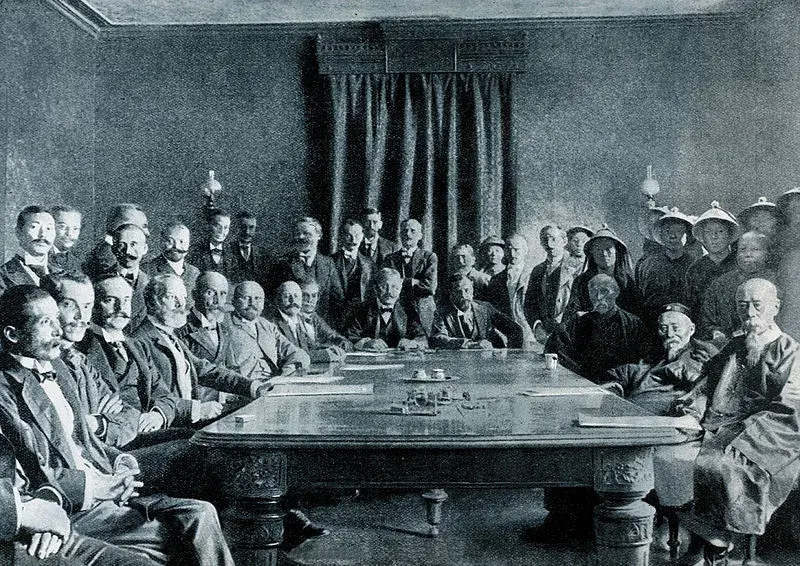
The Gengzi Incident and the conclusion of the Boxer Protocol (庚子) in 1900–1901 marked the most catastrophic collapse of national sovereignty in modern Chinese history. In 1900, the anti-imperialist Boxer Rebellion spread rapidly across northern China. Miscalculating geopolitical realities and seeking to exploit popular anti-foreign fervor to safeguard their own influence, conservative court princes persuaded Empress Dowager Cixi to endorse the Boxers and issue a declaration of war against foreign powers. In retaliation, the Eight-Nation Alliance (Britain, the United States, Japan, Russia, France, Germany, Italy, and Austria-Hungary) launched an invasion of northern China. After storming the Dagu Forts and seizing Tianjin, allied forces captured Beijing in August 1900. Empress Dowager Cixi and the Guangxu Emperor fled westward in disguise to Xi'an, while leading southern viceroys established the Mutual Protection of Southeast China, refusing to participate in hostilities. Following the capture of the imperial capital, allied forces engaged in extensive pillaging, massacre, and cultural destruction. To preserve her political hegemony, Empress Dowager Cixi reversed state policy, ordering the execution of Boxers and appointing Prince Qing (Yikuang) and Li Hongzhang as imperial plenipotentiaries to negotiate peace. On September 7, 1901, the Qing court signed the Boxer Protocol with eleven foreign powers. The agreement imposed a staggering indemnity of 450 million taels of silver (exceeding 980 million taels with interest), fortified the Beijing Legation Quarter under foreign garrisons, demolished coastal defenses, punished anti-foreign princes, and banned anti-imperialist associations under pain of death. The protocol completed the subjugation of the Qing regime to foreign imperialist domination.
Boxer cadres entered the capital region; Japanese chancellor Sugiyama Akira and German minister von Ketteler were slain in public streets.
Empress Dowager Cixi declared war on foreign powers, ordering the assault on the legations; southern viceroys established the Mutual Protection pact.
Allied naval forces seized the Dagu Forts; allied divisions captured Tianjin as Viceroy Yulu committed suicide and Nie Shicheng died in combat.
Allied divisions breached Beijing and relieved the legations; Empress Dowager Cixi and the Guangxu Emperor fled toward Xi'an.
Cixi ordered provincial authorities to eradicate Boxers and appointed Prince Qing and Li Hongzhang as peace plenipotentiaries.
Eleven foreign powers presented twelve peace terms demanding indemnities, punishment of officials, and garrison rights; Cixi conceded fully.
The Qing court executed Yuxian, ordered Zaixun to commit suicide, exiled Zaiyi, and rehabilitated the five executed anti-war ministers.
Prince Qing and Li Hongzhang concluded the protocol in Beijing, imposing the massive 450-million-tael indemnity and establishing garrison zones.
Following the humiliating defeat of the Qing Empire in the First Sino-Japanese War of 1894–1895 and the signing of the Treaty of Shimonoseki, imperialist powers initiated an aggressive drive to establish territorial leaseholds and spheres of influence across China. The Russian Empire acquired the Liaodong Peninsula leasehold covering Port Arthur and Dalian, Imperial Germany seized Jiaozhou Bay in Shandong, the British Empire leased Weihaiwei and the New Territories of Hong Kong, and France obtained Guangzhouwan. Foreign powers aggressively extracted mining concessions, railway construction monopolies, and domestic manufacturing rights, flooding domestic markets with industrial manufactured imports and disrupting regional waterborne shipping and agrarian handicraft industries.
Simultaneously, under the protection of extraterritoriality and consular jurisdiction, foreign Christian missionary bodies penetrated deeply into rural northern China. Friction intensified between local villagers and foreign-backed church establishments over land titles, civil litigation, and traditional cultural customs. In Shandong, Zhili, and Henan, repeated droughts and catastrophic Yellow River floods forced millions of impoverished peasants, displaced canal boatmen, and unemployed laborers into desperate destitution. Intense popular resentment against foreign political and cultural encroachment merged into explosive grassroots unrest, providing fertile ground for the rise of the Boxer movement.
Following the suppression of the Hundred Days' Reform in 1898, Empress Dowager Cixi placed the Guangxu Emperor under house arrest in the Zhongnanhai. When her subsequent maneuver to depose the emperor and enthrone Prince Duan's son met with icy disapproval and formal resistance from Western diplomatic ministers in Beijing, Cixi harbored intense personal animosity toward foreign powers. Conservative Manchu princes—including Prince Duan (Zaiyi), Prince Zhuang (Zaixun), and Grand Secretaries Gangyi and Xu Tong—exploited imperial resentment by championing the Boxers, whose slogan was to support the Qing and exterminate foreigners. They falsely assured the throne that the Boxers possessed supernatural invulnerability against foreign bullets and artillery.
In the spring of 1900, Boxer cadres entered the Beijing-Tianjin corridor in large numbers, burning railway depots, severing telegraph links, destroying missionary compounds, and killing foreign nationals alongside Chinese Christian converts. In June 1900, tensions reached a point of no return when Sugiyama Akira, chancellor of the Japanese legation, and Baron Clemens von Ketteler, the German minister to China, were killed by Chinese imperial troops and Boxers in Beijing. Foreign legations urgently summoned naval detachments to Dagu. Provoked by alarmist rumors and a forged diplomatic note demanding her retirement from sovereign power, an enraged Empress Dowager Cixi formally issued imperial edicts declaring war against eleven foreign powers on June 21, 1900, commanding regular troops and Boxers to besiege the Foreign Legations in Dongjiaominxiang and the Northern Church (Beitang).
Following the imperial declaration of war, military operations descended into tactical chaos. Despite deploying tens of thousands of regular troops alongside Boxer militias and bombarding the foreign quarter with artillery, imperial forces failed to overcome the fortified perimeter defended by several hundred foreign soldiers and armed volunteers. Crucially, southern provincial viceroys—including Liu Kunyi in Liangjiang, Zhang Zhidong in Huguang, and Li Hongzhang in Liangguang—refused to recognize the validity of the Beijing war edicts. Orchestrated through modern telegraphic channels by Sheng Xuanhuai, they concluded the Mutual Protection of Southeast China with foreign consuls, guaranteeing provincial peace in exchange for naval immunity, thereby leaving the imperial capital militarily isolated.
Meanwhile, after initial allied relief forces under British Admiral Edward Seymour were repulsed, the Eight-Nation Alliance rapidly deployed heavy naval divisions, bombarding and capturing the Dagu Forts in mid-June 1900. In July, allied forces assaulted and captured Tianjin following bloody street battles; Zhili Viceroy Yulu committed suicide, while frontline general Nie Shicheng died fighting in action. In early August, an allied expeditionary force numbering approximately twenty thousand elite troops advanced northward along the Grand Canal, disintegrating fragile Qing defensive positions. On August 14, 1900, allied troops breached the outer gates of Beijing, relieving the legations and storming the imperial city.
At dawn on August 15, as foreign artillery shells crashed inside the Forbidden City, Empress Dowager Cixi hastily disguised herself as an ordinary peasant woman, forced the Guangxu Emperor into accompanying her, and fled the palace through the Shenwumen Gate. Prior to departing, Cixi ordered eunuchs to drown the emperor's favored consort, Consort Zhen, in a palace well. The imperial entourage fled through the Juyongguan Pass, traversing Shanxi under miserable conditions before reaching the remote fortress city of Xi'an in Shaanxi to establish a wartime refuge.
Upon occupying Beijing, the Eight-Nation Alliance placed the city under harsh military administration, dividing neighborhoods into separate foreign zones. Under the supreme command of German Field Marshal Alfred von Waldersee, foreign soldiers carried out widespread executions of suspected Boxers and civilian residents, while executing organized plunder across the metropolis.
Allied forces pillaged the Forbidden City, the Summer Palace (Yiheyuan), the Old Summer Palace (Yuanmingyuan), and imperial state archives. Priceless imperial treasures, ancient bronze vessels, jade artifacts, scroll paintings, and state libraries were plundered and shipped overseas. Irreplaceable cultural treasures, including fundamental manuscript volumes of the Yongle Canon and the Complete Library of the Four Treasuries, were burned or dispersed. The Imperial Board of Revenue treasury was looted clean, reducing the ancient imperial capital to desolate ruin.
Trapped in remote Xi'an and terrified that allied forces might pursue the court inland or depose the dynasty, Empress Dowager Cixi underwent an immediate capitulation. She abandoned all connection to the Boxers, issuing imperial edicts branding them as outlaw rebels and ordering regional governors to execute remaining practitioners without mercy. Simultaneously, Cixi reappointed seventy-eight-year-old Li Hongzhang as Viceroy of Zhili and Imperial Plenipotentiary, ordering him to join Prince Qing in Beijing to open unconditional peace negotiations.
Peace talks commenced in October 1900 at the Spanish legation in Beijing. Negotiations involved eleven foreign states: the eight military invaders alongside Belgium, the Netherlands, and Spain, who claimed diplomatic standing under existing commercial treaties. Foreign diplomats assumed an uncompromising stance; British minister Ernest Satow, German minister Alfons Mumm von Schwarzenstein, and American commissioner William Woodville Rockhill periodically utilized military cavalry expeditions into Baoding and Zhili to exert psychological intimidation over the imperial court in Xi'an.
Initial allied deliberations centered upon whether to partition the Chinese empire territorially. Tsarist Russia aimed to annex the three northeastern provinces of Manchuria, having deployed one hundred and seventy thousand troops across the region during the conflict. Germany also sought territorial bases and execution of the sovereign. However, the United States and Great Britain vigorously opposed direct territorial dismemberment, seeking to uphold commercial parity under the Open Door Policy and fearing that outright partitioning would ignite general conflict among European rivals. The powers eventually concluded that preserving the Qing throne as an administrative agency to extract financial reparations and enforce domestic order best served their interests.
On December 24, 1900, the foreign diplomatic corps delivered the joint twelve-point diplomatic ultimatum (the Joint Note). The demands required severe punishment of anti-foreign officials, formal diplomatic apologies to Germany and Japan, an astronomical financial indemnity, the dismantling of coastal defenses, foreign military garrison rights along the capital railway, and absolute prohibition of anti-foreign organizations. Relieved that her own name was excluded from the allied execution roster and that her sovereign authority was preserved, Empress Dowager Cixi telegraphed immediate orders to Prince Qing and Li Hongzhang to accept all allied principles without contest.
Detailed protocol negotiations continued throughout the first half of 1901, marked by intense diplomatic squabbling among allied powers over indemnity shares. Initially demanding close to one billion taels, foreign ministers calculated that the Qing state's total annual budget hovered around eighty-eight million taels. They settled on a principal indemnity of 450 million taels of fine silver, cynically calculating one tael for every individual inhabitant of the Qing Empire as collective punishment.
Because the imperial treasury was entirely bare, the powers dictated that the 450 million taels principal be amortized over thirty-nine years (from 1902 to 1940) at an annual interest rate of four percent. When fully compounded, the total financial extraction rose to an unprecedented 982,238,150 taels of silver (known historically as the Boxer Indemnity). Russia claimed the largest share at 28.97 percent, Germany seized 20.02 percent, France took 15.75 percent, Britain claimed 11.25 percent, Japan secured 7.73 percent, the United States obtained 7.32 percent, with the remainder divided among the minor signatories. To guarantee prompt repayment, foreign powers placed the Maritime Customs Service revenues, native customs revenues, and regional salt gabelle monopolies under direct foreign impoundment.
In territorial and strategic domains, the protocol eviscerated national defense. The treaty carved out a permanent, fortified Legation Quarter in Dongjiaominxiang in southern Beijing, bounded by Chang'an Avenue and the city walls. Chinese residents and administrative offices were forcibly evicted; foreign legations gained sovereign extraterritorial rights to maintain armed garrisons, dig moats, and construct military redoubts in the very heart of the capital.
Furthermore, the protocol mandated the complete demolition of the Dagu Forts and all coastal military emplacements between Beijing and the Gulf of Zhili. Foreign armies obtained permanent rights to station regular troops at twelve strategic junctions, including Shanhaiguan, Qinhuangdao, Changli, Luanzhou, Tangshan, Lutai, Tanggu, Junliangcheng, Tianjin, Yangcun, Langfang, and Huangcun. This provision permanently stripped the Chinese state of any geographic or military capacity to resist foreign naval invasions, leaving the capital permanently vulnerable to foreign forces.
To satisfy allied demands for retributive justice, Empress Dowager Cixi ruthlessly sacrificed the conservative ministers who had executed her wartime commands. Imperial edicts condemned Prince Duan (Zaiyi) and Duke Furen (Zailan) to exile and perpetual imprisonment in Xinjiang; Prince Zhuang (Zaixun) and Censor-in-Chief Xu Chengyu were ordered to commit suicide; Shanxi Governor Yuxian was publicly beheaded; and deceased grand secretaries Gangyi and Xu Tong were stripped of all noble titles posthumously. In contrast, five high-minded imperial ministers—including Xu Jingcheng, Yuan Chang, Xu Yongyi, Lishan, and Lianyuan—who had been executed by Cixi for courageously opposing the assault on the legations, were fully rehabilitated with restored posthumous honors.
Article Ten of the protocol imposed unprecedented political repression upon the Chinese populace. The Qing court was forced to post public proclamations across all towns and villages, banning participation in any anti-foreign society under penalty of decapitation. Local magistrates were held personally liable for anti-foreign outbreaks, facing immediate cashiering and permanent disqualification from civil office if civil disturbances recurred. In all cities where foreign residents or converts had been injured, imperial civil service examinations were suspended for five years, penalizing local scholar elites.
On September 7, 1901 (Guangxu 27, the twenty-fifth day of the seventh lunar month), the formal signing ceremony convened at the Spanish Legation in Beijing. Prince Qing and a terminally ill Li Hongzhang affixed their imperial seals alongside the eleven foreign plenipotentiaries to the Boxer Protocol and its nineteen annexes. Exhausted by the negotiations, Li Hongzhang died in Beijing two months later at the age of seventy-eight. With the protocol ratified, allied troops withdrew from the imperial precincts, leaving small garrison contingents. In January 1902, Empress Dowager Cixi and the Guangxu Emperor returned to Beijing by rail, resuming governance over a broken empire.
The Boxer Protocol stands as the most humiliating unequal treaty in modern Chinese history. By permitting foreign troop garrisons within the fortified Legation Quarter and along the vital Beijing-to-Shanhaiguan railway, the treaty dismantled the northern territorial defense system of the Qing Empire. The imperial court functioned virtually under foreign military observation, unable to conduct independent domestic or foreign policy. The prohibition against domestic anti-foreign organizing transformed the imperial government into an instrument of foreign imperialist domination. China had descended completely into the abyss of a semi-colonial and semi-feudal society.
The burden of the 450-million-tael indemnity, totaling over 980 million taels with interest, inflicted permanent structural damage upon the Chinese economy. To finance annual installments, the Qing court apportioned quotas across every province, compelling local administrations to dramatically elevate land taxes, internal transit duties (likin), and salt surcharges. The systematic outflow of silver depleted domestic capital reserves, starved emerging national commerce, and threw millions of rural households into destitution. The resulting economic misery sparked widespread popular unrest and banditry across rural society.
The catastrophe of the Gengzi Incident irreparably shattered the domestic political legitimacy of the Qing ruling house. The court's initial reckless adventurism, its shameful flight from Beijing, its cowardly execution of internal ministers, and its total subservience to foreign dictates demonstrated to scholar-officials and common citizens alike that the traditional monarchy was irredeemably corrupt. Moderate constitutionalists who had long advocated evolutionary reform increasingly concluded that only revolutionary transformation could rescue the nation. Revolutionary bodies such as Sun Yat-sen's Xingzhonghui and Tongmenghui gained massive followings among students, intellectuals, and military officers, leading directly to the 1911 Wuchang Uprising and the overthrow of the imperial system.
Traditional and modern historians universally characterize the Boxer Protocol as an unprecedented catastrophe in Chinese statehood. In the Draft History of Qing, the compilers recorded: "In the seventh lunar month, Yikuang and Li Hongzhang affixed their signatures with foreign envoys, completing twelve articles; from this juncture, the grand fortunes of the realm were irreparably ruined." The historical scholar Cai Dongfan wrote in his Romance of the Qing Dynasty: "Ever since the Gengzi disturbances, the allied armies entered the capital, the sovereign fled, the nation was partitioned through indemnities, and China's international standing lay shattered in the dust." Modern historians emphasize that while the protocol represented the pinnacle of imperialist oppression, it served as the decisive catalyst for the awakening of modern Chinese national consciousness, propelling the country toward modern anti-imperialist and republican revolution.