Departure from Venice
Marco Polo embarks with his father and uncle across Inner Asia along the Silk Road.
Yuan Dynasty (元朝) · HISTORICAL EVENT
马可·波罗来华
The Marco Polo's Journey to China (马可·波罗来华) refers to the historic expedition and seventeen-year sojourn (1275–1291, corresponding to the twelfth through twenty-eighth years of the Zhiyuan era) of Venetian explorer Marco Polo, who accompanied his merchant father and uncle across the Silk Road to the court of Kublai Khan. The unification of Eurasia under the Mongol Empire created an extensive courier station (yam) network that secured overland trade…
The Marco Polo's Journey to China (马可·波罗来华) refers to the historic expedition and seventeen-year sojourn (1275–1291, corresponding to the twelfth through twenty-eighth years of the Zhiyuan era) of Venetian explorer Marco Polo, who accompanied his merchant father and uncle across the Silk Road to the court of Kublai Khan. The unification of Eurasia under the Mongol Empire created an extensive courier station (yam) network that secured overland trade routes. In 1271, the Polo brothers departed Venice with seventeen-year-old Marco, journeying through Anatolia, Persia, and the Pamir Mountains before arriving at Shangdu in 1275. Impressed by Marco's linguistic agility and cultural adaptability, Kublai Khan appointed him to imperial administrative and diplomatic posts, commissioning him to inspect provinces across Yunnan, Sichuan, and Jiangnan. In 1291, the Polos were chosen to escort Princess Kököchin by sea to the Ilkhanate, departing from Quanzhou and reaching Venice in 1295. Later imprisoned in Genoa, Marco Polo dictated his memoirs to Rustichello da Pisa, producing The Travels of Marco Polo. His descriptions of immense cities, paper currency, and canal trade dismantled medieval European insularity, inspiring navigators such as Christopher Columbus and precipitating the European Age of Discovery.
Marco Polo embarks with his father and uncle across Inner Asia along the Silk Road.
The Polos arrive at Shangdu, where Kublai Khan inducts Marco into the imperial civil service.
Marco Polo travels as an imperial envoy through Yunnan, Sichuan, and the southeastern seaboard.
The Polos escort Princess Kököchin by sea from Quanzhou across the Indian Ocean to Persia.
Marco Polo returns to Venice after twenty-four years, bearing silk, jewels, and travel notes.
Captured in a sea battle with Genoa, Marco Polo dictates his memoirs to romance writer Rustichello da Pisa.
During the first half of the thirteenth century, the conquests of Genghis Khan and his successors forged a trans-continental empire spanning from Eastern Europe to the Pacific Ocean. The founding of the Yuan dynasty under Kublai Khan integrated maritime and overland trade corridors through an empire-wide relay post system (zanchi), issuing bronze and gold passport plaques (paiza) to guarantee safe passage for diplomatic and commercial caravans. This unprecedented political stability reopened the ancient Silk Road, facilitating direct contact between European mercantile centers and China.
Against this backdrop of Eurasian connectivity, Venetian merchants Niccolo and Maffeo Polo traveled east in 1260, reaching Dadu in 1266. Kublai Khan received them warmly and entrusted them with letters to Pope Clement IV requesting one hundred learned scholars to introduce Western science and theology. In 1271, receiving letters and holy oil from Pope Gregory X, the brothers embarked on their return journey, bringing Niccolo's seventeen-year-old son Marco. Traversing Persian deserts, the Hindu Kush, and the Taklamakan Desert, the Polos spent three and a half arduous years traveling across Inner Asia before reaching the summer capital of Shangdu (in modern Inner Mongolia) in the spring of 1275.
In the spring of 1275, the Polos were granted an imperial audience by Kublai Khan. The young Marco Polo presented the papal credentials and holy oil, conducting himself with composure. Impressed by his poise, the Great Khan granted the family residence in the twin capitals of Shangdu and Dadu, inducting Marco into the imperial retinue.
Displaying remarkable intellectual facility, Marco Polo rapidly achieved fluency in Mongolian, Turkic, and Persian, mastering court etiquette, horseback archery, and hunting protocols. Recognizing his analytical discretion, Kublai Khan appointed him as an imperial privy attendant and investigative commissioner. During his residence, Marco witnessed the urban planning of Dadu, with its symmetrical avenues and grand imperial palace, while noting technological and financial innovations such as universal paper currency (Zhongtong Jiaochao) and the burning of mineral coal ("black stones") for fuel.
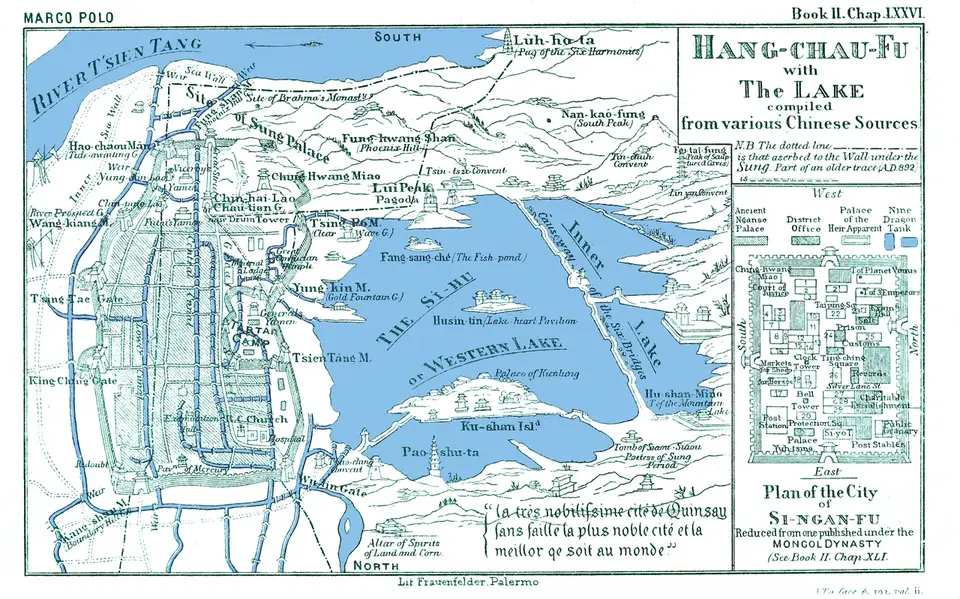
Dismayed by conventional bureaucrats whose reports contained only dry administrative figures without accounts of foreign customs, Kublai Khan favored Marco Polo's colorful observations, deploying him on special inspection tours across distant provinces. Marco traveled across southwestern regions including Dali and Yunnan, surveyed the agricultural valleys of Sichuan, and spent several years in Jiangnan, allegedly holding municipal office in Yangzhou. In Hangzhou (which he called Kinsay), he marveled at the stone bridges, lakeside mansions, and silk markets, proclaiming it the most magnificent city in the world.
After seventeen years in China, the Polos grew anxious to return home, but the emperor repeatedly declined their requests. In 1291, an opportunity arose when the court agreed to send Princess Kököchin to marry Arghun Khan of the Ilkhanate in Persia. Because overland routes were disrupted by conflicts among rival Mongol princes, the mission required maritime passage. Aware of the Polos' maritime navigation skills, Kublai Khan appointed them to escort the imperial bride. In late 1291, a fleet of fourteen multi-masted vessels departed Quanzhou (Zaiton), then the busiest commercial port in the world. Sailing across the South China Sea, Sumatra, and southern India, the voyage reached Hormuz after two years, completing the mission before the Polos returned to Venice in 1295.
Marco Polo's journey completed the longest and most detailed intercontinental geographical reconnaissance of the medieval era. Following his capture during the Venetian-Genoese maritime war in 1298, he collaborated with romance writer Rustichello da Pisa to produce The Travels of Marco Polo (originally titled Description of the World or Il Milione), creating an international literary sensation.
Marco Polo's accounts altered European perceptions of global geography. For centuries, medieval Europe viewed Asia through biblical legends. Marco Polo introduced readers to an advanced civilization characterized by vast urban centers, efficient courier communications, coal fuel, and paper currencies. The book's descriptions of Asian wealth and spices captured the imagination of Western merchants. Navigators including Christopher Columbus studied the text closely, annotating copies in the conviction that sailing west across the Atlantic would lead directly to the ports described by Marco Polo, catalyzing the European Age of Discovery and early modern global integration.