Railway Nationalization Decree
The Qing court arbitrarily seized private railway rights to mortgage them to foreign banking syndicates, triggering widespread protests.
Qing Dynasty (清朝) · HISTORICAL EVENT
辛亥革命
The 1911 Revolution (Xinhai Revolution) (辛亥革命) was a nationwide bourgeois democratic revolution from 1911 to early 1912 that overthrew the Qing Dynasty and established the Republic of China. At the turn of the twentieth century, escalating foreign encroachments and humiliating indemnities plunged Qing China into a deep semi-colonial crisis. Revolutionary leaders led by Sun Yat-sen formed the Chinese United League (Tongmenghui), championed the Three…
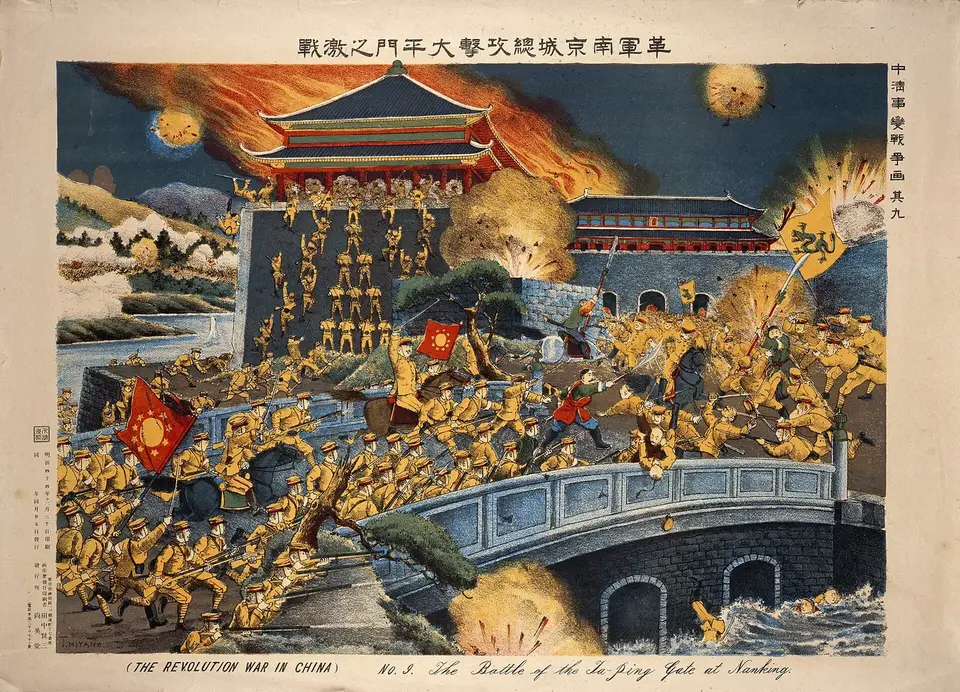
The 1911 Revolution (Xinhai Revolution) (辛亥革命) was a nationwide bourgeois democratic revolution from 1911 to early 1912 that overthrew the Qing Dynasty and established the Republic of China. At the turn of the twentieth century, escalating foreign encroachments and humiliating indemnities plunged Qing China into a deep semi-colonial crisis. Revolutionary leaders led by Sun Yat-sen formed the Chinese United League (Tongmenghui), championed the Three Principles of the People, and launched repeated armed uprisings. In May 1911, the Qing government nationalized trunk railways and mortgaged their construction rights to foreign banking syndicates, igniting the fierce Railway Protection Movement in Sichuan. When the court diverted New Army units from Hubei into Sichuan to suppress protests, Wuhan was left militarily vulnerable. On the evening of October 10, 1911, revolutionary soldiers in Wuchang initiated the uprising, swiftly seizing the tri-cities of Wuhan and proclaiming the military government of the Republic of China. Within two months, fifteen provinces declared independence from imperial rule. On January 1, 1912, Sun Yat-sen was inaugurated in Nanjing as Provisional President. On February 12, 1912, the child Emperor Puyi abdicated, officially ending imperial dynastic rule and inaugurating a new republican epoch in Chinese history.
The Qing court arbitrarily seized private railway rights to mortgage them to foreign banking syndicates, triggering widespread protests.
Sichuan Governor-General Zhao Erfeng shot peaceful protesters, triggering armed guerrilla insurrection and drawing Hubei garrisons west.
The Eighth Engineering Battalion mutinied in Wuchang, seized the imperial arsenal, captured the city, and established the Hubei Military Government.
Fifteen provinces repudiated the Qing throne within sixty days, causing imperial governance to collapse across central and southern China.
Southern envoy Wu Tingfang and northern envoy Tang Shaoyi convened peace talks, agreeing to terminate hostilities and institute a republic.
Sun Yat-sen took the presidential oath in Nanjing, formally inaugurating the Provisional Government of the Republic of China.
Empress Dowager Longyu promulgated the abdication decree of the Xuantong Emperor, formally terminating 268 years of Qing rule.
Following the First Sino-Japanese War and the Boxer Uprising, Western powers and Japan accelerated their economic and territorial partitioning of China. The Boxer Protocol of 1901 burdened the nation with crushing indemnities, reducing the Qing imperial court to an instrument of foreign domination. To preserve dynastic survival, the court enacted the Late Qing Reforms and promised constitutional governance. However, the first responsible cabinet appointed in May 1911 was composed overwhelmingly of Manchu nobility, with seven imperial clan princes occupying key ministerial portfolios. This so-called Royal Cabinet exposed the insincerity of Qing constitutional promises, driving disillusioned constitutionalist gentry and educated elites to embrace armed revolution.
In 1894, Sun Yat-sen founded the Revive China Society (Xingzhonghui) in Honolulu, pioneering the armed struggle for a republic. In 1905, Sun Yat-sen and Huang Xing coalesced multiple anti-Qing factions in Tokyo to create the Chinese United League (Tongmenghui). The league adopted the platform of expelling the Manchus, reviving China, establishing a republic, and equalizing land rights. Revolutionary intellectuals disseminated democratic ideals through publications like Minbao, debating constitutional monarchists and inspiring youth. Tongmenghui coordinated multiple armed rebellions across southern China, culminating in the heroic Huanghuagang Uprising in Canton. Though militarily defeated, these rebellions eroded imperial prestige and established extensive underground networks within the New Army.
In May 1911, Post and Communications Minister Sheng Xuanhuai announced the nationalization of trunk railways, effectively confiscating privately funded shares in Sichuan, Hubei, Hunan, and Guangdong while pledging railway revenues to a consortium of British, French, German, and American banks. This infringement provoked furious protests across southwestern China.
The Sichuan Railway Protection Association organized strikes by merchants, students, and tax boycotts. On September 7, Sichuan Governor-General Zhao Erfeng ordered his troops to open fire on unarmed demonstrators in Chengdu, massacring dozens in what became known as the Chengdu Massacre. Outraged Sichuanese gentry and secret societies launched a guerrilla campaign besieging the provincial capital. Panicked, the Qing court ordered Minister Duanfang to lead elite Hubei New Army units into Sichuan, draining imperial garrisons in Wuhan and presenting revolutionaries with a critical opportunity.
Revolutionary underground societies in Hubei, notably the Literary Society and the Progressive Association, infiltrated New Army regiments and scheduled an uprising for October 1911. On October 9, Sun Wu accidentally detonated an explosive in the Russian concession of Hankou, allowing municipal police to seize revolutionary registers, banners, and proclamations. Governor-General Ruicheng ordered martial law and summarily executed three captured revolutionaries, placing military conspirators under imminent danger of arrest.
On the night of October 10 at approximately seven o'clock, Xiong Bingkun and Jin Zhaolong of the Eighth Engineering Battalion fired the opening shots of the insurrection in Wuchang. Mutinying troops quickly mobilized, storming and securing the Chu Wang Tai imperial arsenal with tens of thousands of rifles and modern artillery pieces. Revolutionary regiments converged on the Governor-General's headquarters. Ruicheng fled through a breached wall to an imperial gunboat, and commander Zhang Biao abandoned his post. By dawn on October 11, Wuchang was liberated, followed shortly by the capture of Hanyang and Hankou, placing all of Wuhan under revolutionary control.
Lacking high-ranking revolutionary officers in Wuhan, the rebel leadership coerced Brigadier Li Yuanhong of the 21st Mixed Brigade to serve as military governor. On October 11, the Hubei Military Government was inaugurated. The administration abolished the Qing Xuantong reign title, proclaimed the founding of the Republic of China, and cabled telegrams calling on all provinces to join the insurrection.
The Wuchang victory sparked an immediate nationwide chain reaction. Within eight weeks, fifteen provinces, including Hunan, Shaanxi, Jiangxi, Shanxi, Yunnan, Zhejiang, Guizhou, Jiangsu, Anhui, Guangxi, Guangdong, Fujian, and Sichuan, renounced allegiance to the Qing Dynasty. Provincial assemblies, progressive gentry, and rebellious army officers dismantled local imperial administrations, causing Qing imperial authority to collapse outside northern China.
To suppress the rebellion, the desperate Qing court recalled General Yuan Shikai from retirement, appointing him Prime Minister and commander of all imperial armed forces. The modernized Beiyang Army launched a furious counteroffensive against the Wuhan tri-cities. Commander Huang Xing led the revolutionary armies in fierce resistance during the battles of Hankou and Hanyang before falling back across the Yangtze to defend Wuchang.
Recognizing that the Beiyang Army suffered severe financial shortages while the southern republican forces faced fiscal strain, both factions sought a diplomatic settlement. In December 1911, official peace talks convened in the British concession of Shanghai. Southern plenipotentiary Wu Tingfang negotiated with northern delegate Tang Shaoyi, reaching an accord that ceased hostilities and accepted a republican form of government.
On December 25, 1911, Sun Yat-sen returned to Shanghai from Europe. On December 29, representatives of seventeen independent provinces gathered in Nanjing and elected Sun Yat-sen as Provisional President by an overwhelming majority. On January 1, 1912, Sun took the presidential oath in Nanjing, formally proclaiming the Provisional Government of the Republic of China and introducing the Gregorian calendar.
Confronted with the solid republican coalition in the south and pressure from Yuan Shikai, along with a joint petition for a republic signed by forty-six Beiyang commanders, Empress Dowager Longyu issued the imperial abdication decree on February 12, 1912. The six-year-old Emperor Puyi surrendered the throne. On February 15, the Provisional Senate honored the negotiated pact by electing Yuan Shikai as Provisional President, completing the revolutionary destruction of imperial dynastic rule.
The founding father of modern Chinese democracy and Provisional President of the Republic of China. He established the Revive China Society and Tongmenghui, formulated the Three Principles of the People, and organized revolutionary uprisings abroad and at home. His ideological leadership and moral authority provided the central cohesion for the republican cause.
A co-founder of Tongmenghui and chief military commander of the revolution. Huang Xing personally led revolutionary assaults in Canton and rushed to Wuhan following the Wuchang outbreak to assume wartime command. His determined military defense during the battles of Hankou and Hanyang bought indispensable time for the southern provinces to organize independence.
A Qing brigade commander in the Hubei New Army who was thrust into political prominence when mutinous soldiers compelled him to lead the Hubei Military Government. Li endorsed the republican uprising, issued crucial telegrams rallying other provinces, and served as a stabilizing political bridge between radical revolutionaries and conservative elites.
The premier of the Qing cabinet and supreme commander of the Beiyang Army. Utilizing his commanding military position, he mediated between the collapsing Qing court and southern revolutionaries, engineered the peaceful abdication of the Manchu dynasty, and became the second Provisional President of the Republic.
A major leader of Tongmenghui and the constitutional architect of early republican governance. He organized the Tongmenghui Central Bureau along the Yangtze River, directly inspiring the Wuchang conspirators, and drafted the Provisional Constitution of the Republic of China to safeguard parliamentary democracy.
A junior non-commissioned officer in the Eighth Engineering Battalion of the Hubei New Army and leading member of the Progressive Association. In the face of impending arrests, he initiated the armed uprising on the night of October 10, firing the first shot and leading the assault on the Chu Wang Tai arsenal.
The 1911 Revolution eradicated the dynastic imperial system that had governed China since the Qin Dynasty in 221 BCE. It created Asia's first democratic republic, replacing monarchical autocracy with republican sovereignty. The promulgation of the Provisional Constitution of the Republic of China affirmed the principle of popular sovereignty, separation of powers, and equal civil rights under the law.
The revolution swept away deep-seated political dogma, establishing the irreversible conviction that sovereign legitimacy belonged solely to the people. Any subsequent attempts to restore monarchy were universally rejected by the nation. Furthermore, the provisional government issued decrees outlawing foot-binding, queue-wearing, and indentured servitude, while promoting modern education and gender equality, catalyzing the cultural modernization of Chinese society.