Fall of Nanjing
Yan forces capture the capital; imperial palaces erupt in flames and Emperor Jianwen disappears.
Ming Dynasty (明朝) · HISTORICAL EVENT
明成祖靖难后建文帝下落之谜
The Mystery of the Jianwen Emperor's Disappearance After Emperor Yongle's Jingnan Campaign (明成祖靖难后建文帝下落之谜) was a monumental political enigma from 1402 to 1423 spanning two decades, regarding the true fate of Ming Emperor Jianwen (Zhu Yunwen) following the fall of Nanjing. In July 1402, Prince of Yan Zhu Di captured the capital at Nanjing, whereupon the inner palace burned and the emperor disappeared. Although Zhu Di inspected a charred corpse from the…
The Mystery of the Jianwen Emperor's Disappearance After Emperor Yongle's Jingnan Campaign (明成祖靖难后建文帝下落之谜) was a monumental political enigma from 1402 to 1423 spanning two decades, regarding the true fate of Ming Emperor Jianwen (Zhu Yunwen) following the fall of Nanjing. In July 1402, Prince of Yan Zhu Di captured the capital at Nanjing, whereupon the inner palace burned and the emperor disappeared. Although Zhu Di inspected a charred corpse from the ruins and declared that the emperor had immolated himself, widespread rumors insisted that Zhu Yunwen had escaped through a secret tunnel, tonsured himself, and lived as a wandering Buddhist monk. Terrified by the specter of a counter-restoration, the newly enthroned Yongle Emperor initiated covert investigations: domestically, he appointed trusted official Hu Ying to travel incognito across the empire for sixteen years under the pretext of seeking Taoist immortals; abroad, he deployed Admiral Zheng He with massive treasure fleets across the Western Ocean to detect potential overseas havens. In late 1423, Hu Ying met Zhu Di in a secret nighttime audience at the Xuanfu military camp, conversing until early dawn, after which imperial suspicions were finally laid to rest. This enduring historical mystery shaped the domestic and foreign initiatives of the Yongle reign, remaining the most celebrated enigma of the Ming Dynasty.
Yan forces capture the capital; imperial palaces erupt in flames and Emperor Jianwen disappears.
Zhu Di inspects a burned corpse, proclaims the emperor immolated, and ascends the imperial throne.
Zheng He launches the first expedition across the Indian Ocean, securing maritime routes and seeking traces of the missing emperor.
Emperor Yongle secretly appoints Hu Ying to search inland provinces incognito for sixteen years.
Hu Ying returns briefly to report on southwestern monastic intelligence and is sent back to the field.
Hu Ying delivers his definitive report in a late-night audience at Xuanfu, permanently laying the emperor's doubts to rest.
Emperor Yongle passes away on his northern expedition, closing the historical mystery.
Following the death of Ming founder Zhu Yuanzhang (Emperor Taizu), his grandson Zhu Yunwen succeeded to the throne as the Jianwen Emperor. Dedicated to humane civilian administration, the young emperor recognized the mortal peril posed by regional uncle-princes commanding vast frontier armies. Collaborating with trusted counselors Qi Tai and Huang Zicheng, he initiated aggressive centralizing containment policies (xiaofan), cashiering five prominent princes within months.
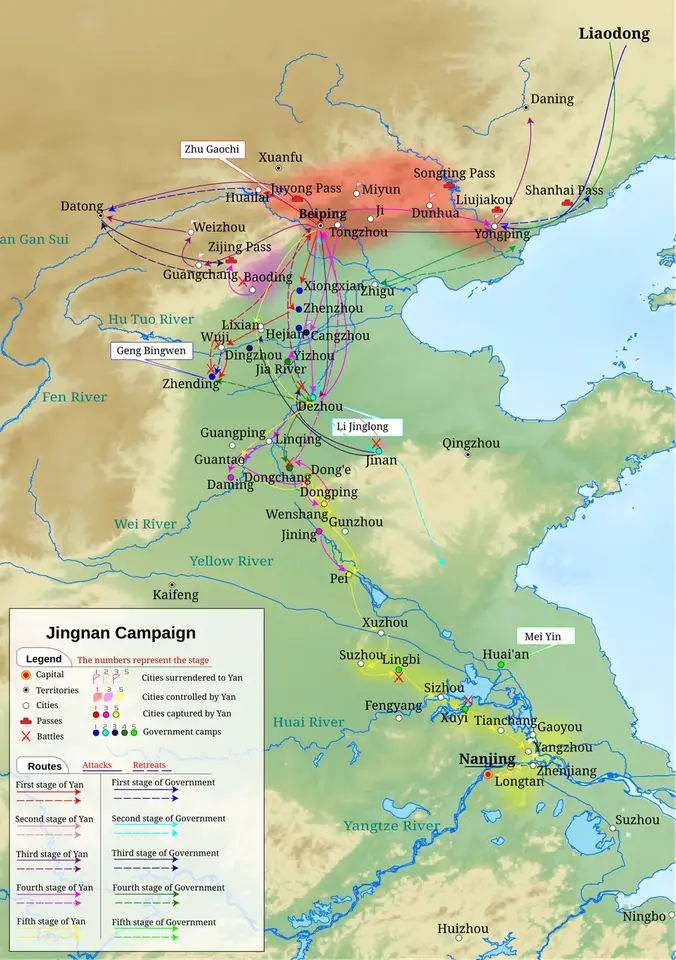
Threatened with demotion, Zhu Di, Prince of Yan, revolted in Beiping in 1398 under the slogan of purifying the court of treacherous flatterers, initiating the four-year civil war known as the Jingnan Campaign. Demonstrating superior cavalry tactics, Zhu Di breached the Yangtze defenses in July 1402, advancing directly to the capital at Nanjing.
On July 13, 1402, imperial commander Li Jinglong and Prince of Gu opened the Jinchuan Gate to the Yan vanguard. As rebel cavalry surged toward the palace grounds, the Fengtian Hall erupted into a massive fire, sending columns of black smoke into the sky.
Arriving at the smoldering imperial palace, Zhu Di searched the ruins, but the Jianwen Emperor was nowhere to be found. For an imperial usurper whose authority rested entirely on naked force, the missing emperor posed a catastrophic threat to political legitimacy. If Zhu Yunwen survived, loyalist scholar-gentry and regional garrisons could rally around the legitimate sovereign to launch counter-rebellions. This existential anxiety haunted Emperor Yongle throughout his reign, prompting unprecedented domestic and maritime intelligence campaigns.
Following the fire, eunuchs presented Zhu Di with an unrecognizable, charred body dragged from the palace ashes, claiming that the emperor and Empress Ma had cast themselves into the flames.
To stabilize the political situation and pacify southern scholar-officials, Zhu Di wept publicly over the corpse, lamenting: "Foolish youth, why did you go so far! I came merely to assist you as the Duke of Zhou!" Zhu Di ordered the body buried with imperial honors, abolished the Jianwen reign title, and ascended the throne on July 17 as Emperor Yongle. In official imperial historiography, the emperor's suicide by fire was recorded as the undisputed truth.
Concurrently, unofficial memoirs and literati chronicles recounted a starkly different narrative of escape. Ming records such as Major Events of Ming History and Secret History of Jiang describe that as gates fell, the Jianwen Emperor prepared to commit suicide, but was halted by a court eunuch who revealed an iron casket left by Zhu Yuanzhang, sealed with instructions to open only during existential crisis.
Opening the chest, they discovered three Buddhist monk robes, credentials made out under the name "Yingwen," razors, silver ingots, and a map showing a hidden drainage tunnel leading outside the palace. The emperor shaved his head, assumed the robes of Monk Yingwen, and escaped beneath the walls with trusted companions, leaving palace attendants to set the hall ablaze with a concubine's corpse to mask his flight.
Folklore and local records claimed that the exiled emperor wandered as an itinerant monk across the remote southwest, residing at temples in Zhejiang, Hunan, Guizhou, and Yunnan. Later collections recorded poems attributed to the wandering monk, lamenting forty years of exile in the southwestern wilderness.
Haunted by the suspicion that the charred corpse had been a decoy, Emperor Yongle summoned Supervising Secretary Hu Ying in 1407 to undertake a sensitive mission. Publicly tasked with seeking the Taoist immortal Zhang Sanfeng, Hu Ying was privately instructed to search monasteries, mountain hermitages, and remote counties across the empire to locate the true whereabouts of the deposed emperor.
To maintain operational secrecy, when Hu Ying's mother passed away, the emperor refused his petition for funeral leave, promoting him to Vice Minister of Rites and ordering him to continue his travels. Traveling incognito across Jiangsu, Zhejiang, Huguang, Guizhou, and Sichuan for sixteen years, Hu Ying compiled exhaustive intelligence regarding itinerant Buddhist masters and the mysterious "Monk Yingwen."
In parallel with overland intelligence missions, Emperor Yongle guarded against the possibility that the Jianwen Emperor had fled overseas. Maritime smuggling routes and expatriate Chinese outposts existed throughout Southeast Asia in Champa, Cambodia, and Java. The court feared that the deposed sovereign might establish a maritime base to organize foreign intervention.
The History of Ming notes in the Biography of Zheng He: "Suspecting that the Hui Emperor had fled overseas, the emperor desired to trace his whereabouts, while displaying military might to demonstrate Chinese opulence." Beginning in 1405, Admiral Zheng He commanded seven naval expeditions across the Western Ocean with over twenty-seven thousand troops aboard massive treasure fleets. Beyond incorporating foreign kingdoms into the tributary system, these expeditions monitored maritime sealanes, ensuring no hostile base formed around the missing emperor.
In the autumn of 1423 (Yongle 21), while Emperor Yongle was returning from his northern campaign against the Mongols, he encamped at Xuanfu (modern Xuanhua, Hebei). Having searched the realm for sixteen years, Hu Ying galloped post-haste to the imperial encampment to request an urgent audience.
The Biography of Hu Ying in the History of Ming records that the emperor had already retired for the night, but upon hearing of Hu Ying's arrival, dressed immediately and summoned him to his private bedroom. Dismissing all attendants, sovereign and minister conversed intimately until the fourth watch before dawn. Chroniclers note that Hu Ying reported everything he had learned, and the emperor's lingering suspicions were permanently resolved.
Historians deduce that Hu Ying presented definitive proof of the Jianwen Emperor's fate: either confirming that the aged former monarch had already passed away peacefully in a remote hermitage, or delivering solemn assurances that the elderly recluse was wholly devoted to Buddhist meditation and harbored no political ambition to challenge the throne. Relieved of this burden, Emperor Yongle passed away the following year during his final northern campaign, bringing closure to the central mystery of the early Ming Dynasty.
The mystery of the Jianwen Emperor's disappearance prompted two of the most significant state endeavors of the Yongle era: the exhaustive sixteen-year domestic intelligence mission led by Hu Ying, and the seven maritime expeditions led by Admiral Zheng He. The late-night audience at Xuanfu in 1423 dissolved imperial anxieties, consolidating the political legitimacy of the Yongle lineage and stabilizing the succession of the Ming Dynasty.
The disappearance left an enduring mark on Chinese political culture. Structurally, it accelerated the institutionalization of imperial secret police surveillance under the Embroidered Uniform Guard and Eastern Depot. Culturally, the romantic tragedy of an exiled sovereign transforming into a wandering Buddhist monk inspired countless novels, dramas, and local temple legends, creating one of the most compelling heroic-elegiac traditions in Chinese historical memory.
Modern historians view the mystery of the Jianwen Emperor's disappearance as an enduring manifestation of the crisis of political legitimacy created by the Jingnan usurpation. Zhu Di's decades-long search reflected sovereign vulnerability behind absolute authority. This intelligence mobilization unexpectedly catalyzed the geographical exploration of China's interior and spurred the maritime golden age across the Indian Ocean.