Famine and Uprising
Devastating floods and famine struck Hebei; Sun Anzu killed the magistrate to resist draft, and Dou Jiande helped him rally rebels in Gaojibo
Sui-Tang Transition · HISTORICAL EVENT
窦建德河北起兵与建夏
Dou Jiande's Uprising in Hebei and Founding of the Xia Regime (窦建德河北起兵与建夏) was a watershed historical event that took place north of the Yellow River during the widespread peasant rebellions of the late Sui Dynasty. In the seventh year of the Daye era (611), as Emperor Yang of Sui prepared for his massive campaign against Goguryeo, catastrophic floods submerged Shandong and Hebei. Fellow villager Sun Anzu killed the local magistrate to resist…
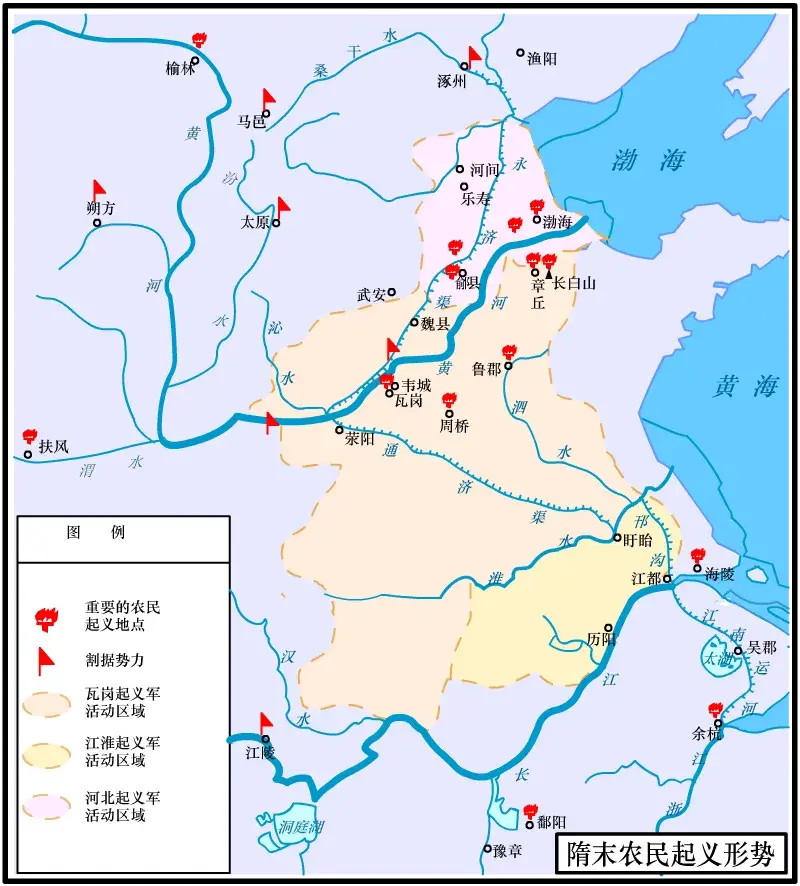
Dou Jiande's Uprising in Hebei and Founding of the Xia Regime (窦建德河北起兵与建夏) was a watershed historical event that took place north of the Yellow River during the widespread peasant rebellions of the late Sui Dynasty. In the seventh year of the Daye era (611), as Emperor Yang of Sui prepared for his massive campaign against Goguryeo, catastrophic floods submerged Shandong and Hebei. Fellow villager Sun Anzu killed the local magistrate to resist conscription, and Dou Jiande helped him assemble peasants to revolt in the vast wetlands of Gaojibo. Later, after imperial authorities executed Dou Jiande's entire family in retaliation, Dou joined the rebels under Gao Shida. Renowned for strict discipline and shared hardships with his men, Dou took over command after Gao's death and led the insurgent army across the northern plains. In the thirteenth year of the Daye era (617), Dou Jiande proclaimed himself King of Changle at Leshou, subsequently launching a surprise nighttime cavalry raid through heavy fog at the Battle of Qilijing to rout thirty thousand elite Sui imperial troops under veteran general Xue Shixiong. In the fourteenth year of the Daye era (618), Dou formally established the dynastic title "Xia", assumed the title King of Xia, proclaimed the Wufeng era, and instituted a comprehensive civil administration. In the second year of the Wufeng era (619), Dou besieged Liaocheng, captured and executed Yuwen Huaji who had assassinated Emperor Yang, pacified the commanderies of Hebei, and relocated the capital to Mingzhou where he built the Wanchun Palace. The Great Xia regime promoted agriculture and reduced taxes, becoming the most powerful and popular regime north of the Yellow River.
Devastating floods and famine struck Hebei; Sun Anzu killed the magistrate to resist draft, and Dou Jiande helped him rally rebels in Gaojibo
Imperial officials murdered Dou Jiande's family, prompting Dou to lead his followers into Gaojibo to serve under Gao Shida
Dou lured Sui troops into an ambush at Pingyuan, wiping out the imperial force and killing Zhuojun commander Guo Xuan
Following Gao Shida's death, Dou unified the insurgents, entered Leshou, proclaimed himself King of Changle, and set up official ranks
Dou led two hundred and eighty shock cavalry in a nighttime raid through thick fog to annihilate Xue Shixiong's thirty thousand troops
Dou proclaimed the dynastic title "Xia", assumed the title King of Xia, proclaimed the Wufeng era, and built civil administrative organs
Xia forces captured Liaocheng and executed regicide Yuwen Huaji, treating Empress Xiao with royal protocol and winning Guandong's respect
Dou captured Mingzhou and relocated the capital there, building Wanchun Palace and dredging canals, bringing the Xia state to its peak
Following his ascension, Emperor Yang of Sui (Yang Guang) embarked on immense engineering enterprises, including the construction of the eastern capital Luoyang, the digging of the Grand Canal, and lavish imperial inspection tours across the empire, consuming astronomical wealth and human labor. In the seventh year of the Daye era (611), Emperor Yang issued an imperial edict ordering an invasion of Goguryeo, conscripting over one million soldiers, civilian laborers, and sailors nationwide. Shipbuilders in the Jiangnan docks were forced to stand day and night in water, causing the lower halves of their bodies to rot with maggots. Meanwhile, military grain provisions relied entirely on civilian overland porters from northern counties, leaving the roadways littered with dead laborers and pushing social tensions to the brink of explosion.
The Guandong region along the Yellow River basin served as the primary base for Sui taxation and soldier recruitment, bearing an extraordinarily crushing burden of corvee labor. Realm-wide mobilization dismantled normal agricultural life, turning fertile fields into wasteland as able-bodied men were dragged away, which seeded deep hatred and explosive revolutionary sentiment among the common populace.
In 611, the lower reaches of the Yellow River and various commanderies across Shandong and Hebei suffered catastrophic once-in-a-century floods. Inundations washed away entire villages and farmlands, followed closely by locust swarms and severe famine. Rather than opening imperial granaries to provide relief, local magistrates aggressively extorted military grain taxes and rounded up draftees for the Korean campaign, forcing millions of starving refugees to wander the highways feeding on wild grass, tree bark, and even human flesh.
Driven into an existential corner, impoverished peasants and bankrupt yeomen refused to endure further oppression. Wang Bo initiated an armed rebellion at Mount Changbai in Zouping, Shandong, composing the Ballad of Not Dying in Vain in Liaodong to rally suffering peasants. Revolts erupted like wildfire across Shandong and Hebei; rebel leaders like Sun Anzu, Zhang Jincheng, and Gao Shida took up arms in marshes and mountain ranges, fracturing Sui local governance into total disarray.
Dou Jiande was a native of Zhangnan County in Beizhou (modern northeast Gucheng, Hebei), born into a farming family and renowned for his upright character, generosity, and chivalrous honor. In the seventh year of the Daye era (611), catastrophic floods struck Zhangnan County, submerging homes and fields. Fellow villager Sun Anzu lost his entire property, and his wife and children starved to death; nevertheless, the Zhangnan magistrate ruthlessly tried to draft him into the frontline expeditionary force. Pushed to despair, Sun Anzu slew the magistrate and fled by night to seek refuge with the respected Dou Jiande. Sensing imminent national turmoil, Dou analyzed the realm for Sun Anzu, noting that even Emperor Wen's golden Kaihuang reign could not prevent military defeat, and that sending starving men to Liaodong was equivalent to murder; moreover, Gaojibo east of Zhangnan spanned hundreds of square miles of dense reeds and labyrinthine channels, forming an ideal defensive sanctuary.
Dou Jiande generously depleted his family wealth to provision Sun Anzu, helping him recruit hundreds of fugitive peasants who refused to fight in Korea to garrison Gaojibo and openly rebel against Sui. Because the wetlands were impassable for heavy government flotillas, the rebels raided with impunity. Before long, however, the Zhangnan magistrate discovered Dou Jiande's covert assistance to the insurgents and ruthlessly slaughtered Dou's entire family. The murder of his kin demolished any remaining hope of accommodation with the Sui dynasty. Dou immediately led the two hundred able-bodied men left in his village to enter Gaojibo and unite with rebel chieftain Gao Shida. Recognizing Dou's strategic genius and broad appeal, Gao Shida appointed him Military Supply Officer and soon promoted him to Army Marshal.
In the initial stage of rebellion, various insurgent factions operated independently without unified discipline, and conflicts broke out frequently. Sun Anzu was treacherously assassinated by rival warlord Zhang Jincheng. Remembering Dou Jiande's past generosity, thousands of Sun Anzu's surviving troops refused to serve other chieftains and placed themselves entirely under Dou's command. Dou instituted strict military discipline, prohibiting any pillage of villagers or traders, shared all rations equally with his men, and distributed captured livestock, grain, and treasures among the soldiers without keeping anything for himself. Dou's reputation flourished, and the rebel force expanded rapidly to over ten thousand combatants.
In the twelfth year of the Daye era (616), Sui Commander of Zhuojun Guo Xuan was ordered to lead over ten thousand elite imperial troops south to annihilate the Gaojibo insurgents. Gao Shida, acknowledging Dou Jiande's superior tactical acumen, placed Dou in complete operational command of the front lines. Dou devised a trap combining false surrender with luring the enemy into difficult terrain. He dispatched a trusted confidant carrying secret letters to Guo Xuan, pretending that he had long quarreled with Gao Shida and feared execution, offering to lead his personal troops as fifth-column scouts to help the imperial army destroy Gao's headquarters.
Guo Xuan was initially suspicious, but upon seeing the emissary's bedraggled appearance and observing rebel outposts scatter in panic during minor skirmishes, he abandoned caution. Eager for imperial honors, Guo Xuan advanced with his elite cavalry without waiting for his lagging infantry columns, plunging deep into the defiles of Pingyuan Commandery. When Guo Xuan entered the prearranged ambush zone, the terrain turned swampy and difficult. Suddenly, deafening war cries echoed from the surrounding reed beds. Dou Jiande had deployed heavy forces on high ridges along the flanks and personally led a ferocious charge into the vanguard while hidden detachments severed the Sui retreat.
Trapped within the narrow reeds, the imperial cavalry lost cohesion and broke into panic. Dou Jiande charged at the front amid flights of arrows; the insurgent soldiers fought with desperate fury, wiping out Guo Xuan's ten thousand imperial troops and slaying Guo Xuan in the melee. The victory yielded thousands of fine cavalry horses and mountains of iron armor and crossbows, shattering the myth of imperial invincibility and elevating Dou Jiande's prestige throughout northern China, attracting regional gentry and commoners alike to his banner.
In late 616, Gao Shida advanced recklessly against veteran Sui general Yang Yichen in Qinghe and fell in battle, dealing a severe blow to the insurgents. Facing imminent disaster, Dou Jiande gathered the surviving forces and retreated into the salt marshes of Yanshan to reorganize. In the first month of the thirteenth year of the Daye era (617), Dou reassembled his army, marched into Leshou in Hejian Commandery (modern Xian County, Hebei), erected an altar to institute official ranks, and was acclaimed by his followers as King of Changle, adopting the reign title Dingchou. Leshou sat at the agricultural core of the northern plain; Dou established order and distributed grain to refugees, stabilizing the fledgling regime.
Alarmed by the insurgency, Emperor Yang urgently commanded Left Guard Senior General and Zhuojun Garrison Commander Xue Shixiong to lead thirty thousand elite troops from Youzhou south to crush Leshou. Xue Shixiong was an experienced battlefield commander whose northern border cavalry was renowned for ferocious archery; he established a fortified encampment at Qilijing south of Hejian to eradicate the new kingdom. It was early summer wheat harvest, and Dou Jiande's main forces were dispersed across neighboring counties reaping grain, leaving the city weakly defended. Recognizing the immense numerical disparity, Dou feigned timidity, commanding garrison posts to withdraw and spreading rumors that his forces feared General Xue's reputation and had fled back to Douzikeng.
Believing the reports, Xue concluded that the rebels were disorganized mobs and relaxed camp vigilance. Learning of the enemy's complacency, Dou assembled two hundred and eighty elite death-squad cavalrymen as a shock vanguard, ordering the main body to follow covertly through the night. Shielded by howling gale-force winds and blinding morning fog, Dou led his cavalry across one hundred and forty miles in a single night, arriving outside the Qilijing encampment at daybreak.
Emerging like wraiths from the dense fog, Dou's shock cavalry smashed through Xue Shixiong's outer perimeters directly into the central command tent. Paralyzed by surprise in the zero-visibility fog, the Sui army collapsed into pandemonium, trampling thousands of their comrades to death. Xue Shixiong fled in terror with only a few dozen retainers back to Zhuojun, where he soon died of shame and acute illness. The victory at Qilijing completely shattered the primary regular imperial field army in northern Hebei.
Following Xue Shixiong's demise, the Sui administrative apparatus north of the Yellow River disintegrated, and Wang Cong, the governor of Hejian, surrendered after a protracted siege. In the fifth month of the fourteenth year of the Daye era (618), news of Emperor Yang's assassination during the Jiangdu coup reached the north. Urged by civil and military subordinates, Dou Jiande formally proclaimed the state title "Xia" in the seventh month at Leshou, built the Jincheng Palace, assumed the title King of Xia, and adopted the reign title Wufeng.
Dou adapted the Sui administrative code to form a structured civil hierarchy. He entrusted prestigious scholars Song Zhengben as Director of the Chancellery and Kong Deshao as Vice Director of the Secretariat to oversee state affairs; he appointed Qi Shanxing as Left Vice Director of the Department of State Affairs, while appointing former Sui Palace Attendant Pei Ju to supervise official examinations and imperial ceremonial court protocol. Pei Ju drafted state rituals and ceremonial codes, transitioning the Great Xia from a rebel movement into a formal dynastic entity. The Xia government treated defecting Sui civil and military officials with exceptional dignity, retaining them in office without executions, and issued strict decrees prohibiting troops from trespassing upon civilian residences, promoting equal land allotment and low taxes.
In the winter of 618, rebel minister Yuwen Huaji, who had murdered Emperor Yang, fled north with mutinous troops, declared himself emperor at Weixian, but was defeated by Li Mi and forced into Liaocheng (modern Liaocheng, Shandong). Yuwen plundered and terrorized the populace, provoking intense moral outrage. In the second month of the second year of the Wufeng era (619), Dou summoned his civil and military council. Adopting the counsel of Kong Deshao and Song Zhengben, he launched a moral punitive expedition with one hundred thousand Xia troops advancing by land and water.
Dou erected catapults and battering rams to batter Liaocheng's fortifications day and night. Rebel leader Wang Bo, who had feigned surrender to Yuwen, threw open the gates from within, allowing Xia forces to capture the stronghold. Dou apprehended Yuwen Huaji and his conspirators, read out their crimes against sovereign and people, and beheaded Yuwen and his two sons in public. Upon entering the city, Dou paid respects to Empress Xiao, donned mourning garments to mourn Emperor Yang, released thousands of seized court maidens to their homes, sealed imperial regalia and carriages intact, and escorted Empress Xiao safely to the Gokturks, winning immense moral renown.
In the autumn of 619, Dou advanced westward, taking Xingzhou and Cangzhou, and in the eighth month captured Mingzhou (modern Yongnian, Handan, Hebei), forcing Tang prince Li Shentong to retreat to Xiangzhou and securing Xiangzhou, Zhaozhou, and Liyang. Dou captured royal Tang relatives and ministers, including Li Shentong, Li Shiji's father Li Gai, and Wei Zheng, treating all captives with honor and clemency. When an assassin murdered Wang Gui, governor of Huaizhou, and presented Wang's head to Dou, Dou angrily condemned the treachery of killing one's master, executed the killer, and returned the head, prompting Huaizhou to surrender voluntarily.
Dou then transferred the Xia capital to Mingzhou, constructing the Wanchun Palace. He initiated agricultural reforms, dredging the Kuxia Canal to connect with the Yongji Canal, revitalizing regional irrigation and grain transport. Under Xia rule, the northern plain enjoyed rare tranquility where "thievery vanished and merchants slept peacefully under the open sky," elevating the Great Xia regime to its historical zenith.
Dou Jiande's Hebei uprising and the establishment of the Great Xia regime dismantled the Sui Dynasty's northern administrative and defensive systems, directly accelerating the collapse of the dynasty. By destroying Xue Shixiong's regular forces and executing Yuwen Huaji, the Xia state consolidated military control over nearly all of Hebei and parts of Shandong, creating a tripartite power balance across the central plains alongside the Tang in Guanzhong and Wang Shichong in Henan.
Dou Jiande implemented an exceptionally benevolent administration during a chaotic era. Maintaining personal asceticism, he wore plain cloth, ate coarse food, and shared plunder with his soldiers. He strictly outlawed harassment of civilians, reduced taxes to one-thirtieth, and restored the Grand Canal connections, allowing the war-ravaged Hebei plain to recover rapidly. Although the Xia regime eventually fell to Li Shimin at the Battle of Hulao, Dou's deep popularity among the Hebei populace sparked Liu Heita's subsequent uprising against the Tang, leaving a lasting imprint on early Tang political consolidation.