Edict Ordering Script Creation
Li Yuanhao commissions Yeli Renrong to seclude himself and engineer an independent writing system for the Tangut nation.
Western Xia (西夏) · HISTORICAL EVENT
西夏文字创制
Creation of the Tangut Script (西夏文字创制) was a monumental cultural event and institutional reform during the Western Xia period spanning 1036 to 1039, wherein Emperor Jingzong of Western Xia (Li Yuanhao) commissioned scholar-statesman Yeli Renrong to engineer a dedicated writing system for the Tangut language. On the eve of proclaiming an independent imperial realm, Li Yuanhao sought to establish dynastic legitimacy, break away from Song and Liao cultural…
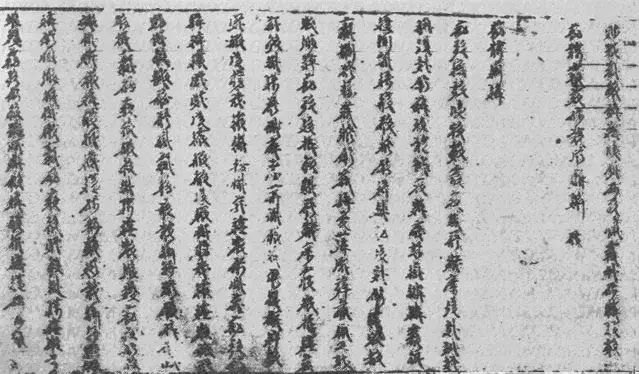
Creation of the Tangut Script (西夏文字创制) was a monumental cultural event and institutional reform during the Western Xia period spanning 1036 to 1039, wherein Emperor Jingzong of Western Xia (Li Yuanhao) commissioned scholar-statesman Yeli Renrong to engineer a dedicated writing system for the Tangut language. On the eve of proclaiming an independent imperial realm, Li Yuanhao sought to establish dynastic legitimacy, break away from Song and Liao cultural hegemony, and foster an independent civilizational identity. Devoting three years of scholarly labor, Yeli Renrong adapted the structural principles of Chinese characters alongside Tangut phonology, formulating a square block writing system exceeding six thousand characters. Li Yuanhao decreed it the national script, establishing imperial academies and examination curricula to mandate its administrative use while organizing translation bureaus to translate Confucian classics, statecraft treatises, and Buddhist canons. The script endured for nearly five centuries into the Ming Dynasty, representing a major cultural monument of imperial borderland civilizations in Chinese history.
Li Yuanhao commissions Yeli Renrong to seclude himself and engineer an independent writing system for the Tangut nation.
Yeli Renrong completes a twelve-volume standard dictionary containing over six thousand newly designed characters.
Li Yuanhao proclaims himself Emperor of Great Xia, utilizing the Tangut script to issue his accession proclamation.
Li Yuanhao decrees the writing system to be the mandatory official medium for all imperial administration, law, and diplomacy.
The court establishes Tangut Academies and imperial examinations, appointing Yeli Renrong to direct linguistic education.
The imperial court initiates translation projects, rendering the Confucian classics, legal codes, and the Buddhist Tripitaka into Tangut.
Scholar Yeli Renrong passes away; Li Yuanhao grants posthumous honors and later elevates him to Prince of Guanghui.
The Mongols destroy the Western Xia state, but the Tangut script continues to be printed and studied under the Yuan Dynasty.
Tangut Buddhist pillars carved at Baoding reveal that the script remained in active liturgical use five centuries after its inception.
The Tangut people originated as a branch of the ancient Qiang nomadic confederacy in northwestern China. In early times, they practiced nomadic pastoralism across the high steppes, lacking agricultural traditions, formal property taxes, or written records, relying on notched wood and knotted cords to keep tallies while tracking seasons by plant cycles. During the late Tang Dynasty, Tangut chieftain Tuoba Sigong was granted the imperial surname Li and appointed Military Governor of Dingnan for aiding in the suppression of the Huang Chao Rebellion, beginning the migration of Tangut communities into northern Shaanxi.
Across five generations from the Five Dynasties through the early Northern Song, Tanguts transitioned to settled agriculture and regional commerce. In their interactions with Han, Tibetan, and Uighur neighbors, the Tangut elite realized that lacking a native script impeded imperial administration. Promulgating legal codes, recording tax registers, drafting official treaties, and preserving dynastic lineage depended entirely on Chinese scribes, generating structural friction with Tangut imperial state-building.
In 1032, Li Yuanhao inherited the dignity of Duke of Xia. Formidable and decisive, he mastered Confucian statecraft and military treatises while cultivating pride in Tangut traditions. He observed that the Northern Song court utilized titles, silk tribute, and classic texts to enforce cultural containment over frontier borderlands.
To establish an independent empire rivaling the Song and Liao dynasties, Li Yuanhao enacted sweeping reforms to assert distinct sovereignty. He renounced the imperial surnames Li and Zhao bestowed by Tang and Song emperors, adopting the Tangut surname Weiming. He issued the Tonsure Edict, ordering Tangut men to shave their crowns while retaining ear-locks, prohibiting Chinese garments in favor of traditional robes and boots. In administration, he paired Chinese-style executive departments with Tangut-staffed military organs.
Within these institutional transformations, engineering an independent national script served as the core cultural pillar of Li Yuanhao's state-building. He declared to his inner circle: "A hero ought to reign supreme over his own domain! If I assume the imperial title, how can we lack our own dynastic writing to record our triumphs and transmit them through eternity?"
In conceptualizing a script, the Tangut elite studied the Khitan scripts developed by the northern Liao Dynasty while analyzing the structural mechanisms of Chinese characters. The Tangut language, belonging to the Tibeto-Burman branch of the Sino-Tibetan family, possessed rich polysyllabic compounds and complex grammatical morphology distinct from spoken Chinese, yet shared single-syllable morphemic structures adaptable to square block characters.
In 1036, Li Yuanhao issued an imperial edict entrusting the invention of the national script to his trusted maternal relative, the eminent Tangut scholar Yeli Renrong. Renowned for his erudition in both Chinese classics and Tangut traditions, Yeli Renrong assembled a circle of phonologists and scribes at Xingqing Prefecture, secluding himself to embark upon the enterprise of linguistic engineering.
Yeli Renrong labored for three continuous years from 1036 to 1038 to systematically construct the new writing system. Using standard Song regular script as an aesthetic foundation, he adopted standard stroke categories—including horizontal, vertical, slanting left, slanting right, dot, turning, and hooked strokes—to craft character layouts aligned with Tangut phonetic rules.
In external appearance, Tangut script adhered to the square aesthetic of Chinese characters, characterized by structural density and vertical-horizontal equilibrium. Superficially, it resembled Chinese calligraphy, yet every character was newly engineered. Unlike Chinese, Tangut script featured no characters with fewer than five strokes, while characters exceeding twenty strokes were rare. The vast majority of graphs ranged between eight and fifteen strokes, characterized by sweeping diagonal strokes that lent an energetic, balanced elegance.
Yeli Renrong completed over six thousand discrete characters, organizing them into a twelve-volume standard dictionary. Each graph was paired with phonetic markers and semantic definitions, giving the script systematic internal consistency from its inception.
Rather than copying Chinese characters, Yeli Renrong implemented a component synthesis system. He generated hundreds of fundamental semantic and phonetic roots, which were assembled to construct characters denoting physical objects, actions, and abstract concepts.
Modern scholars of Tangut studies identify six primary methods of compound character construction:
First, ideographic compounding, which combined two semantic roots to produce a new concept. For example, combining elements of the roots for water and earth yielded the character for mud; merging the elements for person and bravery produced the graph for hero.
Second, phonetic-semantic compounding, combining a semantic determinative with a phonetic marker. An element sounding like ling paired with an element for silk yielded the graph for thin silk.
Third, reciprocal inversion, which repositioned component strokes horizontally to generate related or opposite semantic pairs, such as finger and toe, or flee and submit.
Fourth, symmetrical balance, featuring laterally mirrored structures deployed for concepts embodying bilateral symmetry, such as pair, lips, center, and divide.
Fifth, fanqie phonetic synthesis, adapting traditional Chinese rhyme-cleaving principles to merge the initial consonant of one character with the final vowel of another to transcribe foreign proper nouns, such as the Chinese surname Qin.
Sixth, vowel lengthening synthesis, combining phonetic components with a root meaning long to represent phonemic long vowels in spoken Tangut. This structural system permitted the accurate transcription of spoken Tangut idioms alongside Buddhist scriptures and legal codes.
In the spring of 1038, Yeli Renrong presented the completed twelve-volume dictionary to Li Yuanhao. Examining the compilation, the ruler praised it as a monumental achievement.
Li Yuanhao issued imperial edicts establishing the writing system as the National Script of the Western Xia Empire, known colloquially as Tangut Writing or the National Books. On November 10, 1038, Li Yuanhao ascended the altar at Xingqing Prefecture to proclaim himself Emperor of the Great Xia, inaugurating the Tianshou Lifayanzuo era. During the ceremonies, he drafted his accession edict in the newly created Tangut script, dispatching Tangut-inscribed diplomatic credentials to the courts of Song and Liao to announce the founding of his imperial line.
To guarantee that the script supplanted Chinese across regional administration, Li Yuanhao instituted mandatory administrative directives. The court decreed that all memorial petitions, imperial decrees, diplomatic treaties, and judicial verdicts must be drafted in the national script. Officials who failed to master Tangut characters were barred from holding imperial posts.
The script was stamped across bronze troop-mobilization tallies, minted on cast bronze coinage, and engraved on official seals using stylized nine-fold seal script. Within years, the writing system achieved universal distribution across Ningxia, the Hexi Corridor, northern Shaanxi, and the Alxa grasslands.
To ensure the intergenerational transmission of the writing system, Li Yuanhao established state educational frameworks. He instituted the Bureau of National Script alongside the traditional Bureau of Chinese Characters within the central administration, selecting noble youths from imperial and aristocratic clans to receive formal orthographic instruction.
Yeli Renrong was appointed Director of the Bureau of National Script to oversee educational curricula. Subsequently, the court established Tangut Academies throughout central ministries and provincial commanderies, establishing Tangut Academy Professorships and creating Tangut-language civil service examinations. This innovation marked the first instance in Chinese history where a non-Han imperial dynasty selected its civil bureaucracy through competitive examinations conducted in its native script, making the writing system the core administrative medium of imperial governance.
Following the promulgation of the script, the Western Xia court organized translation campaigns to assimilate classical learning and Buddhist doctrine. Li Yuanhao founded the Central Translation Bureau at Xingqing Prefecture, assembling scholar-monks to translate major Chinese and Tibetan works into Tangut.
In secular philosophy and statecraft, imperial scholars translated the Analects, Mencius, Classic of Filial Piety, Sun Tzu's Art of War, Essentials of Governance of the Zhenguan Era, and the Forest of Classifications, distributing printed editions to royal princes and high officials. In governance, the court compiled the Revised and Sacred Law Code of the Tiansheng Era in twenty-two volumes, standardizing imperial statutes, military organization, and civil jurisprudence entirely in Tangut characters.
In religious literature, Tangut emperors financed the translation of the entire Buddhist Tripitaka, producing thousands of woodblock-printed volumes distributed to temples across the realm. To facilitate linguistic education, scholars compiled sophisticated reference dictionaries, including Sounds in Common, Sea of Characters, The Five Sounds of Rhyme Cleaving, and the bilingual Chinese-Tangut glossary Pearl in the Palm, establishing a mature lexicographical tradition.
Following its creation in 1036, the Tangut script remained the primary official medium of the Western Xia state for over two centuries, recording imperial stele inscriptions, administrative dossiers, commercial sales contracts, and folk ballads.
In 1227, Mongol armies under Chinggis Khan extinguished the Western Xia state, devastating cities and tombs, while Tangut populations assimilated into neighboring communities. Yet the Tangut script survived the destruction of the dynasty.
Because Tangut Buddhist culture was entrenched throughout northwestern China, Emperor Shizu of Yuan (Kublai Khan) ordered the recarving and printing of the complete Tangut Buddhist Tripitaka at Wanshou Monastery in Hangzhou and Da'anguo Monastery in Ningxia. Yuan Confucian master Yu Ji authored formal prefaces for Tangut Buddhist prints. Furthermore, the fourteenth-century Cloud Platform at Juyongguan Pass north of Beijing features Buddhist dharani inscriptions carved in six scripts, with Tangut characters preserved in stone.
As late as 1502, during the Hongzhi reign of the Ming Dynasty, two white marble Buddhist dhvaja pillars carved in Baoding, Hebei, were inscribed with extensive Tangut dharani and donor registries. This proves that Tangut script remained in active ritual and calligraphic use among monastic communities for nearly five hundred years following its creation.
The creation of an independent writing system marked the emergence of Tangut society into institutional maturity. Overcoming the historic absence of written records, the script provided Tangut civilization with a medium to record epic genealogies, dynastic annals, imperial legal statutes, and lyrical poetry. This linguistic achievement fostered national pride, establishing Tangut civilization alongside Han and Khitan cultures as a sophisticated regional civilization in East Asia.
In the tripartite balance between Song, Liao, and Western Xia, written language operated as a symbol of sovereignty. By promulgating the Tangut script, Li Yuanhao challenged the cultural monopoly of the Chinese writing system, declaring to neighboring courts that the Great Xia Empire possessed equal political dignity and civilizational legitimacy. In diplomatic communications, Tangut envoys delivered credentials drafted in Tangut characters, compelling the Song court to appoint official Tangut translators and dismantling Chinese claims of universal cultural suzerainty.
The translation programs that accompanied the script facilitated the diffusion of classical Chinese and Buddhist literature throughout northwestern China. Rather than cultivating cultural isolation, Tangut scholars used their script to absorb external thought. Confucian works like the Analects and Mencius were taught across the Hexi Corridor, while the comprehensive legal code Tiansheng Laws synthesized Tang-Song administrative principles with Tangut customary traditions. These translations preserved rare Buddhist and Confucian texts, contributing to cultural exchange along the ancient Silk Road.
Leaving behind thousands of surviving documents—including the Khara-Khoto archives, Grotto inscriptions, and stone steles—the Tangut script bequeathed an extraordinary textual heritage to modern historiography. Since the recovery of the Liangzhou stele and the discovery of the Khara-Khoto manuscripts, Tangut studies has emerged as an international scholarly discipline. Deciphering Tangut texts allows contemporary historians to reconstruct the administration, ethnic migrations, linguistic evolution, and social life of northwestern China from the eleventh to the thirteenth centuries, preserving a brilliant chapter in China's multicultural heritage.