Jianwen Enthroned
Zhu Yunwen ascends the throne, adopting aggressive policies to disarm princely fiefdoms.
Ming Dynasty (明朝) · HISTORICAL EVENT
靖难之役
The Jingnan Campaign (靖难之役) was a four-year civil war of dynastic succession fought from 1399 to 1402 (the first through fourth years of the Jianwen reign) between Prince of Yan Zhu Di, fourth son of Ming founder Zhu Yuanzhang, and his nephew Zhu Yunwen (the Jianwen Emperor) for supreme control of the Ming Empire. Early Ming founder Zhu Yuanzhang had enfeoffed his sons as regional princes to defend frontier defense lines, conferring upon them…
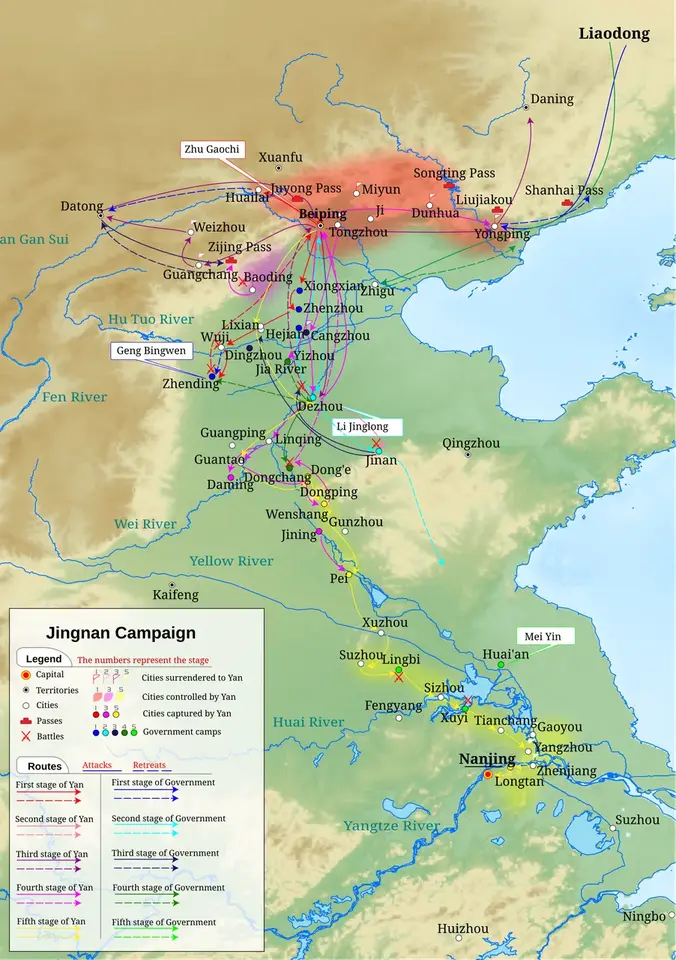
The Jingnan Campaign (靖难之役) was a four-year civil war of dynastic succession fought from 1399 to 1402 (the first through fourth years of the Jianwen reign) between Prince of Yan Zhu Di, fourth son of Ming founder Zhu Yuanzhang, and his nephew Zhu Yunwen (the Jianwen Emperor) for supreme control of the Ming Empire. Early Ming founder Zhu Yuanzhang had enfeoffed his sons as regional princes to defend frontier defense lines, conferring upon them substantial military garrisons. Upon ascending the throne, the young Jianwen Emperor collaborated with senior ministers Qi Tai and Huang Zicheng to implement an aggressive policy of reducing the princely principalities (xiaofan), deposing five imperial princes within a year and driving the Prince of Xiang to commit suicide. Fearing imminent arrest, Zhu Di raised the banner of revolt in Beiping in July 1399 under the justification of "Pacifying the Realm's Distress" (jingnan) to purge corrupt ministers around the throne. Despite facing overwhelming central armies under veterans Geng Bingwen and Li Jinglong, Zhu Di outmaneuvered imperial forces in cavalry engagements at Zhending and the Baigou River. Breaking a strategic stalemate across Shandong, Zhu Di adopted monk-strategist Yao Guangxiao's counsel to launch a deep thrust directly toward the southern capital. In June 1402, imperial commanders surrendered Nanjing's Jinchuan Gate, and the imperial palace burned as the Jianwen Emperor vanished. Zhu Di assumed the throne as the Yongle Emperor, moving the political center to Beijing and establishing institutions that defined late imperial China.
Zhu Yunwen ascends the throne, adopting aggressive policies to disarm princely fiefdoms.
Prince of Yan Zhu Di executes imperial officials in Beiping, initiating the Jingnan Campaign.
Zhu Di crushes Geng Bingwen's initial offensive, prompting the court to appoint Li Jinglong.
Yan cavalry routs Li Jinglong's army of five hundred thousand along the Baigou River.
Zhu Di adopts Yao Guangxiao's plan, bypassing fortified towns to strike directly at Nanjing.
Imperial gates are opened in surrender; the palace burns and Zhu Di claims the throne.
Mindful of the collapse of the Mongol Yuan dynasty due to diplomatic isolation, Ming Taizu (Zhu Yuanzhang) established a system of princely enfeoffments (fengjian), stationing over twenty imperial sons across strategic borderlands. Northern princes such as the Prince of Yan, Prince of Jin, and Prince of Ning commanded extensive elite frontier garrisons. In 1398, following Taizu's death, his grandson Zhu Yunwen ascended the throne. Mild-mannered and supported by Confucian scholar-officials, the young monarch viewed his militarized uncles as existential threats to centralized rule. Directed by Minister of War Qi Tai and Minister of Rites Huang Zicheng, the court launched a rapid campaign to strip regional princes of their titles, arresting the princes of Zhou, Qi, Dai, and Min, while the Prince of Xiang burned himself and his family alive to avoid public degradation.
Among the regional princes, Zhu Di of Beiping was the most experienced combat commander, commanding vast personal prestige along the Mongolian frontier. Convinced that central armies would soon target his household, Zhu Di resolved on rebellion under the counsel of Chan Buddhist monk Yao Guangxiao. Beneath his princely palace in Beiping, Zhu Di excavated subterranean arsenals to forge weapons and armor, keeping thousands of ducks and geese within the courtyards to disguise the sound of metal hammering. He recruited skilled cavalrymen and cultivated alliances with local garrison commanders, preparing his operational apparatus for open insurrection.
In July 1399, the Jianwen court issued secret orders to provincial administrators Zhang Bing and Xie Gui to arrest Zhu Di. Zhu Di struck first, ambushing the imperial envoys within his residence and seizing the nine city gates of Beiping. Invoking the Ancestral Injunctions (Huang Ming Zuxun)—which authorized imperial princes to take up arms against treacherous ministers—Zhu Di inaugurated his campaign under the banner of "Pacifying the Realm's Distress," naming Qi Tai and Huang Zicheng as traitors. The Jianwen Emperor stripped Zhu Di of imperial rank and dispatched veteran general Geng Bingwen with 130,000 troops. In August, Zhu Di exploited divided deployments to crush Geng Bingwen's army at Zhending.
The Jianwen court replaced Geng Bingwen with Duke of Cao Li Jinglong, mobilizing an army of five hundred thousand men to lay siege to Beiping. Zhu Di executed a strategic counter-march, marching north to annex the Daning garrison and absorbing the formidable Mongol cavalry divisions of the Duoyan Three Guards. In April 1400, Zhu Di clashed with Li Jinglong at the Baigou River (north of modern Xiong County, Hebei). As battle hung in the balance, a violent storm snapped Li Jinglong's command standard; taking advantage of the wind, Yan cavalry launched a devastating incendiary charge that routed the imperial host, inflicting tens of thousands of casualties and capturing extensive stores. When Li Jinglong retreated to Jinan, regional commissioner Tie Xuan and general Sheng Yong held the fortress with heavy firearms, subsequently killing Yan vanguard commander Zhang Yu at the Battle of Dongchang and temporarily stalling the rebel advance.
Following the setback at Dongchang, the conflict degenerated into a protracted war of attrition across northern rivers. In late 1401, a palace eunuch defected to the Yan camp, revealing that the defenses of the capital were critically understrength. Strategist Yao Guangxiao urged Zhu Di: "Military strategy favors speed; abandon the sieges of fortified county seats and strike directly at the capital, which will crumble upon your arrival." Adopting this bold maneuver, Zhu Di abandoned regional sieges, leading his elite cavalry corps on a rapid southward dash through Henan and Anhui.
In the spring of 1402, the Yan army crossed the Huai River, destroying the main imperial army under He Fu at the Battle of Lingbi. Advancing rapidly, Zhu Di reached the northern bank of the Yangtze River, where imperial naval commanders defected. In early June, the Yan vanguard crossed the river to seize Zhenjiang, appearing before the walls of Nanjing. On July 13, 1402, as the Yan army reached the Jinchuan Gate, garrison defenders Li Jinglong and Prince of Gu Zhu Hui threw open the gates in surrender. Yan forces entered Nanjing unopposed. Amid the chaos, the imperial palace caught fire, and the Jianwen Emperor disappeared without a trace. Zhu Di launched a brutal purge against loyalist officials, executing Qi Tai, Huang Zicheng, and Fang Xiaoru, before mounting the imperial throne on July 17, inaugurating the Yongle era.
The Jingnan Campaign concluded with Zhu Di's total victory, marking the only successful rebellion by a regional prince against a reigning Chinese dynasty. The imperial succession passed definitively from Zhu Biao's descendants to the Yan line. Upon his accession, the Yongle Emperor initiated severe purges against the Jianwen administration, executing thousands of loyalist scholars and their households.
The war reshaped Ming institutional and geopolitical history. First, Zhu Di initiated the construction of Beijing and relocated the primary capital north in 1421, establishing the geopolitical posture of "the Emperor guarding the northern frontier" (tianzi shou guomen). Second, his reign inaugurated the flourishing Yongle Era, characterized by five military expeditions into the Mongolian steppe, Zheng He's seven oceanic voyages, and the compilation of the encyclopedic Yongle Dadian. Finally, mindful of his own rebellion, Zhu Di stripped surviving regional princes of military authority, converting them into salaried landed nobility; to secure his regime against bureaucratic dissent, he founded the Grand Secretariat (Neige) and empowered eunuch secret police agencies such as the Eastern Depot (Dongchang), profoundly shaping the autocracy of the later Ming dynasty.