Edict of Luntai Issued
Emperor Wu issues the penitential edict, renouncing military expansion to prioritize agriculture
Western Han (西汉) · HISTORICAL EVENT
昭宣中兴
The Zhao-Xuan Resurgence (昭宣中兴) designates the prosperous restorative era spanning the reigns of Emperor Zhao (Liu Fuling) and Emperor Xuan (Liu Xun) from 87 BCE to 48 BCE during the Western Han Dynasty. Following prolonged campaigns and harsh penal exactions under Emperor Wu, the sovereign issued the penitential Edict of Luntai, reorienting imperial policy toward peaceful reconstruction. Ascending the throne in his youth, Emperor Zhao was guided by…
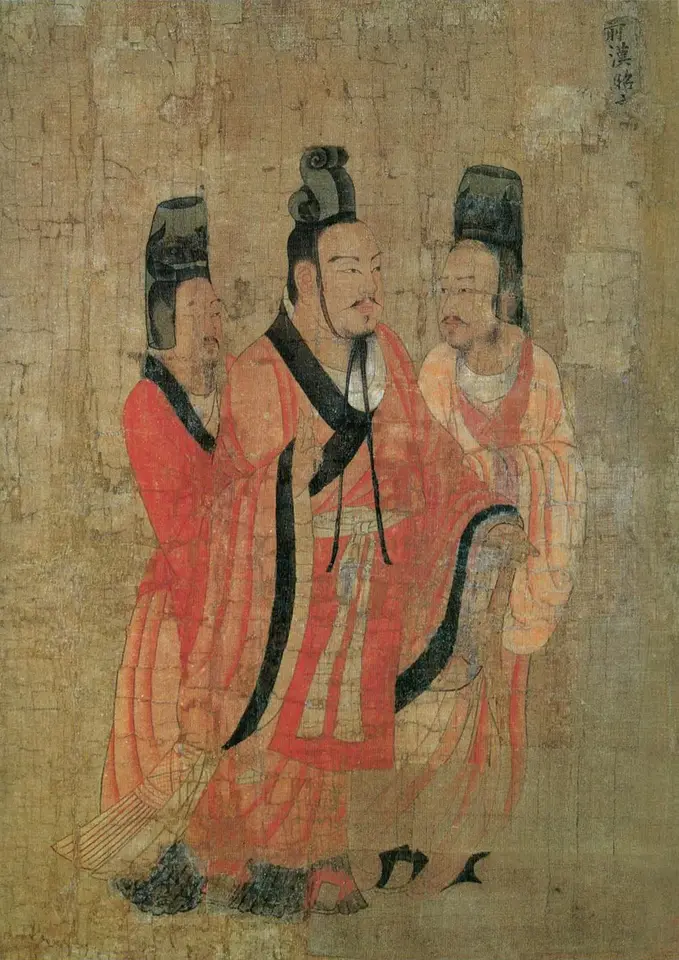
The Zhao-Xuan Resurgence (昭宣中兴) designates the prosperous restorative era spanning the reigns of Emperor Zhao (Liu Fuling) and Emperor Xuan (Liu Xun) from 87 BCE to 48 BCE during the Western Han Dynasty. Following prolonged campaigns and harsh penal exactions under Emperor Wu, the sovereign issued the penitential Edict of Luntai, reorienting imperial policy toward peaceful reconstruction. Ascending the throne in his youth, Emperor Zhao was guided by Supreme General Huo Guang, who convened the historic Salt and Iron Conference to abolish liquor monopolies, suppressed aristocratic conspiracies, and lowered taxes. Emperor Xuan, raised as a commoner, developed profound insight into popular hardships. After Huo Guang's passing, Xuan eliminated the entrenched Huo clan, consolidating imperial governance under the pragmatic synthesis of Confucian moral suasion and Legalist institutionalism known as combining the kingly and hegemonic ways. Xuan instituted strict administrative assessments, created the Ever-Normal Granary system to stabilize grain prices, reduced agricultural levies, reformed the judiciary to eliminate unfair trials, and founded the Western Regions Protectorate while welcoming the submission of Huhanye Chanyu. The resurgence elevated the Western Han to its geopolitical and institutional peak.
Emperor Wu issues the penitential edict, renouncing military expansion to prioritize agriculture
Young Emperor Zhao ascends the throne; Huo Guang directs the regency toward peaceful recovery
Debates result in the abolition of state liquor monopolies, relaxing commercial controls
Huo Guang suppresses the conspiracy of Prince Dan of Yan and Shangguan Jie, securing central authority
Following Emperor Zhao's death and Prince He's deposition, Liu Xun is elevated to the throne
Huo Guang dies; Emperor Xuan reclaims direct command over memorials and reorganizes guards
Emperor Xuan eliminates the rebellious Huo family, consolidating absolute executive authority
Zhao Chongguo deploys agricultural garrisons along the Huangshui River, pacifying the Qiang
Xuan appoints Zheng Ji as Protector General at Wulei, integrating Xinjiang into Han territory
Geng Shouchang establishes granaries to stabilize grain prices, lowering food costs to record lows
Xuan presides over scholars reconciling the Five Classics, formalizing imperial Confucian orthodoxy
The Southern Xiongnu Chanyu pays homage at Chang'an, securing six decades of northern peace
Emperor Xuan dies with the temple name Zhongzong, concluding nearly four decades of resurgence
Emperor Wu governed for over half a century, achieving historic military triumphs against the Xiongnu and opening trade along the Silk Road. However, endless strategic expeditions and grandiose architectural projects exhausted the state treasury and imposed intolerable fiscal extractions upon the agrarian population. Strict property reporting taxes, state monopolies on salt and iron, and severe penal laws proliferated. In 91 BCE, the catastrophic Witchcraft Disaster erupted, leading to the death of Crown Prince Liu Ju, civilian casualties in Chang'an, and peasant rebellions across eastern provinces.
Confronting systemic socio-political exhaustion, the aging Emperor Wu executed a courageous strategic realignment. In 89 BCE, the emperor rejected memorials proposing military colonization in Luntai, issuing the Edict of Luntai. In this historic rescript, Emperor Wu publicly acknowledged previous strategic excesses, declaring that state priorities must focus on abolishing burdensome levies and encouraging agriculture. This policy shift laid foundational groundwork for transitioning the empire toward peaceful demographic and economic recovery.
In 87 BCE, the dying Emperor Wu named his eight-year-old son Liu Fuling as crown prince, investing Supreme Commander Huo Guang as principal regent alongside Jin Midi, Shangguan Jie, and Sang Hongyang. Following the accession of Emperor Zhao, all supreme military and civil deliberations were administered by Huo Guang.
Huo Guang adhered faithfully to the restorative course charted by the late sovereign. Throughout the early regency, Huo Guang enacted tax remissions for disaster-stricken commanderies, strengthened border defense garrisons without offensive adventurism, and championed agricultural restoration. These prudent measures enabled the Western Han dynasty to navigate an adolescent imperial succession without societal fragmentation.
In 81 BCE, to evaluate the socio-economic impact of state monopolies, Emperor Zhao and Huo Guang summoned over sixty recommended scholars and literary exponents from throughout the realm to convene the Salt and Iron Conference in Chang'an. The scholars engaged in intense debates against Imperial Chancellor Tian Qianqiu and Imperial Censor Sang Hongyang. Relying upon classical Confucian doctrines, the scholars condemned state monopolies on salt, iron, and liquor for exploiting peasantry and inflating commodity prices. Conversely, Sang Hongyang defended the monopolies as indispensable for funding national frontier defense.
Following months of deliberations, Huo Guang supported partial economic deregulation. The imperial court officially abolished state liquor monopolies nationwide and dismantled regional state iron offices, returning these commercial enterprises to private management. This policy alleviation stimulated merchant circulation, reduced agrarian exactions, and signaled a decisive philosophical transition toward restrained administrative governance.
During the regency, deep political rivalries developed within the central administration. Co-regents Shangguan Jie and his son Shangguan An clashed with Huo Guang over ministerial patronage. Concurrently, Emperor Wu's eldest surviving son, Prince Dan of Yan, harbored bitter grievances over being passed over for the imperial succession; Sang Hongyang opposed Huo Guang's economic compromises; and Princess Eyi Gai allied with the dissidents after Huo Guang blocked titles for her companion Ding Wairen.
In 80 BCE, Shangguan Jie, Prince Dan of Yan, Sang Hongyang, and Princess Gai orchestrated an armed coup d'etat, plotting to assassinate Huo Guang during an imperial audience, depose Emperor Zhao, and enthrone Prince Dan. Informed of the conspiracy, Huo Guang secured the unwavering support of the young Emperor Zhao and mobilized palace guards to surround the conspirators' residences. Shangguan Jie and Sang Hongyang were executed, while Prince Dan and Princess Gai committed suicide. The suppression of the coup eradicated factional instability and concentrated executive command under Huo Guang.
In 74 BCE, the twenty-one-year-old Emperor Zhao passed away without leaving an imperial heir. Huo Guang initially enthroned Prince He of Changyi, but the young prince engaged in severe improprieties, prompting Huo Guang to depose him after twenty-seven days. In this interregnum, Bing Ji recommended Emperor Wu's great-grandson Liu Bingyi (later renamed Liu Xun). Orphaned during the Witchcraft Disaster, Liu Xun had been raised among commoners in Chang'an, acquiring deep understanding of agrarian struggles and judicial malfeasance.
Huo Guang endorsed Bing Ji's proposal, installing the eighteen-year-old Liu Xun upon the throne as Emperor Xuan. Entering the palace with minimal personal retainers, Emperor Xuan displayed extraordinary prudence before Huo Guang's towering prestige. Xuan confirmed Huo Guang as Supreme Commander, referred state memorials to him, and declined Huo's formal offers to surrender power, preserving structural stability during his early reign.
In the spring of 68 BCE, Supreme Commander Huo Guang passed away after directing imperial governance for two decades. Emperor Xuan interred him with imperial posthumous honors, but immediately executed an orderly restructuring to reclaim direct imperial sovereignty. Xuan appointed reformist statesmen Wei Xiang and Bing Ji to top ministerial posts, commanding that memorials be delivered straight to the throne rather than through the Regency Office.
Subsequently, Emperor Xuan transferred Huo Guang's sons and kin, including Huo Yu and Huo Shan, from command posts overseeing the capital guards to nominal positions, installing trusted commanders to direct the northern and southern palace divisions. In 66 BCE, elements of the Huo family orchestrated an armed insurrection to seize power. Having anticipated the movement, Emperor Xuan moved swiftly to arrest the conspirators, executing the leadership and deposing Empress Huo. This decisive action dismantled entrenched consort monopolies and concentrated centralized authority within the imperial throne.
Upon assuming direct authority, Emperor Xuan articulated a distinctive governing philosophy combining Confucian moral statecraft with Legalist administrative discipline. When Crown Prince Liu Shi advised exclusive reliance upon Confucian scholars, Emperor Xuan sternly rebuked him: "Our Han house possesses its own governing institutions, synthesizing both kingly and hegemonic ways; why should we abandon this to rely purely on moral teaching and Zhou dynasty governance?" Xuan recognized that pure philosophical moralizing promoted corruption, necessitating rigorous legal enforcement.
Operating from this institutional conviction, Emperor Xuan made bureaucratic oversight his paramount focus. Declaring that local governance hinged upon competent commandery administrators, Xuan personally summoned appointed commandery governors to assess their policy acumen. He established a rigorous assessment framework that evaluated officials strictly on verifiable administrative accomplishments: "investigating names and realities, rewarding the worthy and punishing the delinquent." Incorruptible administrators such as Huang Ba and Gong Sui were elevated, while corrupt and predatory officials faced strict legal punishment, cultivating high professional competence throughout the imperial civil service.
Having witnessed judicial abuses during his youth, Emperor Xuan instituted humanitarian penal reforms. He established the post of Judicial Reviser (Tingwei Ping), appointing four distinguished jurists to review capital sentences and contested verdicts forwarded from commanderies, resulting in the exoneration of tens of thousands of wrongfully convicted citizens.
Additionally, Emperor Xuan issued imperial decrees granting judicial exemptions: shielding elders over eighty from physical torture and pre-trial imprisonment, and formalizing the doctrine of mutual familial concealment. Under this principle, parents, children, and spouses were legally protected from denunciatory punishment, mitigating harsh collective guilt practices. Furthermore, the emperor prohibited unauthorized torture and arbitrary executions by local magistrates, establishing a balanced equilibrium between legal deterrence and humanitarian equity.
In economic affairs, Emperor Xuan expanded agrarian recovery policies. Addressing the prohibitive transportation costs and severe price swings associated with grain transport from eastern commanderies, Xuan endorsed the memorial of Grand Agronomist Assistant Geng Shouchang in 54 BCE to establish Ever-Normal Granaries across northern border regions. When bumper harvests depressed grain values, state granaries purchased surplus crops at elevated prices to protect farmers; during harvest shortfalls, granaries released reserves below market rates to stabilize civilian prices. This system became an enduring pillar of Chinese fiscal administration.
Emperor Xuan repeatedly decreed comprehensive tax remissions, lowering the standard land levy to one-thirtieth of agricultural yield and granting complete tax exemptions to drought-stricken regions. Imperial parks were opened for landless peasants to clear and cultivate. Agricultural officials were deployed nationwide to promote advanced alternating furrow techniques. Supported by these reforms, agricultural production expanded dramatically, driving grain prices to an all-time Han low of five copper coins per picul, assuring civilian prosperity.
In cultural governance, Emperor Xuan mobilized classical scholarship to fortify imperial unity. In 51 BCE, Xuan convened the Shiqu Pavilion Conference at Weiyang Palace, gathering prominent scholars such as Xiao Wangzhi and Wei Xuancheng alongside cabinet ministers.
The scholars engaged in comprehensive debates reconciling textual discrepancies, interpretive variances, and ideological meanings across the Five Classics, including the Book of Changes, Book of Documents, Classic of Poetry, and Spring and Autumn Annals. Emperor Xuan attended the hearings in person, issuing authoritative imperial determinations. The conference formalized the canonical authority of the Guliang tradition, integrating Confucian scholarship into imperial civil recruitment and cementing ideological cohesion across the unified state.
In foreign diplomacy and defense, Emperor Xuan pursued decisive strategic maneuvers. In 72 BCE, responding to pleas from allied Wusun princess Jieyou against Xiongnu incursions, Xuan mobilized five expeditionary columns totaling one hundred and sixty thousand cavalry alongside fifty thousand Wusun riders. While Han columns penetrated deep into the steppes, Wusun cavalry stormed the court of the Xiongnu Right Guli King, capturing forty thousand nomads and seven hundred thousand head of livestock, shattering nomadic military capabilities.
In 61 BCE, Western Qiang tribes revolted along the Huangshui River valley. Veteran general Zhao Chongguo, aged over seventy, took personal command of the expedition. Resisting reckless frontal assaults, Zhao Chongguo established self-sustaining military agricultural colonies along defensive nodes. Operating over ten thousand farming soldiers, his garrisons consolidated fortifications and sowed division among hostile chieftains. Within a year, the rebellion collapsed without costly attrition, permanently securing the northwestern frontier.
In Central Asian affairs, Emperor Xuan completed the historic integration of the Western Regions. In 60 BCE, following the defection of Xiongnu Prince Rixuzhu, nomadic authority was severed across the Tarim Basin. Seizing this opportunity, Emperor Xuan established the Western Regions Protectorate at Wulei (modern Luntai County, Xinjiang), commissioning military commander Zheng Ji as the first Protector General of the Western Regions with the title Marquis of Anyuan. Invested with imperial golden seals, the Protector General exercised sovereign civil, judicial, and military authority over thirty-six kingdoms across the northern and southern Tian Shan routes, formalizing Xinjiang's incorporation into Chinese territory.
From 53 BCE to 51 BCE, under overwhelming Han political and military supremacy, Huhanye Chanyu submitted to Han vassalage, traveling in person to Chang'an to pay homage to Emperor Xuan. The northern frontier entered an era of profound peace without defensive alarms for over six decades. Emperor Xuan elevated the territorial and institutional framework of the Western Han dynasty to its zenith.
The Zhao-Xuan Resurgence corrected systemic fiscal and legal abuses inherited from late Emperor Wu, institutionalizing a pragmatic governing synthesis that balanced legal enforcement with popular benevolence. The meritocratic evaluation framework and judicial review offices produced an incorruptible civil service, realizing the ideal state wherein officials fulfilled their duties and civilians prospered in peace.
Economically, the creation of Ever-Normal Granaries and persistent tax reductions revitalized smallholder agriculture, generating unprecedented food surpluses and civilian wealth. Geopolitically, the establishment of the Western Regions Protectorate formally incorporated the vast territories of Xinjiang into China's sovereign administrative framework, while the pacification of the Southern Xiongnu inaugurated sixty years of border peace, standing as a monument of imperial unity.