Northern March
Guan Yu attacked Xiangfan; Cao Ren was besieged while Jing Province was left lightly defended
Late Han / Three Kingdoms Period (late Jian'an reign) · HISTORICAL EVENT
白衣渡江
White Robes Crossing the River (白衣渡江) was a celebrated amphibious stealth campaign in late 219 (the 24th year of Jian'an) conceived and led by Sun Wu Commander-in-Chief Lü Meng, fundamentally altering the trajectory of the Three Kingdoms era. When Shu Han Grand General Guan Yu launched a massive northern offensive against Xiangfan, flooding Cao Wei's seven armies and capturing General Yu Jin, Cao Cao considered relocating the imperial capital. To relieve…
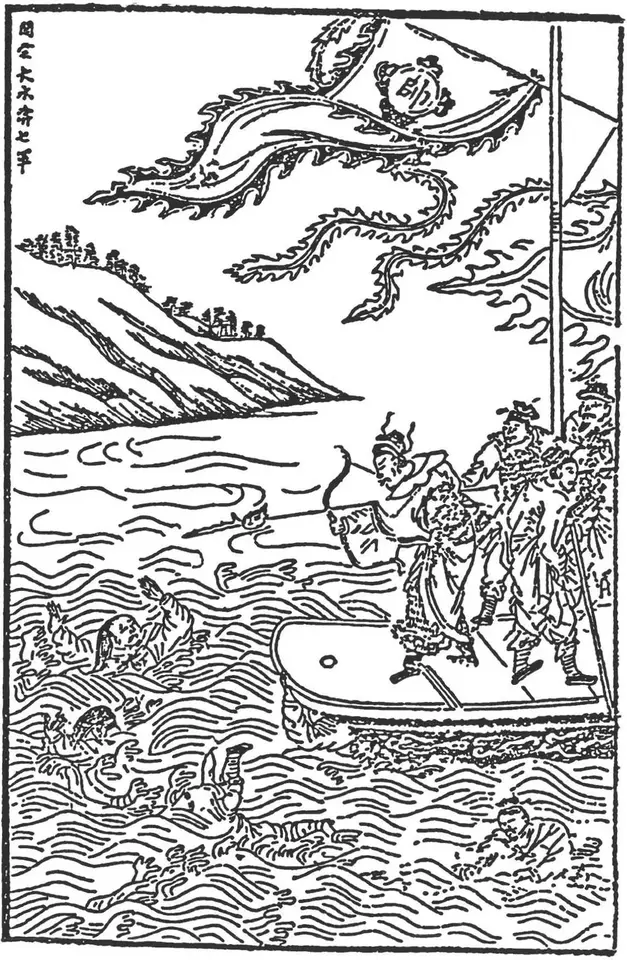
White Robes Crossing the River (白衣渡江) was a celebrated amphibious stealth campaign in late 219 (the 24th year of Jian'an) conceived and led by Sun Wu Commander-in-Chief Lü Meng, fundamentally altering the trajectory of the Three Kingdoms era. When Shu Han Grand General Guan Yu launched a massive northern offensive against Xiangfan, flooding Cao Wei's seven armies and capturing General Yu Jin, Cao Cao considered relocating the imperial capital. To relieve Fancheng, Cao Cao dispatched secret envoys offering territorial concessions south of the Yangtze to induce Sun Quan to strike Guan Yu from the rear. Sun Quan and Lü Meng, determined to control the entire Yangtze valley, capitalized on Guan Yu's exposed rear. Lü Meng feigned critical illness and withdrew, replacing himself with the unassuming young scholar Lu Xun. Lu Xun flattered Guan Yu with humble correspondence, tricking him into transferring all reserve garrisons from Jiangling to the front lines. In the intercalary tenth month, Lü Meng concealed assault shock-troops within large merchant hulls, disguising oarsmen in white civilian attire to dismantle Guan Yu's riverine beacon network overnight. Capturing Jiangling and Gong'an without bloodshed, Lü Meng secured the defection of Shu commanders Mi Fang and Shi Ren. Trapped and deserted by his dispirited troops, Guan Yu retreated to Maicheng and was executed in an ambush at Linju. The campaign transferred Jing Province to Eastern Wu, shattered the Longzhong Plan, and locked the tripartite division of China.
Guan Yu attacked Xiangfan; Cao Ren was besieged while Jing Province was left lightly defended
Han River flooded; Guan Yu submerged seven armies and took Yu Jin; Cao Cao conspired with Sun Quan
Lü Meng resigned under pretext of illness; Lu Xun wrote flattering letters to disarm Guan Yu's caution
Tricked by Lu Xun, Guan Yu redeployed all Jiangling garrison forces to reinforce the front
Disguised in white robes, Lü Meng's sailors neutralized the Yangtze beacon towers overnight
Shi Ren surrendered Gong'an; Mi Fang opened Jiangling; Lu Xun severed the western gorge route
Lü Meng protected civilians and relieved families; Guan Yu's army disintegrated upon hearing the news
Guan Yu retreated to Maicheng with a few hundred cavalry, refusing Sun Quan's surrender terms
Guan Yu broke out of Maicheng but was snared by Ma Zhong at Jueshi and executed with Guan Ping
Sun Quan sent Guan Yu's head to Cao Cao, who buried Guan Yu with prince's honors in Luoyang
Situated at the crossroads of imperial China, Jing Province connected the Central Plains to the north, the South China Sea to the south, the lower Yangtze to the east, and Ba-Shu to the west. Eastern Wu statesman Lu Su had argued in his Bedchamber Dialogue that Jing Province was an indispensable foundation for imperial dynastic power; similarly, General Gan Ning urged Sun Quan to secure the middle Yangtze to safeguard the south. However, following the Battle of Red Cliffs in 208, Liu Bei obtained Nan Commandery as a base to conquer Yi Province, triggering recurring diplomatic and military clashes.
In 215, Sun Quan demanded the return of Jing Province, and both sides mobilized large armies. When Cao Cao conquered Hanzhong, threatening Sichuan, Liu Bei compromised with Sun Quan in the Xiang River Treaty, dividing Jing Province along the river. Yet Guan Yu continued to garrison Jiangling on the north bank, dominating the middle Yangtze like an unsheathed blade over Wu's vital downriver territory.
In July 219, Liu Bei proclaimed himself King of Hanzhong. Guan Yu launched a full-scale offensive northward from Jiangling, surrounding Cao Ren at Fancheng. In August, torrential rains caused the Han River to flood; Guan Yu utilized naval craft to submerge the seven relieving armies under Yu Jin, capturing over 30,000 enemy troops and executing veteran warrior Pang De. With Guan Yu's influence spreading into Central China, Cao Cao contemplated moving the capital from Xuchang.
In response, Sima Yi and Jiang Ji advised Cao Cao that Sun Quan would never tolerate Guan Yu's total victory. Cao Cao sent secret envoys offering to recognize Sun Quan's authority over the southern regions in exchange for an attack on Guan Yu's rear. Recognizing that a victorious Guan Yu would dominate the Yangtze and render Eastern Wu vulnerable to Shu annexation, Sun Quan forged a covert alliance with Cao Cao.
In autumn 219, following the capture of Yu Jin's 30,000 troops, Guan Yu faced a catastrophic logistics crisis. Without consulting Eastern Wu, Guan Yu dispatched troops to unilaterally seize tens of thousands of bushels of military grain stored in Sun Quan's granaries at Xiangguan.
When news of the seizure reached Jianye, Sun Quan was infuriated. This transgression served as the immediate justification to terminate the alliance. Recognizing that Guan Yu's main army was heavily engaged against Cao Wei general Xu Huang before Fancheng, Sun Quan authorized Lü Meng to execute the invasion.
Despite his aggressive temperament, Guan Yu remained vigilant regarding Eastern Wu. He heavily fortified Jiangling and Gong'an under Commandery Administrator Mi Fang and General Shi Ren, establishing an elaborate network of beacon towers along the Yangtze to signal any hostile fleet movements.
Lü Meng realized that a frontal assault on Jiangling would result in heavy casualties and protracted siege. He orchestrated a multi-layered deception, feigning terminal illness and submitting a public resignation to return to Jianye for medical treatment, which Sun Quan ratified.
Lü Meng secretly recommended the junior officer Lu Xun to take over the command at Lukou. Upon assuming duty, Lu Xun dispatched an envoy to Guan Yu bearing lavish gifts and a self-abasing letter, praising Guan Yu as an incomparable military hero and declaring his own youth, inexperience, and desire for peaceful coexistence. Convinced that Eastern Wu posed no threat, Guan Yu withdrew the remaining defense garrisons from Jiangling and Gong'an, rushing them north to reinforce the Xiangfan front.
Guan Yu's troop redeployment left his rear defenses empty. Sun Quan commissioned Lü Meng as commander-in-chief, gathering tens of thousands of picked naval troops at Xunyang. In the intercalary tenth month of 219, shrouded in river mist, Lü Meng launched the clandestine operation.
Lü Meng selected hundreds of expert watermen, dressing them in the plain white linen robes of civilian merchants. Heavily armored shock-troops were concealed below decks inside wide-bottomed transport barges. Plying their oars openly, the disguised vessels navigated upriver as ordinary trade flotillas.
Whenever the convoy approached a Shu beacon tower, the disguised sailors moored under the pretext of seeking shelter from sudden storms, offering food and wine to the sentries. As soon as the guards relaxed, concealed commandos surged ashore, killing or capturing the sentinels before an alarm could be raised. In a single night, the entire communications network along the Yangtze was dismantled without firing a beacon.
Advancing unopposed, Lü Meng's fleet descended upon Gong'an and Jiangling like a thunderbolt.
Lü Meng utilized the former Shu officer Yu Fan to deliver a persuasive surrender ultimatum to General Shi Ren at Gong'an. Shi Ren had long harbored resentment toward Guan Yu for threats of punishment over delayed supplies; facing an overwhelming enemy force with no prospect of relief, he opened the city gates and surrendered.
Lü Meng then brought Shi Ren to Jiangling to persuade Administrator Mi Fang. Mi Fang, Liu Bei's brother-in-law, had also endured Guan Yu's disdain and feared execution after a munitions warehouse fire. Witnessing Shi Ren's defection and surrounded by Wu forces, Mi Fang's resolve broke, and he surrendered Jiangling with all its strategic supplies. Concurrently, Lu Xun led an amphibious detachment west to seize Yidu Commandery, capturing commander Fan You and fortifying the Yiling gorges, completely severing Guan Yu's riverine retreat into Sichuan.
Occupying Jiangling, Lü Meng enforced strict military discipline. He proclaimed that any soldier who plundered local inhabitants of a single copper or garment would be summarily executed. When an officer from his own hometown took a bamboo hat from a peasant to protect military armor from rain, Lü Meng wept but executed him in accordance with martial law, inspiring awe and respect throughout the city.
Lü Meng personally visited the households of Guan Yu's officers and soldiers, establishing field clinics, distributing grain to the needy, and sending medical relief to the sick. When Guan Yu abandoned the siege of Fancheng and retreated south, he sent repeated envoys to Jiangling. Lü Meng treated the emissaries with honor, allowing them to freely inspect the city and converse with soldiers' families. When the envoys returned to Guan Yu's camp, news spread that families were unharmed and enjoying greater comfort than before. Yearning for home, Guan Yu's army dissolved; soldiers deserted in droves, disintegrating the army without combat.
Abandoned by his troops and realizing Jiangling was lost, Guan Yu retreated with his son Guan Ping, officer Zhao Lei, and a few hundred loyal cavalry into the isolated citadel of Maicheng.
Lacking provisions and surrounded by Sun Quan's main army, Guan Yu refused surrender offers carried by Zhuge Jin. Hoisting false surrender banners on the battlements, Guan Yu staged a desperate nocturnal breakout through the northern gate with a dozen horsemen, attempting to slip west through Zhangxiang.
Anticipating this path, Sun Quan and Lü Meng had deployed Generals Pan Zhang and Zhu Ran in deep concealment along the rugged defiles of Jueshi in Linju. As Guan Yu's remnant entered the ravine, Pan Zhang's subordinate officer Ma Zhong sprang the ambush, using long rope snares to trip Guan Yu's charger. Guan Yu and Guan Ping were captured. In December 219, Sun Quan ordered the execution of father and son at Linju. The campaign ended in total victory for Eastern Wu.
The campaign ended in a total triumph for Eastern Wu and a catastrophe for Shu Han. At negligible human cost, Eastern Wu eliminated one of the era's greatest generals and captured Nan, Lingling, and Wuling commanderies, achieving its strategic goal of dominating the middle Yangtze. Shu Han lost its premier military commander and its elite provincial army of tens of thousands, permanently forfeiting its territorial springboard into central China and leaving Liu Bei confined to Sichuan.
The battle reshaped the geopolitical balance of the Three Kingdoms. First, it permanently dismantled Zhuge Liang's Longzhong Plan, which relied upon launching simultaneous pincers from Jing Province toward Luoyang and from Sichuan toward Chang'an. With the eastern route permanently severed, future northern campaigns were forced through the treacherous Qinling mountain paths. Second, it shattered the anti-Cao alliance, directly causing Liu Bei to mobilize national forces in 221 to launch the disastrous invasion of Wu that culminated in the Battle of Yiling. Finally, securing the entire middle and lower Yangtze provided Eastern Wu with an unbreachable defensive line, permanently establishing the tripartite equilibrium between Wei, Shu, and Wu.