First Mongol Incursion
Temüjin leads an exploratory raid across the desert, sacking Luosi City before withdrawing
Western Xia (西夏) · HISTORICAL EVENT
蒙古滅西夏之戰
The Mongol conquest of Western Xia (蒙古滅西夏之戰) was a protracted twenty-two-year war of annihilation waged by the Mongol Empire against the Tangut Western Xia dynasty between 1205 and 1227, personally directed by Genghis Khan. In 1205, Temüjin initiated his first exploratory raid into Western Xia territory. During the third campaign in 1209, Mongol forces breached the Kaimen Pass and inundated the capital, Zhongxing Mansion (modern Yinchuan), forcing…
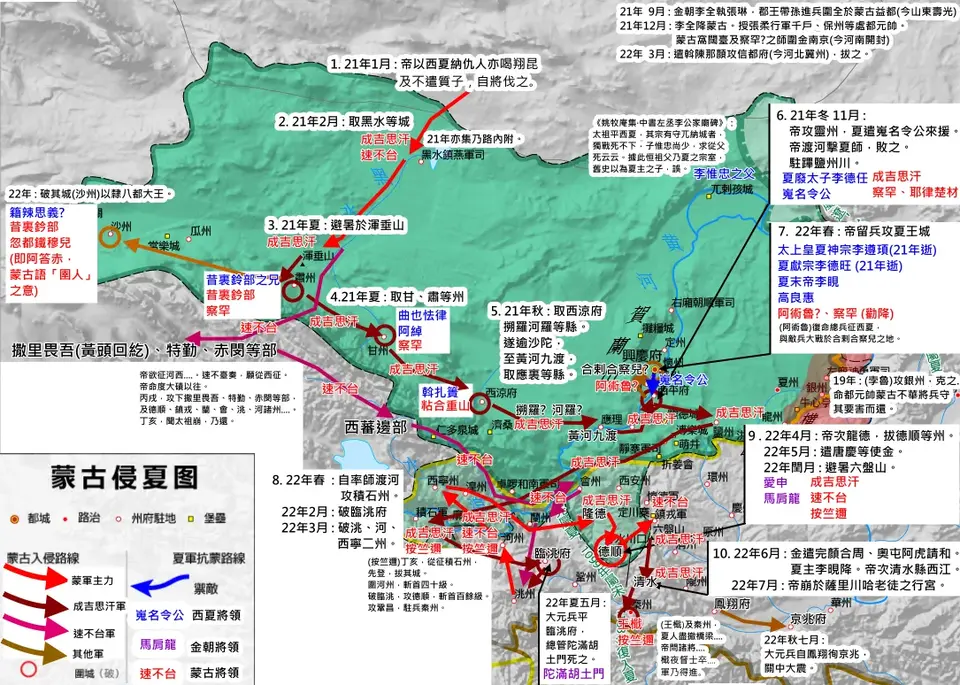
The Mongol conquest of Western Xia (蒙古滅西夏之戰) was a protracted twenty-two-year war of annihilation waged by the Mongol Empire against the Tangut Western Xia dynasty between 1205 and 1227, personally directed by Genghis Khan. In 1205, Temüjin initiated his first exploratory raid into Western Xia territory. During the third campaign in 1209, Mongol forces breached the Kaimen Pass and inundated the capital, Zhongxing Mansion (modern Yinchuan), forcing Emperor Xiangzong (Li Anquan) to submit, offer an imperial princess in marriage, and pledge to support the Mongols in their war against the Jin dynasty. Over the following decade, Western Xia served as an unwilling Mongol vassal, exhausting its economic and human resources in endless border clashes with the Jin dynasty. When Western Xia attempted to renounce its vassalage and form an anti-Mongol coalition with the Jin while Genghis Khan was campaigning in Central Asia, the Mongols launched retaliatory expeditions. In the spring of 1226, Genghis Khan commanded a grand army of one hundred thousand troops in the sixth and final campaign, methodically capturing Heishui City, Shazhou, Suzhou, Ganzhou, and Lingzhou. By the summer of 1227, Zhongxing Mansion was completely encircled and crippled by starvation and a catastrophic earthquake. The last emperor, Li Xian, surrendered the city. Following Genghis Khan's secret deathbed decree at Mount Liupan, the Mongol commanders executed Li Xian and destroyed the Tangut dynastic order.
Temüjin leads an exploratory raid across the desert, sacking Luosi City before withdrawing
The second Mongol expedition captures Wulahai Fortress but withdraws due to fierce Tangut resistance
Genghis Khan breaches Kaimen Pass, floods the capital, and compels Emperor Xiangzong to submit as a vassal
Western Xia adopts the policy of supporting the Mongols against the Jin dynasty, initiating a decade of ruinous conflict
Western Xia refuses to provide auxiliary troops for Genghis Khan's western campaign; Mongols besiege the capital
Bolu storms Yinzhou and captures General Tahai after discovering Emperor Xianzong's secret alliance with the Jin
Genghis Khan leads 100,000 troops across the desert, capturing Heishui, Shazhou, Suzhou, and Ganzhou
Mongol cavalry annihilates the Tangut relief army on the ice at Lingzhou; General Weiming Linggong dies
Trapped inside besieged Zhongxing Mansion, the Tanguts suffer an earthquake and epidemic; Emperor Li Xian offers surrender
Genghis Khan dies at Mount Liupan; Emperor Li Xian is executed, and Western Xia is officially extinguished
In 1206, Temüjin unified the disparate nomadic tribes of the Mongolian plateau, founding the Mongol Empire at the source of the Onon River and assuming the supreme title of Genghis Khan. Following the establishment of the nomadic empire, Genghis Khan identified the Jurchen-led Jin dynasty, which ruled northern China and the central plains, as his primary geopolitical adversary. However, the Jin Empire possessed immense demographic strength, fertile agricultural territories, and formidable fortified citadels.
Situated along the southern margins of the Gobi Desert and controlling the fertile Ordos Loop and the Hexi Corridor, the Tangut Western Xia dynasty served as a historic buffer state. Genghis Khan adopted the strategic doctrine of "subjugating the weak before attacking the strong." He calculated that neutralizing Western Xia first would eliminate any threat to his right flank during future offensives against the Jin, secure control over vital horse-breeding pastures along the Yellow River, and compel the Tanguts to contribute auxiliary troops and grain for the impending invasion of northern China.
Throughout the twelfth century, Western Xia maintained a stable tributary alliance with the Jin dynasty, balancing diplomatic ties to ensure collective security against nomadic incursions. However, by the early thirteenth century, internal dynastic decay and palace intrigue undermined Tangut governance. In 1206, Prince Li Anquan staged a coup d'état, deposing Emperor Huanzong and ascending the throne as Emperor Xiangzong, creating severe factional divisions within the ruling elite.
When Mongol forces attacked Western Xia in 1209 and laid siege to the capital, Emperor Xiangzong sent desperate appeals to Emperor Wanyan Yongji of Jin, pleading for joint defense against the common nomadic threat. Short-sightedly, the Jin emperor refused to assist, remarking that it was fortunate for the Jin when two barbarian neighbors fought each other. Abandoned by its traditional ally, Western Xia was forced to capitulate to the Mongols, terminating the longstanding Jin-Xia alliance and setting the stage for mutual destruction.
In 1205, Temüjin launched his first raid into Western Xia territory on the pretext that the Tanguts were harboring fugitive chieftains from the defeated Naiman and Kerait tribes. Mongol horsemen bypassed border outposts to sack Luosi City (near modern Ejin Banner), plundering livestock and capturing local villagers before retreating to the northern steppe. This initial raid tested the defensive capabilities of the Tangut border garrisons.
In the autumn of 1207, Genghis Khan led his second expedition against Western Xia, driving south through the desert to capture the frontier fortress of Wulahai (west of modern Urad Front Banner). However, Tangut garrisons implemented a scorched-earth strategy, retreating behind well-provisioned stone fortifications. Lacking heavy siege equipment and facing logistical exhaustion, the Mongols withdrew after five months of campaigning.
In the spring of 1209, Genghis Khan launched his third and largest campaign yet. Advancing rapidly through the northern entrance of the Hexi Corridor, the Mongol army captured Heishui City and took Wulahai Fortress once again, advancing toward the strategic Kaimen Pass in the Helan Mountains. Tangut Senior General Weiming Linggong deployed fifty thousand elite Iron Hawk heavy cavalry to defend the narrow defile. The Mongols executed a feigned retreat to lure the defenders into an open valley, ambushed the Tangut army, and captured several senior commanders, leaving the imperial capital completely exposed.
The Mongol army swept forward and encircled Zhongxing Mansion (modern Yinchuan). Protected by towering rammed-earth walls and deep moats, the city repelled direct assaults for months. In the tenth month, Genghis Khan conscripted thousands of laborers to construct a massive dyke along the Yellow River, diverting water to flood the city. However, a sudden torrential surge breached the dyke, causing the floodwaters to reverse course and wash away the Mongol encampment. Facing an impasse and with the city walls on the verge of collapse, Emperor Xiangzong sent an embassy offering his daughter, Princess Chaka, in marriage, along with tribute of camels, fabrics, and falcons, and formally agreed to become a vassal state and assist the Mongols in attacking the Jin dynasty.
Following the 1210 treaty, Western Xia transformed from a sovereign power into a subordinate auxiliary of the Mongol Empire. Bound by the covenant of military assistance, the Tangut court immediately turned its arms against its former ally, launching aggressive campaigns into the Jin border commanderies of Binzhou, Jingzhou, Pingliang, and Gongzhou.
The Jin emperors responded with ferocious counteroffensives, crushing Tangut forces at Qinzhou and Fengxiang. For over a decade, a devastating war of attrition raged along the borders of Shaanxi and Gansu. Western Xia gained no territory, while squandering tens of thousands of its best soldiers, losing commercial revenue from border markets, and driving its agricultural peasantry to ruin through crushing war taxes.
In 1211, Prince Li Zunxu overthrew Emperor Xiangzong and claimed the imperial throne as Emperor Shenzong. Despite popular discontent, Emperor Shenzong stubbornly persisted in the pro-Mongol, anti-Jin policy, deploying large armies to support Mongol General Mukali in assaulting Jin fortresses in Shanxi and northern Shaanxi. By the late 1210s, the Western Xia treasury was depleted, banditry infested the countryside, and the dynasty stood on the brink of fiscal collapse.
In 1217, Genghis Khan prepared to launch his western expedition against the Khwarazmian Empire in Central Asia and demanded that Western Xia dispatch auxiliary cavalry. Tangut commander Asha Gambu insolently refused the levy, remarking that if Genghis Khan lacked the strength to rule, he had no right to claim universal sovereignty. Terrified of Mongol retaliation, Emperor Shenzong fled Zhongxing Mansion, leaving Crown Prince Li Dewang to defend the capital. Genghis Khan besieged Zhongxing Mansion for a fourth time, forcing Li Dewang to dispatch fresh hostages and renew oaths of submission before the Mongol forces departed for the west.
While Genghis Khan was campaigning thousands of miles to the west, Emperor Shenzong abdicated in 1223 in favor of Li Dewang, who became Emperor Xianzong. Recognizing that Mongol expansionism would inevitably destroy his kingdom, Emperor Xianzong executed a dramatic diplomatic reversal. He made peace with the Jin dynasty, establishing a defensive pact known as "Aligning with Jin to Resist the Mongols." Simultaneously, Xianzong sent secret emissaries across the desert to form alliances with unsubdued Kerait and Naiman tribes in northern Mongolia.
In the autumn of 1224, Bolu, the son of the deceased Mongol commander Mukali, discovered the Tangut plot. Bolu struck eastward across northern Shaanxi, storming the critical Western Xia bastion of Yinzhou (modern Mizhi, Shaanxi). The Mongols captured Tangut General Tahai, slaughtered tens of thousands of garrison troops, and plundered vast herds of cattle and sheep. Intimidated by this display of force, Emperor Xianzong sent envoys to plead for terms, temporarily averting an immediate assault on the capital.
In the autumn of 1225, Genghis Khan returned victorious from his Central Asian campaigns. Enraged by Tangut insolence and their failure to dispatch imperial princes as hostages, the Great Khan resolved to eradicate the Western Xia dynasty permanently. In the second month of 1226, despite his advanced age and failing health, Genghis Khan personally led a formidable army of one hundred thousand warriors across the Gobi Desert to initiate the sixth and final campaign.
The Mongol vanguard stormed Heishui City, then pressed southwest along the Hexi Corridor. Utilizing siege engines and counterweight trebuchets constructed by Muslim and Chinese engineers, the Mongols systematically breached the fortifications of Ganzhou, Suzhou, and Shazhou. Tangut general Quye Qielü at Ganzhou refused all surrender demands and fought to the death; at Shazhou, General Jila Sijie defended the cliff citadel for months until the entire garrison perished in hand-to-hand fighting.
Witnessing the collapse of the Hexi Corridor, Emperor Xianzong fell into profound despair, vomited blood, and died in the seventh month of 1226. His nephew Li Xian was elevated to the throne as the last ruler of Western Xia. In the eighth month, Genghis Khan crossed the Yellow River, taking Yingli and Xiazhou, and besieged the auxiliary capital of Lingzhou.
Tangut Grand Councilor Weiming Linggong marched with one hundred thousand veteran troops to relieve Lingzhou. In the eleventh month, in freezing winter conditions, the two armies collided on the frozen surface of the Yellow River. The Mongol heavy cavalry shattered the Tangut infantry lines, slaughtering tens of thousands of Tangut soldiers across miles of ice. Weiming Linggong was killed in the carnage, and Lingzhou fell immediately thereafter. Western Xia was stripped of its outer defenses, and Zhongxing Mansion stood alone.
In the first month of 1227, Genghis Khan's main force completely encircled Zhongxing Mansion, constructing trenches and wooden palisades to cut off all communication. Leaving his senior generals to maintain the siege, Genghis Khan moved south to escape the summer heat at Mount Liupan in southern Ningxia, dispatching divisions to seize Jin territory in Lintao and Tianshui to sever all possible relief routes.
Inside Zhongxing Mansion, Emperor Li Xian and his garrison resisted with desperate courage for more than six months. However, famine soon consumed the city, reducing the inhabitants to eating leather harnesses and vermin. In the sixth month of 1227, a catastrophic earthquake struck Zhongxing Mansion, collapsing ramparts, towers, and residences, while epidemics swept through the crowded shelters.
Driven to utter despair, Emperor Li Xian dispatched envoys to Mount Liupan offering to surrender the kingdom, requesting a one-month grace period to prepare the dynastic registers and imperial treasures. On the twelfth day of the seventh month, sixty-five-year-old Genghis Khan died at his palace camp at Mount Liupan. Before his death, he issued a secret decree forbidding the disclosure of his demise and commanding his generals to slaughter the Tangut sovereign the moment he surrendered.
In late July 1227, Emperor Li Xian, accompanied by Grand Tutor Li Zhong'e and high ministers, emerged from the gates carrying the dynastic maps, census registers, and ancestral jade seals. Acting on Genghis Khan's deathbed orders, Mongol commanders escorted Li Xian and his retinue to Sari Plain (near modern Zhuanglang, Gansu) and executed them. Mongol columns entered Zhongxing Mansion, sacking palaces and imperial tombs, but total extermination of the populace was halted through the intervention of Chaghan, a distinguished Tangut-born general serving in the Mongol high command. The Western Xia dynasty, which had spanned ten imperial reigns over one hundred and ninety-six years, was permanently eradicated.
The Mongol conquest of Western Xia ended nearly three hundred and fifty years of autonomous Tangut governance dating back to the late Tang dynasty when Tuoba Sigong was created military commissioner of Dingnan. Western Xia's territory, encompassing the Hexi Corridor, the Ordos Loop, and the Ningxia plains, was absorbed directly into the Mongol Empire. Genghis Khan abolished the indigenous Tangut civil administrative apparatus, establishing Mongol darughachi governors and military thousand-households across the region. This laid the administrative foundation for the later establishment of the Gansu and Ningxia Branch Secretariats under the Yuan dynasty.
The eradication of Western Xia profoundly altered the geopolitical landscape of East Asia. The Jin Empire was deprived of its western shield, leaving its Shaanxi and Henan defenses entirely exposed to Mongol enveloping maneuvers. On his deathbed at Mount Liupan, Genghis Khan formulated his famous strategy of "borrowing passage through the Southern Song to crush the Jin." Utilizing newly conquered territories in Ningxia and southern Gansu, the Mongol armies bypassed the impregnable Tongguan Pass by marching through the Han River valley, ultimately encircling the Jin court at Caizhou in 1234.
Because of fierce resistance from Tangut garrisons and the untimely death of Genghis Khan during the siege, Mongol troops enacted sweeping destruction across the Western Xia realm. The imperial mausoleums at the foot of the Helan Mountains were systematically looted and desecrated, palaces and Buddhist monasteries were torched, and centuries of Tangut woodblock printing archives and translation libraries were reduced to ashes. In the aftermath of the war, surviving Tanguts were incorporated into Mongol auxiliary units known as the Tamachi or dispersed throughout Henan, Hebei, and southwestern China, where they gradually assimilated into Han, Hui, and Mongol populations.