Outbreak of the First Northern Expedition
Zhuge Liang advances through Mount Qi; Nan'an, Tianshui, and Anding defect from Wei, shaking the Guanzhong region.
Cao Wei (曹魏) · HISTORICAL EVENT
街亭之战
Battle of Jieting (街亭之战) was a decisive engagement fought in the spring of 228 during the Three Kingdoms Period, occurring in the course of Chancellor Zhuge Liang's First Northern Expedition at the strategic pass of Jieting (modern Qin'an County, Gansu Province). In the opening phase of the campaign, Zhuge Liang advanced through Mount Qi by surprise, causing the three commanderies of Nan'an, Tianshui, and Anding to defect from Cao Wei, which shook the…
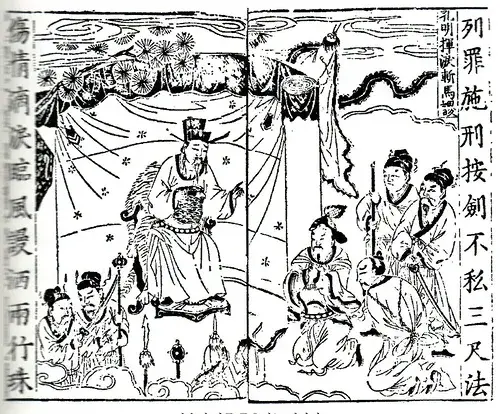
Battle of Jieting (街亭之战) was a decisive engagement fought in the spring of 228 during the Three Kingdoms Period, occurring in the course of Chancellor Zhuge Liang's First Northern Expedition at the strategic pass of Jieting (modern Qin'an County, Gansu Province). In the opening phase of the campaign, Zhuge Liang advanced through Mount Qi by surprise, causing the three commanderies of Nan'an, Tianshui, and Anding to defect from Cao Wei, which shook the Guanzhong region. Emperor Ming of Wei (Cao Rui) traveled to Chang'an to direct operations, dispatching veteran general Zhang He with fifty thousand elite troops westward to counter the invasion. Zhuge Liang appointed his military consultant Ma Su as vanguard commander to hold the vital pass of Jieting. Defying Zhuge Liang's tactical instructions, Ma Su abandoned the fortified valley road and water supplies to encamp atop an isolated hill, rejecting urgent warnings from deputy commander Wang Ping. Zhang He encircled the hill, severed the water source, and routed the dehydrated Shu forces. The fall of Jieting exposed the northern expedition's flank and severed its supply routes, forcing Zhuge Liang to evacuate over a thousand civilian households from Xixian and retreat to Hanzhong. Following the retreat, Zhuge Liang executed Ma Su to uphold martial law and demoted himself by three ranks.
Zhuge Liang advances through Mount Qi; Nan'an, Tianshui, and Anding defect from Wei, shaking the Guanzhong region.
Emperor Ming of Wei travels to Chang'an to steady defense lines, dispatching Zhang He with fifty thousand troops to relieve Longyou.
Overruling senior generals, Zhuge Liang appoints Ma Su to command the Jieting gateway with Wang Ping as deputy.
Ma Su violates operational orders by abandoning the valley pass to establish camp on an isolated summit; Wang Ping separates with one thousand men.
Zhang He cuts off water supplies and sets fire to the mountain camp, routing the Shu vanguard while Ma Su flees.
Beating war drums and maintaining formation, Wang Ping bluffs Zhang He into halting, gathering over a thousand stragglers and retreating safely.
With Jieting lost and his flank exposed, Zhuge Liang withdraws his army, evacuating one thousand households from Xixian.
Zhuge Liang executes Ma Su to uphold dynastic military discipline, promotes Wang Ping, and demotes himself by three ranks.
In the spring of 227, having pacified the southern Nanzhong region, Chancellor Zhuge Liang of Shu Han prepared a major offensive to restore the Han Dynasty. Zhuge Liang submitted the Memorial on Taking the Field to the Young Emperor Liu Shan and mobilized the main army northward to Hanzhong. At the time, Emperor Wen of Wei (Cao Pi) had recently passed away, succeeded by his youthful heir Cao Rui, who appointed his brother-in-law Xiahou Mao as Senior General Pacifying the West to command Chang'an and regional defenses.
In the spring of 228, Zhuge Liang launched the First Northern Expedition. Employing deceptive feints, he announced that the main forces would march through the Xie Valley toward Mei County, deploying senior generals Zhao Yun and Deng Zhi into the Ji Valley as a diversion. This maneuver deceived the supreme Wei commander Cao Zhen into concentrating forces at Mei County to guard the capital approaches.
Simultaneously, Zhuge Liang led the primary Shu strike force across the Mount Qi corridor into Longyou. Shu forces moved with strict discipline and martial array. Having seen no major incursions from Shu since Liu Bei's defeat at Yiling, the Wei court had relaxed its frontier vigilance. The sudden arrival of Zhuge Liang's army sent shockwaves throughout the northwestern borderlands.
Zhuge Liang's advance galvanized regional resistance against Wei authority. Local magistrates and gentry leaders in the three commanderies of Nan'an, Tianshui, and Anding renounced Wei allegiance and opened their gates to Shu Han, while the talented young Tianshui staff officer Jiang Wei surrendered to Zhuge Liang's service.
Within weeks, Wei defenses across Longyou dissolved, leaving only Shanggui and Jixian holding out as isolated outposts. Recognizing the danger of losing the western marches, Emperor Ming acted with resolve. He traveled westward from Luoyang to Chang'an to anchor regional morale, while commissioning the veteran commander Zhang He with special imperial honors to lead fifty thousand elite imperial guards westward along the Longyou highway.
Jieting was situated in a narrow river valley near modern Longcheng Town, northeast of Qin'an County, serving as the strategic transit gateway connecting Guanzhong with Longyou. If Shu Han forces could seal this mountain defile, they would block Zhang He's relief army east of Mount Long. This isolation would grant Zhuge Liang ample time to reduce the remaining isolated Wei garrisons, absorb the five commanderies of Longyou, and transform the western passes into an offensive springboard toward Chang'an.
When selecting the vanguard commander to hold Jieting, senior generals and staff advisors unanimously urged Zhuge Liang to deploy veteran commanders like Wei Yan or Wu Yi. However, Zhuge Liang overruled the consensus, insisting on promoting his trusted personal consultant Ma Su to command the front.
Ma Su possessed an agile intellect and excelled at military theory, frequently conferring with Zhuge Liang from dawn to dusk. Yet before his death at Baidicheng, the founding emperor Liu Bei had issued a grave warning to Zhuge Liang: "Ma Su's words outstrip his practical abilities; he must not be entrusted with major responsibilities. You must examine him with utmost caution!" Overlooking this counsel, Zhuge Liang placed Ma Su in supreme command of the vanguard, appointing the prudent and illiterate frontline veteran Wang Ping as deputy to hold Jieting.
In the spring of 228, Ma Su led the Shu vanguard into Jieting. Before their departure, Zhuge Liang had repeatedly instructed Ma Su to construct strong ramparts directly across the narrow valley corridor, anchoring defenses against the natural road to prevent Wei cavalry from maneuvering, while strictly avoiding open-field engagements until the main army secured Longyou.
However, upon arrival, Ma Su disregarded these operational orders. Surveying the terrain, he noted that the valley road was constricted, whereas an isolated steep mountain arose south of the road. Dismissing orthodox tactics, Ma Su decided to abandon the valley town and mountain streams, ordering his troops and supply trains to ascend and camp on the dry, elevated summit.
Ma Su proclaimed to his skeptical officers: "The Art of War states that one must place troops in mortal peril so that they may survive. Looking down from superior heights, our momentum will be irresistible! When the Wei army approaches, our soldiers will charge downhill and shatter them in a single stroke!"
Confronted with this perilous disposition, deputy commander Wang Ping recognized an impending catastrophe. Though illiterate, Wang Ping was a seasoned combat officer who understood that high-altitude encampments depended entirely on accessible water and supply lines. He repeatedly climbed to the summit headquarters, imploring Ma Su: "Entrenching across the highway guarantees that Wei troops cannot pass. If we abandon the road for an isolated hill, the enemy will encircle the mountain and sever our water routes; our troops will perish of thirst within three days!"
Ma Su rejected these warnings with scorn, accusing Wang Ping of cowardice while junior officers backed their commander, generating confusion in camp regulations. Realizing he could not persuade Ma Su, Wang Ping demanded a detachment to secure the highway.
Yielding to Wang Ping's insistence, Ma Su assigned him one thousand infantry. Wang Ping led this small contingent down the mountain and established a fortified camp directly across the transit road several li away, maintaining beating drums and disciplined watches to provide mutual support during a crisis.
Zhang He was one of the Five Elite Generals of Cao Wei, renowned for his tactical versatility and deep grasp of military terrain. Leading fifty thousand cavalry and infantry to Jieting, he anticipated facing heavily fortified defenses across the defile and had prepared for costly siege assaults.
However, upon surveying the battlefield, Zhang He discovered that the Shu army had abandoned the valley fortifications and was perched atop an isolated summit lacking internal springs. Overjoyed by this fatal blunder, Zhang He deployed his forces to encircle the hill.
Rather than ordering a costly uphill assault, Zhang He stationed his divisions around the base of the mountain and seized every brook, spring, and pathway leading down to water sources.
In early spring, the arid winds of Longyou accelerated dehydration. Trapped atop the barren hill under scorching sunlight, tens of thousands of Shu soldiers were deprived of drinking water. Within twenty-four hours, soldiers and horses suffered from cracked throats and exhaustion, unable to swallow dry rations. Panic spread through the ranks. Ma Su launched desperate downhill charges to breach the perimeter and reach water, but Zhang He's disciplined archers and heavy infantry repelled every breakout attempt with devastating volleys.
After two days of total dehydration, observing that the Shu garrison was incapacitated by thirst, Zhang He ordered a coordinated assault. Wei troops advanced with scaling ladders, launching fire arrows and setting the scrub and timber defenses ablaze. Enormous fires swept the mountain, plunging the Shu camp into chaos as panicked soldiers trampled one another in the smoke.
Zhang He's elite divisions scaled the summit, and Shu defensive cohesion collapsed. Vanguard commanders Li Sheng and Huang Xi fled, while Ma Su abandoned his army, escaping under the protection of personal retainers as the Jieting force disintegrated.
In this catastrophic rout, Wang Ping demonstrated remarkable composure. Recognizing that attacking with one thousand men against fifty thousand victorious enemies was suicidal, Wang Ping ordered his men to hold their ramparts, maintain formation, and beat their war drums with maximum volume while displaying multiple banners.
Hearing the deafening drumbeats and witnessing the orderly deployment in the valley, Zhang He suspected that Zhuge Liang had concealed main ambush divisions along the road. Fearing a counter-ambush, Zhang He halted his pursuit and refrained from pressing the fortified camp. Seizing this opportunity, Wang Ping withdrew in good order under steady drumbeats, gathering over a thousand scattered survivors along the mountain slopes and leading them safely back toward Hanzhong.
Following the loss of Jieting, general Gao Xiang's reserve force at Lieliucheng was defeated by Wei commander Guo Huai, completely uncovering the left flank of the expeditionary army. With Zhang He commanding the mountain gateway, the Wei relief army threatened to sever Zhuge Liang's rear communications through Mount Qi.
Recognizing that his strategic posture had collapsed, Zhuge Liang suspended operations against Tianshui and Shanggui, ordering a full retreat. To protect local populations from Wei retribution, Zhuge Liang evacuated over one thousand civilian households from Xixian, leading his army back across the Qinling Mountains to Hanzhong in an orderly withdrawal.
Upon returning to base, Zhuge Liang enforced military discipline. For his foresight, courage, and successful extraction of survivors, Wang Ping was promoted to Army Consultant, placed in charge of the elite Feiyi garrison camps, appointed General Who Chastises Bandits, and created a Village Marquis. Conversely, commanders who abandoned their posts were stripped of commands, while Li Sheng was executed.
Regarding the primary culprit Ma Su, despite staff officer Jiang Wan pleading that executing a brilliant strategist in an unfinished war was a tragic waste, Zhuge Liang declared with tears in his eyes: "Sun Wu triumphed over the realm precisely because he enforced the law without fear or favor! If we abandon state law at the outset of this struggle, how can we command armies or defeat the enemy?"
Zhuge Liang ordered Ma Su beheaded before the assembly, weeping bitterly alongside the entire army. Zhuge Liang then submitted a memorial to Emperor Liu Shan taking full responsibility for poor personnel judgment, requesting a demotion of three ranks to General of the Right while continuing to oversee the chancellery.
The defeat at Jieting dismantled the promising operational posture of Shu Han's First Northern Expedition. Prior to this engagement, Shu had achieved complete tactical surprise, securing the allegiance of three major commanderies without protracted fighting. The loss of Jieting severed the army's lines of communication, compelling Zhuge Liang to abandon newly acquired territories and fall back to Hanzhong. Shu Han permanently lost its most advantageous opportunity to capture the western marches.
The rigorous punishment meted out by Zhuge Liang reinforced the rule of law within the Shu Han administration. By executing his favorite protégé and voluntarily accepting demotion while elevating the humble soldier Wang Ping, Zhuge Liang demonstrated that dynastic law applied equally to all ranks. This integrity unified the state's military and civil leadership, ensuring administrative cohesion despite battlefield catastrophe.
The battle alerted Cao Wei to the operational capability of Shu Han. Realizing that the western borders required systematic defense, General Cao Zhen predicted that future Shu offensives would utilize the Chencang route and stationed the capable officer Hao Zhao to construct an impregnable stone fortress at Chencang (modern Baoji, Shaanxi). When Zhuge Liang marched out through the San Pass later that year, Hao Zhao held Chencang against all assaults, demonstrating how Jieting altered Wei's defensive readiness.
Jieting dictated the strategic framework of the late Three Kingdoms era. Because Shu Han failed to secure Longyou, subsequent northern campaigns were forced to confront heavily fortified positions manned by seasoned Wei commanders like Zhang He, Guo Huai, and Sima Yi. Zhuge Liang never again secured the sweeping defections achieved during his initial march, locking the northwestern frontier into a prolonged war of attrition until his death at Wuzhang Plains.