Relocation of Hexi Merchants
Northern Wei conquers Northern Liang, relocating Sogdian merchants from Hexi to Pingcheng
Northern and Southern Dynasties to Sui and Tang Dynasties · HISTORICAL EVENT
昭武九姓
The Nine Zhaowu Clans (昭武九姓) designates the collective Chinese historical appellation for the Iranian Sogdian peoples and their descendant kingdoms in Transoxiana between the Amu Darya and Syr Darya rivers, spanning the Northern and Southern Dynasties through the Sui and Tang eras. Primarily comprising the kingdoms of Kang (Samarkand), An (Bukhara), Cao, Shi (Tashkent), Mi, Shi, He, and Mu, their dynastic rulers claimed ancestral origins from Zhaowu City…
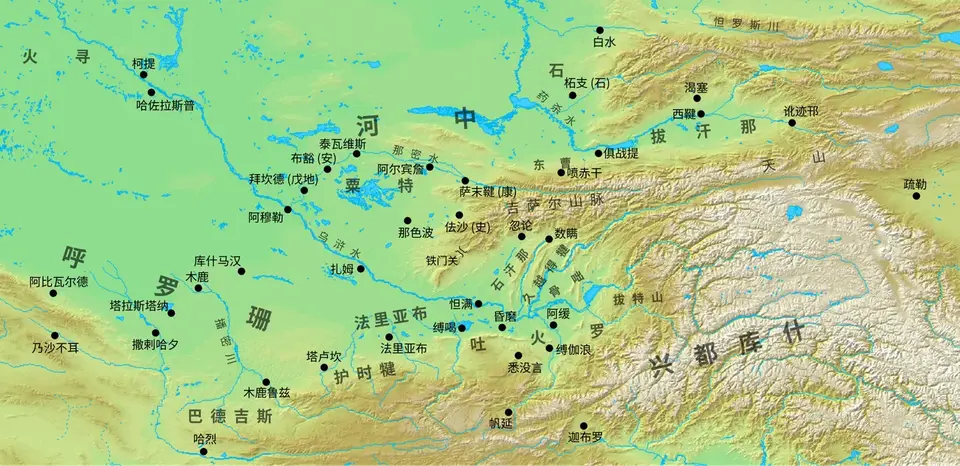
The Nine Zhaowu Clans (昭武九姓) designates the collective Chinese historical appellation for the Iranian Sogdian peoples and their descendant kingdoms in Transoxiana between the Amu Darya and Syr Darya rivers, spanning the Northern and Southern Dynasties through the Sui and Tang eras. Primarily comprising the kingdoms of Kang (Samarkand), An (Bukhara), Cao, Shi (Tashkent), Mi, Shi, He, and Mu, their dynastic rulers claimed ancestral origins from Zhaowu City north of the Qilian Mountains. Renowned for commercial aptitude, Sogdians established fortified caravan colonies across the Eurasian trade routes. Under the Sui and Tang, the Nine States submitted to Chinese imperial authority following the fall of the Western Turks, being incorporated into imperial administrative protectorates such as Kangju. Massive influxes of Sogdians settled within frontier prefectures, the Ordos Six Barbarian Prefectures, and the imperial capitals of Chang'an and Luoyang, where the Sabao office was created to manage community autonomy. They dominated overland commerce and attained prominence in the military, civil bureaucracy, and arts, introducing the Sogdian Whirl Dance and Central Asian music into court life. Following the An Lushan Rebellion, the inland Sogdians thoroughly integrated into Chinese society, marking an essential epoch in multi-ethnic civilizational integration.
Northern Wei conquers Northern Liang, relocating Sogdian merchants from Hexi to Pingcheng
Yuwen Tai dispatches Sogdian leader An Nuopanduo to the Turks, opening diplomatic relations
Emperor Yang inspects Zhangye; Sogdian kings and merchants pay formal tribute
Tang creates six border prefectures in the Ordos Loop to resettle incoming Sogdian tribes
Su Dingfang captures the Western Turkic khagan, leading Transoxianan city-states to submit
Tang confirms Sogdian monarchs as hereditary governors under the Anxi Protectorate
Merchant leader Kang Yandian establishes five major fortified agricultural settlements around Lop Nur
Sogdian monarchs petition Chang'an for military intervention against invading Arab armies
Sogdians in the Six Prefectures revolt; Tang disperses fifty thousand tribesmen into the interior
Generals of Sogdian descent revolt, leading inland Sogdians to adopt Han surnames and assimilate
According to records in the Western Regions treatises of the Book of Wei, Book of Sui, and New Book of Tang, the Nine Zhaowu Clans originated from the Greater Yuezhi people. During the early Western Han dynasty, the Greater Yuezhi inhabited Zhaowu City north of the Qilian Mountains (modern Linze County, Zhangye, Gansu). Following their defeat by Modu Chanyu of the Xiongnu, they migrated westward across the Pamir Mountains into Transoxiana along the Zeravshan River basin. Royal descendants divided the territory into autonomous city-states, adopting Zhaowu as their dynastic surname to commemorate their ancestral roots, forming the states of Kang (Samarkand), An (Bukhara), Cao, Shi (Tashkent), Mi, Shi, and He.
Transoxiana was characterized by lush riverine oases, sophisticated irrigation, and rich yields of grapes, alfalfa, horses, and precious metals. Situated at the crossroads connecting China, Persia, and the Roman world, this geopolitical niche molded the Sogdians into preeminent commercial intermediaries between Eastern and Western civilizations.
Sogdian society was inherently oriented toward commerce. Contemporary chronicles noted that upon the birth of a male child, honey was placed upon his lips and resin upon his palms, so that as an adult he would speak sweet words and money would adhere to his grasp. At age twenty, young men departed on trade caravans across remote regions.
Operating armed camel caravans to ward off desert raiders, Sogdian merchants transported precious lapis lazuli, gold and silver plate, thoroughbred chargers, fine vintage wines, and rare spices eastward into China, returning with valuable Chinese silk textiles, porcelain, tea, and iron wares to resell in Sasanian Persia and the Byzantine Empire. This long-distance commerce established the Sogdians as the commercial masters of the medieval Silk Road.
Between the fifth and seventh centuries, Transoxiana was dominated by nomadic empires. In the mid-fifth century, the Hephthalites conquered the oasis states, demanding tribute. In the mid-sixth century, the First Turkic Khaganate allied with Sasanian Persia to eradicate the Hephthalites, incorporating Transoxiana into the Western Turkic Khaganate.
The Western Turks dispatched overseers known as Tuduns to monitor taxation and levies. Balancing between steppe rulers and Chinese courts through diplomatic skill and financial resources, the Sogdians made themselves indispensable. Turkic khagans relied upon Sogdians as civil administrators and foreign diplomats, which provided Sogdian merchants protected commercial conduits across Eurasia into northern China.
As early as the late Eastern Han and Wei-Jin periods, Sogdian merchants began migrating along the Hexi Corridor. Ancient Sogdian Letters discovered in Dunhuang watchtowers document the sophisticated organization of Sogdian merchants trading silver bullion and raw silk across Liangzhou, Dunhuang, Guzang, and Luoyang.
When Emperor Taiwu of Northern Wei conquered Northern Liang in 439, he relocated tens of thousands of Hexi merchant families and artisans to the imperial capital of Pingcheng (modern Datong, Shanxi), including numerous Sogdians. Following Emperor Xiaowen's relocation to Luoyang, Sogdian merchant enclaves flourished in the new capital. During the Western Wei, Chancellor Yuwen Tai dispatched the Jiuquan-based Sogdian merchant An Nuopanduo as an official envoy to the Turkic court in 545, inaugurating formal diplomatic ties between China and the Turks.
The Sui Dynasty actively consolidated frontier trade across the northwest. Emperor Yang dispatched Vice Minister Pei Ju to Zhangye to superintend Central Asian commerce. Pei Ju interrogated Sogdian merchants and envoys, compiling the Illustrated Gazetteer of the Western Regions. In 609, Emperor Yang visited Zhangye and held an imperial assembly at the Da Douba Valley, where Sogdian monarchs and envoys paid homage in state vestments.
Sogdian descendants attained high civil posts in the imperial court. He Chou, of He kingdom descent, was a celebrated master of engineering and artistic crafts. He replicated Persian brocades with extraordinary finesse and developed glazed porcelain techniques for constructing palaces in Chang'an and Luoyang, rising to Minister of Works and setting an enduring precedent for Sogdian service in the imperial bureaucracy.
In the early Tang Dynasty, Emperor Taizong destroyed the Eastern Turks in 630. In 657, Emperor Gaozong dispatched General Su Dingfang on a western campaign that captured Ashina Helu, extinguishing the Western Turkic Khaganate.
Following the collapse of Turkic authority, the Nine Zhaowu States submitted to the Tang Empire. In 658, the Tang established the Jimi system across Transoxiana, designating Kang as the Kangju Commandery under the King of Kang, An as the Anxi Prefecture, and Shi as the Dawan Commandery, placed under the authority of the Anxi Protectorate. Imperial golden patents were bestowed upon local monarchs, confirming Chinese suzerainty over Transoxiana.
With the stabilization of the Anxi garrisons, the Silk Road entered a golden age of transcontinental transit. Contemporary Tang legal and administrative records designated these itinerant traders as "prosperous foreign merchants" (Xingshenghu).
From Suyab, Hami, and Turpan along the desert rims to Dunhuang, Jiuquan, and Zhangye in Hexi, down to Chang'an and Luoyang, Sogdian commercial settlements flourished. Excavated administrative registers from Astana in Turpan reveal that Sogdian clans operated pawnshops, silk markets, and camel caravans, developing credit transfer systems that sustained the flourishing economy of the High Tang.
Sogdian settlers exhibited exceptional pioneering agricultural capabilities. In the early seventh century, merchant leader Kang Yandian led thousands of tribesmen to settle around Lop Nur. Capitalizing on their resources, they constructed five fortified towns including Dianhe City, developing irrigation canals and farmlands that turned the southern Silk Road into a vibrant transit node.
In the Ordos Loop south of the Yellow River, Emperor Taizong created six Jimi prefectures in the 630s to accommodate thousands of Sogdian tribesmen who entered China with the Eastern Turks, collectively known as the Six Barbarian Prefectures. These communities pursued pastoral farming while supplying elite mounted archers to defend the northern approaches to the capital.
To supervise foreign resident merchant populations, the Tang court created an official administrative bureau known as the Sabao Office in major commercial cities. Derived from the Sogdian term for caravan leader (s'rtp'w), the Sabao was typically chosen from prominent Sogdian commercial or religious figures.
Ranked as fifth-class imperial officials and wearing official Tang robes, the Sabaos functioned both as imperial magistrates responsible for tax collection and census registers, and as community elders overseeing Zoroastrian fire temples and judicial mediation. Under this dual administrative framework, Zoroastrian fire shrines were erected in Chang'an and Luoyang, harmonizing community autonomy with imperial bureaucracy.
During the late seventh and early eighth centuries, the Umayyad and Abbasid caliphates expanded rapidly into Transoxiana, capturing Bukhara and Samarkand and destroying traditional Zoroastrian temples.
Confronting foreign invasion, the Nine Zhaowu States demonstrated profound loyalty to the Tang Empire. Between the Kaiyuan and Tianbao eras, kings of Kang, An, and Shi dispatched dozens of diplomatic missions to Chang'an, submitting urgent memorials requesting imperial armies to repel Arab forces. The Tang court conferred military titles upon Sogdian monarchs and mobilized Anxi garrison divisions to provide strategic deterrence. For over half a century, the Sogdians fought tenaciously to defend their ancestral cities and imperial Silk Road commerce.
Friction also manifested within the immigrant communities. In 721, provoked by extortionate exactions imposed by local imperial officials, Sogdian tribesmen in the Six Barbarian Prefectures revolted under the leadership of Kang Daibin, capturing regional garrisons and severing the trade corridors to Chang'an.
Emperor Xuanzong dispatched Shofang and Longyou armies under Wang Jun and Guo Zhiyun to suppress the uprising. Following two years of campaigning, Kang Daibin was executed. Recognizing the hazards of insular tribal concentrations along frontier borders, the Tang court forcibly dispersed over fifty thousand Sogdian inhabitants across commanderies in Henan and Hebei, which accelerated their intermarriage and acculturation with the Han agrarian populace.
During the cosmopolitan High Tang, Sogdian culture profoundly influenced elite life. Sogdian attire, including narrow sleeves and turned-down collars, alongside Central Asian pastries and grape wines, became ubiquitous in the capital. The dynamic Sogdian Whirl Dance (Huxuanwu) and Leaping Dance (Hutengwu) captivated court poetry and imperial assemblies, while Kang and An musical suites were incorporated into the Ten Part Court Musics. Numerous Sogdian officers attained elite commands along regional military circuits.
In 755, Jiedushi An Lushan, a Sogdian officer from Chaoyang, Liaoning, launched the devastating An Lushan Rebellion alongside his general Shi Siming. The widespread trauma of the eight-year rebellion provoked profound anti-foreign suspicion across northern China. Immigrant Sogdians discarded their original surnames to assimilate into Han clans. Following the Arab conquest of Transoxiana and Tibetan occupation of the Hexi Corridor in the late eighth century, overland transit was severed, and the inland Sogdian communities completely dissolved into the multi-ethnic fabric of China.
The Nine Zhaowu Clans constructed and maintained the continental commercial conduits connecting East Asia, Central Asia, and the Mediterranean for centuries. By establishing caravanserais, expanding irrigation, and establishing trade entrepots across the desert corridors, they accelerated the circulation of commodities, gold bullion, and Chinese silks, providing the commercial lifeline for the overland vitality of the Han and Tang dynasties.
Culturally, the Sogdians introduced Central Asian music, dances, painting, and viticulture alongside Zoroastrianism and Nestorian Christianity into China. The adoption of nomadic costume and court dance infused High Tang culture with vibrant cosmopolitan character. Demographically, following the An Lushan Rebellion, millions of resident Sogdians adopted standard Chinese surnames, integrating into the Han, Hui, and Uyghur populations as a foundational tributary of China's multi-ethnic civilization.